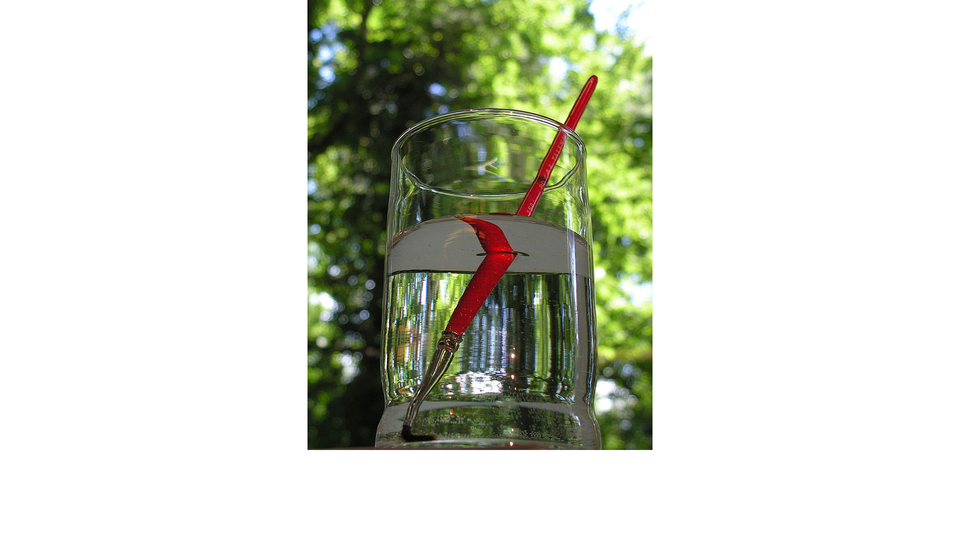
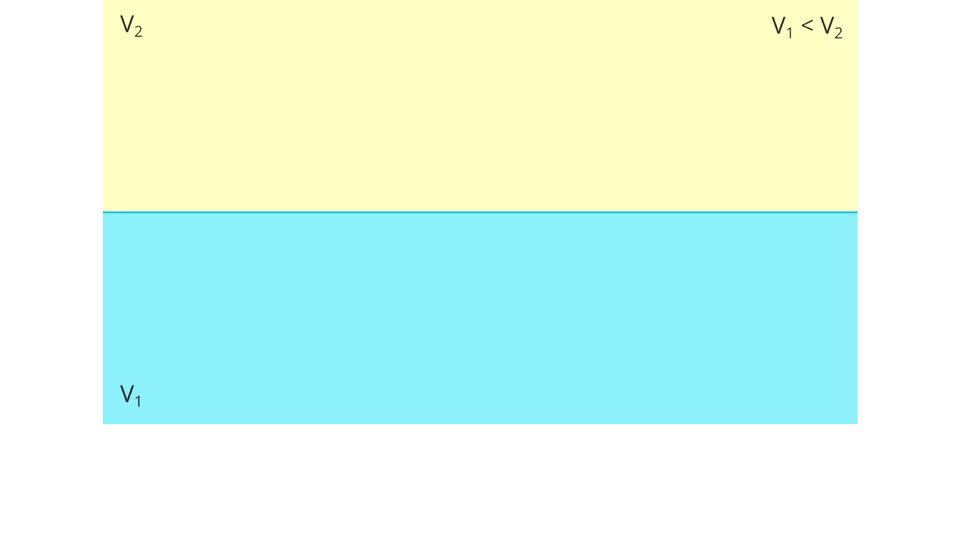
What does it mean that one medium is more optically dense than the other?
The phenomenon of light refraction is always accompanied by the phenomenon of light reflection.
Part of the light beam refracts, and part of the light beam reflects off the boundaryboundaryboundary of the two media. Therefore, for example, standing on the edge of the lake, we can see our reflection or shimmering waves, and while diving, we can observe what is happening under its surfacesurfacesurface.
For certain values of the angle of incidenceangle of incidenceangle of incidence, the light rays travelling in a more optically dense medium do not refract, but are reflected fully off the boundary of the two media.
Task 1
Watch the slideshow and see examples of total internal reflectiontotal internal reflectiontotal internal reflection.
R1B3OpJVqKFLw
Pokaz multimedialny przedstawia przykłady całkowitego wewnętrznego odbicia. Instrukcja obsługi z poziomu klawiatury: 1. Uruchomienie aplikacji - ENTER, 2. Na każdym ze slajdów czytany jest automatycznie tekst alternatywny po polsku, 3. Przy pierwszym uruchomieniu na pierwszym slajdzie, czytanie tekstu po angielsku - TAB, 4. Przejście między slajdami: do następnego slajdu - TAB, do poprzedniego slajdu - TAB + SHIFT, 5. Przejście do czytania napisu po angielsku - strzałka w górę + strzałka w dół (czyta tekst po angielsku widoczny na slajdzie).
Pokaz multimedialny przedstawia przykłady całkowitego wewnętrznego odbicia. Instrukcja obsługi z poziomu klawiatury: 1. Uruchomienie aplikacji - ENTER, 2. Na każdym ze slajdów czytany jest automatycznie tekst alternatywny po polsku, 3. Przy pierwszym uruchomieniu na pierwszym slajdzie, czytanie tekstu po angielsku - TAB, 4. Przejście między slajdami: do następnego slajdu - TAB, do poprzedniego slajdu - TAB + SHIFT, 5. Przejście do czytania napisu po angielsku - strzałka w górę + strzałka w dół (czyta tekst po angielsku widoczny na slajdzie).
The phenomenon of total internal reflection occurs when the light ray passes from a more optically dense medium to a less optically dense medium. The more optically dense the medium, the lower the speed of light in it.
If we gradually increase the angle of incidence of the light ray in the more optically dense medium, then we notice that for a certain angle, called the critical angle, the refracted ray begins to travel exactly on the boundaryboundaryboundary of the two media. If we continue to increase the angle of incidence, then we will no longer observe the phenomenon of refraction of the light ray, only its total internal reflectiontotal internal reflectiontotal internal reflection.
Familiarize yourself with the slideshow and follow how the phenomenon of total internal reflection occurs.
R1HIkvgjuoPtD
Pokaz multimedialny przedstawia proces powstawania zjawiska całkowitego odbicia wewnętrznego. Instrukcja obsługi z poziomu klawiatury: 1. Uruchomienie aplikacji - ENTER, 2. Na każdym ze slajdów czytany jest automatycznie tekst alternatywny po polsku, 3. Przy pierwszym uruchomieniu na pierwszym slajdzie, czytanie tekstu po angielsku - TAB, 4. Przejście między slajdami: do następnego slajdu - TAB, do poprzedniego slajdu - TAB + SHIFT, 5. Przejście do czytania napisu po angielsku - strzałka w górę + strzałka w dół (czyta tekst po angielsku widoczny na slajdzie).
Pokaz multimedialny przedstawia proces powstawania zjawiska całkowitego odbicia wewnętrznego. Instrukcja obsługi z poziomu klawiatury: 1. Uruchomienie aplikacji - ENTER, 2. Na każdym ze slajdów czytany jest automatycznie tekst alternatywny po polsku, 3. Przy pierwszym uruchomieniu na pierwszym slajdzie, czytanie tekstu po angielsku - TAB, 4. Przejście między slajdami: do następnego slajdu - TAB, do poprzedniego slajdu - TAB + SHIFT, 5. Przejście do czytania napisu po angielsku - strzałka w górę + strzałka w dół (czyta tekst po angielsku widoczny na slajdzie).
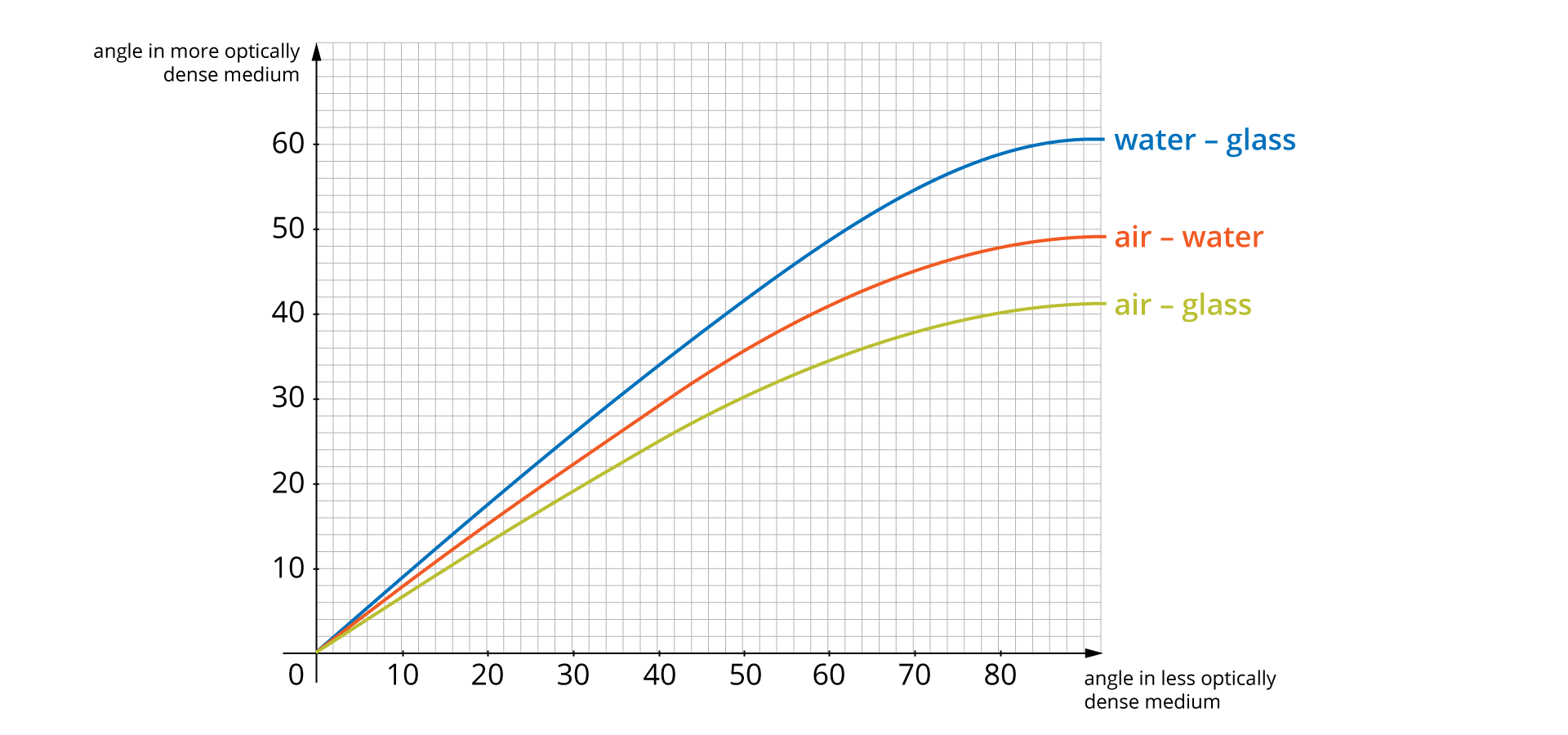
The relation between the angle of incidenceangle of incidenceangle of incidence and the angle of refractionangle of refractionangle of refraction is shown in the graphgraphgraph below. There are shown curves for various media: air‑to‑glass, air‑to‑water, water‑to‑glass.
Critical angles values are different for different media.
RHIG97IIL3x9s
Wykres zależności kąta załamania od kąta padania dla różnych mediów: woda-szkło, powietrze-woda, powietrze-szkło. Oś pozioma opisana angle in less optically dense medium, skala od 0 do 80 z odcinkiem jednostkowym 2. Oś pionowa opisana angle in more optically dense medium, skala od 0 do 60 z odcinkiem jednostkowym 2. Krzywa air-glass przechodzi przez punkty: w nawiasie 0, 0; w nawiasie 42, 26; w nawiasie 78, 40. Krzywa air-water przechodzi przez punkty: w nawiasie 0, 0; w nawiasie 38, 28; w nawiasie 80, 48. Krzywa water-glass przechodzi przez punkty: w nawiasie 0, 0; w nawiasie 30, 26; w nawiasie 78, 58. Wynika z tego, że wartości kątów granicznych są różne dla różnych ośrodków, największy jest między ośrodkami woda-szkło, mniejszy między powietrze-woda, a najmniejszy między powietrze-szkło.
Relation between the angle of incidence and the angle of refraction
The light rays on their path meet different media and many times pass their boundaries, e.g. the passage of a light ray through the window glass (air‑to‑glass and glass‑to‑air), light illuminating the interior of the aquarium (air‑to‑glass and glass‑to‑water).
A simple element that allows tracing the behaviour of the light beam is a plane parallel plateplane parallel plateplane parallel plate. It is an optically homogeneous medium for the light. Most often it is made of glass or acrylic. It is important that such a plate has at least two flat sides parallel to each other.
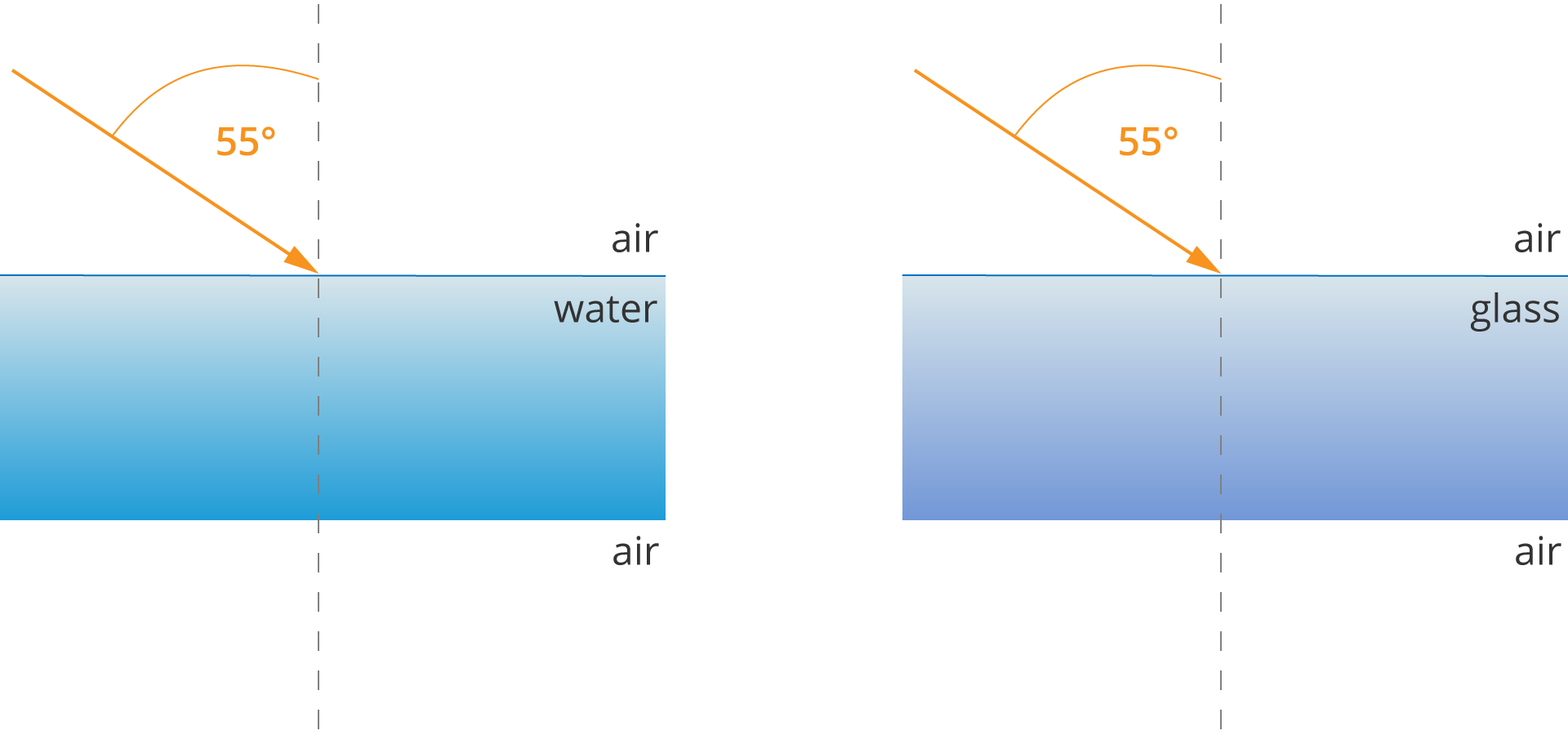
Make a drawing in the notebook according to the diagram below. Using a protractor and a ruler, draw the exact path of the light ray passing through the plates. Read the necessary angles from the graphgraphgraph above.
At what angle is the light ray coming out of the plate directed? What conclusion can you draw?
RUcds3wz9YUF7
Rysunek po lewej pokazuje promień padający na granicę powietrze-woda-powietrze. Od góry opisane air, prostokąt niebieski opisany water, pod nim air. Przez środek przechodzi pionowa linia przerywana, symbolizująca normalną. Normalna jest to prosta prostopadła do powierzchni, na którą pada promień. W pierwszym od góry ośrodku narysowana strzałka, symbolizująca promień, skierowana w prawo do dołu, do miejsca styku ośrodka pierwszego i drugiego. Zaznaczony kąt między strzałką a linią pionową równy 55 stopni. Rysunek po prawej pokazuje promień padający na granicę powietrze-szkło-powietrze. Od góry opisane air, prostokąt niebieski opisany glass, pod nim air. Przez środek przechodzi pionowa linia przerywana, symbolizująca normalną. W pierwszym od góry ośrodku narysowana strzałka, symbolizująca promień, skierowana w prawo do dołu, do miejsca styku ośrodka pierwszego i drugiego. Zaznaczony kąt między strzałką a linią pionową równy 55 stopni.
Refraction in water and glass
Source: GroMar, licencja: CC BY 3.0.
The light ray coming out of the plate is parallel to its previous direction. Its angle of refractionangle of refractionangle of refraction after leaving the water/glass is 55⁰.
The light ray passing from a more optically dense medium to a less optically dense medium can be totally reflected.
The light ray passing through the plane parallel plateplane parallel plateplane parallel plate retains its original direction.
Exercises
RAUFHXZAHgg4f
Exercise 3
Wersja alternatywna ćwiczenia: Determine which sentences are true. Możliwe odpowiedzi: 1. A more optically dense medium is one where the speed of light is larger., 2. The critical angle is the same for each substance., 3. The light in the prism may undergo a double total internal reflection., 4. The angle of refraction is the angle between the light ray and the line delimiting the boundary of the media.
Wersja alternatywna ćwiczenia: Determine which sentences are true. Możliwe odpowiedzi: 1. A more optically dense medium is one where the speed of light is larger., 2. The critical angle is the same for each substance., 3. The light in the prism may undergo a double total internal reflection., 4. The angle of refraction is the angle between the light ray and the line delimiting the boundary of the media.
Determine which sentences are true.
A more optically dense medium is one where the speed of light is larger.
The critical angle is the same for each substance.
The light in the prism may undergo a double total internal reflection.
The angle of refraction is the angle between the light ray and the line delimiting the boundary of the media.
zadanie
Source: GroMar, licencja: CC BY 3.0.
Exercise 4
Find in available sources how the phenomenon of total internal reflection in optical fibres is used.
Exercise 5
Explain in English what the phenomenon of total internal reflection is.
R1LjsOwDqYHcF
Exercise 6
Wersja alternatywna ćwiczenia: Indicate which pairs of expressions or words are translated correctly. Możliwe odpowiedzi: 1. całkowite wewnętrzne odbicie - total internal reflection, 2. granica - boundary, 3. powierzchnia - surface, 4. wykres - graph, 5. kąt załamania - angle of incidence, 6. kąt padania - angle of refraction
Wersja alternatywna ćwiczenia: Indicate which pairs of expressions or words are translated correctly. Możliwe odpowiedzi: 1. całkowite wewnętrzne odbicie - total internal reflection, 2. granica - boundary, 3. powierzchnia - surface, 4. wykres - graph, 5. kąt załamania - angle of incidence, 6. kąt padania - angle of refraction
Indicate which pairs of expressions or words are translated correctly.
całkowite wewnętrzne odbicie - total internal reflection
granica - boundary
powierzchnia - surface
wykres - graph
kąt załamania - angle of incidence
kąt padania - angle of refraction
zadanie
Source: GroMar, licencja: CC BY 3.0.
RF01kdZ6P4Ioa1
Interaktywna gra, polegająca na łączeniu wyrazów w pary w ciągu jednej minuty. Czas zaczyna upływać wraz z rozpoczęciem gry. Jeden ruch to odkrywanie najpierw jednej potem drugiej karty z wyrazem. Każdy wyraz jest odczytywany. Kolejny ruch to odkrywanie trzeciej i czwartej karty. W ten sposób odsłuchasz wszystkie wyrazy. Nawigacja z poziomu klawiatury za pomocą strzałek, odsłuchiwanie wyrazów enterem lub spacją. Znajdź wszystkie pary wyrazów.
Interaktywna gra, polegająca na łączeniu wyrazów w pary w ciągu jednej minuty. Czas zaczyna upływać wraz z rozpoczęciem gry. Jeden ruch to odkrywanie najpierw jednej potem drugiej karty z wyrazem. Każdy wyraz jest odczytywany. Kolejny ruch to odkrywanie trzeciej i czwartej karty. W ten sposób odsłuchasz wszystkie wyrazy. Nawigacja z poziomu klawiatury za pomocą strzałek, odsłuchiwanie wyrazów enterem lub spacją. Znajdź wszystkie pary wyrazów.
Match Polish terms with their English equivalents.
granica
kąt załamania
angle of incidence
surface
kąt padania
angle of refraction
boundary
powierzchnia
total internal reflection
całkowite wewnętrzne odbicie
Source: Zespół autorski Politechniki Łódzkiej, licencja: CC BY 3.0.