Atoms belonging to the same element have the same nucleus charge (identical number of protons) and the same number of electrons moving around the nucleus. However, as it turns out, these atoms can differ in mass. The reason for this phenomenon is the possibility that different numbers of neutrons occurs in the nucleus of atoms of the same element. Those atoms that have more neutral particles have a larger mass.
The atoms of the element with the same number of protons, and different number of neutrons in the nucleus are called isotopesisotopesisotopes.
Task 1
Consider whether the isotopes of the same element have the same atomic and mass numbers. If not, which of these numbers may be different and why?
RX66qnOLGdWzO
Wykonaj zadanie zgodnie z poleceniem.
Wykonaj zadanie zgodnie z poleceniem.
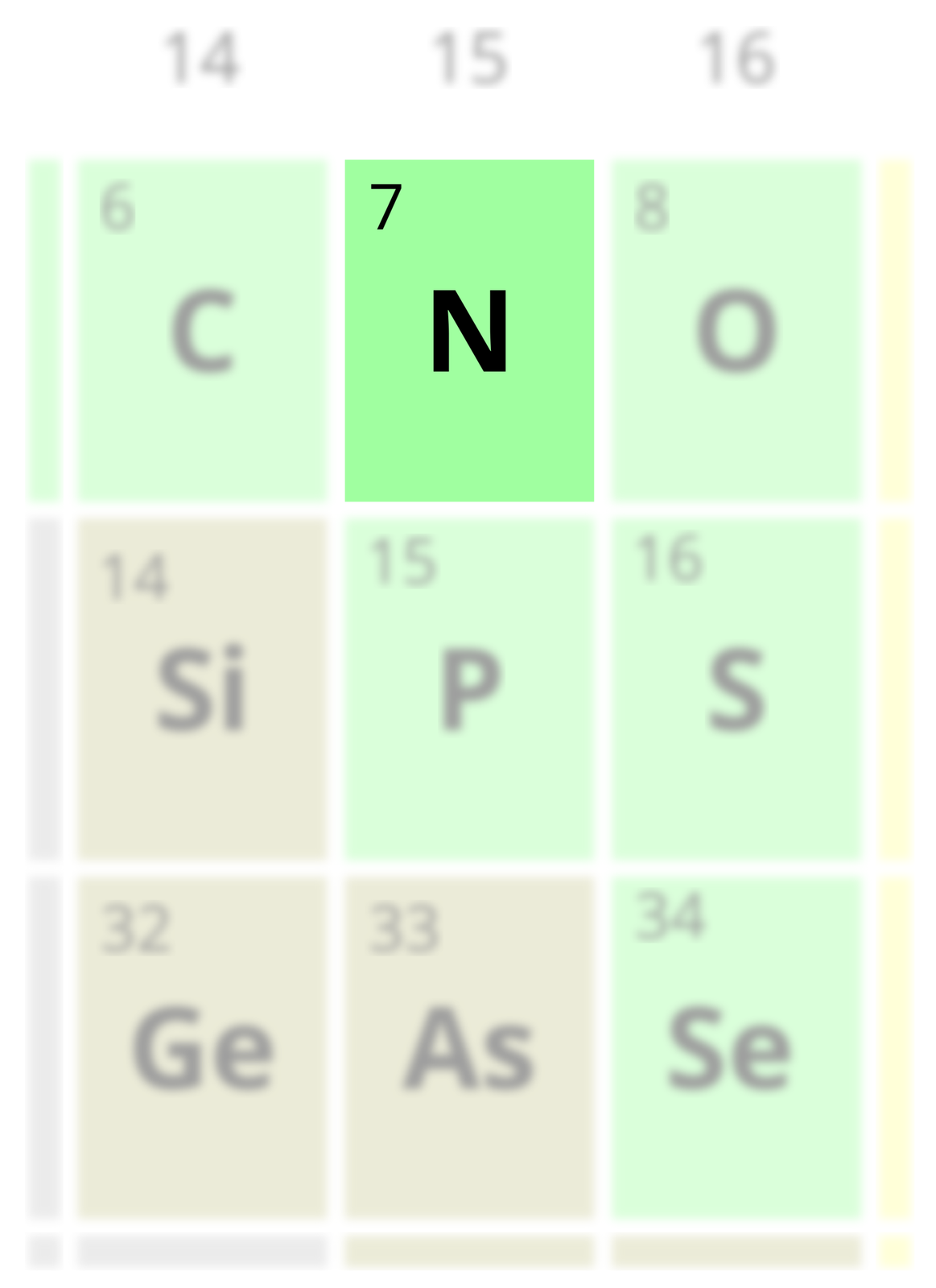
The element with several isotopes is nitrogen. There are seven neutrons in the nucleus of one of them, and in the nucleus of the other – eight neutrons. Each of these isotopes has the same number of protons that can be found in the periodic table.
R5fVQB3GayQxN
Ilustracja przedstawia fragment układu okresowego. W przybliżeniu widać azot i jego liczbę atomową - siedem.
The atomic number of nitrogen is 7, and this is also amount of protons found in the nuclei of all atoms of this element. In the case of the isotopes described above, the sum of protons and neutrons will be different.
Number of atom
Number of protons
Atomic number
Number of neutrons
Mass number (sum of protons and neutrons)
Description of atom
1
7
7
7
7 + 7 = 14
2
7
7
8
7 + 8 = 15
The information on the number of neutrons isotopes contain is important in their description. Therefore, mainly mass number providing information on the number of these particles is used in its description. The atomic number is usually omitted due to the fact that it can be found in the periodic table.
Isotopes are presented in two ways: the mass number is placed in the upper index on the left side of the symbol of the element or after the dash after the name of the element, e.g. or nitrogen‑14.
Task 2
Using periodic table that shows the percentage of stable isotopes of particular elements, determine how many elements have only one natural type of isotope and which elements have the most of them.
RFufx7HoTkBvZ
Wykonaj zadanie zgodnie z poleceniem.
Wykonaj zadanie zgodnie z poleceniem.
Isotopes of hydrogen in nature
Isotopes with the same atomic number belong to the same element. In principle, these show identical properties, with the only exception being hydrogen isotopes. The hydrogen in nature is a mixture of mainly two isotopes in stable‑state: (99.985%) and (0.015%). It means that of 100,000 atoms of hydrogen, 99,985 are isotopes , and 15 atoms – isotopes . There is also the third, unstable isotope . It occurs in trace amounts. The isotopes of hydrogen were the only ones in the world of elements to have their names: protium, deuterium and tritium.
Symbol of hydrogen isotope or hydrogen‑1 Name of hydrogen isotope – protium
R1cqHZRgUx0N8
Ilustracja przedstawia model atomu protu - czerwoną kulę z białą kulką pośrodku.
Symbol of hydrogen isotope or hydrogen‑2 Name of hydrogen isotope – deuterium
RRtc8sGVvxB18
Ilustracja przedstawia model atomu deuteru - czerwoną kulę z białą i niebieską kulą pośrodku.
Symbol of hydrogen isotope or hydrogen‑3 Name of hydrogen isotope – tritium
R1QZd6PZPNJWy
Ilustracja przedstawia model atomu trytu - czerwoną kulę z białą i dwiema niebieskimi kulkami pośrodku.
It is easy to see that hydrogen isotopes differ in the number of nucleons. For this reason, there is a large mass difference between them, for example the deuterium atom has a mass twice as large as the weight of the protium and the tritium mass is three times larger than protium. This phenomenon affects the properties of these isotopes: protium, deuterium and tritium have different properties.
Isotope
Symbol of isotope
Density [g/dmIndeks górny 33]
Melting point [K]
Boiling point [K]
protium
H
0.08233
13.83
20.27
deuterium
D
0.1645
18.73
23.67
tritium
T
0.2464
20.62
25.04
Task 3
Watch the presentation „Potassium isotopes”. Which of the types of the element are stable? What is the application of its isotopes?
R1L5jruGlvnTS
Ilustracja przedstawia napis Isotopes of potassium.
Source: GroMar Sp. z o.o., licencja: CC BY-SA 3.0.
RxAIIJVqVFN7L
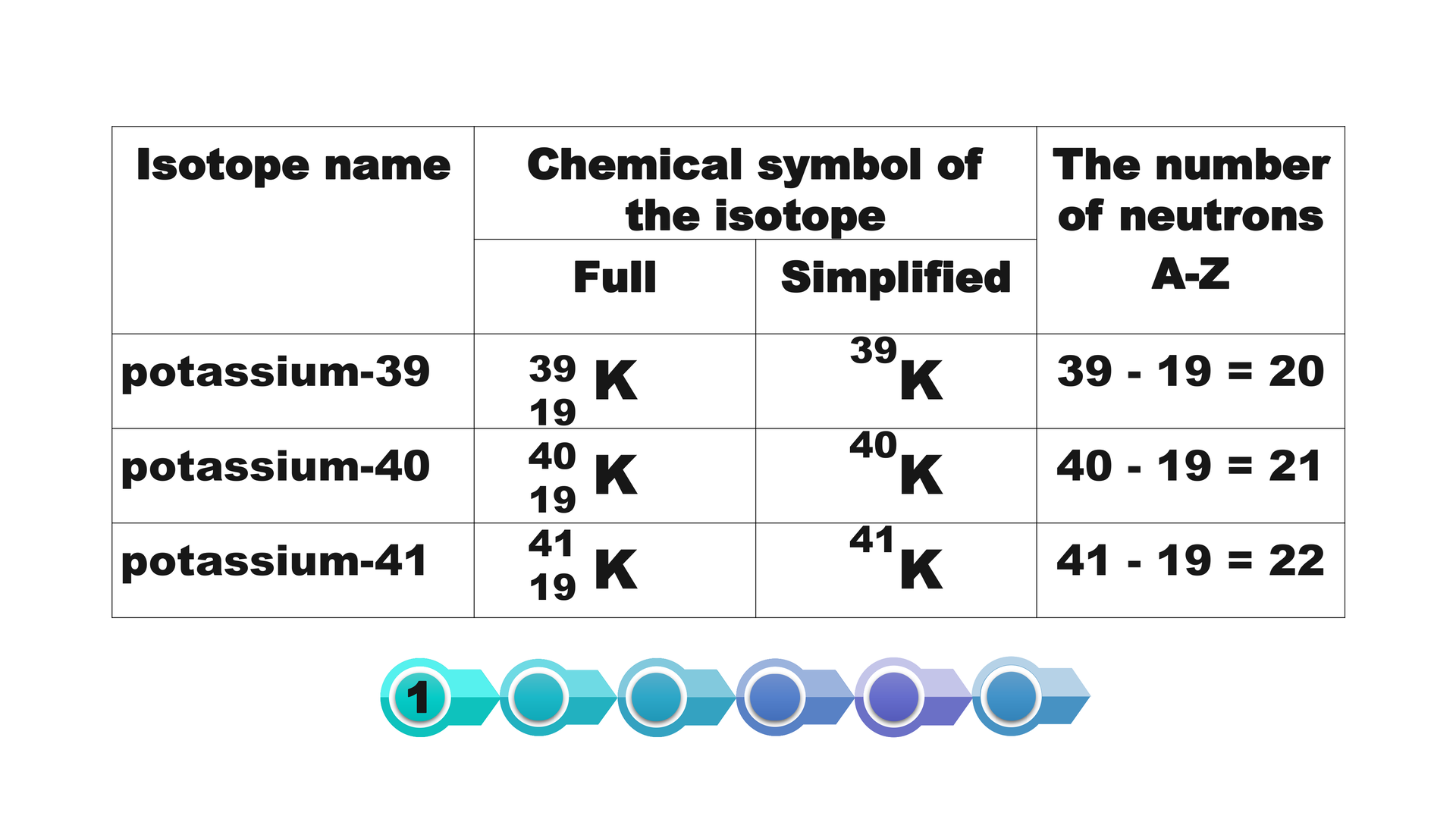
Nazwy trzech izotopów potasu: potas trzydzieści dziewięć, czterdzieści i czterdzieści jeden. Symbol chemiczny litera ka. W przypadku pierwszego izotopu: liczba masowa trzydzieści dziewięć, liczba atomowa dziewiętnaście. W przypadku drugiego izotopu odpowiednio czterdzieści i dziewiętnaście. W przypadku trzeciego izotopu - czterdzieści jeden i dziewiętnaście. Obliczenia liczby neutronów: od liczby masowej odejmujemy liczbę atomową. W przypadku pierwszego izotopu liczba neutronów wynosi dwadzieścia. U drugiego izotopu dwadzieścia jeden, u trzeciego dwadzieścia dwa.
The table contains three potassium isotopes: potassium-39, potassium-40 and potassium-41. The chemical symbols of the isotopes are also shown next to it: the symbol is full and simplified. The full symbol contains two numbers: at the top, the mass number, different for each isotope, that is 39, 40 and 41. At the bottom there is an atomic number that does not change, and for potassium it is always 19. Therefore, we can use simplified chemical symbolization of isotopes with only the mass number at the top. Knowing the mass and atom numbers of the isotope, one can calculate the number of neutrons in each isotope, subtracting from the mass number the atomic number. In the case of the potassium isotope 39, we subtract the atomic number 19 from the mass number 39. We get a result of 20, which means that this isotope has 20 neutrons in the nucleus. In the case of potassium-40 logically we obtain 21 neutrons, and in the case of potassium-41 - 22 neutrons.
Source: GroMar Sp. z o.o., licencja: CC BY-SA 3.0.
Rg50jmDmaT5mw
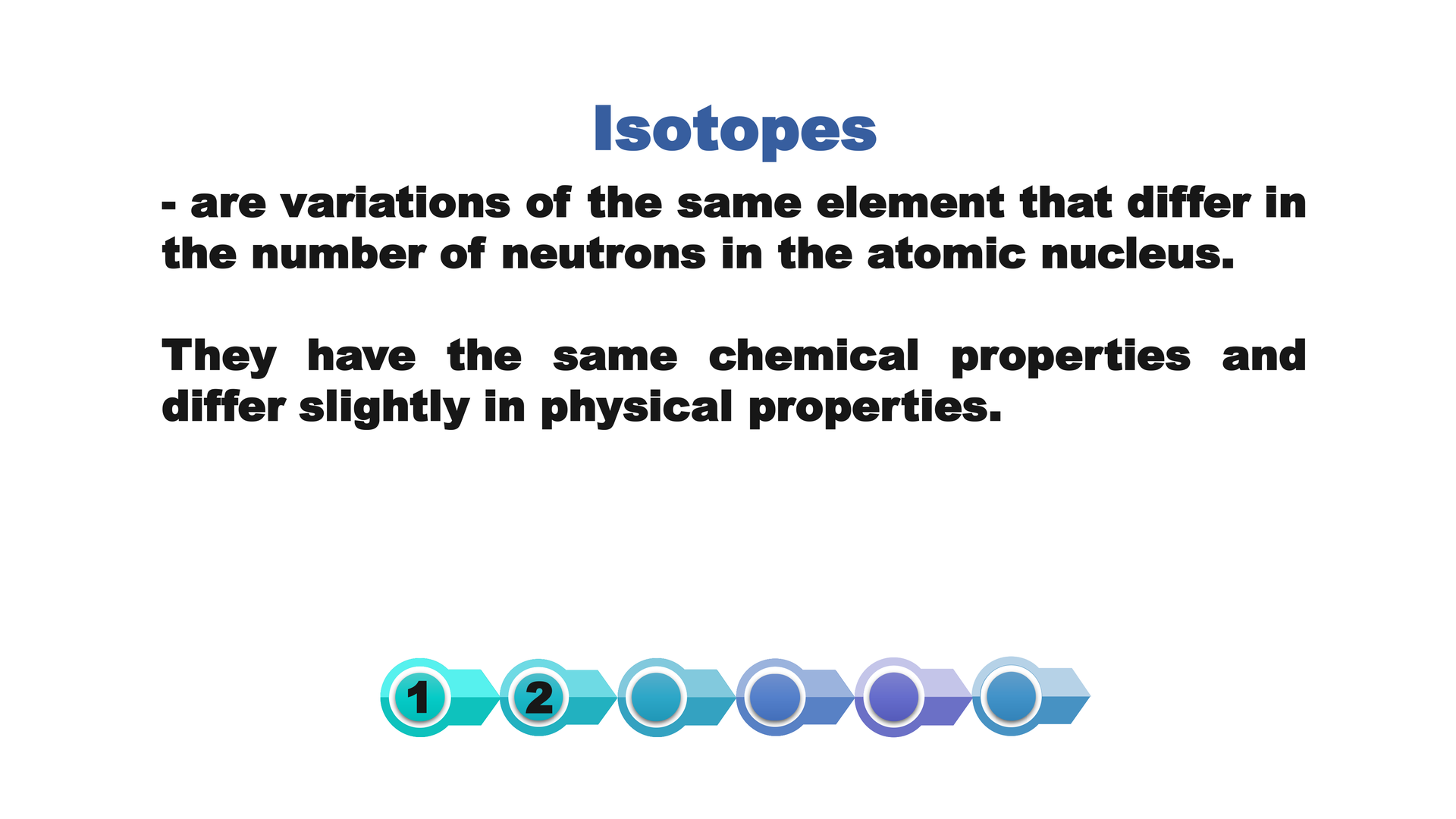
Napis: Isotopes: are variations of the same element that differ in the number of neutrons in the atomic nucleus. They have the same chemical properties and differ slightly in physical properties.
Let us remind you at the end of the most important news about isotopes. Isotopes are variations of the same element that differ in the number of neutrons in the atomic nucleus. They have the same chemical properties and differ slightly in physical properties.
Source: GroMar Sp. z o.o., licencja: CC BY-SA 3.0.
RiA7zT0luBNnb
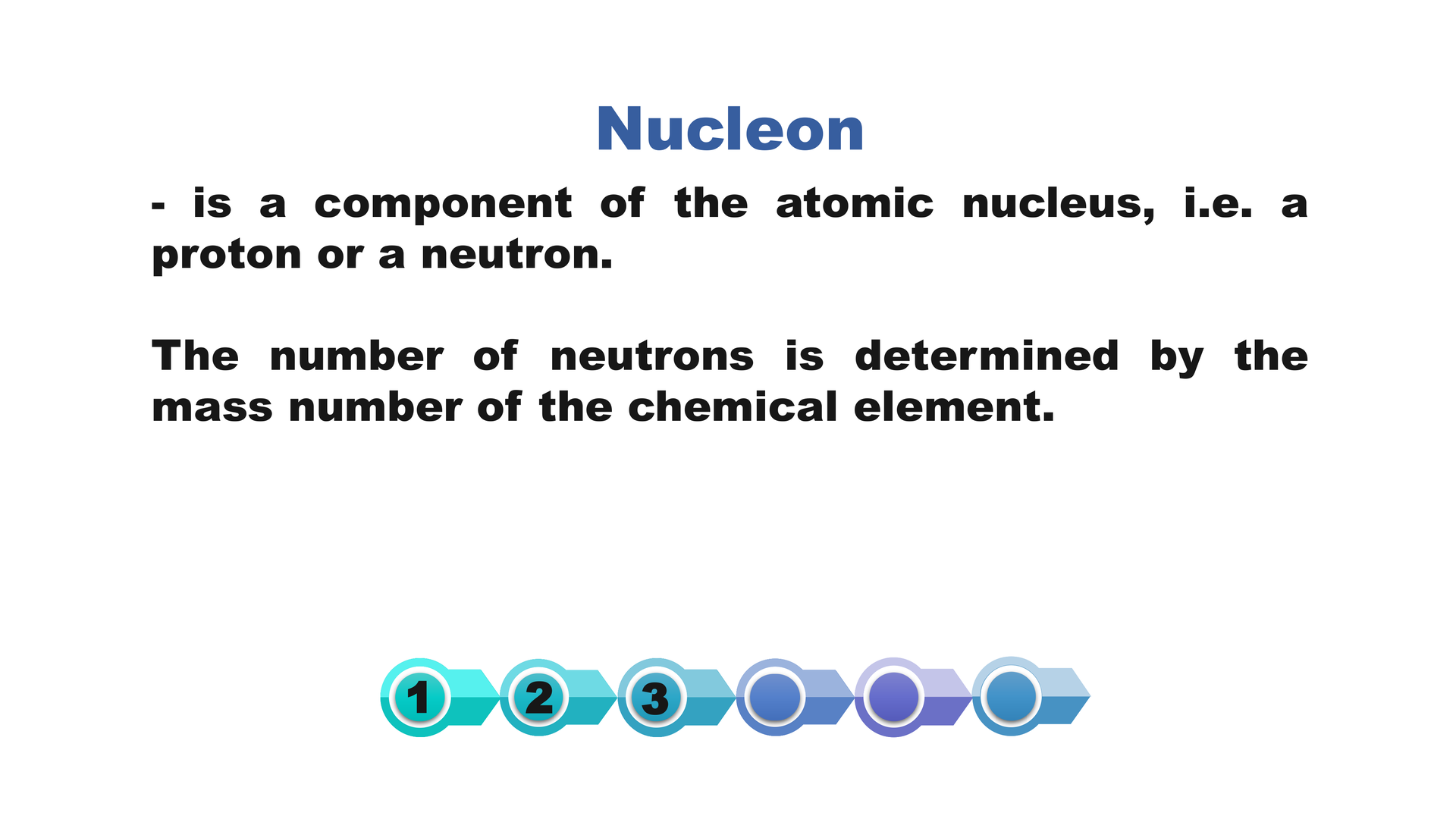
Napis: Nucleon is a component of the atomic nucleus, i.e. a proton or a neutron. The number of neutrons is determined by the mass number of the chemical element.
Nucleon is a component of the atomic nucleus, i.e. a proton or a neutron. The number of neutrons is determined by the mass number of the chemical element.
Source: GroMar Sp. z o.o., licencja: CC BY-SA 3.0.
R1DOJTKRZquj0
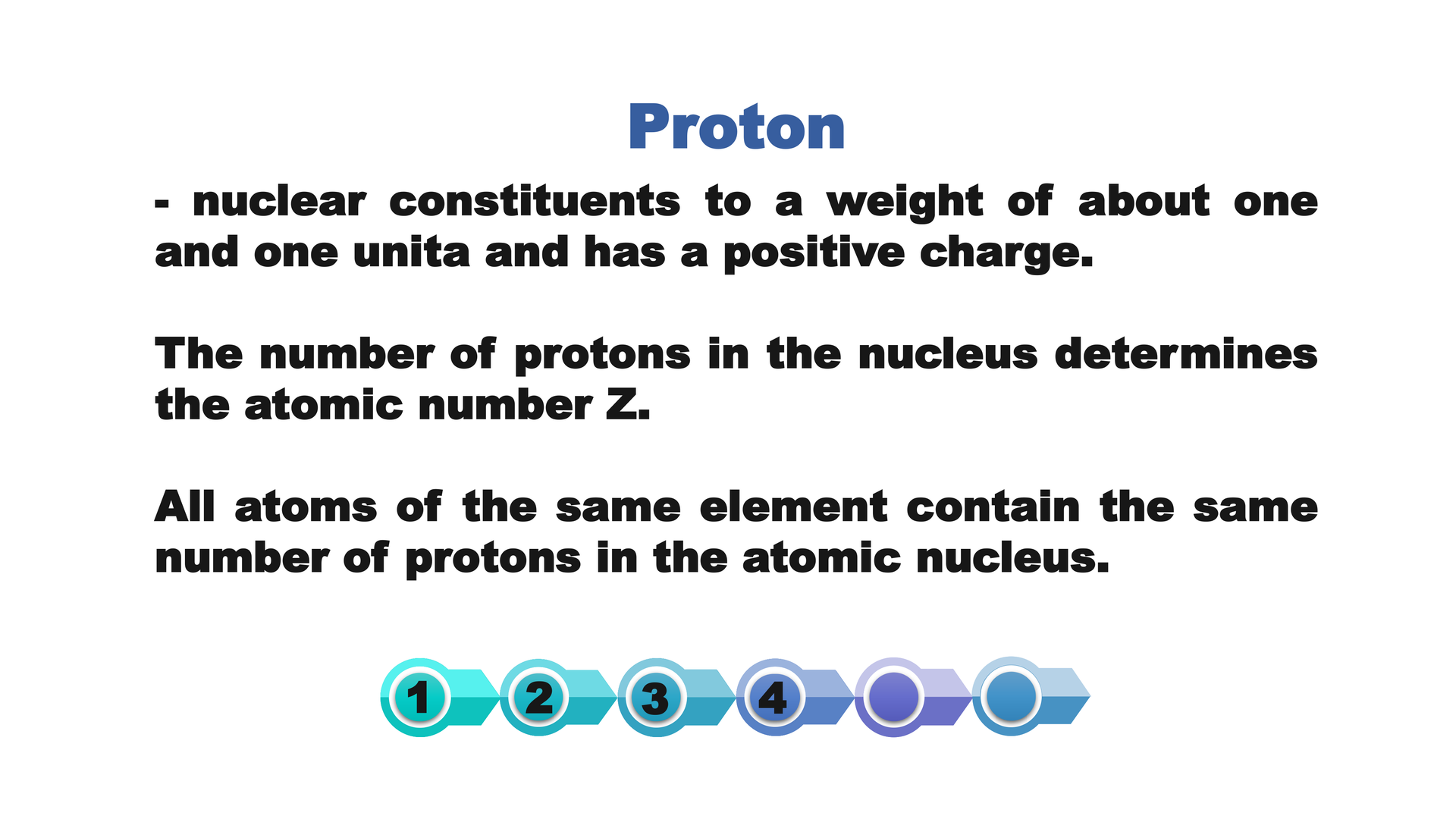
Napis: Proton nuclear constituents to a weight of about one and one unita and has a positive charge. The number of protons in the nucleus determines the atomic number Z. All atoms of the same element contain the same number of protons in the atomic nucleus.
Proton nuclear constituents to a weight of about one and one unita and has a positive charge. The number of protons in the nucleus determines the atomic number Z. All atoms of the same element contain the same number of protons in the atomic nucleus.
Source: GroMar Sp. z o.o., licencja: CC BY-SA 3.0.
R8EqZ18Czr1qV
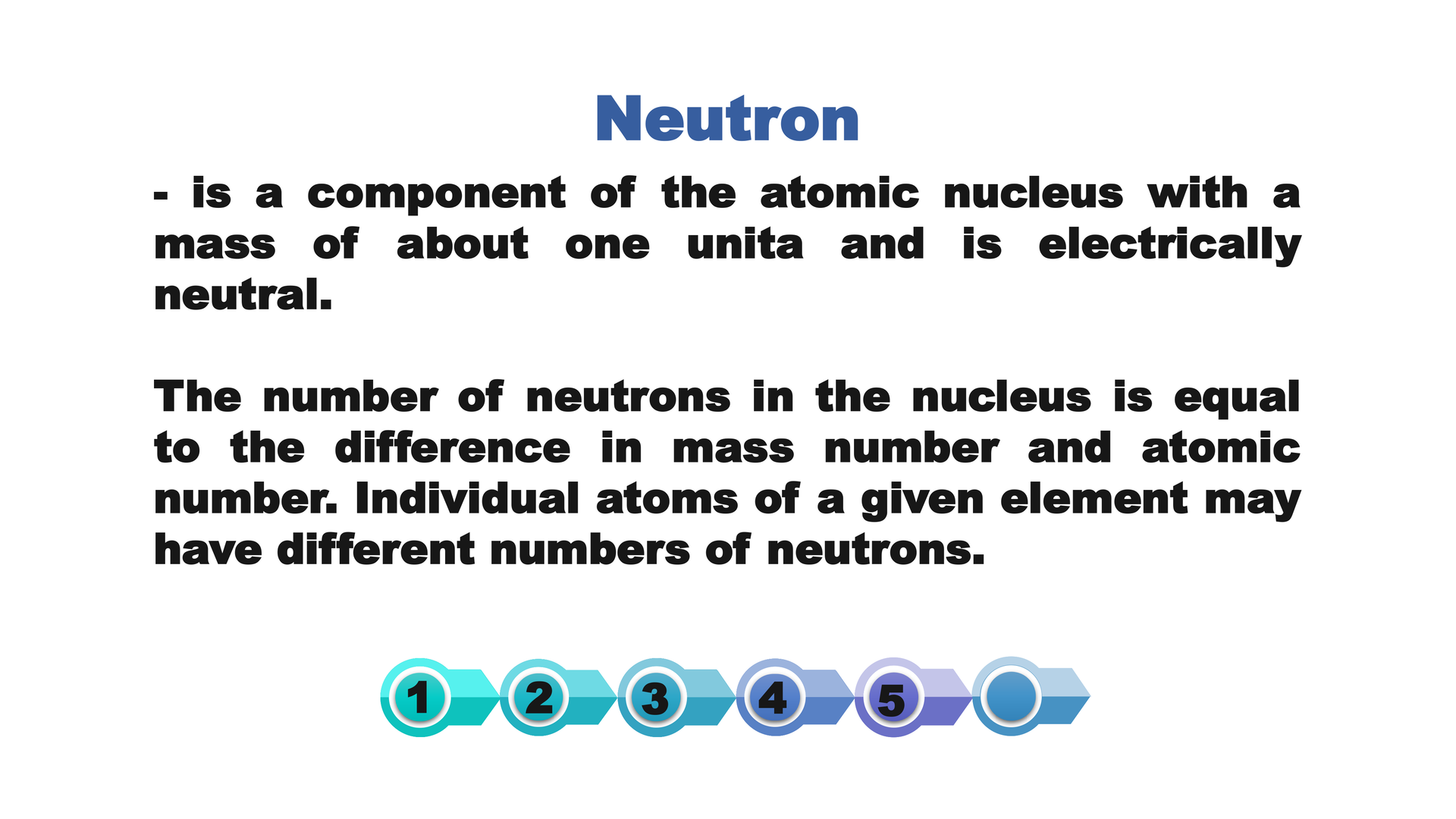
Napis: Neutron is a component of the atomic nucleus with a mass of about one unita and is electrically neutral. The number of neutrons in the nucleus is equal to the difference in mass number and atomic number. Individual atoms of a given element may have different numbers of neutrons.
Neutron is a component of the atomic nucleus with a mass of about one unita and is electrically neutral. The number of neutrons in the nucleus is equal to the difference in mass number and atomic number. Individual atoms of a given element may have different numbers of neutrons.
Source: GroMar Sp. z o.o., licencja: CC BY-SA 3.0.
RmYNMFfOtDIMu
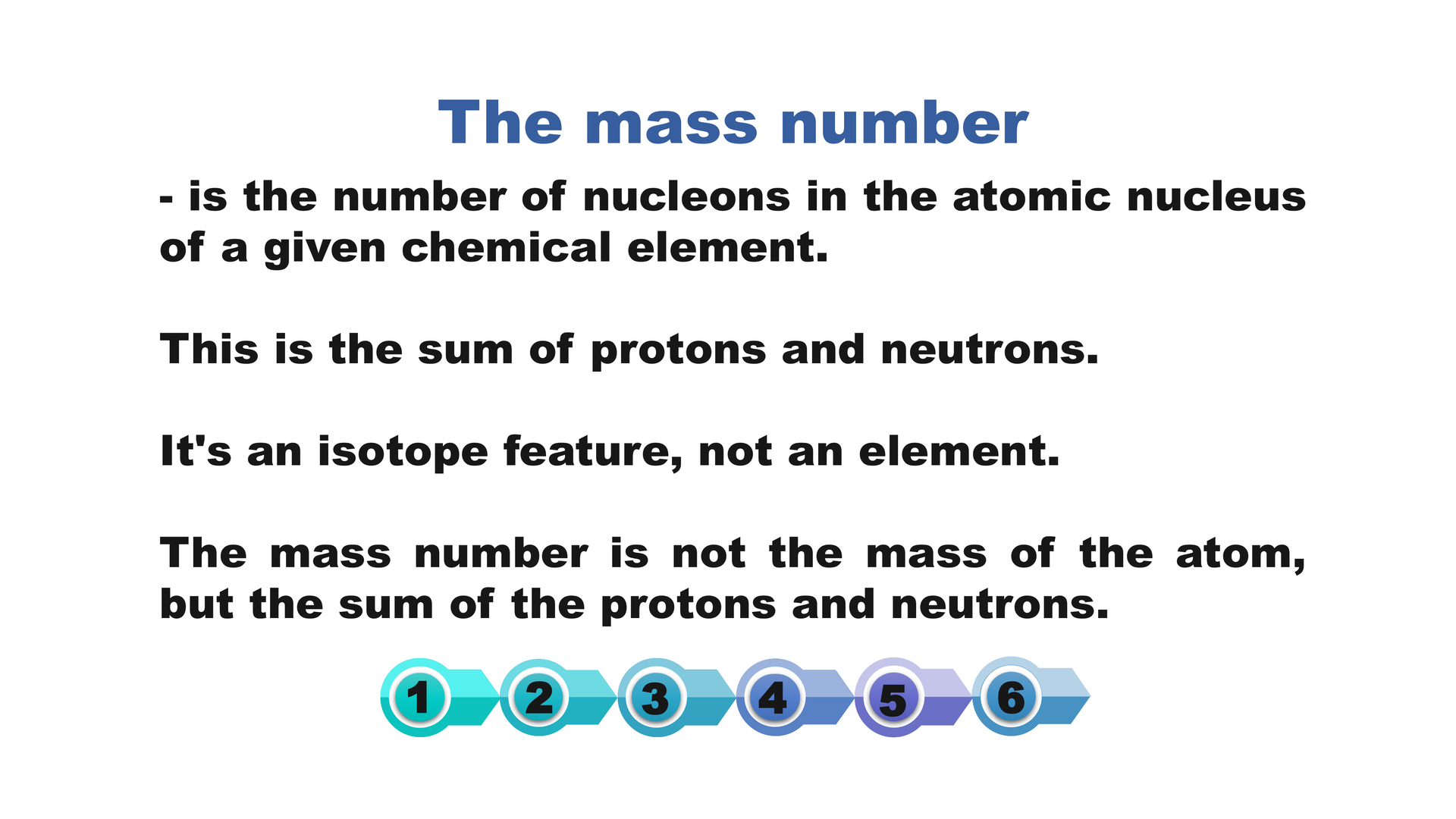
Napis: The mass number is the number of nucleons in the atomic nucleus of a given chemical element. This is the sum of protons and neutrons. It's an isotope feature, not an element. The mass number is not the mass of the atom, but the sum of the protons and neutrons.
The mass number is the number of nucleons in the atomic nucleus of a given chemical element. This is the sum of protons and neutrons. It's an isotope feature, not an element. The mass number is not the mass of the atom, but the sum of the protons and neutrons.
Source: GroMar Sp. z o.o., licencja: CC BY-SA 3.0.
Which types of potassium are stable? (Uzupełnij). What are applications of potassium isotopes? (Uzupełnij).
Which types of potassium are stable? (Uzupełnij). What are applications of potassium isotopes? (Uzupełnij).
R9tfnq1HVycTL
Exercise 1
Przyporządkuj atomy do odpowiednich zbiorów izotopów - chromu, żelaza, potasu, niklu, argonu i wapnia. Możliwe odpowiedzi: atom o liczbie masowej 52 i liczbie atomowej 24, pierwiastek o liczbie masowej 60 i liczbie atomowej 28, atom o liczbie masowej 56 i liczbie atomowej 26, atom o liczbie masowej 42 i liczbie atomowej 30, atom o liczbie masowej 5 i liczbie atomowej 24, atom o liczbie masowej 58 i liczbie atomowej 28, atom o liczbie masowej 50 i liczbie atomowej 24, atom o liczbie masowej 40 i liczbie atomowej 19, atom o liczbie masowej 54 i liczbie atomowej 26, atom o liczbie masowej 38 i liczbie atomowej 18, atom o liczbie masowej 44 i liczbie atomowej 20, atom o liczbie masowej 40 i liczbie atomowej 20, atom o liczbie masowej 40 i liczbie atomowej 18, atom o liczbie masowej 39 i liczbie atomowej 19.
Przyporządkuj atomy do odpowiednich zbiorów izotopów - chromu, żelaza, potasu, niklu, argonu i wapnia. Możliwe odpowiedzi: atom o liczbie masowej 52 i liczbie atomowej 24, pierwiastek o liczbie masowej 60 i liczbie atomowej 28, atom o liczbie masowej 56 i liczbie atomowej 26, atom o liczbie masowej 42 i liczbie atomowej 30, atom o liczbie masowej 5 i liczbie atomowej 24, atom o liczbie masowej 58 i liczbie atomowej 28, atom o liczbie masowej 50 i liczbie atomowej 24, atom o liczbie masowej 40 i liczbie atomowej 19, atom o liczbie masowej 54 i liczbie atomowej 26, atom o liczbie masowej 38 i liczbie atomowej 18, atom o liczbie masowej 44 i liczbie atomowej 20, atom o liczbie masowej 40 i liczbie atomowej 20, atom o liczbie masowej 40 i liczbie atomowej 18, atom o liczbie masowej 39 i liczbie atomowej 19.
Czym różni się różni budowa atomu chloru o liczbie masowej 35 od atomu chloru o liczbie masowej 37?
Czym różni się różni budowa atomu chloru o liczbie masowej 35 od atomu chloru o liczbie masowej 37?
What are the differences between atoms of the elements? Complete the gaps in the table.
information about elements
35Cl
37Cl
number of protons
number of electrons
number of netrons
electron configuration a, b, c
Ri2dcUp4ZVS49
Exercise 3
Czym się różni budowa atomu cynku o liczbie masowej 64 od atomu cynku o liczbie masowej 70?
Czym się różni budowa atomu cynku o liczbie masowej 64 od atomu cynku o liczbie masowej 70?
What are the differences between atoms of the elements? Complete the gaps in the table.
information about elements
64Zn
70Zn
number of protons
number of electrons
number of netrons
electron configuration a, b, c
RmHcHQcqRcBrT
Exercise 4
Czym się różni budowa atomów tlenu u o liczbie masowej 16, 17 i 18?
Czym się różni budowa atomów tlenu u o liczbie masowej 16, 17 i 18?
What are the differences between atoms of the elements? Complete the gaps in the table.
information about elements
16O
17O
18O
number of protons
number of electrons
number of netrons
electron configuration a, b, c
Summary
Isotopes are atoms of the same chemical element that have the same number of protons and different number of neutrons.
Most of the chemical elements found in nature are a mixture of isotopes with a stable composition.
Isotopes of hydrogen are: protium (), deuterium () and tritium (). Their properties are different.
RzXRXiCPJP9321
Grafika przedstawiająca tablicę szkolną, na której znajdują się zdania do dokończenia. Finish selected sentences. 1 It was easy for me (uzupełnij). 2 It was difficult for me (uzupełnij). 3 Today I learned (uzupełnij). 4 I understood that (uzupełnij). 5 It surprised me (uzupełnij).
Grafika przedstawiająca tablicę szkolną, na której znajdują się zdania do dokończenia. Finish selected sentences. 1 It was easy for me (uzupełnij). 2 It was difficult for me (uzupełnij). 3 Today I learned (uzupełnij). 4 I understood that (uzupełnij). 5 It surprised me (uzupełnij).
Source: GroMar Sp. z o.o., licencja: CC BY-SA 3.0.
izotopy – odmiany tego samego pierwiastka, które mają jednakową liczbę atomową (liczbę protonów w jądrze) i różną liczbę masową (liczbę neutronów w jądrze)