Mammals prevail on land
mammals are vertebrates that live in all habitats;
mammals, like other animals, show capability to adapt to the habitat and the mode of life.
justify that mammals are vertebrates;
indicate and describe the mammals’ adaptation to the life on land, in water or air (based on observation of their external body structure);
recognise selected mammal representatives;
explain the meaning of homeothermy in mammals;
Characteristic features of mammals
Mammals, like birds, are warm‑blooded animals, which allows them to inhabit in all ecosystems on the earth, from hot deserts, tropical forests to circumpolar areas and Antarctica. They can be found on land, in water and even in the air.
In the mammals’ body structure distinguished are: head, neck, trunk, tail and 2 pairs of usually five‑digit limbs. In most land mammals, the limbs are pulled up under the trunk, lifting it high above the ground, which improves locomotion. The body of mammals is covered with hairhair, which can form a thick, compact cover, called fur. Hair protects against mechanical injuries and helps to maintain a constant body temperature. It is the product of the epidermis, as are horns, hooves, claws, nails and scales of reptiles. It's role is also to protect against injuries. In the mammals’ dermis there are numerous glands: sweat glands, sebaceous glands, mammary glandsmammary glands and scent glands. Sweat glandsSweat glands produce a special secretion called sweat, the function of which is to cool down the body and to a lesser extent – excrete unnecessary substances. Sebaceous glands secrete sebum, which forms an antibacterial barrier. During the feeding period, the mammary glands secrete milk, while the scent glands are used to mark the territory, attract partners and identify individuals. The innermost part of the skin, the so‑called subcutaneous layer, is composed of fat tissue which has many important functions: it protects against mechanical injuries, loss of heat, it also is the energy reserve for the organism.
Receipt of stimuli from the environment is enabled by a very well‑developed sensory nervous system (mainly the sense of hearing, vision and smell). Mammals are also the only vertebrates to have the auricle that makes it easier to capture sound waves and route them into the auditory meatus.
Mammals’ limbs
Depending on the mode of life and the habitat, limbs of mammals take different forms. Several species of mammals can glide, and bats are the only mammals to fly actively. In bats, the bones of the forelimb are strongly elongated, and between the digits and the side of the body there is a stretched patagiumpatagium. Mammals that live in water, such as whales, dolphins and seals, have a streamlined body and limbs that are transformed into fins. Moles spend most of their life underground, which is why their limbs are wide and have their inside sides directed towards the back so that they can dig tunnels. In hoofed animals, the vertically positioned digits are covered with hooves which protect them against mechanical injury and allow them to run quickly. Hares and kangaroos can move as fast as the hoofed animals thanks to their elongated foot bones, which allow them to jump.
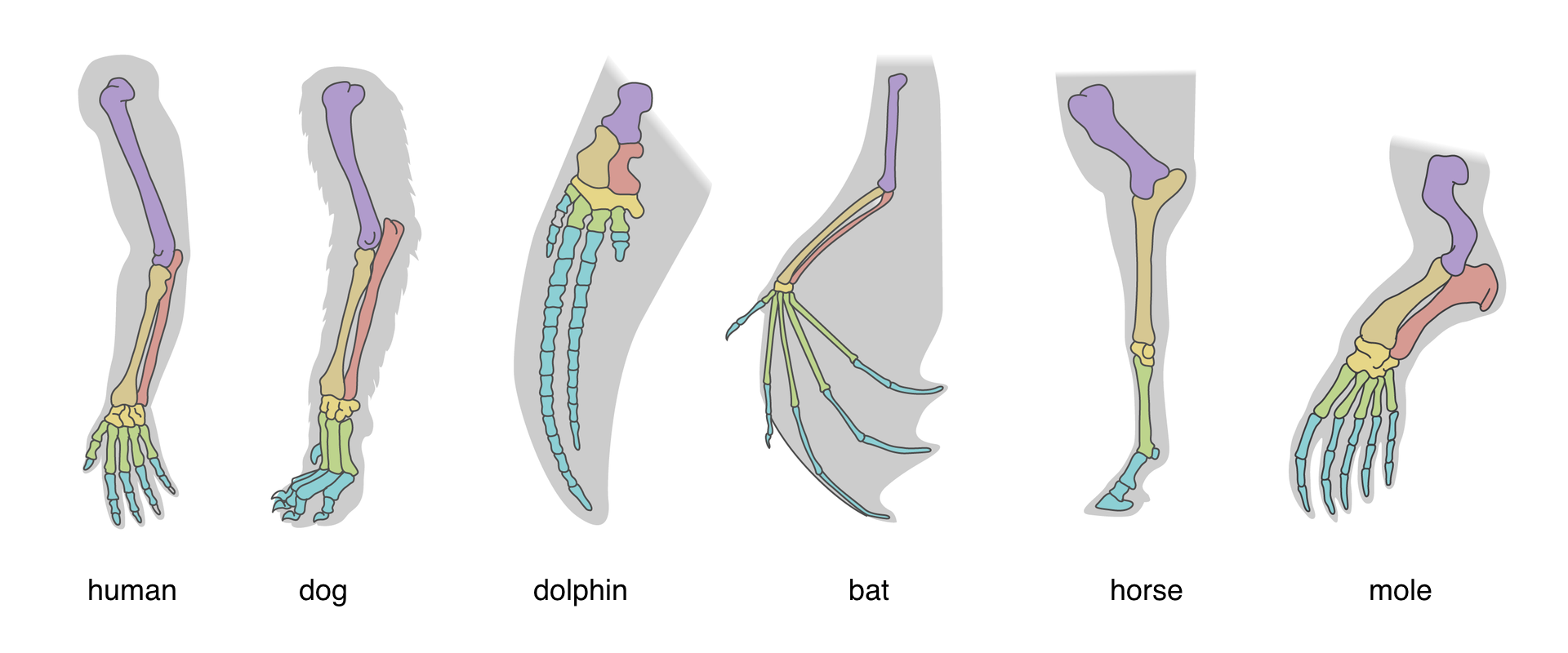
The forelimbs of all mammals are built according to the same plan: the shoulder bone is joined to 2 bones of the forearm, behind them there are several small bones of the wrist, on which 5 metacarpal bones are usually supported. Their extensions are bones forming digit parts. Joints between them have a similar location. This means that they are built according to one structure plan, which indicates the evolutionary relationship of mammals. Depending on the habitat and mode of life, the bones of various mammals’ limbs can be shortened or elongated, sometimes some of them are absent or strongly reduced (as in horses: the bones of the first, second and fifth digit).
Homeothermy
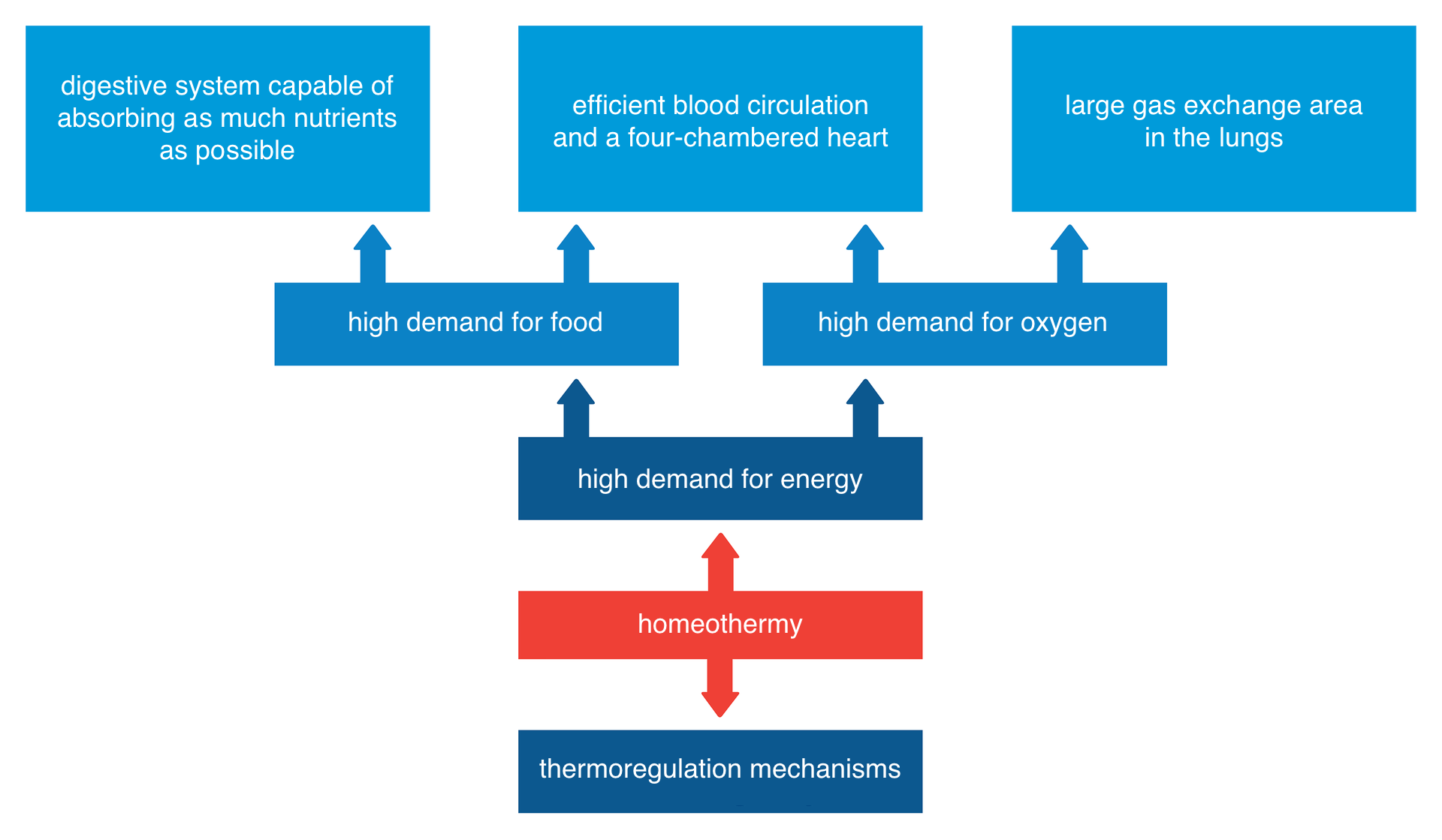
The gas exchange in mammals takes place in the lungs. The mammalian lungs are of alveolar structure. Pulmonary alveoli are thin‑walled bubbles entangled in a network of blood vessels. There are 300‑500 million of them. Thanks to them, the respiratory surface of mammals' lungs (in relation to their body size) is larger than the respiratory surface of other vertebrates. For this reason, the gas exchange is very effective and is one of the adaptations that have made the mammals warm‑blooded animals. They can therefore be very active, even at low temperatures. Mammals need a lot of food from which the energy necessary to carry out life processes and maintain a constant body temperature comes.
Determination of the mammal's diet based on the structure of molar teeth.
molar teeth of ruminant and predator.
Observe the shape and appearance of the surface of the molar teeth crowns of different species of mammals.
Identify which teeth are best suited for shredding meat and bones and which teeth are best suited for grass. Justify your opinion by indicating the characteristics of the teeth structure.
Draw different types of teeth.
Features that make it easier to identify the type of food shredded by the teeth are, for example: the height of the crown, the shape of its upper surface, the presence of nodules and the shape of their edges.
The teeth of some mammals have undergone significant transformation and do not fulfill their original function. Elephants have large incisors called tusks, wild boars’ canine teeth have been transformed into razors and tusks, and sea lions’ canine teeth have a structure similar to elephant tusks. Explain what such teeth are used for.
List the benefits and risks of oviparity and viviparity for mothers and their offspring.
Analyse the table and formulate a conclusion based on it.
animal name | body weight in kg | average number of heart beats per minute |
blue whale | 190 000 | 30 |
elephant | 30 000 | 30 |
horse | 1 200 | 44 |
cow | 800 | 65 |
pig | 150 | 70 |
dog | 20 | 90 |
cat | 4 | 150 |
rat | 0.5 | 205 |
mouse | 0,04 | 600 |
Some animals may transmit parasitic, viral, bacterial diseases, such as taeniasis, rabies, plague. Give examples of behaviours that protect against zoonosis.
Currently, in Poland there are about 115 species of mammals, of which over 70 are under total species protection. List the actions that each of us, as tourists, consumers and farmers, can take to ensure that the number of protected mammals and other rare animals does not decrease.
Put the descriptions of features of mammals and birds into an appropriate group.
sweat glands, oviparity, feathers, mammary glands, viviparity, double breathing, wings, hair
| Mammals | |
|---|---|
| Birds |
Vertebrates
Conclusion
Mammals are warm‑blooded vertebrates that can be found all over the globe – on land, in water or even in the air.
The body of mammals consists of the head, neck, trunk, tail and 2 pairs of limbs, the structure of which depends on the habitat and the mode of life.
The body of mammals is covered with skin whose epidermis produces hair, nails, claws, horns and hooves. In the dermis there are numerous glands: sweat glands, sebaceous glands, mammary glands and scent glands.
Internal fertilisation and viviparity of mammals are the result of adaptation to a terrestrial environment.
All young mammals are fed with milk.
Keywords
mammals, vertebrates, homeothermy
Glossary
błona lotna – fałd skóry ułatwiający lot, rozciągnięty na kończynach nietoperzy, latawców oraz niektórych gatunków jaszczurek i żab
gruczoły mlekowe – przekształcone gruczoły potowe obecne w skórze właściwej ssaków; wydzielają mleko, które służy do karmienia młodych
gruczoły mlekowe – gruczoły obecne w skórze właściwej ssaków; produkują specjalną wydzielinę zwaną potem, której funkcją jest schładzanie organizmu i (w mniejszym stopniu) wydalanie
łożysko – narząd ssaków powstający w okresie ciąży z dwóch błon płodowych: omoczni i kosmówki; pośredniczy w wymianie substancji między matką a zarodkiem przez sznur pępowinowy
włosy – rogowe wytwory naskórka pokrywające ciało ssaków; chronią przed urazami mechanicznymi i pozwalają utrzymać stałą temperaturę ciała; niektóre włosy porastające głowę pełnią również funkcje czuciowe
żyworodne organizmy – organizmy, których młode rozwijają się w ciele samicy (w macicy), są połączone z ciałem matki za pomocą łożyska, przez które zachodzi wymiana substancji odżywczych, gazów oddechowych oraz usuwanie zbędnych i szkodliwych produktów przemiany materii