Plants grow throughout their lives. Responsible for their growth are meristematic tissuesMeristematic tissuesmeristematic tissues made of small cells with thin walls and large cellular nuclei. These cells have non‑ligneous walls and a small volume, and therefore are capable of continuos division. The daughter cells of meristem cells give rise to all the tissues that build the plant's body.
RTGrnJOhEcOXH
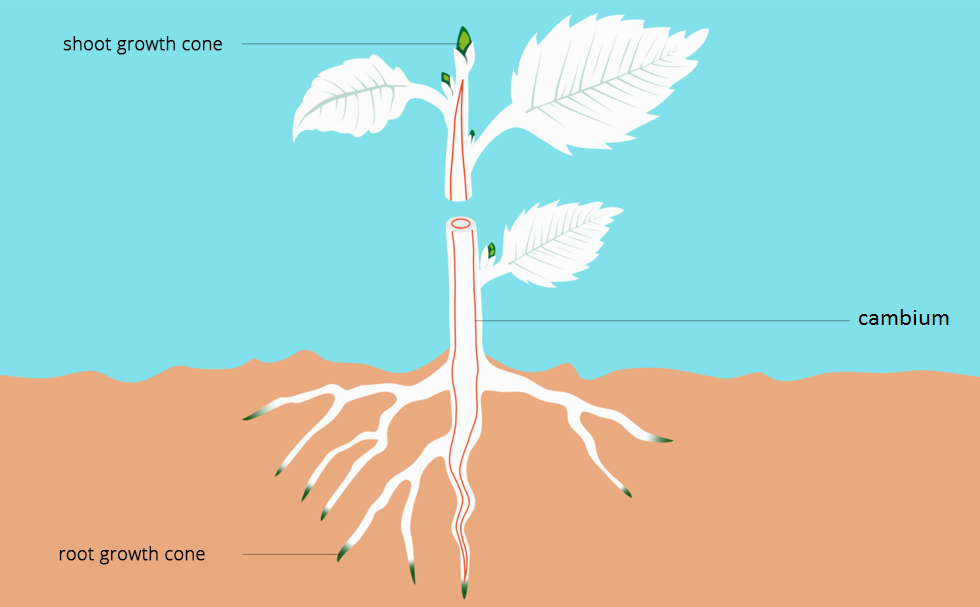
Schemat ilustrujący lokalizację merystemów w roślinie. Schematyczny rysunek przedstawia ukorzenioną roślinę umieszczoną w podłożu. Końcówki korzeni oznaczono kolorem zielonym, są to stożki wzrostu korzenia (root growth cone). Wzdłuż wnętrza łodygi rośliny, na czerwono zaznaczono położenie tkanek twórczych bocznych (cambium). Na zielono oznaczono stożek wzrostu (shoot growth cone), który znajduje się na szczycie łodygi.
The location of meristems
Source: Tomorrow Sp. z o.o., licencja: CC BY 3.0.
RrIrZhMaUH1Wb
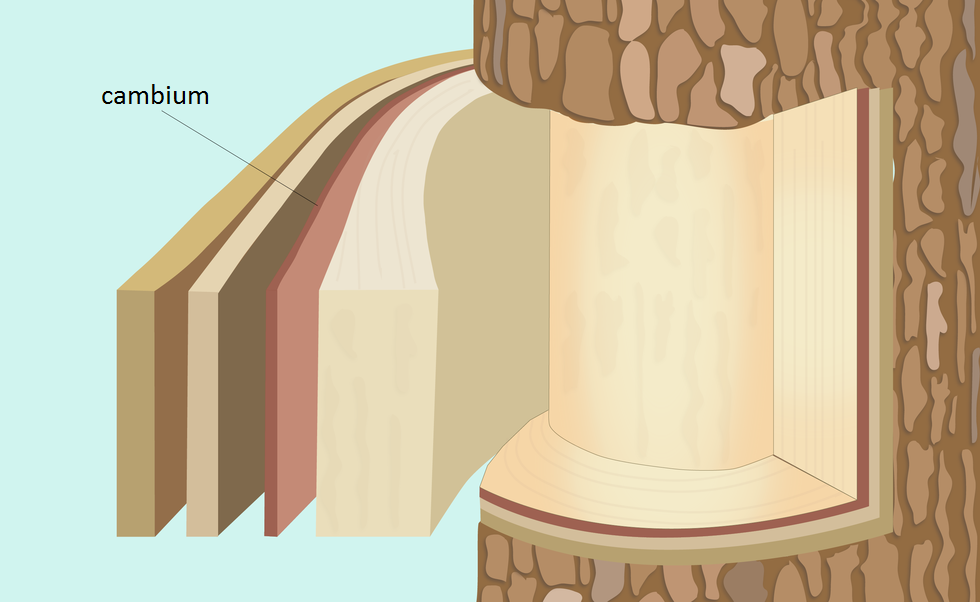
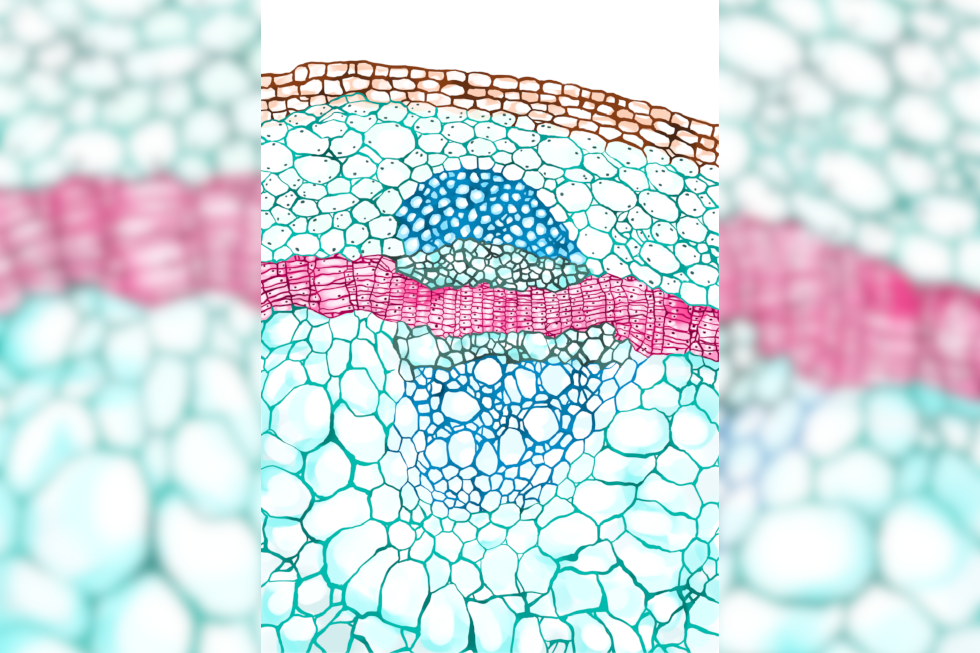
Ilustracja pokazuje fragment pnia i warstwy tkanek położonych pod korą, w tym miazgę (cambium).
The cambium forms a thin sheath situated under the bark
Source: Tomorrow Sp. z o.o., licencja: CC BY 3.0.
R1eIfM5jNOT9D
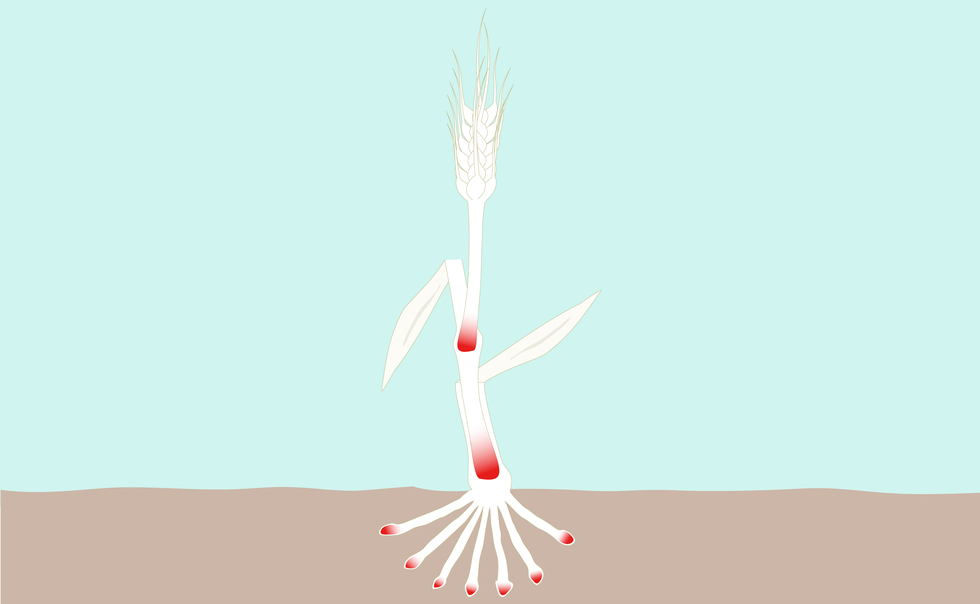
Ilustracja przedstawia położenie tkanek twórczych u traw. Czerwony kolor zaznaczono na szczytach korzeni i u podstawy członów łodygi.
The location of meristems in grasses
Source: Tomorrow Sp. z o.o., licencja: CC BY 3.0.
Meristematic tissues growth occurs in cones at the top of the stem and at the end of the root. The effect of cell divisions taking place in stem growth cone and root growth cone is that the plant extends. In perennial plants – trees and shrubs– there is also a meristem called cambium, which is below the surface of the stem and root. Thanks to it, the plants grow in thickness.
RqOiBFPttvVHN
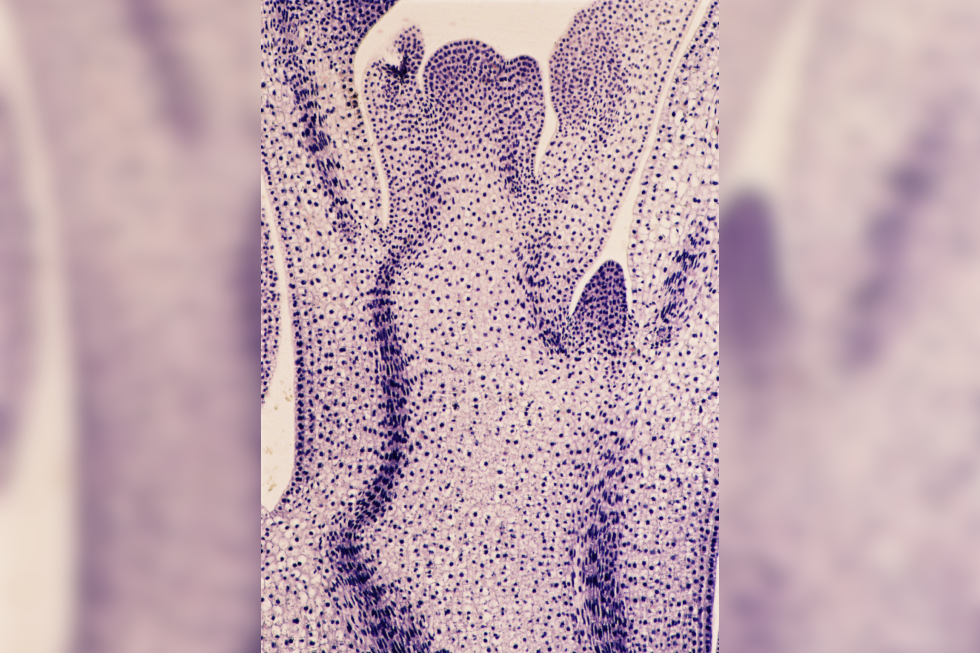
Mikrofotografia przedstawiająca przekrój podłużny przez stożek wzrostu pędu. Komórki zabarwione na fioletowo, cienkościenne o dużych jądrach.
Shoot apical meristem with leaf primordia - microscopic image
Source: Tomorrow Sp. z o.o., licencja: CC BY 3.0.
RQhhFkoe3ongy
Ilustracja przedstawia fragment przekroju łodygi. Pomiędzy drewnem i łykiem występuje miazga.
Cambium - microscopic image
Source: Tomorrow Sp. z o.o., licencja: CC BY 3.0.
R1N1S0usLZ3G9
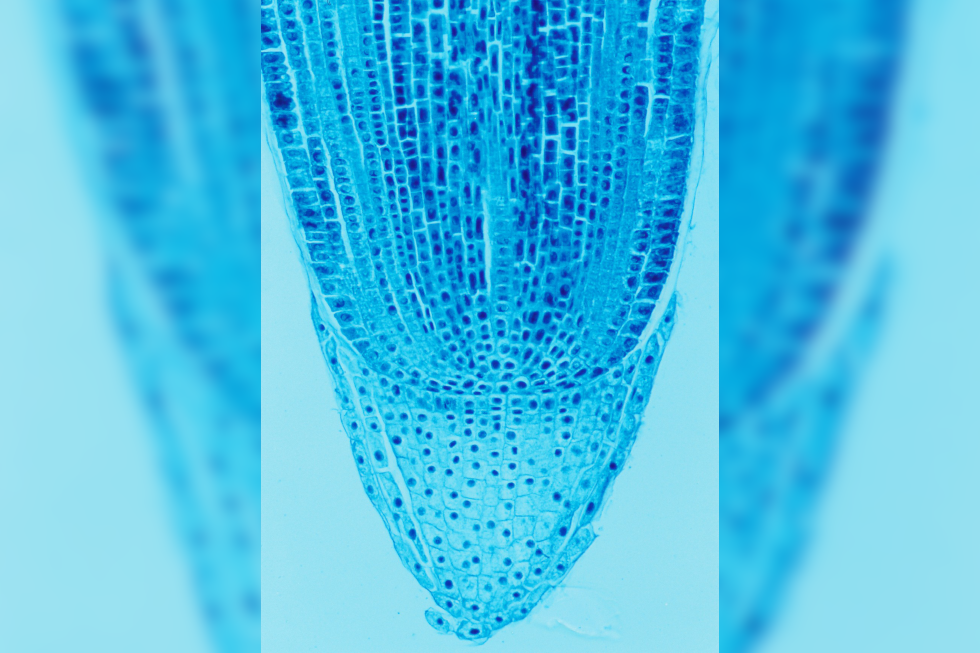
Mikrofotografia pokazuje tkanki szczytu korzenia w przekroju podłużnym. Komórki cienkościenne, o dużych jądrach.
Root apical meristem - microscopic image
Source: Tomorrow Sp. z o.o., licencja: CC BY 3.0.
Task 1
Before you watch the animation „Root meristems”, Write down the research question and the hypothesis. Make notes while watching the animation, and finally make conclusions.
R1Puz03rPcfaR
Wybierz jedno zagadnienie opisane w abstrakcie. Poszerz swoją wiedzę na jego temat, szukając dodatkowych informacji w dostępnych ci źródłach (np. w internecie, encyklopedii lub specjalistycznych publikacjach).
Wybierz jedno zagadnienie opisane w abstrakcie. Poszerz swoją wiedzę na jego temat, szukając dodatkowych informacji w dostępnych ci źródłach (np. w internecie, encyklopedii lub specjalistycznych publikacjach).
Analysis:
RCXpzrsucjJli
Film przedstawia tworzenie merystemów korzennych, root meristems. Na ekranie wypustka tkanki twórczej, składająca się z komórek, meristem cells. Na wierzchołku komórki nasadowe chronią merystem, root cap cells protects the meristem. Komórki, które pochodzą z tkanki merystematycznej przekształcają się w miąższ, naskórek lub komórki przewodzące, cell that originate from meristematic tissue and transform into parenchyma, epidermis or conductive cells.
Film przedstawia tworzenie merystemów korzennych, root meristems. Na ekranie wypustka tkanki twórczej, składająca się z komórek, meristem cells. Na wierzchołku komórki nasadowe chronią merystem, root cap cells protects the meristem. Komórki, które pochodzą z tkanki merystematycznej przekształcają się w miąższ, naskórek lub komórki przewodzące, cell that originate from meristematic tissue and transform into parenchyma, epidermis or conductive cells.
Root meristems
Source: GroMar Sp. z o.o., licencja: CC BY-SA 3.0.
Source: GroMar Sp. z o.o., licencja: CC BY-SA 3.0.
Film przedstawia tworzenie merystemów korzennych, root meristems. Na ekranie wypustka tkanki twórczej, składająca się z komórek, meristem cells. Na wierzchołku komórki nasadowe chronią merystem, root cap cells protects the meristem. Komórki, które pochodzą z tkanki merystematycznej przekształcają się w miąższ, naskórek lub komórki przewodzące, cell that originate from meristematic tissue and transform into parenchyma, epidermis or conductive cells.
R1LyY3F8JoRtF
Exercise 1
Put missing words into the gaps. The meristem cell is adapted to frequent {uzupełnij} and producing {uzupełnij} cells. The division is easy when the cell has {uzupełnij} volume and thin cell {uzupełnij}. Cell division begins with the cell nucleus because it contains {uzupełnij}. Możliwe odpowiedz: divisions, descendant, small, wall, genetic material
Put missing words into the gaps. The meristem cell is adapted to frequent {uzupełnij} and producing {uzupełnij} cells. The division is easy when the cell has {uzupełnij} volume and thin cell {uzupełnij}. Cell division begins with the cell nucleus because it contains {uzupełnij}. Możliwe odpowiedz: divisions, descendant, small, wall, genetic material
Put missing words into the gaps.
small, divisions, wall, descendant, genetic material
The meristem cell is adapted to frequent ................................ and producing ................................ cells. The division is easy when the cell has ................................ volume and thin cell ................................. Cell division begins with the cell nucleus because it contains .................................
RM3odA2P4d6ed
Exercise 2
The daughter cells of these cells give rise to all the tissues that build the plant's body. Możliwe odpowiedzi: 1. meristematic tissues, 2. epidermal tissues, 3. vascular tissues
The daughter cells of these cells give rise to all the tissues that build the plant's body. Możliwe odpowiedzi: 1. meristematic tissues, 2. epidermal tissues, 3. vascular tissues
The daughter cells of these cells give rise to all the tissues that build the plant's body.
meristematic tissues
epidermal tissues
vascular tissues
Summary
The body of plants is filled with tissues, i.e. assemblies of cells with a similar structure specialized to perform specific functions.
Meristematic tissues have a constant ability to divide and are responsible for the growth of the plant in length and thickness.