Przeczytaj
The picture below shows a homeless man in the streets of a city. What are the problems that the homeless have to face on a regular basis? In this section, you are going to read a text which will help you understand and talk about them.
Poniższe zdjęcie przedstawia bezdomnego mężczyznę na ulicach miasta. Z jakimi problemami na co dzień borykają się bezdomni? W tej sekcji przeczytasz tekst, który pomoże ci je zrozumieć i o nich opowiadać.
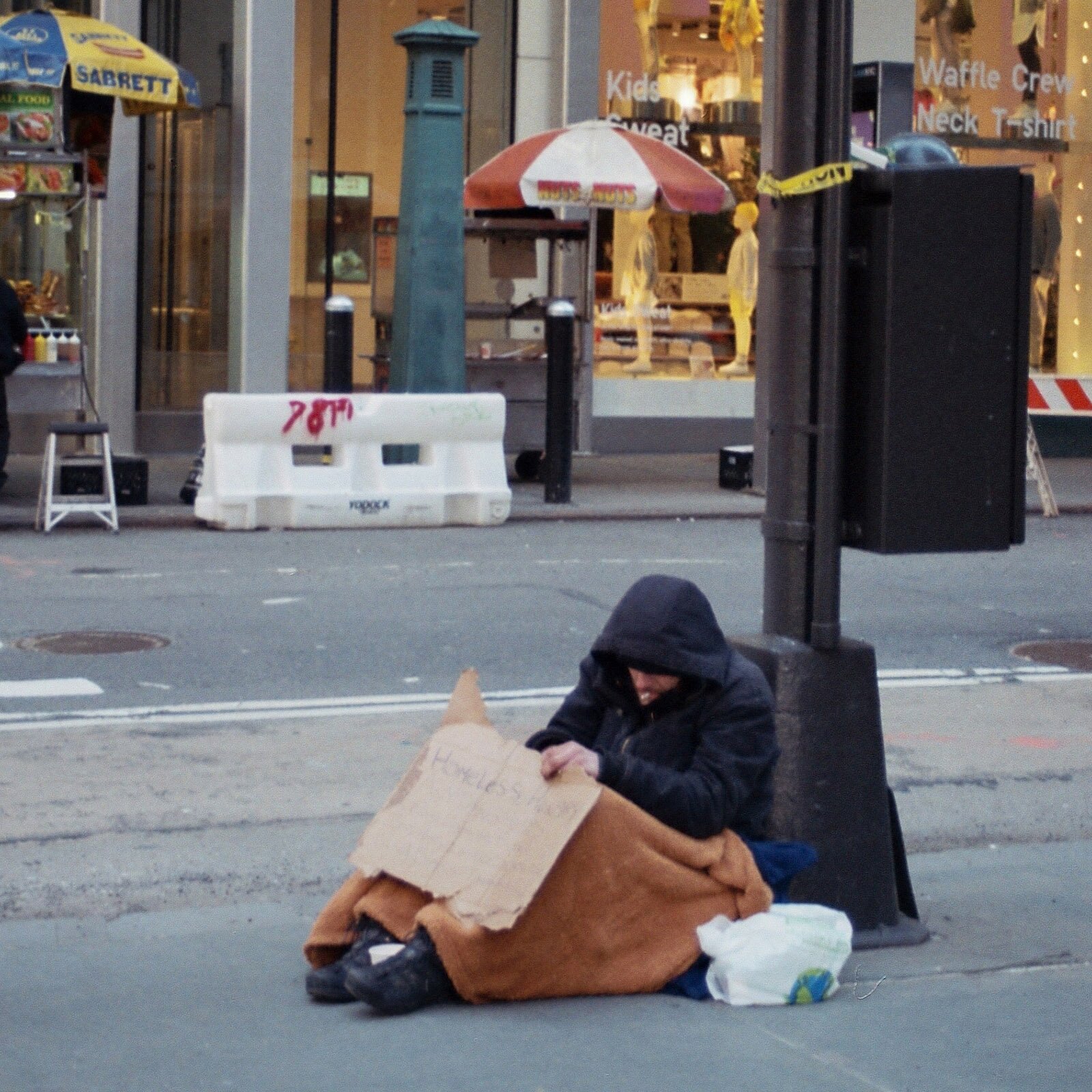
Read the text about homelessness and do the exercises below.
Being HomelessPeople living on the streets often get labelled as street urchinsstreet urchins or driftersdrifters since many communities see them as a problem. With housing being very expensive, particularly in heavily populated areas in the likes of New York City, sleeping roughsleeping rough is often the only option for some people. Others may be able to afford to sleep in hostelshostels – small accommodation which often caters to several people per room, making them much cheaper alternatives to actual hotels.
It is common for the homeless population to have no fixed addressno fixed address, which most often leads to issues like being unable to find work or open bank accounts. In other words, it is very difficult for homeless people to claim housing benefitshousing benefits. The lack of a bank account can also mean that buying food is impossible, which in turn makes their need for places like soup kitchenssoup kitchens more pressing. And what are soup kitchens exactly? They are locations where free meals are provided to homeless or down and outdown and out people. Other than receiving food, they can also count on warmth and support from the workers. Unfortunately, little more can be done.
The question may arise at this point: how does one become homeless? What leads to this inhumane situation? Sociologists argue there are many reasons. Among others: abuse or losing a job. Of course, some people claim that homelessness is their choice. That may well be true, but many of them did not, in fact, decide to live on the streets. They're homeless due to events beyond their control.
Unfortunately, the problem of homelessness affects not only individuals but also entire families who are sometimes referred to as waifs and strayswaifs and strays, and are most likely to be displaceddisplaced by either catastrophic events, such as Hurricane Katrina, or economic factors. Due to circumstances beyond their control, whole families are forced to live as though they had no roots, no background and often no hope to retrieve their homes.
Źródło: Chris Howard, [na podstawie:] https://www.crisis.org.uk/ending-homelessness/about-homelessness/ [dostęp 11.10.2021], https://www.ohchr.org/en/special-procedures/sr-housing/homelessness-and-human-rights [dostęp 11.10.2021], licencja: CC BY-SA 3.0.
- Having Tu uzupełnij (żadnego stałego adresu) often results in poor or no job perspectives.
- How long has he been living Tu uzupełnij (w tym schronisku)? It is shabby and gloomy.
- After this enormous flood, nearly all Tu uzupełnij (przesiedleni) need new homes.
- It is difficult when people regard you as a Tu uzupełnij (menel, ulicznik), because it creates an inevitable image of a feeble person who cannot be trusted.
- She has always tried to help Tu uzupełnij (przybłędom, bezdomnym rodzinom), and her house was always the centre of confusion full of those in need.
- Most of his teenage years he spent begging and Tu uzupełnij (śpiąc pod gołym niebem).
- When you are Tu uzupełnij (w dołku), life seems to be sensless and pitiful.
- Some of those homeless lost their homes due to Tu uzupełnij (eksmisji).
GRAMATYKA
Niektóre przymiotniki mogą pełnić funkcję rzeczowników. Opisują wówczas grupę ludzi. W tym celu przed przymiotnik należy wstawić the – przymiotnik przejmuje wtedy funkcję rzeczownika, a rzeczownik jest już zbędny. Przykładowo: zamiast mówić sick people, można po prostu powiedzieć the sick. Czasowniki występujące po przymiotnikach w funkcji rzeczowników przyjmują zwykle liczbę mnogą.
- (People who are famous) Tu uzupełnij happen not to enjoy fame.
- The government should provide special aid for (people who have no education) Tu uzupełnij.
- This splendid, ultra modern device is especially designed for (people who cannot see) Tu uzupełnij.
- (People who are about to die) Tu uzupełnij feel more secure and peaceful with their loved ones around them.
- Nurses were hectically trying to help (soldiers who were wounded by a weapon) Tu uzupełnij.
- (People who are sick) Tu uzupełnij need emphatetic care and deep understanding.
- Those who live on the verge of poverty rarely understand (people who are rich)Tu uzupełnij.
- (People who are homeless) Tu uzupełnij deal with a plethora of issues that extend beyond the lack of a safe harbour.
- In many cases, those who suffer from homelessness can only rely on (those who have compassion) Tu uzupełnij.
- Sign language was invented to communicate with people who cannot hear. Sign language was invented as a means of Tu uzupełnij.
- People who have no home constitute a significant percentage of the population of this town. Tu uzupełnij constitute a significant percentage of the population of this town.
- Every year, millions join the ranks of people without a job worldwide. Every year, the number of Tu uzupełnij and bigger worldwide.
- There were thousands of injured people. Tu uzupełnij in the thousands.
- The facilities in the new toilets were not adequate for people with disabilities. The facilities in the new toilets were Tu uzupełnij.
- My aunt claims that people who are no longer alive talk to her. My aunt claims that she can Tu uzupełnij.
- Mr and Mrs Browns haven't been invited for the annual company ball. Nobody has invited the Tu uzupełnij annual company ball.
- Homeless people are apparently deprived of many priviliges. Homeless people are apparently Tu uzupełnij.
Słownik
/ dɪsˈpleɪst /
przeniesiony, przesiedlony (having been forced to leave your home, for example by a war or dangerous event)
/ daʊn ənd aʊt /
w dołku, bez domu i pieniędzy (having no luck, no money, and no opportunities)
/ ˈdrɪftəz / / ˈdrɪftə /
włóczędzy [włóczęga] (someone who does not have a permanent home or job and moves from one place to another or from one job to another)
/ ɪnˈfɔːs ðə lɔː /
egzekwować prawo (to make people obey a law)
/ ˈhɒstl̩z / / ˈhɒstl̩ /
schroniska [schronisko] (a large house where people can stay free or cheaply)
/ ˈhaʊzɪŋ ˈbenɪfɪts /
dodatki mieszkaniowe (money paid by the government to help people who are poor pay for a place to live in)
/ ˈnəʊ fɪkst əˈdres /
bez stałego adresu (to not have a permanent home)
/ ˈɒn ðə striːts /
na ulicy (without a home)
/ ˈsli:pɪŋ rʌf /
spanie pod gołym niebem (to sleep outside because you have no home and no money)
/ ˈsu:p kɪtʃənz / / ˈsu:p kɪtʃən /
jadłodajnie dla ubogich [jadłodajnia dla ubogich] (a place where free soup or other food is given to people with no money or no home)
/ stri:t ɜ:tʃɪnz / / stri:t ɜ:tʃɪn /
ulicznicy [ulicznik] (a child who is poor and does not have a home, living and sleeping on the streets of a city)
/ weɪfs ənd streɪz /
bezdomne rodziny (people with no homes)
Źródło: GroMar Sp. z o.o., licencja: CC BY‑SA 3.0