a) Indicate characteristics of liquids. b) How are the molecules in liquids arranged? c) Do molecules in liquids have the ability to move relative to each other? d) Can a metal be a liquid?
a) Liquids have a definite volume and take the shape of the vessel in which they are. b) Molecules in liquids are randomly arranged. The average distance between molecules in liquids is much smaller than in the case of gases and is close to the average distance of molecules in solids. c) Molecules in liquids constantly move relative to each other. d) After reaching a high temperature, exceeding the melting point of the metal, it may become liquidliquidliquid.
Under the influence of external forces, liquids do not change their volume.
Instruction
1. Fill the syringe with water to a certain volume. 2. Clog the end of the syringe with finger and try to change the water volume by pressing the plunger and pulling it back. 3. Repeat the same for oil.
a) The volume of water and oil cannot be reduced. b) Despite compression and expansionexpansionexpansion, the volume of liquidliquidliquid remains constant.
Conclusion
a) Liquids do not change their volume, under the influence of external forces, they are practically incompressible. b) Because liquids retain their volume during compressioncompressioncompression, their molecules repel each other during compression. c) When expanding, the liquids retain their volume because their molecules attract.
Exercise 2
Rmz689A50yifw
Wersja alternatywna ćwiczenia: Determine which sentences are true. Możliwe odpowiedzi: 1. Liquids are incompressible because the molecules in the liquids are close together., 2. Liquids are incompressible because their molecules move relative to each other., 3. Liquids are incompressible because their molecules are more repulsive when compressed, and when expanded, they attract more., 4. Liquids are incompressible because their temperature decreases significantly during compression.
Wersja alternatywna ćwiczenia: Determine which sentences are true. Możliwe odpowiedzi: 1. Liquids are incompressible because the molecules in the liquids are close together., 2. Liquids are incompressible because their molecules move relative to each other., 3. Liquids are incompressible because their molecules are more repulsive when compressed, and when expanded, they attract more., 4. Liquids are incompressible because their temperature decreases significantly during compression.
Determine which sentences are true.
Liquids are incompressible because the molecules in the liquids are close together.
Liquids are incompressible because their molecules move relative to each other.
Liquids are incompressible because their molecules are more repulsive when compressed, and when expanded, they attract more.
Liquids are incompressible because their temperature decreases significantly during compression.
Free surface of liquidfree surface of liquidFree surface of liquid - the surface spontaneously formed by a liquid in contact with another medium (air, other liquid).
The free surface is e.g. the upper surface of the liquid in the vessel, the surface of the drops and the stream of liquid in the air.
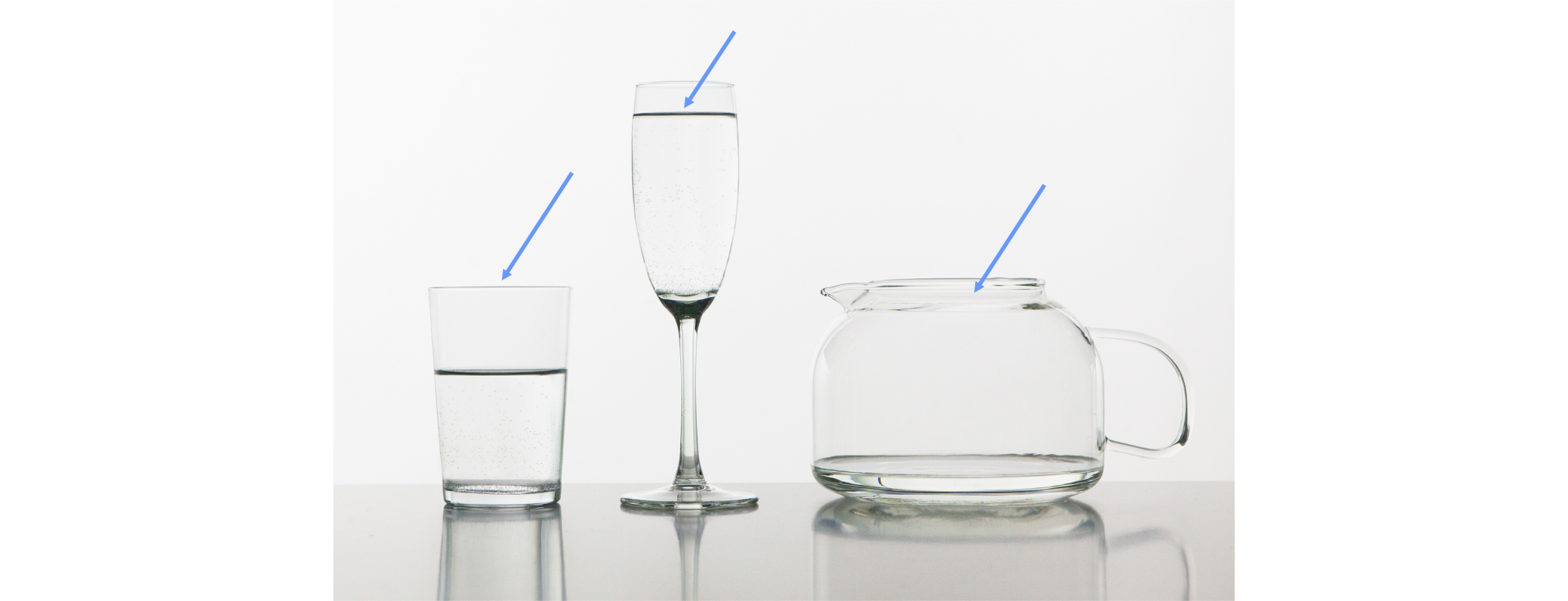
Familiarize yourself with illustration „Free surface of water under the Earth’s gravitational interaction” in which the same amount of water poured into various vessels is shown.
RElScX2fknuGZ
Ilustracja przedstawia szklankę mniej więcej do połowy napełnioną wodą, kieliszek całkowicie wypełniony wodą i dzbanek do herbaty, wypełniony wodą tylko na dnie. Na każde z przezroczystych naczyń wskazuje strzałka.
Free surface of water under the Earth's gravitational interaction
Source: GroMar, licencja: CC BY 3.0.
Exercise 3
Answer the questions.
a) What shape does the upper part of the liquid bordered with air have? b) Is the surface of the upper part of the liquid bordered with air the free surface of this liquid? c) Is the surface of the liquid under Earth's gravitational interaction parallel to the Earth's surface and is it dependent on the shape of the vessel?
a) The upper part of the liquid bordered with air is flat and horizontal. b) The liquid surface bordered with air is its free surface. c) The surface of the liquid under Earth's gravitational interaction is parallel to the Earth's surface and is independent of the shape of the vessel.
Surface tensionsurface tensionSurface tension is a phenomenon that causes the surface of the liquid to behave like a stretched elastic membrane.
RFm7BdwF6klsW1
Pokaz slajdów – zjawisko napięcia powierzchniowego. Instrukcja obsługi z poziomu klawiatury: 1. Uruchomienie aplikacji - ENTER, 2. Na każdym ze slajdów czytany jest automatycznie tekst alternatywny po polsku, 3. Przy pierwszym uruchomieniu na pierwszym slajdzie, czytanie tekstu po angielsku - TAB, 4. Przejście między slajdami: do następnego slajdu - TAB, do poprzedniego slajdu - TAB + SHIFT, 5. Przejście do czytania napisu po angielsku - strzałka w górę + strzałka w dół (czyta tekst po angielsku widoczny na slajdzie).
Pokaz slajdów – zjawisko napięcia powierzchniowego. Instrukcja obsługi z poziomu klawiatury: 1. Uruchomienie aplikacji - ENTER, 2. Na każdym ze slajdów czytany jest automatycznie tekst alternatywny po polsku, 3. Przy pierwszym uruchomieniu na pierwszym slajdzie, czytanie tekstu po angielsku - TAB, 4. Przejście między slajdami: do następnego slajdu - TAB, do poprzedniego slajdu - TAB + SHIFT, 5. Przejście do czytania napisu po angielsku - strzałka w górę + strzałka w dół (czyta tekst po angielsku widoczny na slajdzie).
Due to the surface tension, small insects can run on the water surface without immersing, small objects with a density higher than the water density (pin, razor blade) can float on its surface, and the diving bell spider can collect air under water in a woven vessel made of spiderweb.
The surface tension causes the liquids to take the shape of a drop, and also that the liquidliquidliquid level in the narrow glass tube or in the narrow gap between the panes rises above the water level in the vessel into which we immerse the tube or the glass.
Explanation of the surface tension phenomenon
RHPmUmPgt06fw1
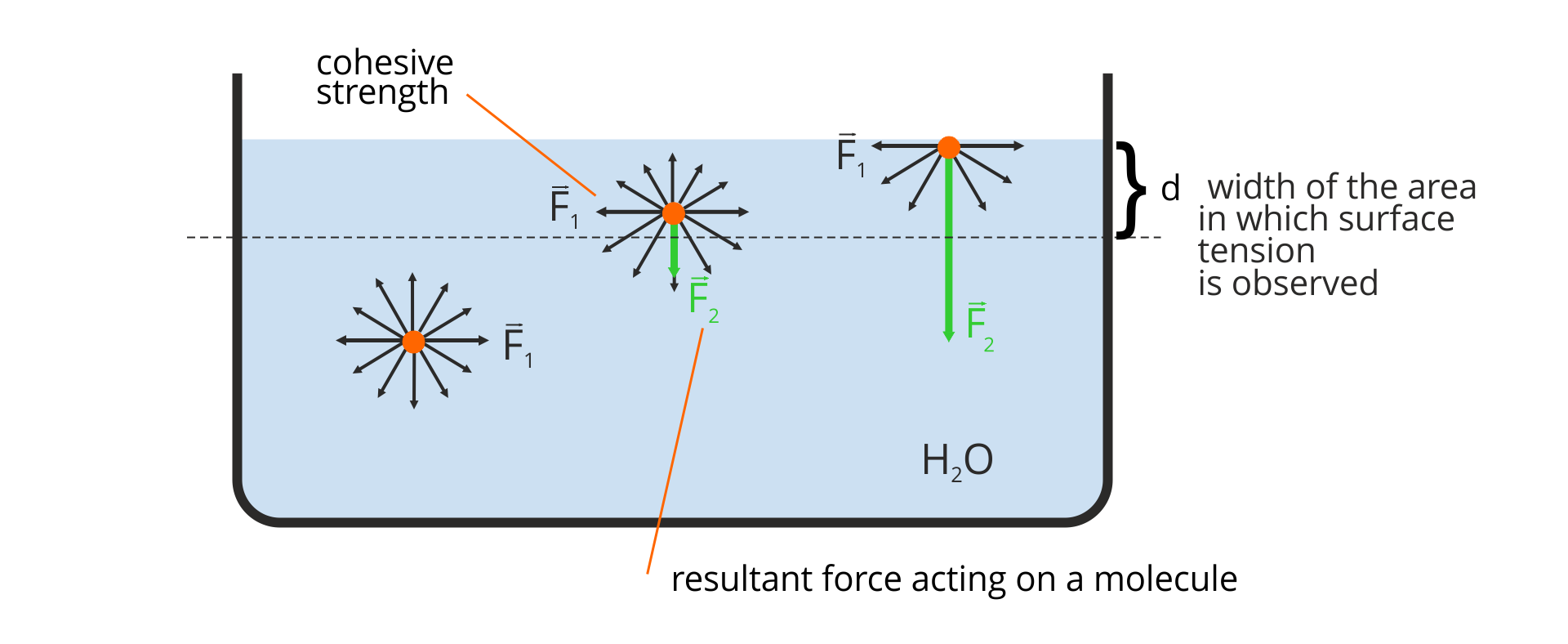
Rysunek przedstawia schemat oddziaływań zachodzących na powierzchni cieczy i w jej wnętrzu. Narysowane naczynie w kształcie prostokąta z zaokrąglonymi rogami wypełnione od dołu prawie do samej góry kolorem niebieskim, symbolizującym wodę, podpisanym H z indeksem dolnym 2, O. Mniej więcej na wysokości dwóch trzecich narysowana linia pozioma przerywana. Odległość od linii do powierzchni cieczy oznaczona d, symbolizujące odległość od powierzchni, gdzie można zaobserwować zjawisko napięcia powierzchniowego, opisana width of the area in which surface tension is observed. Po lewej stronie w połowie wysokości punkt. Wokół niego czarne strzałki skierowane na zewnątrz, symbolizujące siły kohezji, jedna z nich opisana F z indeksem dolnym 1. Na środku nad linią przerywaną punkt. Wokół niego czarne strzałki skierowane na zewnątrz, symbolizujące siły kohezji, jedna z nich opisana F z indeksem dolnym 1, podpisana cohesive strength. Na strzałce skierowanej pionowo do dołu narysowana krótsza strzałka zielona, symbolizująca siłę wypadkową działającą na cząsteczkę, opisana F z indeksem dolnym 2, podpisana resultant force acting on a molecule. Po prawej pod linią powierzchni wody punkt. Wokół jego dolnej połowy czarne strzałki skierowane na zewnątrz, symbolizujące siły kohezji, jedna z nich opisana F z indeksem dolnym 1. Na strzałce skierowanej pionowo do dołu narysowana mniej więcej trzykrotnie dłuższa strzałka zielona, symbolizująca siłę wypadkową działającą na cząsteczkę, opisana F z indeksem dolnym 2.
1. There is virtually no resultant force acting on molecules placed in a liquid far below the surface. More specifically; the force acting on the given moleculemoleculemolecule is the same from each direction, because in each direction there are virtually the same number of other molecules. 2. Approaching the surface of the liquid we observe a certain asymmetry of interactions. More molecules pull the given molecule into the centre of the liquid than towards the surface. So there is a resultant force acting on the molecule directed to the centre of the liquid. 3. A large force directed to the centre of the liquid acts on the moleculemoleculemolecule on the surface. 4. Forces acting on molecules on the surface therefore make the liquid to minimize the free surface of the liquid. 5. A stretched surface membrane is created, a phenomenon called surface tensionsurface tensionsurface tension.
Consider what experiment you can perform to show the surface tensionsurface tensionsurface tension of the liquid and its molecular structure. Discuss ideas in the classroom.
Liquids combine the characteristics of gases and solids. On one hand, the molecules of liquids remain at distances similar to those of solids (slightly larger than the diameter of their molecules), on the other hand - they move freely relative to each other (they are characterized by high mobility).
The surface spontaneously produced by the liquidliquidliquid in contact with another medium (air, other liquid) is called the free surface of the liquid.
Liquids are very difficult to change volume under the influence of external forces. This is due to the strong intermolecular interactions that lead to the repulsionrepulsionrepulsion of molecules during compressioncompressioncompression and, when they expand, to attractionattractionattraction.
Most liquids are bad heat conductors compared to, for example, metal.
Some liquids are electrically conductive. These are most often electrolytes, i.e. aqueous solutions of certain bases, acids or salts. They can also be metals in the liquid state, such as mercury or tin.
Exercises
R1eOwdf5Gal57
Exercise 5
Wersja alternatywna ćwiczenia: Determine which sentences are true. Możliwe odpowiedzi: 1. All liquids conduct electricity well., 2. Liquids retain their own shape, but not the volume., 3. The volume of water decreases as the temperature rises from 0° C to 4° C. Above a temperature of 4° C, the volume of water increases again., 4. Water on the Earth has a free surface only on the upper surface on the boundary with gas., 5. In the state of weightlessness, liquids always have the shape of a sphere., 6. Liquids are incompressible because their molecules repel each other during compression and when expanded they attract., 7. Liquids conducting electric current are electrolytes.
Wersja alternatywna ćwiczenia: Determine which sentences are true. Możliwe odpowiedzi: 1. All liquids conduct electricity well., 2. Liquids retain their own shape, but not the volume., 3. The volume of water decreases as the temperature rises from 0° C to 4° C. Above a temperature of 4° C, the volume of water increases again., 4. Water on the Earth has a free surface only on the upper surface on the boundary with gas., 5. In the state of weightlessness, liquids always have the shape of a sphere., 6. Liquids are incompressible because their molecules repel each other during compression and when expanded they attract., 7. Liquids conducting electric current are electrolytes.
Determine which sentences are true.
All liquids conduct electricity well.
Liquids retain their own shape, but not the volume.
The volume of water decreases as the temperature rises from 0° C to 4° C. Above a temperature of 4° C, the volume of water increases again.
Water on the Earth has a free surface only on the upper surface on the boundary with gas.
In the state of weightlessness, liquids always have the shape of a sphere.
Liquids are incompressible because their molecules repel each other during compression and when expanded they attract.
Liquids conducting electric current are electrolytes.
zadanie
Source: GroMar, licencja: CC BY 3.0.
Exercise 6
Why is it not allowed to use electric equipment when bathing?
Because flooding them with water may result in electric shock. Our bath does not take place in distilled water, and tap water contains substances that allow the flow of electric current.
Exercise 7
Write in English where in practice the fact of bad water heating is used. Think about industrial and home applications.
Extinguishing fires, cooling nuclear reactors, cooling car engines, maintaining high or low temperature of vessels or bottles with beverages for consumption.
R1UgkuYZJiLIG
Exercise 8
Wersja alternatywna ćwiczenia: Indicate which pairs of expressions or words are translated correctly. Możliwe odpowiedzi: 1. powierzchnia swobodna cieczy - free surface of liquid, 2. przyciąganie - attraction, 3. odpychanie - repulsion, 4. ciecz - liquid, 5. rozprężanie - compression, 6. ściskanie - expansion
Wersja alternatywna ćwiczenia: Indicate which pairs of expressions or words are translated correctly. Możliwe odpowiedzi: 1. powierzchnia swobodna cieczy - free surface of liquid, 2. przyciąganie - attraction, 3. odpychanie - repulsion, 4. ciecz - liquid, 5. rozprężanie - compression, 6. ściskanie - expansion
Indicate which pairs of expressions or words are translated correctly.
powierzchnia swobodna cieczy - free surface of liquid
przyciąganie - attraction
odpychanie - repulsion
ciecz - liquid
rozprężanie - compression
ściskanie - expansion
zadanie
Source: GroMar, licencja: CC BY 3.0.
R1STesKsWhQOT1
Interaktywna gra, polegająca na łączeniu wyrazów w pary w ciągu jednej minuty. Czas zaczyna upływać wraz z rozpoczęciem gry. Jeden ruch to odkrywanie najpierw jednej potem drugiej karty z wyrazem. Każdy wyraz jest odczytywany. Kolejny ruch to odkrywanie trzeciej i czwartej karty. W ten sposób odsłuchasz wszystkie wyrazy. Nawigacja z poziomu klawiatury za pomocą strzałek, odsłuchiwanie wyrazów enterem lub spacją. Znajdź wszystkie pary wyrazów.
Interaktywna gra, polegająca na łączeniu wyrazów w pary w ciągu jednej minuty. Czas zaczyna upływać wraz z rozpoczęciem gry. Jeden ruch to odkrywanie najpierw jednej potem drugiej karty z wyrazem. Każdy wyraz jest odczytywany. Kolejny ruch to odkrywanie trzeciej i czwartej karty. W ten sposób odsłuchasz wszystkie wyrazy. Nawigacja z poziomu klawiatury za pomocą strzałek, odsłuchiwanie wyrazów enterem lub spacją. Znajdź wszystkie pary wyrazów.
Match Polish terms with their English equivalents.
molecule
napięcie powierzchniowe
electrolyte
powierzchnia swobodna cieczy
surface tension
elektrolit
intermolecular force
cząsteczka
free surface of liquid
oddziaływania międzycząsteczkowe
Source: Zespół autorski Politechniki Łódzkiej, licencja: CC BY 3.0.