In how many states of mater does water exist on the Earth?
When does the water transform from one state of matter to another?
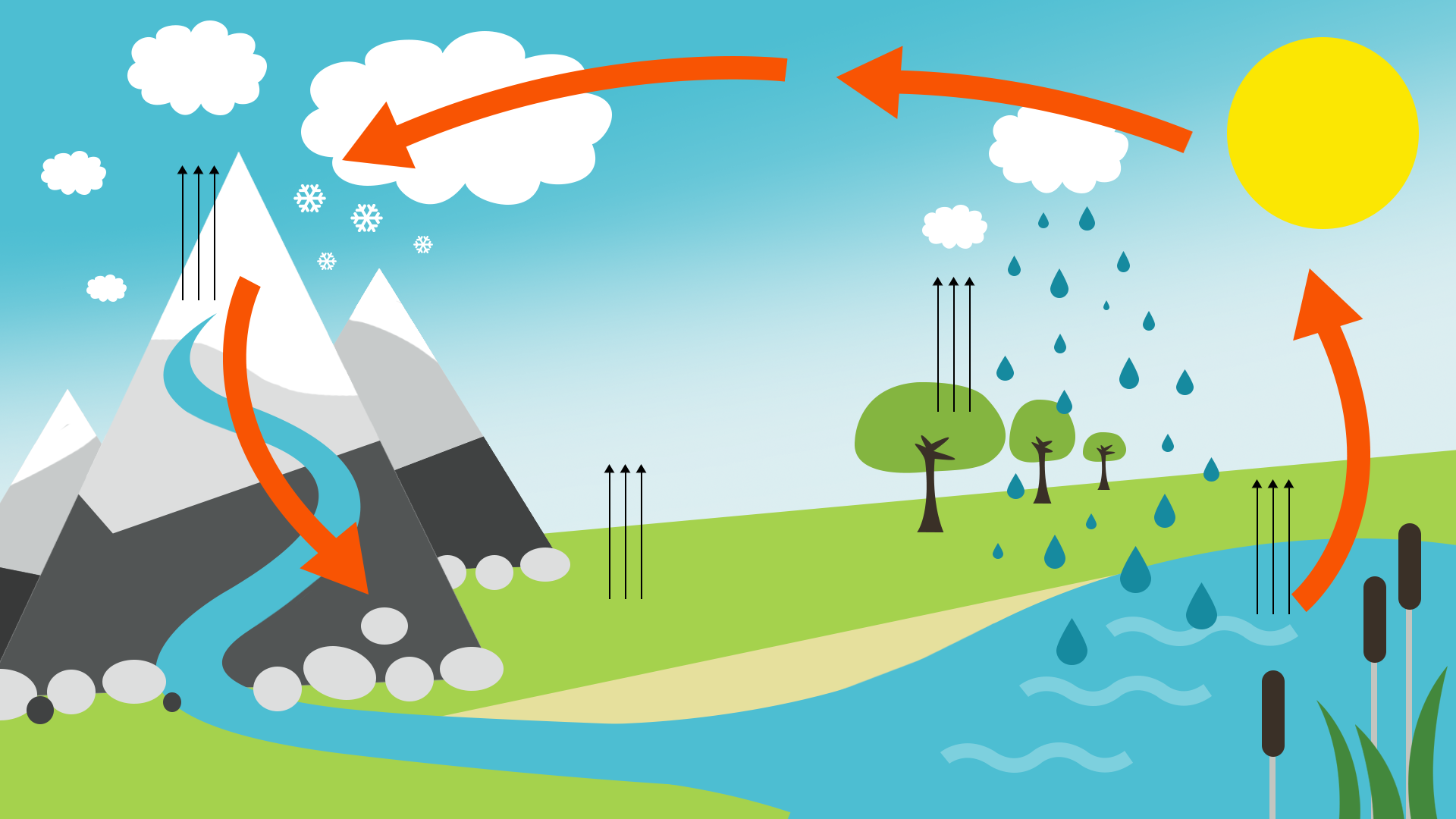
Name the physical processes presented in the picture which you know.
R1aD7tzpO3YYz1
Ilustracja przedstawia schematyczny obieg wody w przyrodzie. Na rysunki widoczne są góry, z jednej z nich wypływa rzeka uchodząca do jeziora, chmury deszczowe oraz chmury śniegowe. Strzałki łączą elementy pokazując obieg wody. Pierwsza strzałka pomiędzy śniegiem na szczycie a wodą w rzece. Druga pomiędzy wodą w jeziorze a chmurami. Trzecia i czwarta łączy chmury deszczowe, śniegowe. Jednocześnie widać padający deszcz i śnieg z chmur. Widoczne są również strzałki (w grupach po 3) skierowane do góry pokazujące parowanie, znajdują się one w jeziorze, wśród drzew, na trawie oraz śniegu.
Source: GroMar, licencja: CC BY 3.0.
Water on Earth occurs in a liquid state, solid (as ice) and gas (as steam).
Cooling below 0 °C turns water into ice, and steam in the clouds turns into snow. Above 0 °C water evaporates and condenses into small drops forming clouds. It can rain from clouds.
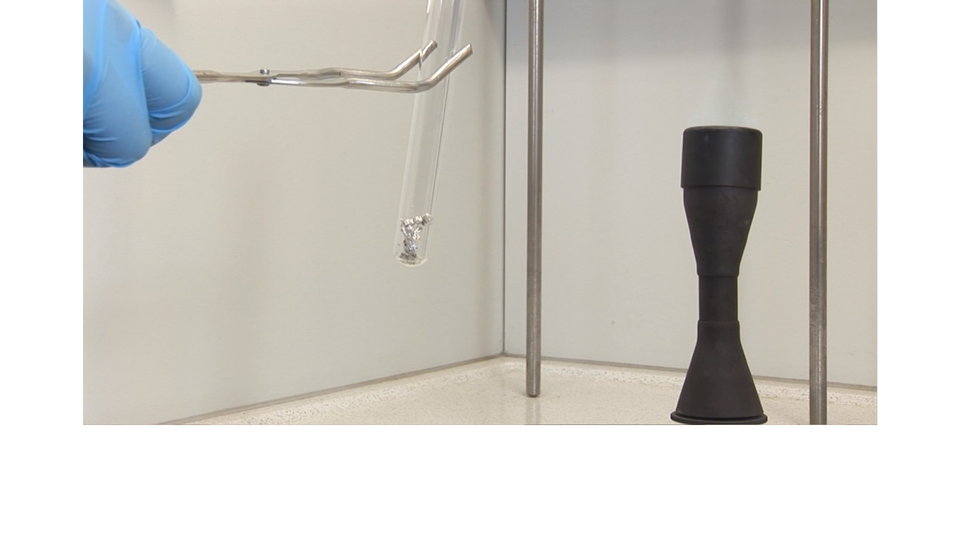
Watch the slideshow „MeltingmeltingMelting of Wood's alloy”
Note:
Wood alloy - a low-meltingmeltingmelting metal alloy (melts already at 66,5°C), silver‑gray, fine‑grained, consisting of bismuth, cadmium, lead and tin.
It was received by an American dentist Barnabas Wood and was used in dentistry. This alloy is usually used: in jewellery for soldering.
RCnHqZ9gQcFTZ1
Pokaz slajdów - topnienie stopu Wooda. Instrukcja obsługi z poziomu klawiatury: 1. Uruchomienie aplikacji - ENTER, 2. Na każdym ze slajdów czytany jest automatycznie tekst alternatywny po polsku, 3. Przy pierwszym uruchomieniu na pierwszym slajdzie, czytanie tekstu po angielsku - TAB, 4. Przejście między slajdami: do następnego slajdu - TAB, do poprzedniego slajdu - TAB + SHIFT, 5. Przejście do czytania napisu po angielsku - strzałka w górę + strzałka w dół (czyta tekst po angielsku widoczny na slajdzie).
Pokaz slajdów - topnienie stopu Wooda. Instrukcja obsługi z poziomu klawiatury: 1. Uruchomienie aplikacji - ENTER, 2. Na każdym ze slajdów czytany jest automatycznie tekst alternatywny po polsku, 3. Przy pierwszym uruchomieniu na pierwszym slajdzie, czytanie tekstu po angielsku - TAB, 4. Przejście między slajdami: do następnego slajdu - TAB, do poprzedniego slajdu - TAB + SHIFT, 5. Przejście do czytania napisu po angielsku - strzałka w górę + strzałka w dół (czyta tekst po angielsku widoczny na slajdzie).
The solid body constantly requires to melt the energy delivery.
The solid melts at a strictly defined temperature.
Particles in the solid body vibrate only around the equilibrium positions, while in the liquid they move relatively. Thus, during meltingmeltingmelting, the body molecules gain greater freedom of movement.
The energy released by the liquid reduces the velocity of the particles, and the attraction forces connect them to a solid body.
The start of solidificationsolidificationsolidification process depends on the presence of nucleation seeds in the liquid on which the crystal formation process begins.
The direct transfer of substances from solid to gas state without passing the liquid state.
Dry ice (solidified carbon dioxide) is an example of a sublimating body in normal conditions.
A block of frozen carbon dioxide, exposed in a room to a typical atmospheric pressure and the temperature about 20°C, will sublimate and will not melt.
Resublimation
Direct transfer of a substance from a gas state to a solid one, omitting a liquid state.
Resublimation is a process opposite to sublimationsublimationsublimation. Frost is created as a result of resublimation of water (steam).
Resublimation, in combination with sublimationsublimationsublimation or evaporationevaporationevaporation, is used to purify or separate the substance and to obtain it in the form of fine crystals (this is, among others, iodine purification method).
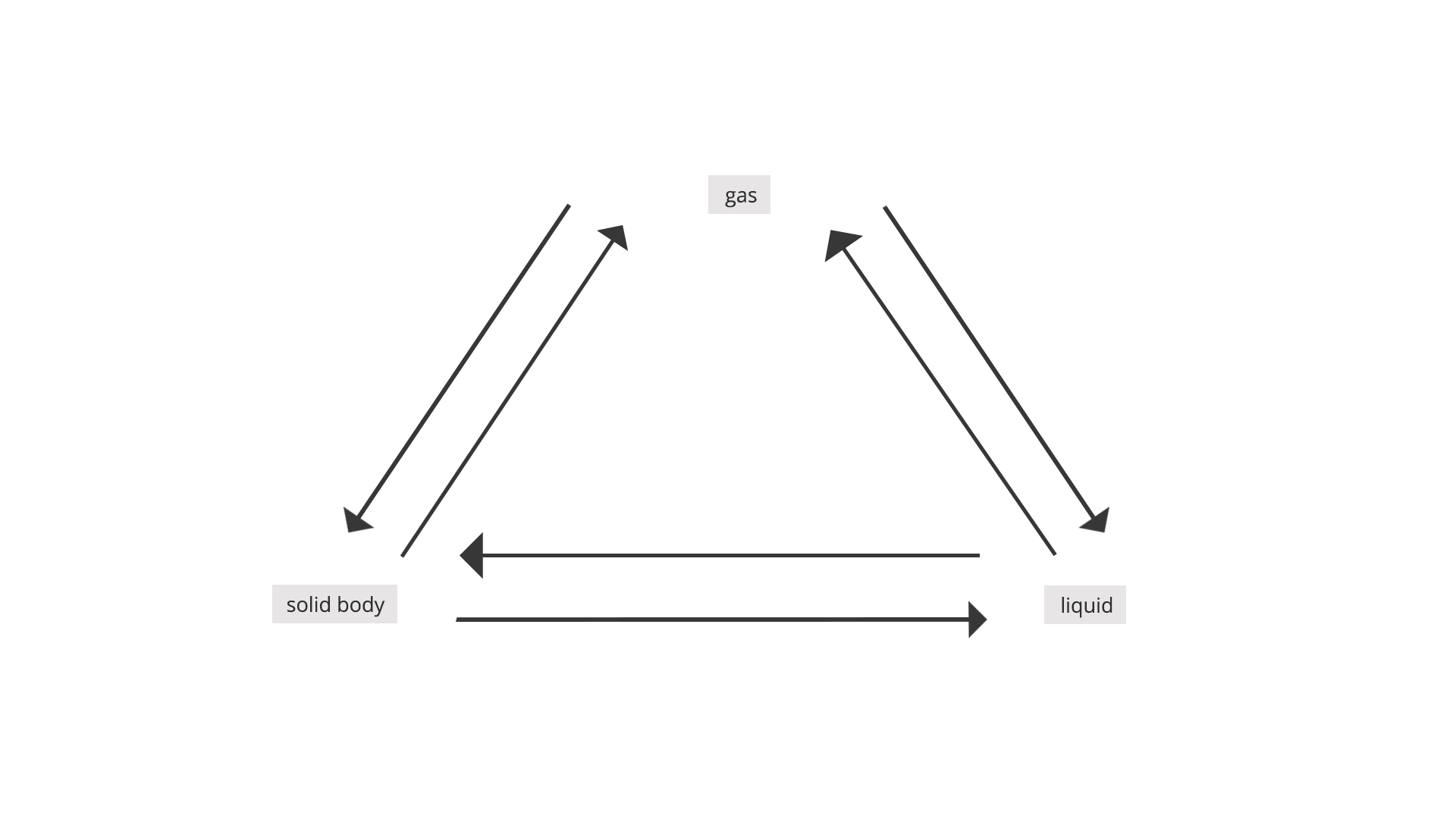
Complete the phase transformation scheme with the names of phase transitions next to the arrows (use the following names of phase transformations: meltingmeltingmelting, solidificationsolidificationsolidification, sublimationsublimationsublimation, resublimation, evaporationevaporationevaporation, condensationcondensationcondensation).
RObDdjg74NJqD
Na ilustracji przedstawiony jest diagram, kształtem przypominający trójkąt. W wierzchołkach tego trójkąta umieszczone są napisy. Na górze znajduje się napis gas. Od napisu gas biegnie strzałka skierowana do lewego, dolnego wierzchołka gdzie znajduje się napis solid body oraz strzałka przeciwna. Od napisu gas biegnie druga strzałka skierowana do prawego, dolnego wierzchołka gdzie znajduje się napis liquid oraz strzałka przeciwna. Kolejna strzałka narysowana jest od napisu solid body do liquid oraz strzałka przeciwna.
Phase transformation scheme
Source: GroMar, licencja: CC BY 3.0.
RSBSgSUBI8cYi
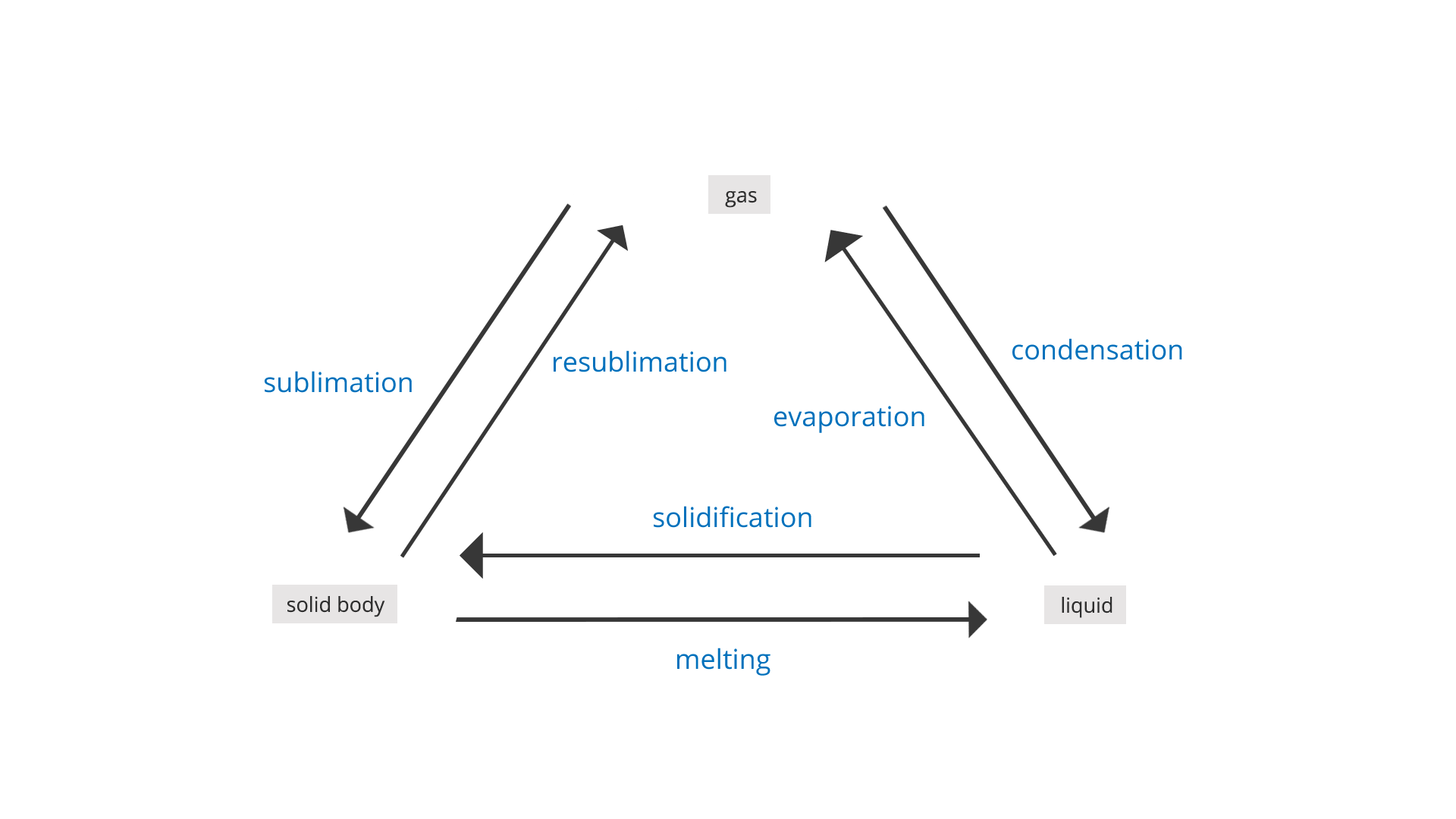
Na ilustracji przedstawiony jest diagram, kształtem przypominający trójkąt. W wierzchołkach tego trójkąta umieszczone są napisy. Na górze znajduje się napis gas. Od napisu gas biegnie strzałka skierowana do lewego, dolnego wierzchołka, gdzie znajduje się napis solid body. Strzałka podpisana jest sublimation. W przeciwnym kierunku jest również dorysowana strzałka podpisana resublimation. Od napisu gas biegnie strzałka skierowana do prawego, dolnego wierzchołka, gdzie znajduje się napis liquid. Strzałka podpisana jest condensation. W przeciwnym kierunku jest również dorysowana strzałka podpisana evaporation. Kolejna strzałka narysowana jest od napisu solid body do liquid i podpisana melting. Ostatnia strzałka biegnie od napisu liquid do solid body i podpisana jest solidification.
Phase transformation scheme with the names of phase transitions
MeltingmeltingMelting is a change in the state of the body from solid into liquid. It occurs at a constant temperature, called the meltingmeltingmelting temperature.
SolidificationsolidificationSolidification is a change in the state of the body from liquid to solid. This process can occur in the opposite direction (meltingmeltingmelting).
Some bodies change from the solid to the liquid state without the established transition temperature. Within a certain temperature range, the body gradually softens and becomes liquid. This process is called softening.
EvaporationevaporationEvaporation is the change in the state of the body in which the body transforms from liquid to gas. It occurs on the surface of the liquid.
CondensationcondensationCondensation is a phenomenon of transforming steam or gas into the liquid state.
SublimationsublimationSublimation is a phenomenon of a direct transition from the solid state to the gas state, omitting the liquid state.
Resublimation is the phenomenon of direct transition from the gas to the solid state, omitting the liquid state.
Exercises
R1bfEqt9jSItF
Exercise 4
Wersja alternatywna ćwiczenia: Determine which sentences are true. Możliwe odpowiedzi: 1. Wet underwear can be dried outside in winter because sublimation takes place., 2. Water turns into ice at the melting point of water., 3. Atmospheric sediment; the result of the water vapor contact with the substrate at the temperature lower than 0°C - it's frost., 4. The process of converting liquids into gas, taking place in the whole volume of the liquid at a specific temperature - it's boiling., 5. The ice melts at -10°C.
Wersja alternatywna ćwiczenia: Determine which sentences are true. Możliwe odpowiedzi: 1. Wet underwear can be dried outside in winter because sublimation takes place., 2. Water turns into ice at the melting point of water., 3. Atmospheric sediment; the result of the water vapor contact with the substrate at the temperature lower than 0°C - it's frost., 4. The process of converting liquids into gas, taking place in the whole volume of the liquid at a specific temperature - it's boiling., 5. The ice melts at -10°C.
Determine which sentences are true.
Wet underwear can be dried outside in winter because sublimation takes place.
Water turns into ice at the melting point of water.
Atmospheric sediment; the result of the water vapor contact with the substrate at the temperature lower than 0°C - it's frost.
The process of converting liquids into gas, taking place in the whole volume of the liquid at a specific temperature - it's boiling.
The ice melts at -10°C.
Exercise 5
Mum put salt and some butter into the pot with soup. What kind of process are butter and salt subject to?
Butter does not dissolve in water and, therefore, it melts and floats as liquid on the surface of the soup. Salt dissolves in water and forms a homogeneous mixture with water.
Exercise 6
Write in English why liquid evaporates faster when it has a higher temperature? Explain this process taking into account the molecular structure of bodies.
When the liquid is heated, the kinetic energy of the liquid molecules increases. It evinces in the increase of the average velocity of these molecules. With the increase of the temperature, the quantitative contribution of liquid molecules is increasing. Their velocity is so high that they can escape from the liquid and become vapor molecules. Thus, the increase of temperature causes the increase of the evaporation rate.
RUjwk3d0gaJ25
Exercise 7
Wersja alternatywna ćwiczenia: Indicate which pairs of expressions or words are translated correctly. Możliwe odpowiedzi: 1. parowanie - evaporation, 2. topnienie - melting, 3. skraplanie - condensation, 4. krzepnięcie - boiling, 5. wrzenie - freezing
Wersja alternatywna ćwiczenia: Indicate which pairs of expressions or words are translated correctly. Możliwe odpowiedzi: 1. parowanie - evaporation, 2. topnienie - melting, 3. skraplanie - condensation, 4. krzepnięcie - boiling, 5. wrzenie - freezing
Indicate which pairs of expressions or words are translated correctly.
parowanie - evaporation
topnienie - melting
skraplanie - condensation
krzepnięcie - boiling
wrzenie - freezing
zadanie
Source: GroMar, licencja: CC BY 3.0.
RbOTbDQpWoi341
Interaktywna gra, polegająca na łączeniu wyrazów w pary w ciągu jednej minuty. Czas zaczyna upływać wraz z rozpoczęciem gry. Jeden ruch to odkrywanie najpierw jednej potem drugiej karty z wyrazem. Każdy wyraz jest odczytywany. Kolejny ruch to odkrywanie trzeciej i czwartej karty. W ten sposób odsłuchasz wszystkie wyrazy. Nawigacja z poziomu klawiatury za pomocą strzałek, odsłuchiwanie wyrazów enterem lub spacją. Znajdź wszystkie pary wyrazów.
Interaktywna gra, polegająca na łączeniu wyrazów w pary w ciągu jednej minuty. Czas zaczyna upływać wraz z rozpoczęciem gry. Jeden ruch to odkrywanie najpierw jednej potem drugiej karty z wyrazem. Każdy wyraz jest odczytywany. Kolejny ruch to odkrywanie trzeciej i czwartej karty. W ten sposób odsłuchasz wszystkie wyrazy. Nawigacja z poziomu klawiatury za pomocą strzałek, odsłuchiwanie wyrazów enterem lub spacją. Znajdź wszystkie pary wyrazów.
Match Polish terms with their English equivalents.
freezing
evaporation
condensation
parowanie
krzepnięcie
wrzenie
melting
topnienie
skraplanie
boiling
Source: Zespół autorski Politechniki Łódzkiej, licencja: CC BY 3.0.