Earth’s layers
the dimensions of the Earth;
spheres forming the Earth;
what the lithosphere is.
You will discuss the interior structure of the Earth based on a scheme;
name and characterize the Earth's interior layers;
name the methods used to study the Earth’s interior;
indicate the place and the depth of the deepest borehole in the world on the map.
Do you know Earth's interior layers? Set them in the correct order starting with the surface.
- lower mantle
- upper mantle
- inner core
- outer core
- earth's crust
As a result of geological research, it was found that our planet consists of the following layers (counting from the surface):
Earth's crust – the most diverse layer that is several kilometres thick under the oceans, and several dozen kilometres thick under the continents; the continental crust is made of a thick layer of granite and other deep‑sea magmatic rocks covered with sedimentary rocks, and it lays on a thin layer of basalt; the oceanic crust is basically basalt rocks covered gradually with sedimentary rocks; the Earth's crust is separated from the lower layers of the Earth with a surface on which the course of seismic waves changes markedly; it is called the surface of discontinuity or Moho discontinuity (from the name of the Croatian geophysician - A. Mohorovičić);
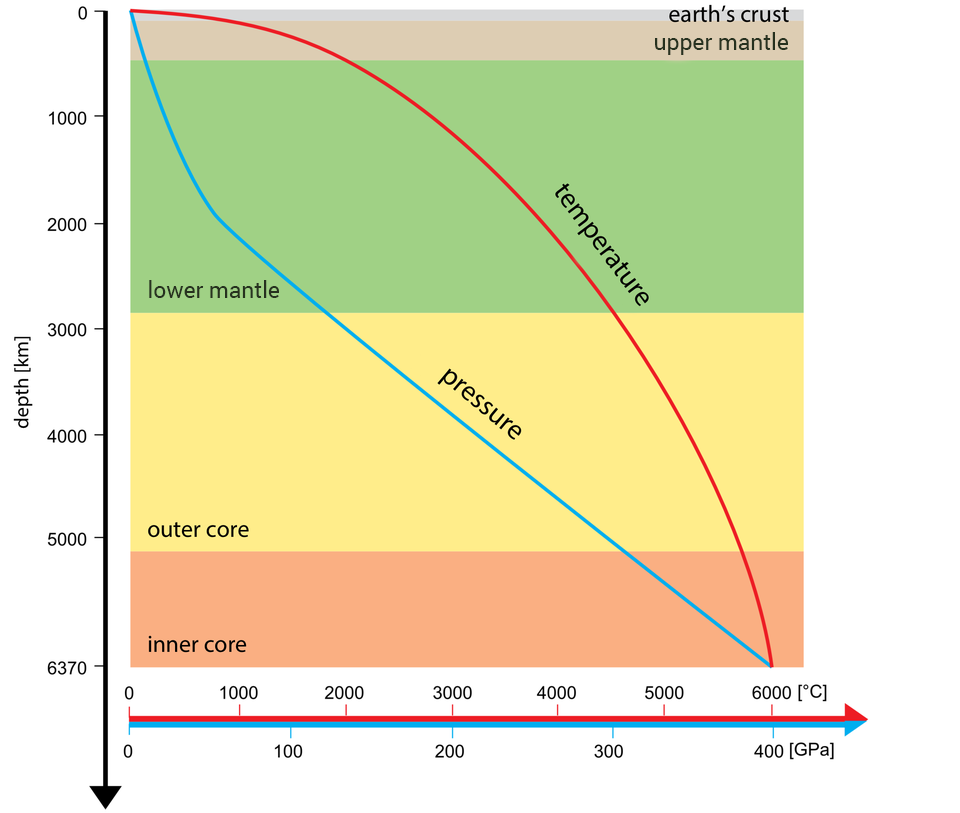
Earth’s mantle – a layer below the Earth's crust with a thickness of 2.8 - 2.9 thousand km and temperature rising gradually to 4.5 - 5 thousand degrees Celsius; the rocks of the highest part of the mantle are rigid, but deeper they become semi‑liquid; the mantle is usually divided into the upper mantle that is in contact with the crust and layers located lower which are the lower mantle;
Earth's core – below the lower boundary of the mantle, i.e. from the depth of 2.9 thousand km to the inside of our planet, there are layers called the core of the Earth, and the radius of the core is approximately 3.5 thousand km, and the temperature reaches 6 thousand degrees Celsius; due to very high pressure, the inner part of the core (called the inner core) is a solid, crystallized body; the remaining part (the so‑called outer core) is probably in a liquid state; subsequent layers are separated by the surfaces of the discontinuity.
The Earth's crust and the rigid (rock), upper part of the mantle form the lithosphere. It has a thickness of several km below the mid‑oceanic ridges to approximately 120 km below the land, and is divided into huge blocks called lithospheric plates.
Familiarize yourself with the illustration showing the structure of the Earth's interior. Pay attention to the temperature and thickness of each layer. Which of the layers is the thinnest?
Pressure increases as the distance to the inside of the Earth becomes shorter and the depth becomes greater. Of course, we cannot measure the pressure but it is estimated that at a depth of about 1.8‑2.2 thousand km it can be almost a million times higher than atmospheric pressure, and in the middle even 3.5‑4 million times higher.
You already know Earth's layers and their substances. Fill the blanks.
Earth's ............ – layer extending from a few kilometres under oceans to 11-19 kilometres in continents. The oceanic crust is composed mostly of .............
Earth's ............ – layer beneath the Earth’s crust. Rocks in it's top part are ............, but deeper down they become ...........................
Earth's ............ – layer beneath the mantle’s lower boundary extending to the very centre of our planet. Due to very high pressure, the inner part is ........................ and solid; the outer core is probably .............
Keywords
Earth's crust, Earth's core, tectonic plates
Glossary
litosfera - zewnętrzna, skalna powłoka Ziemi, tworząca sztywną, ale niejednolitą (podzieloną na płyty litosferyczne) warstwę; litosfera > obejmuje skorupę ziemską oraz górną część płaszcza; jej miąższość (grubość) wynosi od kilku do ponad 100 km; nazwa litosfera pochodzi od greckiego słowa lithos, czyli 'kamień'
skorupa ziemska - górna, sztywna część litosfery o grubości od dziesięciu do kilkudziesięciu kilometrów, zbudowana z minerałów i skał
płaszcz - warstwa o grubości ok. 2,9 tys. km między skorupą ziemską a jądrem Ziemi
rdzeń Ziemi - najbardziej wewnętrzna część naszej planety. Obecnie uważa się, że jądro ma średnicę ok. 3,5 tys. km i jest stopem żelaza i niklu
stopień geotermiczny - głębokość (mierzona w metrach), na której temperatura wzrasta o 1°C w stosunku do punktu początkowego. Różni się w zależności od miejsca i głębokości. Średnia wartość stopnia geotermicznego w skali globalnej wynosi 33 m, zaś dla Polski 47,2 m (do głębokości 5000 m).