When you hear the word “robot” – what is the first thought that comes to your mind? Is it something positive or negative? Do you think robots can be our friends or enemies?
Jaka pierwsza myśl przychodzi ci do głowy, kiedy słyszysz słowo „robot”? Czy to coś pozytywnego, czy raczej negatywnego? Jak myślisz, czy roboty mogą być naszymi wrogami, czy przyjaciółmi?
R404Ep2nXyQ3q
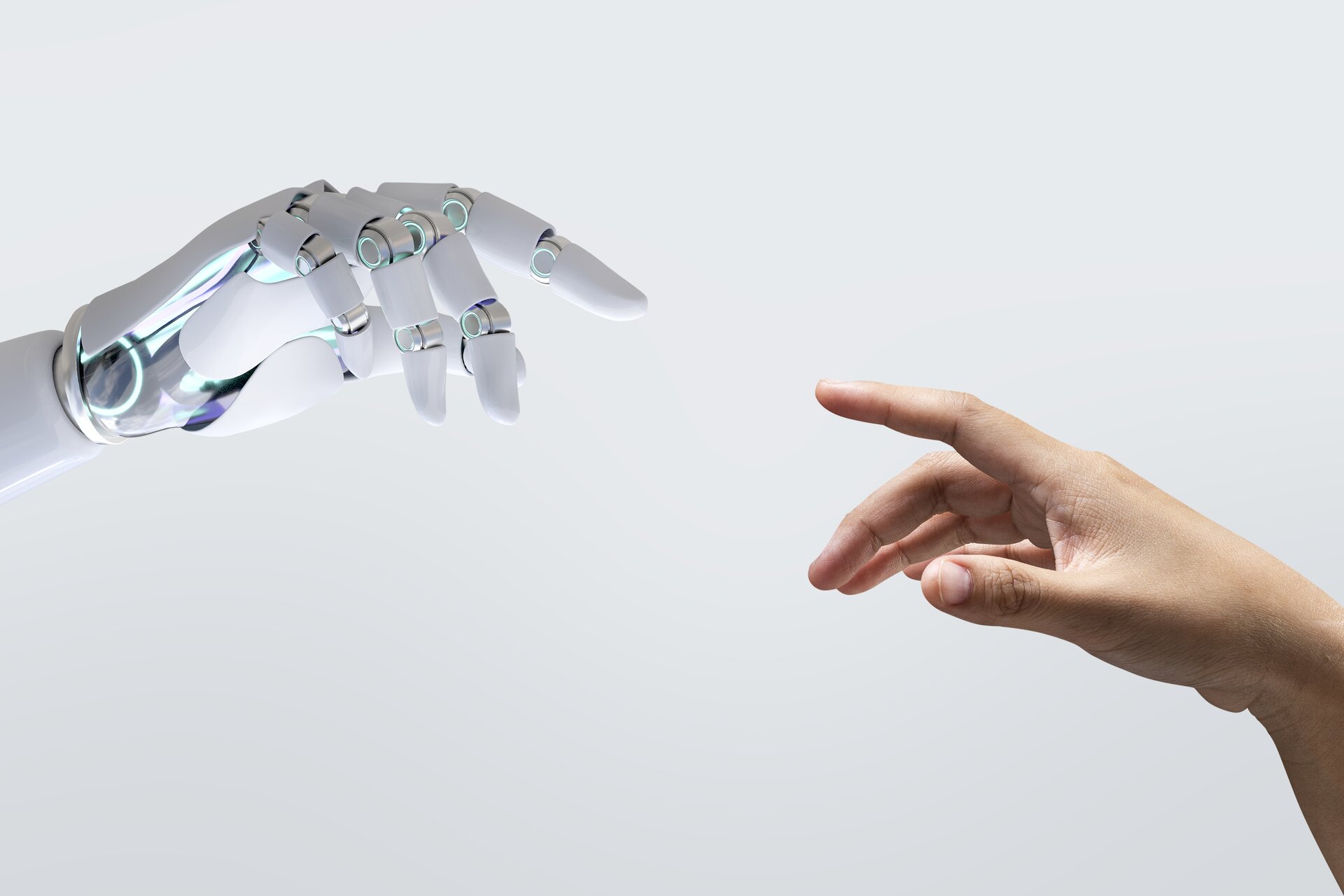
Zdjęcie przedstawia dwie dłonie z wyciągniętym palcem wskazującym. Jedna z dłoni jest dłonią robota.
Will we live in peaceful coexistence?
Czy będziemy współistnieć w zgodzie?
Źródło: dostępny w internecie: freepik.com [dostęp 29.12.2021], domena publiczna.
Exercise1
Match the types of robots with their translations.
Źródło: GroMar Sp. z o.o., licencja: CC BY-SA 3.0.
Exercise1
Match types of robots with their pictures.
Dopasuj typy robotów do obrazków.
RQJUoKNOlJIb8
Źródło: GroMar Sp. z o.o., licencja: CC BY-SA 3.0.
Robots - Friends or Enemies?
Daria WieliczkoRobots - Friends or Enemies?
A hundred years ago many people didn’t have electricity and lived simple lives.
Since then, the world has moved forward so much that when in 2019 the world got hit by the Covid‑19 pandemic, people who got stuck at home during lockdown could still communicate, and students could still learn online. First electricity, then the Internet - we get so used to technology that we sometimes forget that it’s there. So while our robot vacuum cleanerrobot vacuum cleanerrobot vacuum cleaner is hoovering the house, we can go online to talk to a chatbotchatbotchatbot to get the most recent bus timetable. These days, technological progress is happening at the speed of lightat the speed of lightat the speed of light, thanks to scientific researchresearchresearch new inventions appear every day. We have robotic lawnmowerslawnmowers [lawnmower]lawnmowers and weed‑killer robotsweed killer robots [weed killer robot]weed‑killer robots in our gardens, robot waiters serve us in restaurants and driverless vehiclesdriverless vehicles [driverless vehicle]driverless vehicles are being tested and improved all the time. And yet, when we think of the word “robot”, we imagine a humanoidhumanoidhumanoid metal creature from old sci‑fi films that want to take over. Well, we can’t be more wrong!
So, what do we need robots for? Today, robots can do many different things, but they were designed to save factory workers from hard and repetitiverepetitiverepetitive work. That is how automationautomationautomation began. Such mechanical jobsmechanical jobs [mechanical job]mechanical jobs as assembling a car are now delegated todelegated todelegated to machines.
Machines are also very welcome because they can replace humans carrying out dangerous tasks such as detonating bombs. But it also seems that machines are slowly learning to do more complicated and creative jobscreative jobs [creative job]creative jobs. These days a surgeon can be replaced by a more precise machine - a healthcare robothealthcare robothealthcare robot, and an artist is no longer needed when pictures can be generated on the computer. That is why people worry that robots will put them out of jobsput people out of jobsput them out of jobs. The fact is that whether we work in the office and perform white‑collar jobswhite collar jobs [white collar job]white‑collar jobs, or whether we work in industry and do blue‑collar jobs, robots are slowly replacing us. Artificial Intelligence (AI)Artificial Intelligence (AI)Artificial Intelligence (AI) robots can complete different office jobs much faster than people. And when automation happens at the expense ofat the expense ofat the expense of workers, people will definitely try to fight for their workplaces.
1 Źródło: Daria Wieliczko, dostępny w internecie: https://cs.stanford.edu/people/eroberts/courses/soco/projects/1998-99/robotics/history.html [dostęp 29.05.2023], https://www.ppma.co.uk/bara/expert-advice/robots/why-use-robots.html [dostęp 29.05.2023], https://www.ibm.com/topics/artificial-intelligence [dostęp 29.05.2023], licencja: CC BY-SA 3.0.
Exercise2
Decide if the following sentences are true or false.
Zdecyduj, czy podane zdania są prawdziwe, czy fałszywe.
RLYLj68zTXVJv
Źródło: GroMar Sp. z o.o., licencja: CC BY-SA 3.0.
Exercise3
Read the text and choose the correct answer.
Przeczytaj tekst, a następnie wybierz prawidłową odpowiedź.
RQP7cFTpLNZdo
1. In your garden you may need Możliwe odpowiedzi: 1. a white collar worker., 2. a robotic lawnmower., 3. Artificial Intelligence.
Źródło: GroMar Sp. z o.o., licencja: CC BY-SA 3.0.
R1JOUdV3EwZ1J
2. White collar workers usually work in Możliwe odpowiedzi: 1. factories., 2. offices., 3. hospoitals.
Źródło: GroMar Sp. z o.o., licencja: CC BY-SA 3.0.
RYQrYy1pNSVg3
3. You can usually see a blue collar worker in Możliwe odpowiedzi: 1. a factory., 2. in an office., 3. in an AI laboratory.
Źródło: GroMar Sp. z o.o., licencja: CC BY-SA 3.0.
RGeCXPZujDxXE
4. Some people are worried that AI will Możliwe odpowiedzi: 1. take over their jobs., 2. do all the repetitive work., 3. collaborate with humans.
Źródło: GroMar Sp. z o.o., licencja: CC BY-SA 3.0.
Exercise4
Read the text again and drag the following words to fill in the gaps.
Przeczytaj tekst ponownie, a następnie przeciągnij wyrazy w odpowiednie luki.
RWpuDADkOz97b
1. Technology is developing at the 1. artificial, 2. speed, 3. inventions, 4. blue, 5. collar of light.
2. New 1. artificial, 2. speed, 3. inventions, 4. blue, 5. collar appear every day.
3. Some people believe that 1. artificial, 2. speed, 3. inventions, 4. blue, 5. collar intelligence is able to think creatively.
4. White 1. artificial, 2. speed, 3. inventions, 4. blue, 5. collar workers often work in offices.
5. First robots helped 1. artificial, 2. speed, 3. inventions, 4. blue, 5. collar collar workers in factories.
1. Technology is developing at the 1. artificial, 2. speed, 3. inventions, 4. blue, 5. collar of light.
2. New 1. artificial, 2. speed, 3. inventions, 4. blue, 5. collar appear every day.
3. Some people believe that 1. artificial, 2. speed, 3. inventions, 4. blue, 5. collar intelligence is able to think creatively.
4. White 1. artificial, 2. speed, 3. inventions, 4. blue, 5. collar workers often work in offices.
5. First robots helped 1. artificial, 2. speed, 3. inventions, 4. blue, 5. collar collar workers in factories.
Źródło: GroMar Sp. z o.o., licencja: CC BY-SA 3.0.