Life originated in water
that the biological evolution is a fact;
how natural selection works;
how do new species evolve.
to describe the conditions prevailing in selected geological eras;
to present the main stages of plant and animal evolution;
to organize chronologically the most important events in the history of life on Earth.
Life originated in water
Life appeared on Earth about 3.9 billion years ago, but up to this day we are not able to describe all the processes that led to the production of living matter. Our understanding of the earliest stages of the evolution of life is based mainly on hypotheses. Another source of information is the genetic material of the first unicellular organisms. The principle is: the more differences (mutations) are present in the DNA of the studied species, the earlier their common ancestor lived.
What is certain is that life originated in water. According to one of the hypotheses, organic particles were created spontaneously from inanimate matter in the warm and shallow ocean bays near volcanoes, where waters were rich in numerous minerals. This process took place under anaerobic conditions. The atmosphere at that time was oxygen‑free, saturated with hydrogen, methane, carbon and nitrogen oxides, which were the source of elements necessary for the production of organic compounds.
First simple organic compounds were formed as a result of chemical reactions caused by cosmic rays, UV radiation and electrical discharges released during storms. Such compounds transformed over time into amino acids, proteins and nucleic acids. The macromolecular compounds have acquired the ability to self‑replicate. This process lasted long enough to form the simplest cells made of the increasingly more complex organic particles.
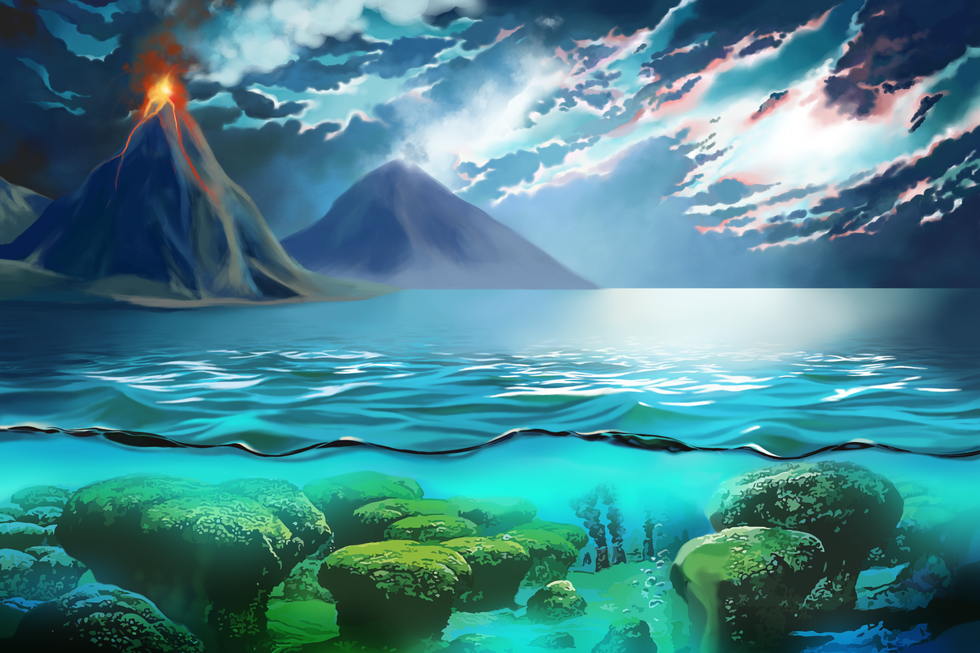
Explain whether the formation of organic compounds would be possible in an oxygen‑saturated atmosphere.
The first unicellular organisms
The first fossil evidence of the existence of unicellular organisms comes from around 3.6 billion years ago. These organisms resembled the modern bacteria. They were surrounded by a cell membrane and contained a DNA molecule. The first cells did not have a separate cell nucleus, chloroplasts or mitochondria. As heterotrophs, they obtained nutrients by absorbing simple organic compounds from the environment and produced energy during anaerobic respiration. Soon after that, organisms capable of carrying out chemosynthesis, and later photosynthesis, which resembled the modern cyanobacteria, appeared. Autotrophic organisms had an advantage over heterotrophic ones, which is why their number was constantly growing.
According to one of modern theories, cells containing chloroplasts and mitochondria were created as a result of symbiosis.

It is likely that the cells which were the ancestors of today's nucleated cells absorbed specialized aerobic bacteria (which began to function as mitochondria) as well as cyanobacteria capable of photosynthesis (equivalents of present chloroplasts). The evidence for this is the presence of DNA in chloroplasts and mitochondria of modern nucleated cells. Unicellular organisms with nucleus have given rise to a huge variety of unicellular algae and protozoans, which have been developing to this day. Nucleated cells were probably created about 2.1 billion years ago.
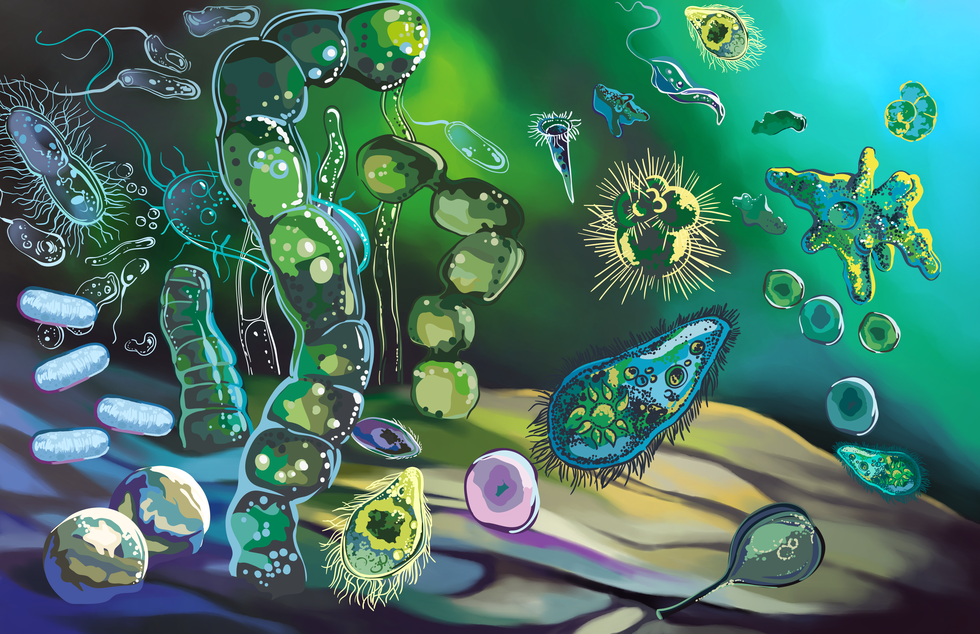
As a result of photosynthesis, oxygen began to accumulate in the atmosphere. This led to the formation of oxygen‑breathing organisms, which became the dominant life forms on Earth. Their presence influenced the stabilization of the composition of the atmosphere. The appearance of oxygen‑breathing organisms that excreted carbon dioxide promoted the development of autotrophic organisms.
Present the changes in the composition of the atmosphere that initiated the process of photosynthesis in the form of a graphical representation.
Changes in the composition of the atmosphere also included a decline in the concentration of greenhouse gases – methane and carbon dioxide – which could have caused global glaciation. The result of that was – as we assume – the great extinction of organisms, and then their expansion after the re‑warming, already in the form of other multicellular species.
The formation of multicellular organisms
The first multicellular organisms appeared around 1.5 billion years ago. It is assumed that they originated from unicellular organisms that did not separate after the division, or concentrated in organized multicellular groups – colonies. After that, multicellular forms with clusters of specialized cells that acted as tissues appeared. The first multicellular plants were small algae – probably the green algae. Fossils as old as 1.2 billion years confirm that.
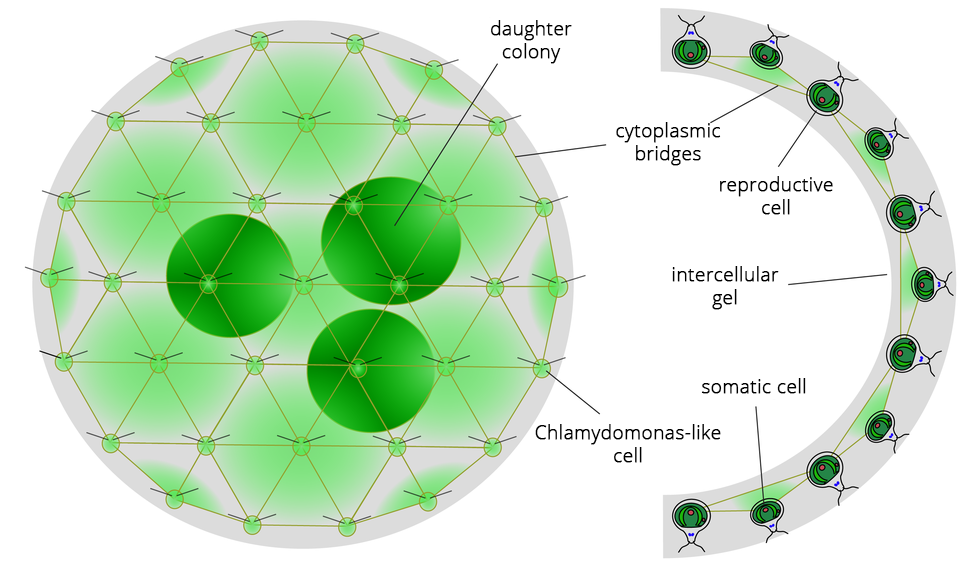
In the animal world, the first multicellular forms probably appeared around 900 million years ago. They resembled modern sponges and cnidarians, and lived in shallow, coastal zones of seas.
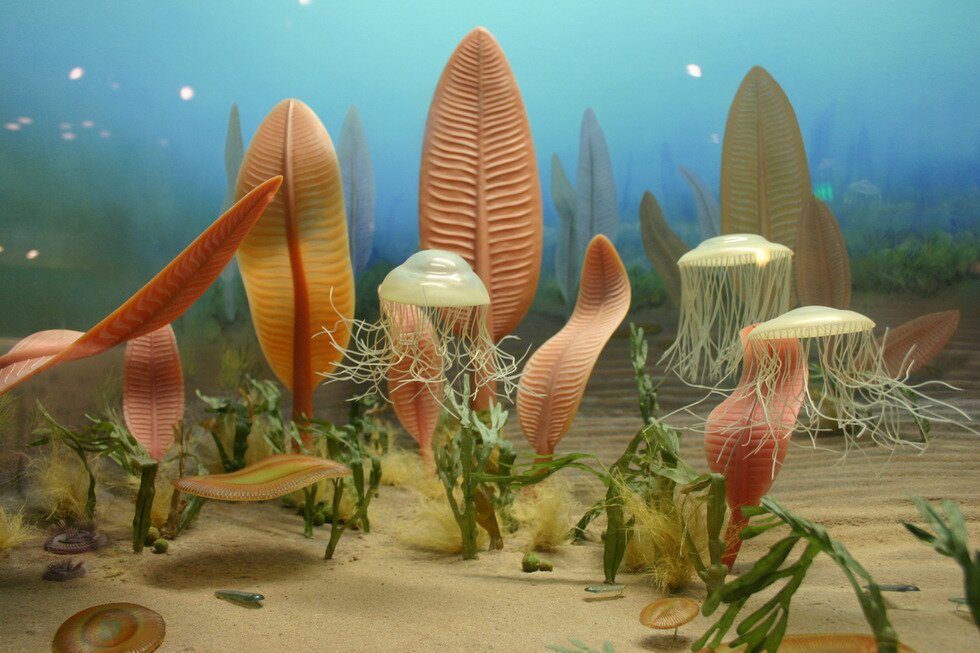
The oldest evidence of the existence of multicellular animals are fossils preserved in the Ediacara hills in Australia. Traces of amazing animals known as the Ediacaran faunafauna have been found there. These primitive, soft‑bodied organisms appeared on Earth at the end of the first global glaciation and inhabited the seas about 560‑540 million years ago. They were built differently than the animals we know nowadays and rested immobile at the bottom of the sea or attached to it with an organ that resembled the pulvillus. They did not have a digestive tract and we assume that they derived the energy from the symbiotic bacteria living in their tissues, which carried out chemo- or photosynthesis.
Under what conditions did the first organisms form? Select all the correct answers.
- in the aquatic environment
- in an atmosphere rich in free oxygen
- in an atmosphere of rich in hydrogen and methane
- in an atmosphere rich in carbon and nitrogen oxides
- in very low temperatures
- in the presence of UV radiation and atmospheric discharges
Organize in the right order the stages of life on Earth.
- creation of simple organic compounds
- creation of the first multicellular organisms
- formation of the first unicellular symbiotic organisms
- appearance of the first unicellular heterotrophic organisms
- appearance of the first unicellular autotrophic organisms
- formation of self-replicating macromolecular organic compounds
Match each event in the history of life on Earth with the time in which it happened.
1.5 billion years ago, 3.6 billion years ago, 2.1 billion years ago, 3.9 billion years ago
| creation of life on Earth | |
| the emergence of the first unicellular organisms | |
| creation of the first nucleated cells | |
| the emergence of the first multicellular organisms |
Summary
Life originated in water.
The key event in the evolution of life was the emergence of nucleated cells and multicellular organisms.
The first multicellular plants were the green algae.
The rapid development of aquatic invertebrates took place 540 million years ago.
In the history of life on Earth, mass extinctions of species have occurred repeatedly.
Keywords
unicellular organisms, cyanobacteria, multicellular organisms, green algae
Glossary
fauna – zespół wszystkich zwierząt zamieszkujących dane środowisko