Africa – a brief outline of the history of the continent
Sub‑Saharan Africa is different from North Africa in terms of culture, population and history. This part of the world is also often referred to as the real Africa or the Dark Land. One characteristic of this part of Africa was the continuation of society without state structures until the 19th century. The bases for social organisation were family connections, kinships, religious groups or groups with legal powers.
In the fifteenth century European sailors, mostly from Portugal, reached the West African coast. In 1488 they discovered the Cape of Good Hope and were able to sail further east – to India, where Vasco de Gama became the first European to arrive by ship. In the 16th century, English, Frnnch and Dutch merchants had established trading poststrading posttrading posts along the entire coast of Africa. The period from the 16th to the 19th century was one of the most tragic periods in the history of Africa – the slave trade. Historians estimate that over 400 years, around 65 million people were removed from Africa, of which only 15 million reached America and 40 million lost their lives travelling across the sea. The slave trade ended in the first half of the nineteenth century, although in Brazil slavery was only abolished in 1988.
Africa's interior was only explored by Europeans in the 19th century. It was at that time that the sources of the Nile and Congo were discovered, as well as the diversity of peoples living there. In the nineteenth century, several European countries expanded their spheres of influence, creating institutions to economically and politically exploit territories in Africa. This period is known as colonialism. The only countries not to be colonies of European nations were Abyssinia (modern‑day Ethiopia) and Liberia.
Population of Africa
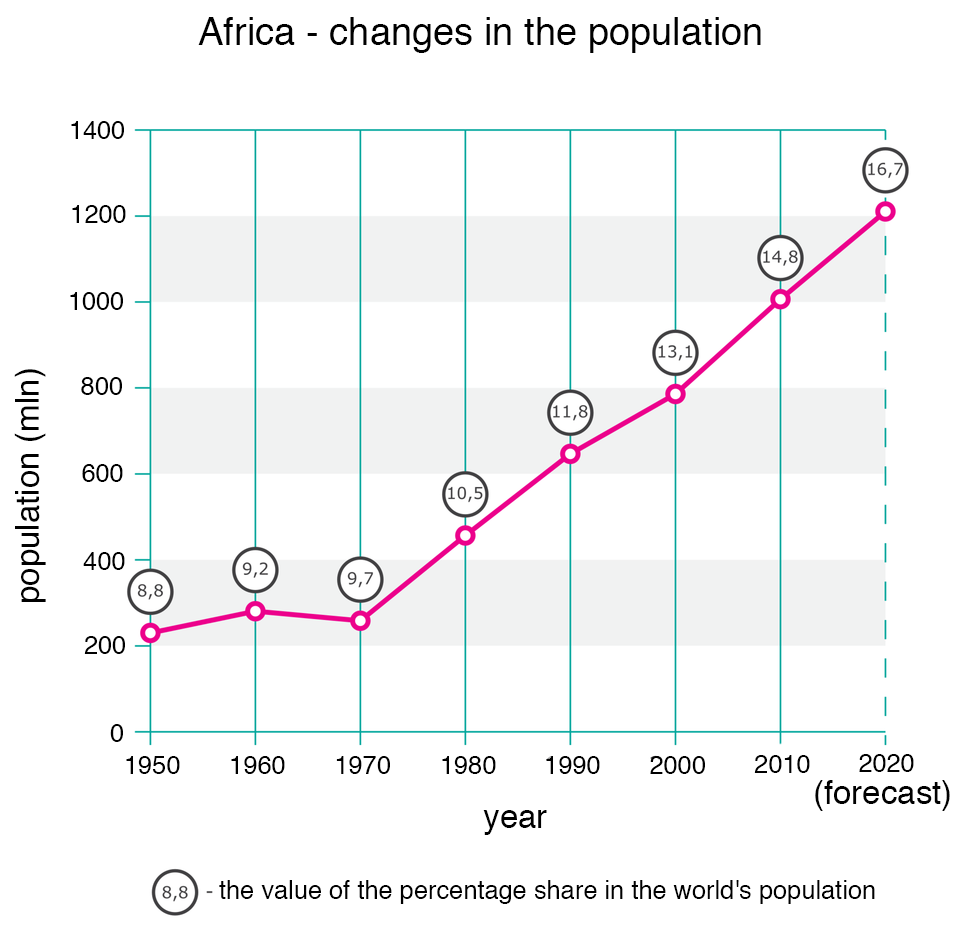
In 2015, 1 billion 186 million people lived in Africa, which accounted for 16.1% of the world's population. This share is constantly growing. There are 39 people on average per 1 kmIndeks górny 22. In 1950‑2010 nearly fivefold growth was recorded in Africa, unparalleled on any other continent. This great demographic explosiondemographic explosion (demographic bomb)demographic explosion was mainly due to the improvement of hygienic and general living conditions, better access to medical care and the awareness of the need to look after one's own health.
The result was, among others reducing infant mortality and increasing life expectancy. The adult population of Africa is divided into five different groups. They are white Africans, black Africans, Pygmies, Khoisan peoples and Austronesians. The white population lives in northern Africa, the Sahara and the Somali Peninsula. The areas south of the Sahara are populated by Negroes (black Africans), mainly belonging to the Bantu group. Currently, it is the largest population group in Africa. Pygmies - people with a very small body - live in the Congo Basin. In the Kalahari Basin, Khoisan population groups have a yellowish skin tone - formerly the Khoisan peoples were called Bushmen and Hottentots. On the largest island of Africa, Madagascar, there are Austronese people showing a cultural and linguistic relationship with the population of the island of Borneo, distant from Madagascar by 7,000. km.
The population living in areas south of the Sahara is strongly ethnically, culturally and linguistically diverse, which often leads to various social conflicts, including armed conflicts.
R1KzFh4AMOoOT1
Na ilustracji znajduje się wykres liniowy, przedstawiający zmiany populacji w Afryce, Africa - changes in the population. Na osi X population w milionach, na osi Y year od 1950 do 2020. Nastąpił sześciokrotny wzrost liczby ludności z dwustu milionów w tysiąc dziewięćset pięćdziesiątym roku do miliarda dwustu milionów w dwa tysiące dwudziestym (prognoza, forecast). Wartość procentowego udziału ludności Afryki w liczbie ludności świata wzrosła dwukrotnie (1950 - 8,8%, 2020 - 16,7%). Widoczne dane liczbowe to: osiem i osiem dziesiątych dla lat pięćdziesiątych, dziewięć i dwie dziesiąte dla sześćdziesiątych, dziewięć i siedem dziesiątych dla lat siedemdziesiątych, dziesięć i pół, jedenaście i osiem dziesiątych, trzynaście przecinek jeden, czternaście przecinek osiem i przewidywane na rok dwa tysiące dwudziesty szesnaście i siedem dziesiątych.
Source: Dariusz Adryan, licencja: CC BY 3.0.
To the south of the Sahara lies almost 50 countries with strong social and economic differences. According to international statistics, most of the countries in this region are among countries with low level of economic development. The worst situation is in Liberia, Burundi, Malawi, Democratic Republic of the Congo and the Central African Republic, where the value of the annual national income per capita does not exceed USD 1,000. And only in a few African countries are high income per capita above 10,000 USD. These are mainly countries with mineral wealth, such as South Africa (various riches) or Nigeria, Gabon and Equatorial Guinea (oil) as well as Botswana (diamonds). High national income is also achieved in small island states - Seychelles and Mauritius - where profits come almost exclusively from tourism.
R1NeioeHLYc0H1
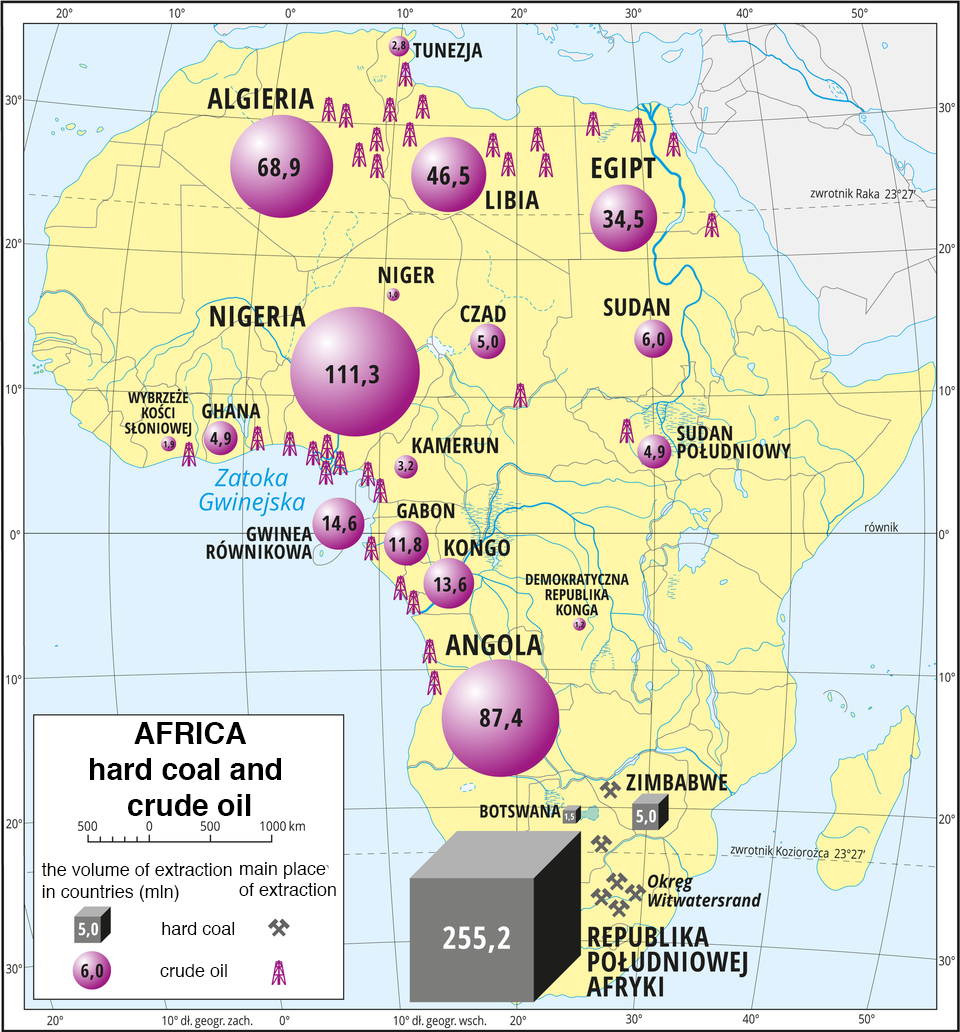
lustracja przedstawia mapę wydobywczą Afryki, Africa hard coal and crude oil. Na mapie odmiennymi sygnaturami oznaczono miejsca wydobycia węgla kamiennego i ropy naftowej oraz wielkość wydobycia w państwach. Węgiel kamienny – miejsca wydobycia: Republika Południowej Afryki (Okręg Witwatersrand), Zimbabwe i Botswana. Wielkość wydobycia węgla kamiennego w Republice Południowej Afryki – 255 milionów ton, w Zimbabwe – 5 milionów ton. Ropa naftowa – miejsca wydobycia: zachodnie wybrzeże nad Zatoką Gwinejską, północna część kontynentu. Największe wydobycie: Nigeria – 111 milinów ton, Angola – 87 milionów ton, Algieria – 68 milionów ton, Libia – 46 milionów ton, Egipt – 34 miliony ton, dalej – Gwinea Równikowa, Kongo, Gabon, Sudan, Czad, Ghana, Sudan Południowy, Kamerun. Na zachodnim wybrzeżu kontynentu opisano Zatokę Gwinejską.
Extraction of crude oil and hard coal in 2013
Source: Wydawnictwo Edukacyjne Wiking, licencja: CC BY 3.0.
In most African countries, agriculture is a sector of the economy employing from 30% to 60% of the total employed. In extreme cases, this share reaches 80%. This is the case, for example, in Chad, Niger, Ethiopia.
Africa is a continent rich in mineral resources. However, the exploitation of useful minerals requires large amounts of money. The costs of processing raw materials are also very high, that is why in Africa mineral resources are obtained that do not have to be processed and bring big profits.
Task 1
Ułóż trzy pytania quizowe odnoszące się do abstraktu i daj je do rozwiązania swoim kolegom i koleżankom.
Ułóż trzy pytania quizowe odnoszące się do abstraktu i daj je do rozwiązania swoim kolegom i koleżankom.
Using geographic atlases and source materials, students should explore the following issues.
R13gnKZfvOHHC
Ćwiczenie sprawdź, jaka jest populacja i gęstość zaludnienia Afryki?
Ćwiczenie sprawdź, jaka jest populacja i gęstość zaludnienia Afryki?
Group I
Group II
Group III
Group IV
Task 2
The illustration below depicts countries considered to be part of Sub‑Saharan Africa. Familiarise yourself with the basic information about these countries.
RcPHSulY0lQXI
Ilustracja interaktywna.
1. Nigeria. Religious denominations in Nigeria are interwoven in Nigeria, both territorially and amongst ethnic groups. Islam dominates in the north and Christianity in the south of the country. Nigeria is characterised by having one of the highest rates of population increase in West Africa (32 per million).,
2. Ethiopia. The so-called Great Rift Valley runs through Ethiopia, which is anintersection of tectonic plates. It is one of the poorest countries in the world, where the average age of the whole population is 17.75 years.,
3. Democratic Republic of Congo. The people of the Demoratic Republic of Congo are amongst the poorest in the world. It is however considered to be the richest in terms of natural resources, estimated to be worth 24 trillion,
4. Botswana. Botswana has the highest level of growth of GDP per capita in the world. This spectacular development is mostly due to economic reform and diamond mining. Botswana is presently battling an AIDS epidemic: it is estimated that one in three people in this country is infected with the HIV virus.,
5. Republic of South Africa (RSA). Around 52 million people, from diverse backgrounds, cultures, languages and religions live in the RSA. The South African Statistical Office lists 5 racial groupings amongst the country's population, and there are as many as 11 official languages.,
6. Republic of Burundi. Burundi is a poorly-developed agricultural nation. The official languages are French and English. Burundi has a high birth rate is amongst the most densely populated and non-urbanised countries in Africa.,
7. Lesotho. The only industries here are food processing and clothes factories. A large number of people from Lesotho work in South Africa and their earnings, with the exception of income from tourism, make up a large part of the national budget. Only a small part of the country is suitable for cultivation. Breeding of Angora goats plays an important part.,
8. Liberia. There are a number of ethnic groups in the population of Liberia. They are descended from freed American and Caribbean slaves, who occupy a higher social position here. However, the majority of the population are indigenous tribal groups. There are more than 20 languages spoken (the official language is English).,
9. Namibia. Namibia is characterised as having the largest white population in Africa. The official language is English. Until 1990 it was German and Afrikaans.,
10. Angola. The Angolan economy is in a state of disarray due to non-stop military unrest, that has been ongiong for a quarter of a century. The UN considers Angola to be one of the world's least-developed countries. Despite having a rich base of natural resources, their income per capita is one of the lowest in the world.
Ilustracja interaktywna.
1. Nigeria. Religious denominations in Nigeria are interwoven in Nigeria, both territorially and amongst ethnic groups. Islam dominates in the north and Christianity in the south of the country. Nigeria is characterised by having one of the highest rates of population increase in West Africa (32 per million).,
2. Ethiopia. The so-called Great Rift Valley runs through Ethiopia, which is anintersection of tectonic plates. It is one of the poorest countries in the world, where the average age of the whole population is 17.75 years.,
3. Democratic Republic of Congo. The people of the Demoratic Republic of Congo are amongst the poorest in the world. It is however considered to be the richest in terms of natural resources, estimated to be worth 24 trillion,
4. Botswana. Botswana has the highest level of growth of GDP per capita in the world. This spectacular development is mostly due to economic reform and diamond mining. Botswana is presently battling an AIDS epidemic: it is estimated that one in three people in this country is infected with the HIV virus.,
5. Republic of South Africa (RSA). Around 52 million people, from diverse backgrounds, cultures, languages and religions live in the RSA. The South African Statistical Office lists 5 racial groupings amongst the country's population, and there are as many as 11 official languages.,
6. Republic of Burundi. Burundi is a poorly-developed agricultural nation. The official languages are French and English. Burundi has a high birth rate is amongst the most densely populated and non-urbanised countries in Africa.,
7. Lesotho. The only industries here are food processing and clothes factories. A large number of people from Lesotho work in South Africa and their earnings, with the exception of income from tourism, make up a large part of the national budget. Only a small part of the country is suitable for cultivation. Breeding of Angora goats plays an important part.,
8. Liberia. There are a number of ethnic groups in the population of Liberia. They are descended from freed American and Caribbean slaves, who occupy a higher social position here. However, the majority of the population are indigenous tribal groups. There are more than 20 languages spoken (the official language is English).,
9. Namibia. Namibia is characterised as having the largest white population in Africa. The official language is English. Until 1990 it was German and Afrikaans.,
10. Angola. The Angolan economy is in a state of disarray due to non-stop military unrest, that has been ongiong for a quarter of a century. The UN considers Angola to be one of the world's least-developed countries. Despite having a rich base of natural resources, their income per capita is one of the lowest in the world.
Source: licencja: CC 0.
Exercise 1
Rd8WXbUTgJmtQ
Wymyśl pytanie na kartkówkę związane z tematem abstraktu.
Wymyśl pytanie na kartkówkę związane z tematem abstraktu.
Source: licencja: CC 0.
R12mfmTv86OyQ
Exercise 2
Poszukaj informacji, gdzie w Afryce Subsaharyjskiej wydobywa się diament.
Poszukaj informacji, gdzie w Afryce Subsaharyjskiej wydobywa się diament.
Indicate the countries of Sub-Saharan Africa that are visible in the picture where minerals are mined.
Namibia
Mauritania
Bostwana
Ethiopia
RSA
Senegal
Sudan
Exercise 3
RwAmKUr8KG8pu
Gdzie żyją Masajowie? Czym się wyróżniają?
Gdzie żyją Masajowie? Czym się wyróżniają?
Source: licencja: CC 0.
Exercise 4
RjvIxaSAqImVN
Ćwiczenie wymień przykłady krajów Afryki, w których wydobywa się węgiel, oraz te, w których wydobywa się ropę.
Ćwiczenie wymień przykłady krajów Afryki, w których wydobywa się węgiel, oraz te, w których wydobywa się ropę.
Move to the appropriate table the countries where the indicated raw materials are extracted.
eksplozja demograficzna (bomba demograficzna) - określenie szybkiego tempa przyrostu rzeczywistego liczby ludności w danym regionie. Przyjmuje się, że o eksplozji demograficznej możemy mówić, gdy przyrost rzeczywisty przekracza 3%, oznacza to podwojenie liczby ludności w ciągu 24 lat, czyli w ciągu jednej generacji