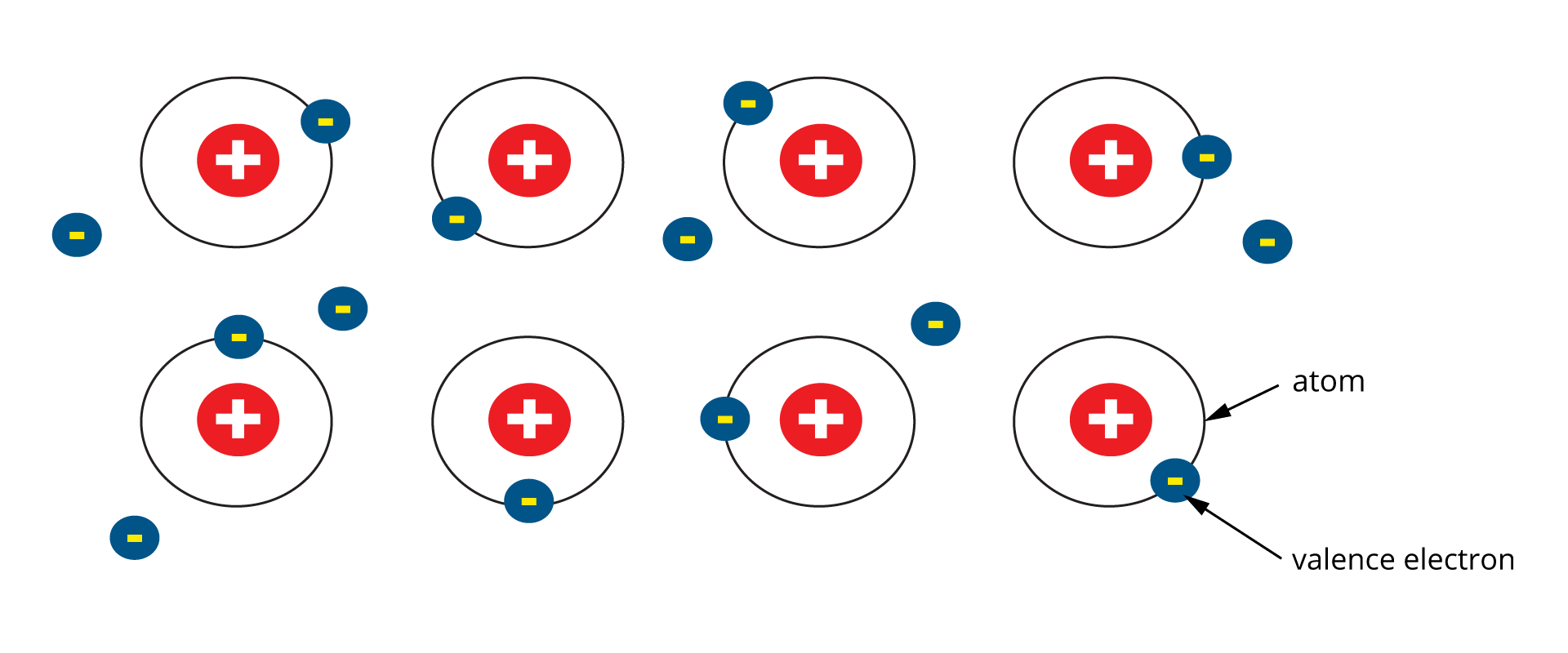
The conductor is everyday object in which electrons, orbiting around the atomic nucleus, are poorly connected with. The electrons on the valence shell can be detached from their atom and then become free electrons and virtually move freely throughout an object.
R6Y1jfcVOq9Xj
Na rysunku przedstawione jest schematycznie osiem atomów: kółko ze znakiem plus, wokół niego okrąg, na którym jest kółko ze znakiem minus. Kółka ze znakiem minus znajdują się także w wolnej przestrzeni między atomami. Jeden z atomów podpisany atom, jedno kółko ze znakiem minus znajdujące się na okręgu podpisane valence electron.
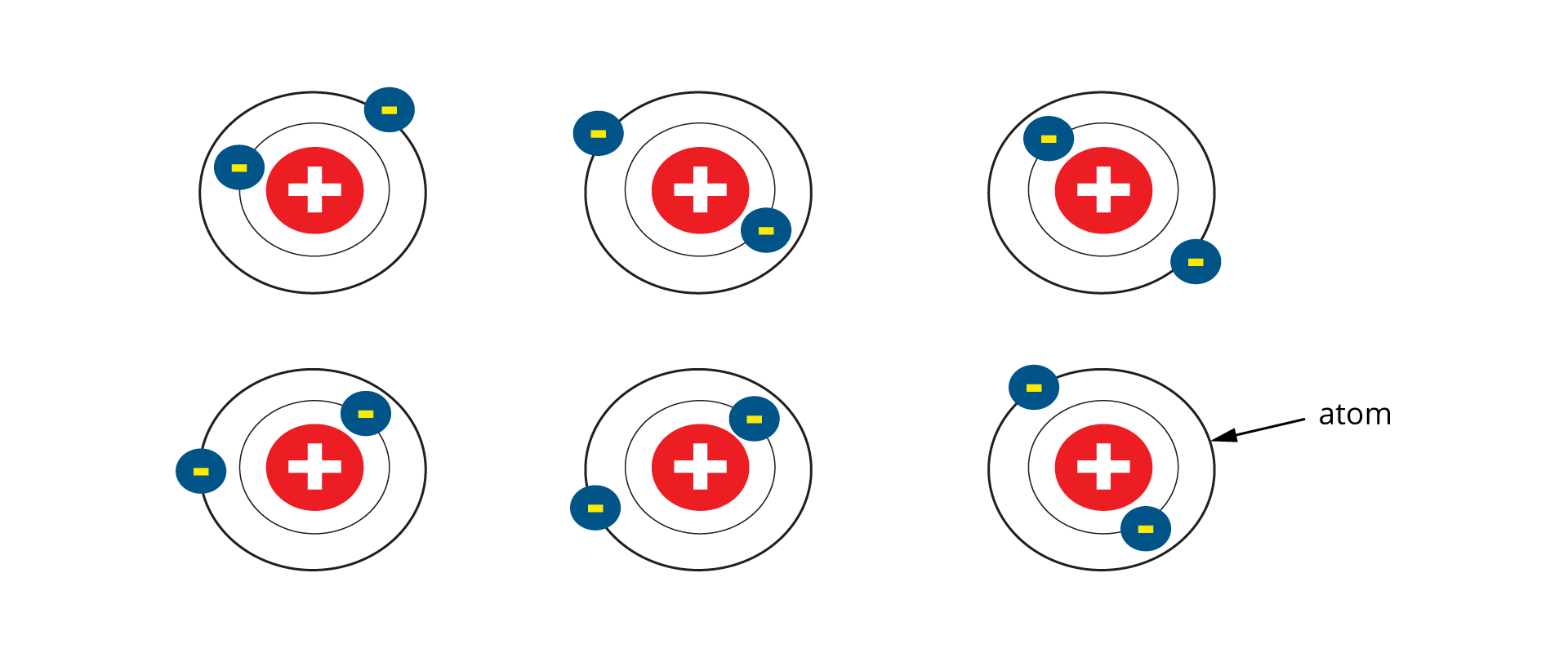
An insulator is every object in which electrons, orbiting around the atomic nucleus are very strongly attached to this nucleus and cannot move through the entire insulator. In certain situations, they can move slightly in the volume of an atom.
RaFc8vo39tNVV
Na rysunku przedstawione jest schematycznie sześć atomów: kółko ze znakiem plus, wokół niego dwa okręgi, na każdym z nich jest kółko ze znakiem minus. Jeden z atomów podpisany atom.
Insulator
Source: GroMar, licencja: CC BY 3.0.
RuirJoiEdml0n
W górnej części ilustracji interaktywnej przedstawione jest schematycznie sześć atomów: kółko ze znakiem plus, wokół niego dwa okręgi, na każdym z nich jest kółko ze znakiem minus. Jeden z atomów oznaczony jest numerem 1, jedno kółko ze znakiem minus oznaczone jest numerem 2. W dolnej części ilustracji interaktywnej przedstawione jest jest schematycznie osiem atomów: kółko ze znakiem plus, wokół niego okrąg, na którym jest kółko ze znakiem minus. Kółka ze znakiem minus znajdują się także w wolnej przestrzeni między atomami. Jeden z atomów oznaczony jest numerem 3, jedno kółko ze znakiem minus oznaczone jest numerem 4. Na ilustracji widoczne są numery, a na nich podpisy. 1. insulators {audio}, 2. electrons move only around atom's parent nucleus {audio}, 3. conductors {audio}, 4. electrons move in the entire volume {audio}.
W górnej części ilustracji interaktywnej przedstawione jest schematycznie sześć atomów: kółko ze znakiem plus, wokół niego dwa okręgi, na każdym z nich jest kółko ze znakiem minus. Jeden z atomów oznaczony jest numerem 1, jedno kółko ze znakiem minus oznaczone jest numerem 2. W dolnej części ilustracji interaktywnej przedstawione jest jest schematycznie osiem atomów: kółko ze znakiem plus, wokół niego okrąg, na którym jest kółko ze znakiem minus. Kółka ze znakiem minus znajdują się także w wolnej przestrzeni między atomami. Jeden z atomów oznaczony jest numerem 3, jedno kółko ze znakiem minus oznaczone jest numerem 4. Na ilustracji widoczne są numery, a na nich podpisy. 1. insulators {audio}, 2. electrons move only around atom's parent nucleus {audio}, 3. conductors {audio}, 4. electrons move in the entire volume {audio}.
Charging is the process of accumulation of an excess of charge of the same sign in a given body.
There are known phenomena in which certain bodies when rubbingrubbingrubbing acquire the property of attracting other bodies, e.g. amber rubbed with silk attracts small scraps of paper (from the Greek name of the amber „electron”, these phenomena are called electrication the bodies).
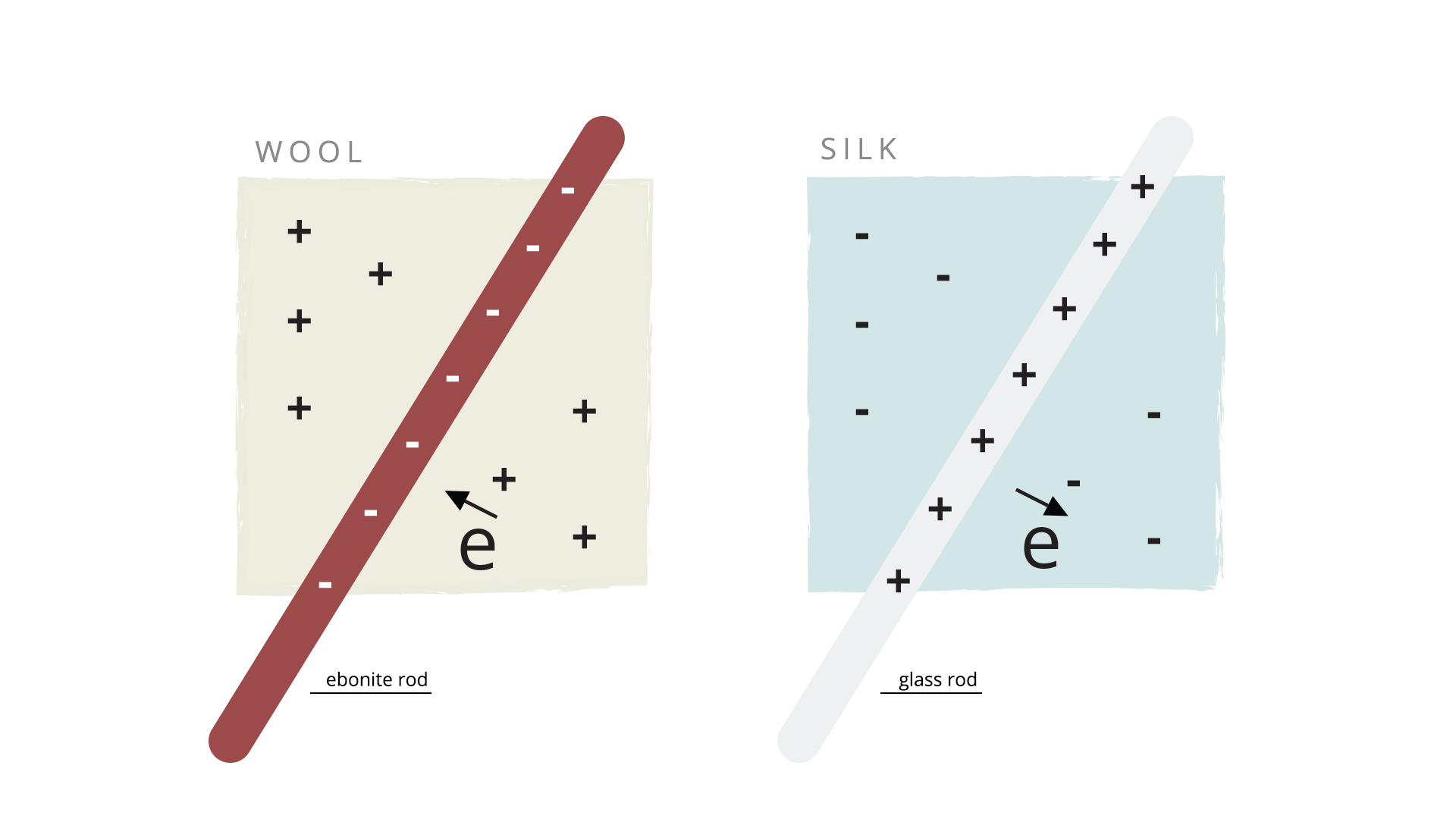
One evidence of the existence of the phenomenon of electrification in nature, is the impact of glass sticks on the silk, after rubbing the glass rod with silk, and the ebonite sticks after rubbing with them with wool. In both cases, you can observe the attraction between sticks and fabrics.
ROCvb94ftelL3
Po lewej stronie rysunku znajduje się prostokąt opisany wool, na którym narysowane są znaki plus i litera e ze strzałką skierowaną do prostokąta ukośnego. Na nim prostokąt ukośny z zaokrąglonymi rogami, ze znakami minus wewnątrz, opisany ebonite rod. Po prawej stronie rysunku znajduje się prostokąt opisany silk, na którym narysowane są znaki minus i litera e ze strzałką skierowaną od prostokąta ukośnego. Na nim prostokąt ukośny z zaokrąglonymi rogami, ze znakami plus wewnątrz, opisany glass rod.
When we rub an ebonite rod with wool, the rod becomes charged negatively and the wool positively. In the case of rubbing a glass rod with silk - the glass rod is charged positively and silk negatively
Source: GroMar, licencja: CC BY 3.0.
Task 1
Conduct an experiment to verify the validity of the statements describing Figure 1: Conductor.
Examining the properties of different bodies in this way, we can say that they can be charged either like ebonite rubbed with wool, i.e. they repel charged ebonite rod or like glass rubbed with silk, i.e. they repel charged glass rod.
The experiment discussed above shows that like charges repel one another and unlike charges attract.
Charging through rubbing means causing friction leading to the movement of electrons from one object to another. The difference between charging due to friction and insulation is that in the case of electrification by friction, the displacement of charges occurs after the job that forces the electrons to move.
The object from which the electrons flow away is charged positively, while the body that receives these particles is charged negatively.
As a result of rubbingrubbingrubbing an ebonite rod with wool, some of the electrons from the wool pass to the surface of the rod.
The rod is characterized by an excess of electrons - it charges negatively.
Wool, due to the transfer of these electrons has their deficiency, so it is charged positively.
As a result of rubbing the glass rod with silk, some of the electrons from the glass got transferred to the surface of the silk.
The rod has an electron deficiency - the glass is electrified positively.
Silk electrifies negatively as a result of accumulation of electron.
Plastics are charged negatively, while glass and porcelain positively.
R5qNCHehF9poF
Ilustracja interaktywna podzielona jest na trzy części. Pierwsza część oznaczona numerem 1 przedstawia dwa prostokąty. Wewnątrz każdego z nich narysowane jest sześć kółek ze znakiem plus i sześć kółek ze znakiem minus. Druga część oznaczona numerem 2 przedstawia dwa prostokąty mające jeden poziomy bok wspólny. Wewnątrz prostokąta na górze narysowane jest sześć kółek ze znakiem plus i trzy kółka ze znakiem minus. Wewnątrz prostokąta na dole narysowane jest sześć kółek ze znakiem plus i dziewięć kółek ze znakiem minus. Narysowane są strzałki skierowane od prostokąta na górze do prostokąta na dole. Trzecia część przedstawia dwa prostokąty. Wewnątrz prostokąta na górze, oznaczonego numerem 3, narysowane jest sześć kółek i trzy kółka ze znakiem plus. Wewnątrz prostokąta na dole, oznaczonego numerem 4, narysowane jest dwanaście kółek i trzy kółka ze znakiem minus. Na ilustracji widoczne są numery, a na nich podpisy. 1. two electrically neutral bodies {audio}, 2. when rubbing electrons go from one body to another {audio}, 3. body positively charged {audio}, 4. body negatively charged {audio}.
Ilustracja interaktywna podzielona jest na trzy części. Pierwsza część oznaczona numerem 1 przedstawia dwa prostokąty. Wewnątrz każdego z nich narysowane jest sześć kółek ze znakiem plus i sześć kółek ze znakiem minus. Druga część oznaczona numerem 2 przedstawia dwa prostokąty mające jeden poziomy bok wspólny. Wewnątrz prostokąta na górze narysowane jest sześć kółek ze znakiem plus i trzy kółka ze znakiem minus. Wewnątrz prostokąta na dole narysowane jest sześć kółek ze znakiem plus i dziewięć kółek ze znakiem minus. Narysowane są strzałki skierowane od prostokąta na górze do prostokąta na dole. Trzecia część przedstawia dwa prostokąty. Wewnątrz prostokąta na górze, oznaczonego numerem 3, narysowane jest sześć kółek i trzy kółka ze znakiem plus. Wewnątrz prostokąta na dole, oznaczonego numerem 4, narysowane jest dwanaście kółek i trzy kółka ze znakiem minus. Na ilustracji widoczne są numery, a na nich podpisy. 1. two electrically neutral bodies {audio}, 2. when rubbing electrons go from one body to another {audio}, 3. body positively charged {audio}, 4. body negatively charged {audio}.
Charging by rubbingrubbingrubbing can be explained in a way that during mutual contact between two insulators, electrons from one body pass to the other. In this way, one body is charged negatively and the other positively with equal charge value.
Exercises
R14wpu53yjmOF
Exercise 1
Wersja alternatywna ćwiczenia: Determine which sentence is true. Możliwe odpowiedzi: 1. A charge is generated during charging by friction., 2. Rubbing one body with the other, we increase the area of their mutual contact and increase the probability of transition of electrons from one body to another., 3. Rubbing one body with the other, we increase the area of their mutual contact and increase the probability of transition of protons from one body to another., 4. Only insulators can be charged by rubbing.
Wersja alternatywna ćwiczenia: Determine which sentence is true. Możliwe odpowiedzi: 1. A charge is generated during charging by friction., 2. Rubbing one body with the other, we increase the area of their mutual contact and increase the probability of transition of electrons from one body to another., 3. Rubbing one body with the other, we increase the area of their mutual contact and increase the probability of transition of protons from one body to another., 4. Only insulators can be charged by rubbing.
Determine which sentence is true.
A charge is generated during charging by friction.
Rubbing one body with the other, we increase the area of their mutual contact and increase the probability of transition of electrons from one body to another.
Rubbing one body with the other, we increase the area of their mutual contact and increase the probability of transition of protons from one body to another.
Only insulators can be charged by rubbing.
zadanie
Source: GroMar, licencja: CC BY 3.0.
Exercise 2
The electrostatic machine is a device by which very large portions of charge can be obtained. Find information about the construction of this device in the available sources. Is it true that charging by friction is also used in this device? Justify your answer.
It is true that charging by friction is used to obtain charge in an electrostatic machine.
Exercise 3
Based on the available sources, indicate the differences between the electrostatic machine and the Van der Graff generator. Write a short information about this topic in English.
R1G5kTWV58c2W
Exercise 4
Wersja alternatywna ćwiczenia: Indicate which pairs of expressions or words are translated correctly. Możliwe odpowiedzi: 1. elektryzowanie ciał - charging bodies, 2. pocieranie - rubbing, 3. przepływ elektronów - electron flow, 4. ładunki różnych znaków - charging bodies, 5. ładunek sumaryczny - electron flow
Wersja alternatywna ćwiczenia: Indicate which pairs of expressions or words are translated correctly. Możliwe odpowiedzi: 1. elektryzowanie ciał - charging bodies, 2. pocieranie - rubbing, 3. przepływ elektronów - electron flow, 4. ładunki różnych znaków - charging bodies, 5. ładunek sumaryczny - electron flow
Indicate which pairs of expressions or words are translated correctly.
elektryzowanie ciał - charging bodies
pocieranie - rubbing
przepływ elektronów - electron flow
ładunki różnych znaków - charging bodies
ładunek sumaryczny - electron flow
zadanie
Source: GroMar, licencja: CC BY 3.0.
Rqrb48dxNjWoP1
Interaktywna gra, polegająca na łączeniu wyrazów w pary w ciągu jednej minuty. Czas zaczyna upływać wraz z rozpoczęciem gry. Jeden ruch to odkrywanie najpierw jednej potem drugiej karty z wyrazem. Każdy wyraz jest odczytywany. Kolejny ruch to odkrywanie trzeciej i czwartej karty. W ten sposób odsłuchasz wszystkie wyrazy. Nawigacja z poziomu klawiatury za pomocą strzałek, odsłuchiwanie wyrazów enterem lub spacją. Znajdź wszystkie pary wyrazów.
Interaktywna gra, polegająca na łączeniu wyrazów w pary w ciągu jednej minuty. Czas zaczyna upływać wraz z rozpoczęciem gry. Jeden ruch to odkrywanie najpierw jednej potem drugiej karty z wyrazem. Każdy wyraz jest odczytywany. Kolejny ruch to odkrywanie trzeciej i czwartej karty. W ten sposób odsłuchasz wszystkie wyrazy. Nawigacja z poziomu klawiatury za pomocą strzałek, odsłuchiwanie wyrazów enterem lub spacją. Znajdź wszystkie pary wyrazów.
Match Polish terms with their English equivalents.
charging bodies
elektryzowanie ciał
electron flow
rubbing
pocieranie
przepływ elektronów
Source: Zespół autorski Politechniki Łódzkiej, licencja: CC BY 3.0.