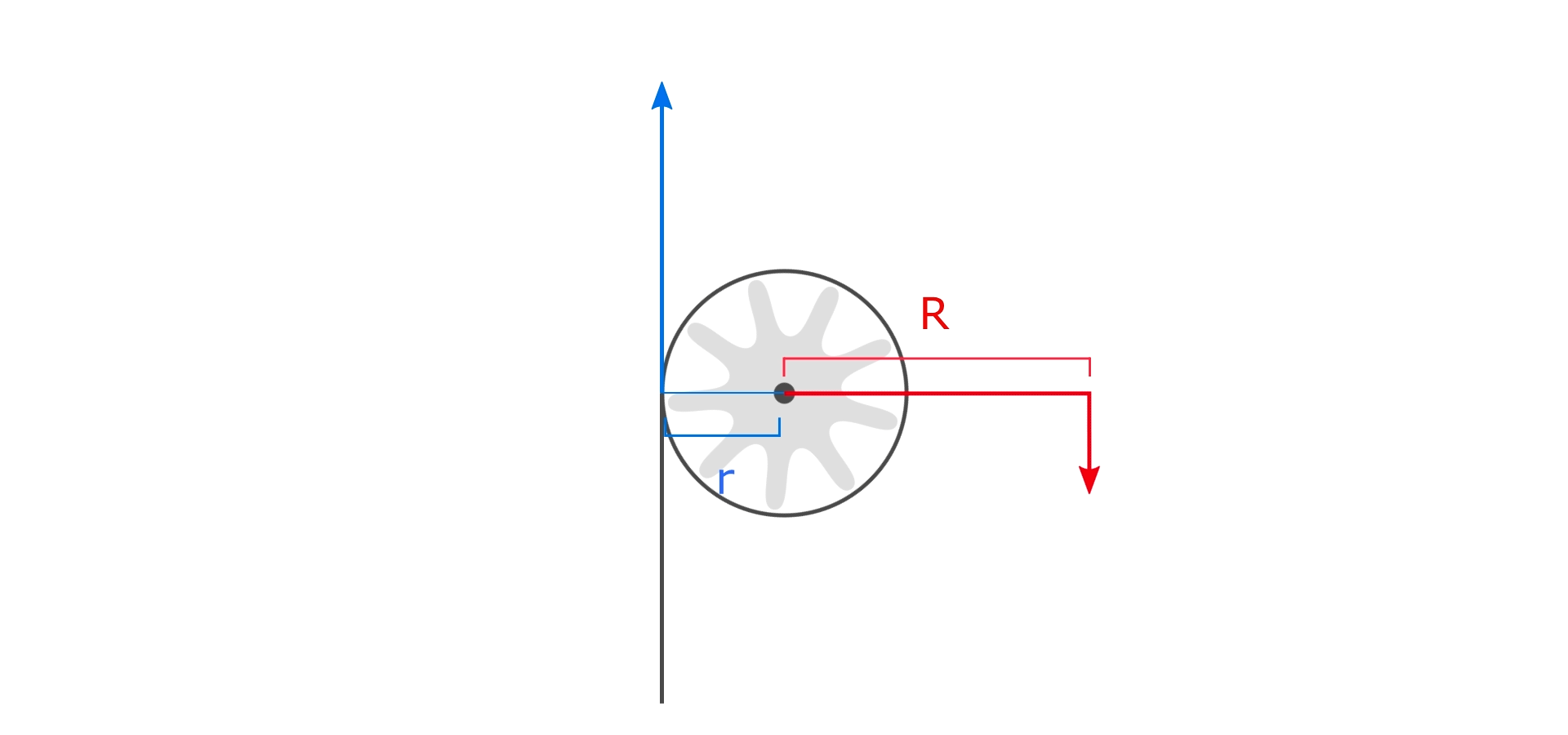
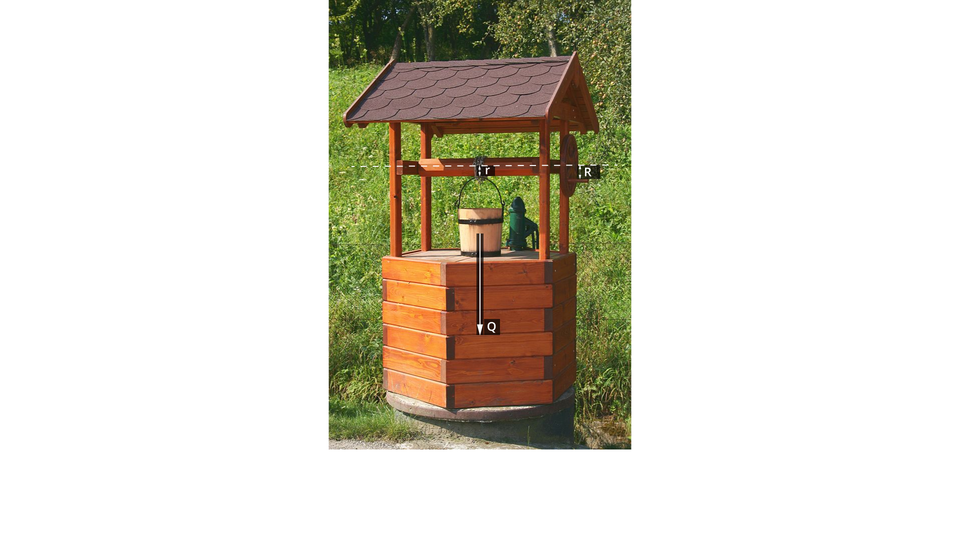
The windlasswindlasswindlass usually consists of a shaft with a radiusradiusradius r and a handle. The length of the handle arm R is greater than the radiusradiusradius r of the cylinder.
R1NryXS0720KK1
Na ilustracji przedstawiono model kołowrotu - okrąg z umieszczonym w środku kołem zębatym. Od środka kołowrotu poprowadzono poziomy odcinek oznaczony R, to długość uchwytu. Od jego końca znajdującego się poza kołowrotem poprowadzono wektor długości promienia koła skierowany w dół. Od środka kołowrotu poprowadzono poziomy odcinek oznaczony r, to promień kołowrotu. Od jego końca znajdującego się na obwodzie kołowrotu poprowadzono wektor długości uchwytu skierowany w górę.
Pokaz slajdów - zasada działania kołowrotu. Instrukcja obsługi z poziomu klawiatury: 1. Uruchomienie aplikacji - ENTER, 2. Na każdym ze slajdów czytany jest automatycznie tekst alternatywny po polsku, 3. Przy pierwszym uruchomieniu na pierwszym slajdzie, czytanie tekstu po angielsku - TAB, 4. Przejście między slajdami: do następnego slajdu - TAB, do poprzedniego slajdu - TAB + SHIFT, 5. Przejście do czytania napisu po angielsku - strzałka w górę + strzałka w dół (czyta tekst po angielsku widoczny na slajdzie).
Pokaz slajdów - zasada działania kołowrotu. Instrukcja obsługi z poziomu klawiatury: 1. Uruchomienie aplikacji - ENTER, 2. Na każdym ze slajdów czytany jest automatycznie tekst alternatywny po polsku, 3. Przy pierwszym uruchomieniu na pierwszym slajdzie, czytanie tekstu po angielsku - TAB, 4. Przejście między slajdami: do następnego slajdu - TAB, do poprzedniego slajdu - TAB + SHIFT, 5. Przejście do czytania napisu po angielsku - strzałka w górę + strzałka w dół (czyta tekst po angielsku widoczny na slajdzie).
In this experiment, use the school windlasswindlasswindlass or its constructed built.
Hang a weight with certain mass on a string which is wound around the windlass. Attach a dynamometer to the handle of the windlass and read the value of force when the system is balanced.
If possible, attach a force dynamometer in different positions of the handle and repeat the experiment according to the instructions in 1).
Write the results of your experiments in the appropriate table.
Draw conclusions from the experiments and form the condition for the windlasswindlasswindlass balance.
If we notice that the windlasswindlasswindlass, depending on the position of the handle, first the one‑sided leverleverlever and then the double‑sided one, the above condition of balance becomes obvious.
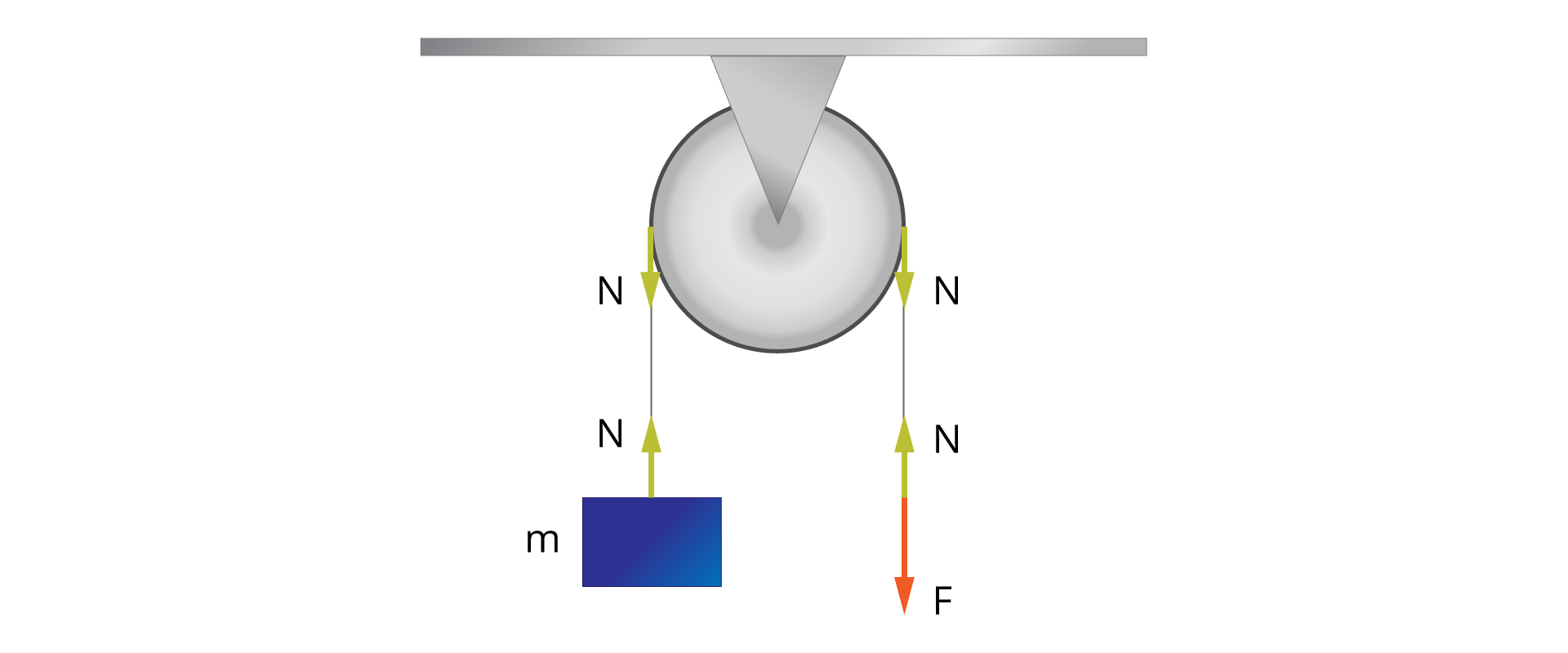
The stationary blockstationary blockstationary block is a disc that can rotate around a fixed axis. A rope is thrown through the disc, and it does not slip on the surface of the disc.
RWysva3gkSyIf
Na ilustracji przedstawiono model bloczka nieruchomego, który zaczepiony jest w środku do belki. Po lewej jak i po prawej stronie bloczka zwisa lina. Po lewej stronie bloczka do liny zaczepiony jest kwadratowy blok oznaczony m. Od niego do bloczka oraz od środka bloczka do bloku zaznaczono na linie wektory N. Po prawej stronie od końca liny do bloczka oraz od środka bloczka do końca liny zaznaczono na linie wektory N oraz na końcu liny widnieje wektor F skierowany w dół. Blok nieruchomy nie zmniejsza wykonywanej pracy, ale umożliwia łatwiejsze wykonywanie tej pracy poprzez określenie dogodnego kierunku działania siły.
Prepare the stationary blockstationary blockstationary block. At one end of the rope hang weights of certain mass. Attach the dynamometer to the other end of the rope. Read the force value indicated by the dynamometer at the moment when the system is in balance. While changing the mass of the suspended weights, read the values of the forces indicated by the dynamometer.
After completing the experiment, form the condition for the stationary block balance.
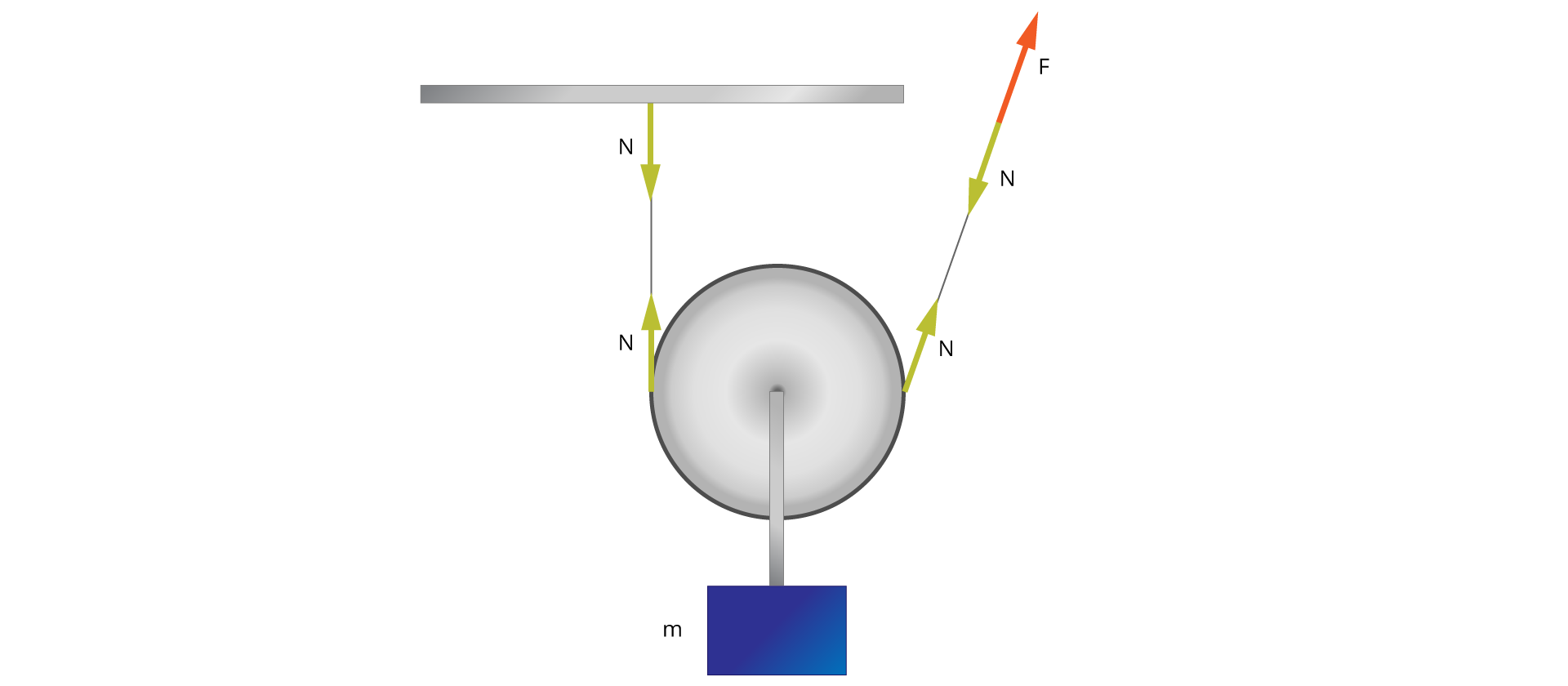
The movable blockmovable blockmovable block is a disc with a rope thrown around it that does not slide on the surface of the block, but it can move in the vertical direction and perform rotation.
R1TpLZ92XMOh71
Na ilustracji przedstawiono model bloczka ruchomego, który owinięty jest liną przyczepioną do belki po jego lewej stronie. Na linie od belki do bloczka i od środka bloczka do belki zaznaczono wektory N skierowane do siebie. Do bloczku przyczepiony w środku został kwadratowy blok oznaczony m. Na linie, która skierowana jest w prawą stronę do góry zaznaczono wektory N skierowane do siebie od środka bloczka i od końca liny, który znajduje się na wysokości belki. Od końca lin posiada dwa wektory skierowane w swoją stronę N. Na końcu liny zaznaczono wektor F skierowany w przeciwnym kierunku do bloczka. Blok ruchomy umożliwia dwukrotne obniżenie wartości siły potrzebnej do wykonania pracy, ale dwukrotnie zwiększa przesunięcie niezbędne do wykonania pracy. Również w tym przypadku nie zyskujemy na wykonanej pracy.
Prepare some weights with the movable blockmovable blockmovable block. Attach the dynamometer to the loose end of the rope. Choose different weights and fix them to the moving block. Write the value of the force displayed by the dynamometer when the system is in balance.
Is the force indicated by the dynamometer equal to the weight of the suspended weights in the case of the moving block?
By how many times is the force F indicated by the dynamometer lesser?
Describe two examples of a practical application of the windlasswindlasswindlass, the movable and the stationary blocks.
Exercises
RDq4l96EiHOTv
Exercise 1
Enter the appropriate words from the following: same, simple, easier, machine, work, movable. A [tu uzupełnij] block is used when we want to do work with lesser force than without using this simple [tu uzupełnij]. Doing [tu uzupełnij] is then much [tu uzupełnij], but we always do the [tu uzupełnij] work as we do not without using any [tu uzupełnij] machine.
Enter the appropriate words from the following: same, simple, easier, machine, work, movable. A [tu uzupełnij] block is used when we want to do work with lesser force than without using this simple [tu uzupełnij]. Doing [tu uzupełnij] is then much [tu uzupełnij], but we always do the [tu uzupełnij] work as we do not without using any [tu uzupełnij] machine.
Enter the appropriate words from the following.
simple, machine, movable, work, same, easier
A .............. block is used when we want to do work with lesser force than without using this simple ............... Doing .............. is then much .............., but we always do the .............. work as we do not without using any .............. machine.
Exercise 2
A 20 kg bucket with water was attached to a rope thrown through a stationary block with a 30 cm shaft radius.
With what force should you pull the other end of the rope to lift the bucket in a steady motion?
What work should be done to lift the bucket to the height of 2 m?
What work should be done to lift the bucket to the height of 3 m without using the stationary block?
200 N
400 J
600 J
Exercise 3
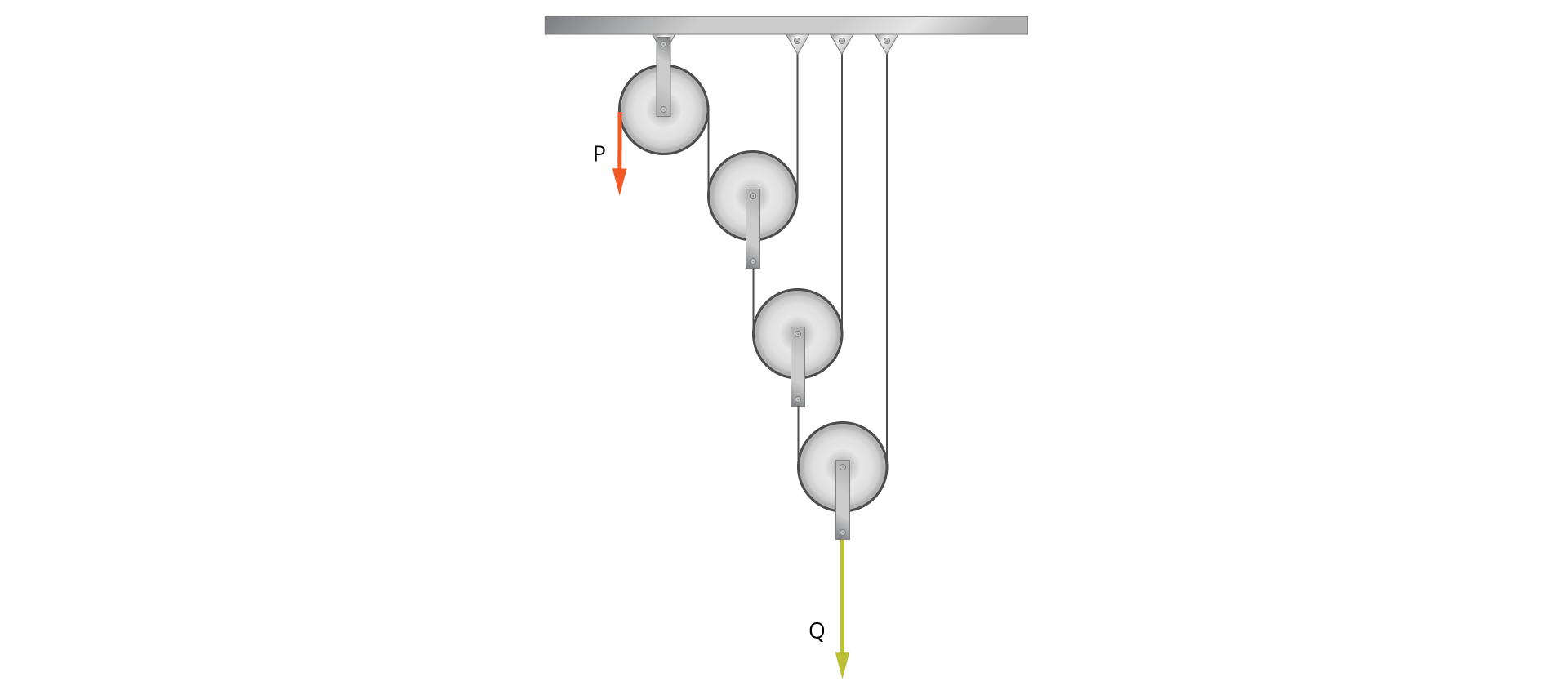
Build a multi‑disc system as shown in the figure below. Suggest how you can experimentally determine the relationship between the two forces marked in the figure?
Write a short instruction!
RY8cviW5dZnpP1
Na ilustracji przedstawiono układ trzech bloczków ruchomych i jednego bloczka nieruchomego. Pierwszy bloczek od lewej przyczepiony do belki, po jego lewej stronie zaznaczono wektor skierowany w dół P. Po jego prawej stronie lina do bloczka drugiego zawieszonego niżej. Po prawej stronie bloczka drugiego jest lina do góry zaczepiona do belki. Z środka bloczka drugiego wychodzi lina, na której zawieszony jest niżej bloczek trzeci. Po prawej stronie bloczka trzeciego jest lina do góry zaczepiona do belki. Z środka bloczka trzeciego wychodzi lina, na której zawieszony jest niżej bloczek czwarty. Po prawej stronie bloczka dczwartego jest lina do góry zaczepiona do belki. Z środka bloczka czwartego zaznaczono wektor Q skierowany w dół. W układzie tym ciężar jest podtrzymywany za pomocą dwóch nici, a naciąg nici zmniejsza się co każdy bloczek dwa razy.
Source: GroMar, licencja: CC BY 3.0.
R10SE9RwCHZa7
Exercise 4
Wersja alternatywna ćwiczenia: Indicate which pairs of expressions or words are translated correctly. Możliwe odpowiedzi: 1. wielokrążek - pulley, 2. blok ruchomy - movable block, 3. zmniejszenie siły - force reduction, 4. maszyna prosta - simple machine, 5. kołowrót - stationary block, 6. blok nieruchomy - windlass
Wersja alternatywna ćwiczenia: Indicate which pairs of expressions or words are translated correctly. Możliwe odpowiedzi: 1. wielokrążek - pulley, 2. blok ruchomy - movable block, 3. zmniejszenie siły - force reduction, 4. maszyna prosta - simple machine, 5. kołowrót - stationary block, 6. blok nieruchomy - windlass
Indicate which pairs of expressions or words are translated correctly.
wielokrążek - pulley
blok ruchomy - movable block
zmniejszenie siły - force reduction
maszyna prosta - simple machine
kołowrót - stationary block
blok nieruchomy - windlass
zadanie
Source: GroMar, licencja: CC BY 3.0.
RIZsJiJai91fz1
Interaktywna gra, polegająca na łączeniu wyrazów w pary w ciągu jednej minuty. Czas zaczyna upływać wraz z rozpoczęciem gry. Jeden ruch to odkrywanie najpierw jednej potem drugiej karty z wyrazem. Każdy wyraz jest odczytywany. Kolejny ruch to odkrywanie trzeciej i czwartej karty. W ten sposób odsłuchasz wszystkie wyrazy. Nawigacja z poziomu klawiatury za pomocą strzałek, odsłuchiwanie wyrazów enterem lub spacją. Znajdź wszystkie pary wyrazów.
Interaktywna gra, polegająca na łączeniu wyrazów w pary w ciągu jednej minuty. Czas zaczyna upływać wraz z rozpoczęciem gry. Jeden ruch to odkrywanie najpierw jednej potem drugiej karty z wyrazem. Każdy wyraz jest odczytywany. Kolejny ruch to odkrywanie trzeciej i czwartej karty. W ten sposób odsłuchasz wszystkie wyrazy. Nawigacja z poziomu klawiatury za pomocą strzałek, odsłuchiwanie wyrazów enterem lub spacją. Znajdź wszystkie pary wyrazów.
Match Polish terms with their English equivalents.
stationary block
maszyna prosta
blok nieruchomy
wielokrążek
windlass
pulley
blok ruchomy
simple machine
kołowrót
movable block
Source: Zespół autorski Politechniki Łódzkiej, licencja: CC BY 3.0.
movable blockmovable blockmovable block - to krążek z przerzuconą liną nieślizgającą się po powierzchni bloczka, mogący przemieszczać się w kierunku pionowym oraz wykonywać obrót
stationary blockstationary blockstationary block - to krążek, który może wykonywać obrót wokół nieruchomej osi. Przez krążek taki jest przerzucona linka, która nie ślizga się względem powierzchni krążka
windlasswindlasswindlass - składa się zazwyczaj z wału o promieniu r oraz korby. Długość ramienia korby R jest większa od promienia walca r