A trip to the Ancient Greece theatre
you will describe the origins of the Greek theatre
you will describe individual elements of the construction of the Ancient Greek theatre
you will discuss the functions of the actors in ancient dramaancient drama
you will describe the classical unitiesclassical unities and decorum
Before the lesson
The history of the Ancient Greece theatre and its drama
A vast majority of historians agree that drama and theatre have their roots in ancient religious customs. During such ceremonies, the ancient Greeks praised the god Dionysus, the god of wine and wild nature. It is not surprising that initially such festivals were full of wine drinking and ecstatic dances of men and women. Since the VII century BC, the ceremonies praising the god Dionysus have started to civilize. Among all, they comprised the choral singing worshiping the god. The choirchoir was led by the CoryphaeusCoryphaeus whose role was to choose the songs called dithyrambsdithyrambs. Thespis, living in the VI century B.C. was probably one of them. Was he any special? He was, coming up with a revolutionary idea to make one person stand out from the choir. The chosen one didn't initiate the singing like the Coryphaeus did, but actually answered the whole group. This resulted in the creation of a sort of dialogue. The actors and the drama itself came along. Among the festivals worshiping Dionysus, The City and Rural Dionysia stood out. Although it may be hard for now, try to match the following terms with the two festivals.
Point out the differences between the City and Rural Dionysia - drag over the elements to the appropriate places.
Who?, Where?, When?, What?, How?, Which genre?
| City Dionysia | Rural Dionysia | |
|---|---|---|
| Who? | ||
| Where? | ||
| When? | ||
| What? | ||
| How? | ||
| Which genre? |
The names of the two genres of drama indicate the character of the individual plays.
Tragedy = tragos (a goat) + ode (song)
Comedy = komos (a joyful retinue) + ode (song).
These names probably indicate that:
the members of the choir praising the Dionysus in songs wore goat leather to look more like the satirists and silenuses who surrounded the god of wine;
the retinue of peasants from Athens wearing costumes with funny elements (such as big genitalia), was singing facetious songs and telling (sometimes quite unsavoury) jokes.
Look at the plan of the Greek amphitheatre and match the descriptions with the places.
Proskenion, Theatron, Skene, Parodos, Orchestra
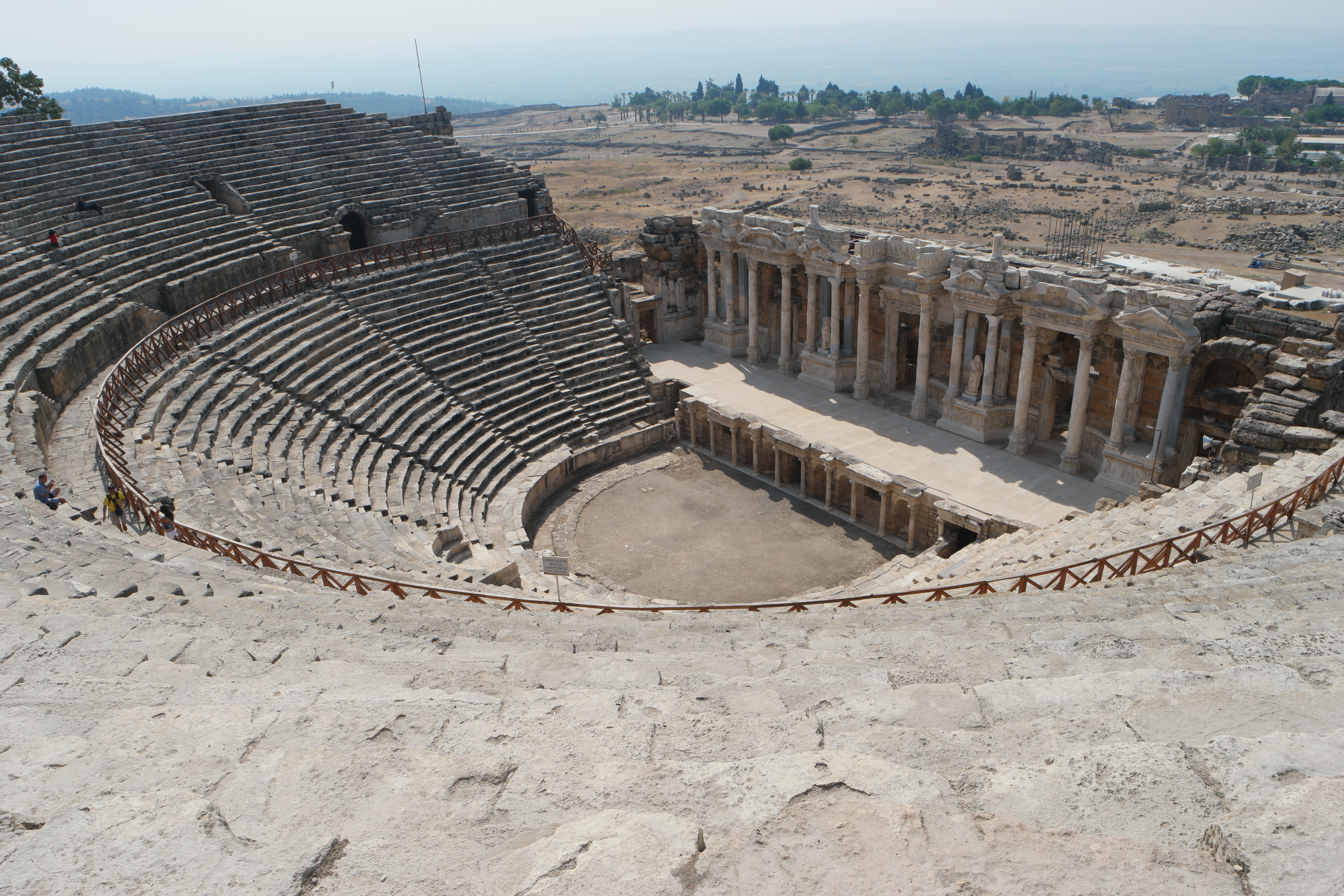
The tragedy was part of the religious ceremonies. Therefore, it was important that everyone heard and saw it well. It was, of course, the specific seating plan that was responsible for good visibility for the audience. The acoustics were supported by:
the tubes embedded in masks thanks to which the voice of the actors was amplified,
resonators (in a form of copper hemispheres) functioning as loudspeakers. They were set up in the amphitheatreamphitheatre in order to reinforce the words of the actors and the choir singing. It was necessary due to the numerous audience. The oldest amphitheatre built in stone - the theatre in Athens - could accommodate even 17 000 people.
You already know how the Greek theatre looked like. Now it's time for you to get familiar with its characters.
As the drama has developed, the role of the choir was reducing in order to enhance the actors in the play. However, the role of the choir, assembling dozens of peoples, didn't change much. The choir played a role of a narrator (remember this term refers to the epic, not the drama). Therefore, it was commenting on the ongoing situation and adding information about the past or future events.
At the end of our journey, look at some information about the costumes and accessories used in the theatre.
Costumes and accessories
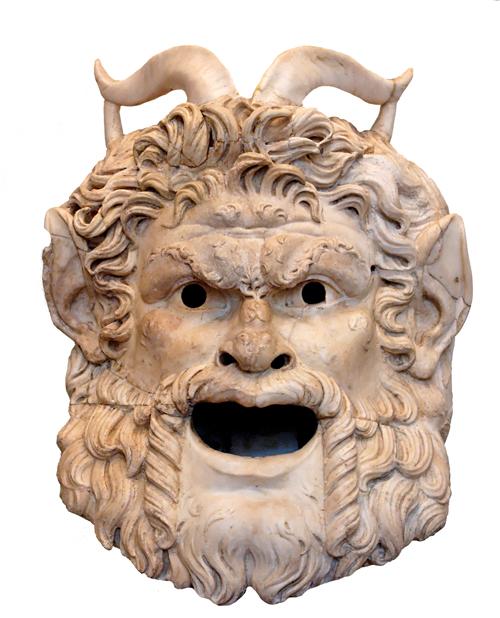
Mask
It had strong facial features, showing e.g. anger or anxiety.
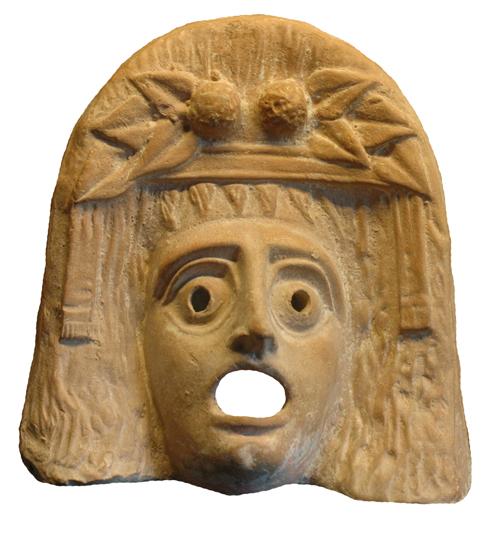
Wig
So-called onkos. Its colour and height informed spectators about the social group to which the character belonged.
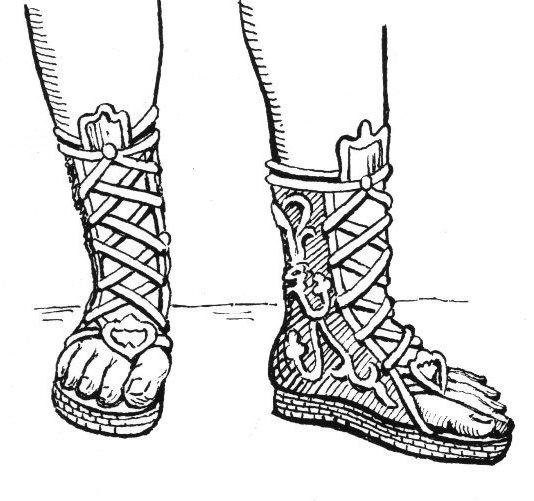
Wedges
Their height depended on the membership in a certain social group: the Lords had the highest soles.
Costume
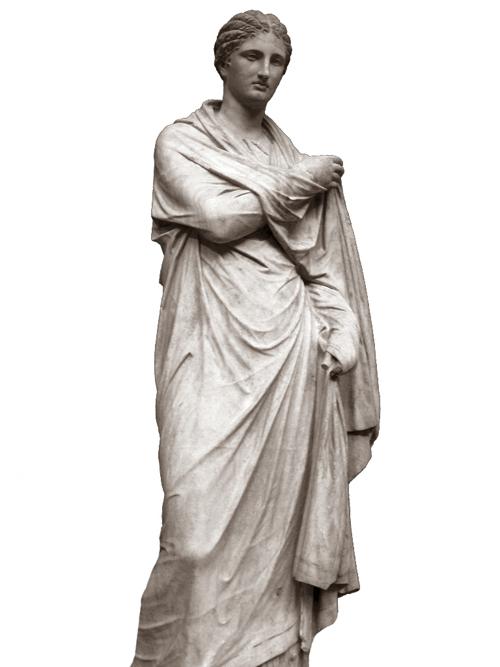
Usually it was a chiton in vivid colours, a loose robe worn with a coat.
What are the classical unities? Fill the gaps with suitable words.
Action, plot, time, place, two, action, four, one, three
The group scenes weren't played in Greek dramas: there were no more than ............ actors on the scene. The ............ lasted no longer than 24 hours. This rule is called the unity of ............. The number of locations where the events were taking place was limited to ............. This rule is defined as a unity of ............. In dramas such as the Oedipus Rex, there was only one main plot. This rule is called the unity of .............
Find out in available sources what the decorum was. What genre did it concern? Why?
Make a crossword for your classmate containing words that you've learned on today's lesson (minimum 8 entries)
Keywords
greek theatre, tragedy, comedy, drama
Match the pairs: English words with Polish definition.
koryfeusz, deus ex machina, chiton, maska, proskenion, dytyramb, parodos, peruka, zasada decorum, orchestra, theatron, zasada trzech jedności, koturny, dramat antyczny, amfiteatr, episkenion, skene, chór
| choir | |
| Coryphaeus | |
| dithyramb | |
| mask | |
| wig | |
| wedges | |
| chiton | |
| theatron | |
| skene | |
| orchestra | |
| proskenion | |
| episkenion | |
| parodos | |
| amphitheatre | |
| deus ex machina | |
| classical unities | |
| decorum | |
| ancient drama |
Glossary
chór
koryfeusz
dytyramb
maska
peruka
koturny
chiton
theatron
skene
orchestra
proskenion
episkenion
parodos
amfiteatr
deus ex machina
zasada trzech jedności
zasada decorum
dramat antyczny