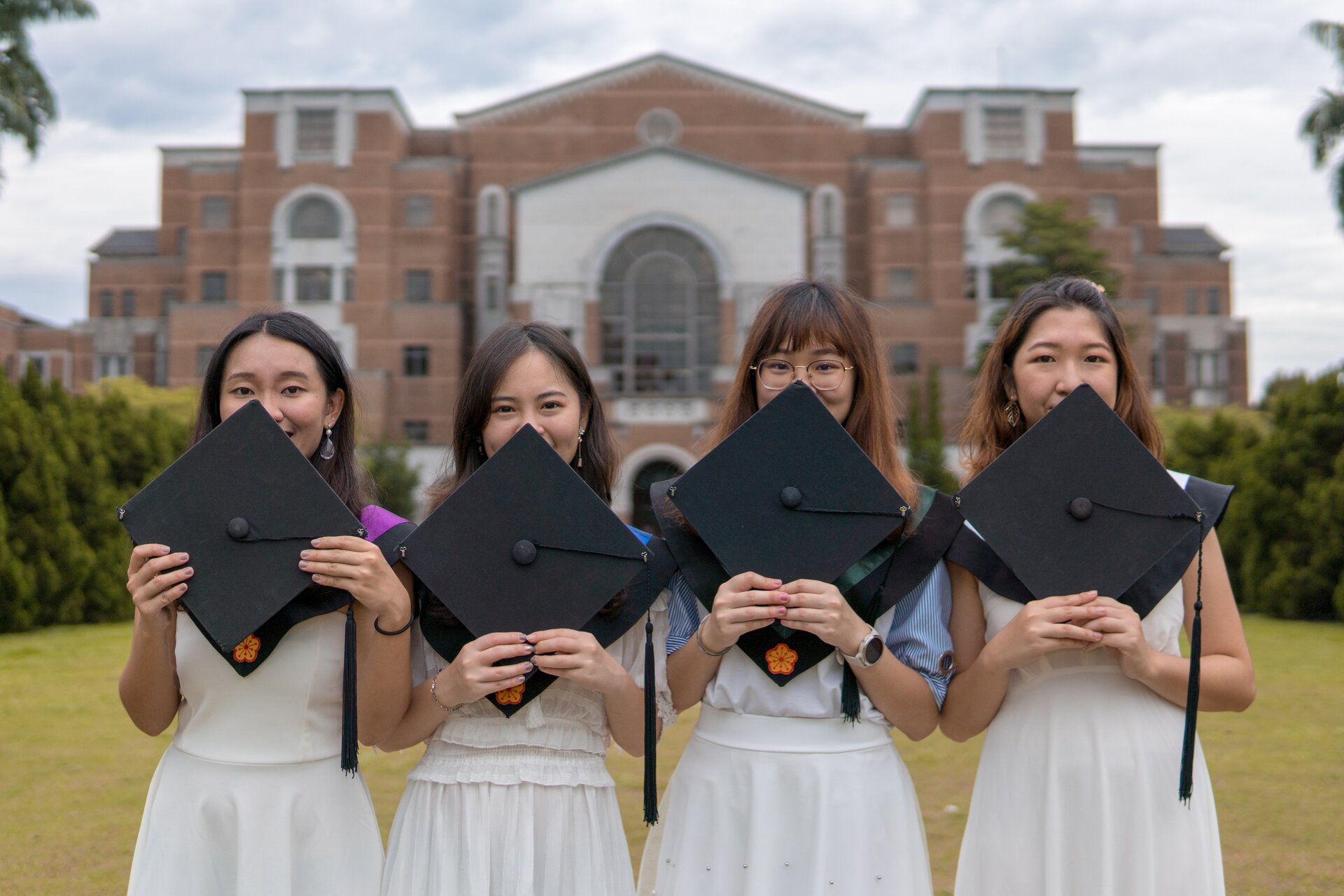
The picture below shows an important moment in a student’s life: graduation. You can graduate from many types of schools, and each one will teach you in a different way. In this section, you will learn about some of the educational options that you can choose from in Great Britain.
Poniższe zdjęcie przedstawia ważny moment w życiu ucznia: ukończenie szkoły. Możesz być absolwentem wielu rodzajów szkół, a w każdej z nich edukacja wygląda inaczej. Z tego materiału dowiesz się, jakie opcje edukacyjne możesz wybrać w Wielkiej Brytanii.
R1etwYscb4tsv
Zdjęcie przedstawia cztery nastoletnie dziewczyny stojące na tle wysokiego budynku z cegły. Wszystkie przysłaniają sobie twarze absolwenckimi czapkami, zwanymi biretami.
Some can’t wait for the graduation day while others miss school the moment they graduate
Niektórzy nie mogą doczekać się dnia ukończenia szkoły, podczas gdy inni tęsknią za szkołą, w chwili gdy zostają absolwentami
Źródło: dostępny w internecie: unsplash.com [dostęp 16.07.2021], domena publiczna.
Exercise1
Study the sentence below and then answer the question.
R9nsXECCI5ysZ
The King’s School in Canterbury was established in 597 AD. It’s
Źródło: GroMar Sp. z o.o., licencja: CC BY-SA 3.0.
1
Exercise1
Complete the puzzle to see the oldest school in Great Britain: The King’s School in Canterbury, England. Then, answer the question.
R56OtOlw84rwJ
Źródło: dostępny w internecie: en.wikipedia.org [dostęp 16.07.2021], domena publiczna.
RgS5Ys4YexTaP
How old is The King’s School in Canterbury? Możliwe odpowiedzi: 1. Over 1,400 years old., 2. Over 1,500 years old., 3. Over 1,600 years old.
Źródło: GroMar Sp. z o.o., licencja: CC BY-SA 3.0.
RxuiVnFFO8lit
Exercise2
Study the text below and choose the best title. Only one answer is correct. Możliwe odpowiedzi: 1. University Is Key, 2. The Teachers that Changed My Life, 3. So Many Choices
Źródło: GroMar Sp. z o.o., licencja: CC BY-SA 3.0.
Renata Nowakowska, Konrad Gniazdowski, Zdzisław Dudek
Generally, it may seem that educational systems in all European countries are quite similar. The youngest children go to nurserynursery (BrE) nursery. When they get a bit older, they go to reception classreception classreception class and enjoy practical, fun based learning, preparing them for school. There are three main stagesstages [stage]stages of education. The first one is primary school, followed by secondary schoolsecondary school secondary school, and then children may undertakeundertakeundertake some form of higher‑level education. They can go to a college of further educationcollege of further educationcollege of further education or university. It’s all pretty simple, isn’t it?
It is not. Even in the United Kingdom there are differences between the way the system works in England and other parts of the country. At every stage of education, there are many types of schools that you can choose from, too. Even in primary school, you can go to a state schoolstate schoolstate school, which is paid for by the government, or decide to choose a free schoolfree schoolfree school. You can also enter a posh public schoolpublic school (BrE)public school when you’re eleven. When it comes to secondary school, most people go to a comprehensive schoolcomprehensive school (BrE)comprehensive school, but in some parts of England there are grammar schoolsgrammar school (BrE)grammar schools for gifted and talented children, especially those who are focused onfocused onfocused on ambitious academic studies. There are also faith schoolsfaith school (BrE)faith schools for those who want to concentrate on religion.
Children in the United Kingdom must attend schoolattend schoolattend school from the beginning of the school year following their fifth birthday and finish their secondary education at the age of 16, but many choose to stay at school for another year or go to a college of further education which prepares them to enter university, or gives vocational trainingvocational trainingvocational training. The name ‘college’ may be confusing to foreigners because it is traditionally used for parts of certain universities (and in the US it is used as a synonym of university), while in the UK it is a name most often applied to various post‑secondarypost‑secondarypost‑secondary schools. Usually, universities give you a degreedegreedegree when you finish them, while colleges only prepare you for earning a degree.
But what if you are a fan of STEM subjectsSTEM subjects (science, technology, engineering and mathematics)STEM subjects and don’t want to go to a university? You can choose an institute of technologyinstitute of technologyinstitute of technology, a new type of institution based on collaboration between colleges of further education, universities and employersemployers [employer]employers, designed to provide vocational skillsvocational skillsvocational skills, help with skilled employmentskilled employmentskilled employment, higher study or apprenticeshipsapprenticeships [apprenticeship]apprenticeships. They may prepare you for the job of an engineer and may open many doors in life.
Most people finish their academic education in two to four years. But is it over then? Hardly. You can always enter postgraduate studiespostgraduate studiespostgraduate studies or just study on your own. After all, you can finish school but your further educationfurther educationfurther education never ends.
1 Źródło: Zdzisław Dudek, Konrad Gniazdowski, Renata Nowakowska, dostępny w internecie: https://en.wikipedia.org/wiki/Education_in_the_United_Kingdom [dostęp 18.02.2022], https://www.gov.uk/schools-admissions/school-starting-age [dostęp 18.02.2022], https://foundationyears.org.uk/2014/08/school-reception-class/ [dostęp 18.02.2022], https://www.gov.uk/government/publications/institutes-of-technology--2 [dostęp 18.02.2022], https://en.wikipedia.org/wiki/College [dostęp 18.02.2022], https://www.institutesoftechnology.org.uk/about [dostęp 18.02.2022], https://careerpilot.org.uk/parent-zone/all-questions/how-can-i-help-my-child-choose-their-a-levels [dostęp 18.02.2022], licencja: CC BY-SA 3.0.
Exercise3
Study the text above and choose the correct answer. There is only one correct answer in each point.
RIlxwh5DUdzLE
Educational systems in Europe Możliwe odpowiedzi: 1. differ from country to country., 2. are, generally speaking, identical., 3. very similar all across Britain.
Źródło: GroMar Sp. z o.o., licencja: CC BY-SA 3.0.
RVl74NowKTHDr
Where do you go just before the primary school? Możliwe odpowiedzi: 1. Secondary school., 2. Reception class., 3. Nursery.
Źródło: GroMar Sp. z o.o., licencja: CC BY-SA 3.0.
RQXFOfc5sXuT8
Where can young people go after finishing secondary school? Możliwe odpowiedzi: 1. College., 2. Postgraduate studies., 3. Grammar school.
Źródło: GroMar Sp. z o.o., licencja: CC BY-SA 3.0.
RDHx0VWaSehli
Which of these gives higher‑level education and a degree in the UK? Możliwe odpowiedzi: 1. College., 2. Free school., 3. University.
Źródło: GroMar Sp. z o.o., licencja: CC BY-SA 3.0.
RpaLdrpWH2bZk
Where would you go if you are good at STEM subjects? Możliwe odpowiedzi: 1. An institute of technology., 2. Faith school., 3. Kindergarten.
Źródło: GroMar Sp. z o.o., licencja: CC BY-SA 3.0.
RC2DkQ7lOp94q
Exercise4
Drag and drop the elements to fill in the text below. There are two elements that you do not need. I remember when I was 11 and I had to choose my school. I was scared. I had just finished 1. STEM, 2. public, 3. primary, 4. nursery, 5. institute of technology, 6. college, 7. school, 8. faith, 9. grammar school and I had to choose a secondary one. My parents didn’t have enough money for a posh 1. STEM, 2. public, 3. primary, 4. nursery, 5. institute of technology, 6. college, 7. school, 8. faith, 9. grammar school, but I wasn’t sure about going to a comprehensive 1. STEM, 2. public, 3. primary, 4. nursery, 5. institute of technology, 6. college, 7. school, 8. faith, 9. grammar like everybody else. I had talent, and I was good at maths, so I wanted to go to a 1. STEM, 2. public, 3. primary, 4. nursery, 5. institute of technology, 6. college, 7. school, 8. faith, 9. grammar school. Or at least, that is what I thought.
My parents didn’t like the idea. There aren’t many grammar schools, and when I was 11, we didn’t live near one. But we lived next door to a protestant school for boys. They wanted to send me there, but I said I didn’t want to go to a 1. STEM, 2. public, 3. primary, 4. nursery, 5. institute of technology, 6. college, 7. school, 8. faith, 9. grammar school. I wanted to be an engineer and study 1. STEM, 2. public, 3. primary, 4. nursery, 5. institute of technology, 6. college, 7. school, 8. faith, 9. grammar subjects like maths and physics. I didn’t like going to church much back then.
In the end, I went to a comprehensive school like almost everybody else in my class. But it turned out OK. I later went to an 1. STEM, 2. public, 3. primary, 4. nursery, 5. institute of technology, 6. college, 7. school, 8. faith, 9. grammar and became an engineer like my father. We build bridges together. Life is good, and it didn’t end the moment when I was 11 and didn’t get accepted to a grammar school.
Drag and drop the elements to fill in the text below. There are two elements that you do not need. I remember when I was 11 and I had to choose my school. I was scared. I had just finished 1. STEM, 2. public, 3. primary, 4. nursery, 5. institute of technology, 6. college, 7. school, 8. faith, 9. grammar school and I had to choose a secondary one. My parents didn’t have enough money for a posh 1. STEM, 2. public, 3. primary, 4. nursery, 5. institute of technology, 6. college, 7. school, 8. faith, 9. grammar school, but I wasn’t sure about going to a comprehensive 1. STEM, 2. public, 3. primary, 4. nursery, 5. institute of technology, 6. college, 7. school, 8. faith, 9. grammar like everybody else. I had talent, and I was good at maths, so I wanted to go to a 1. STEM, 2. public, 3. primary, 4. nursery, 5. institute of technology, 6. college, 7. school, 8. faith, 9. grammar school. Or at least, that is what I thought.
My parents didn’t like the idea. There aren’t many grammar schools, and when I was 11, we didn’t live near one. But we lived next door to a protestant school for boys. They wanted to send me there, but I said I didn’t want to go to a 1. STEM, 2. public, 3. primary, 4. nursery, 5. institute of technology, 6. college, 7. school, 8. faith, 9. grammar school. I wanted to be an engineer and study 1. STEM, 2. public, 3. primary, 4. nursery, 5. institute of technology, 6. college, 7. school, 8. faith, 9. grammar subjects like maths and physics. I didn’t like going to church much back then.
In the end, I went to a comprehensive school like almost everybody else in my class. But it turned out OK. I later went to an 1. STEM, 2. public, 3. primary, 4. nursery, 5. institute of technology, 6. college, 7. school, 8. faith, 9. grammar and became an engineer like my father. We build bridges together. Life is good, and it didn’t end the moment when I was 11 and didn’t get accepted to a grammar school.
Źródło: GroMar Sp. z o.o., licencja: CC BY-SA 3.0.