a) Give a definition of motion. b) Give quantities describing motion of the body. c) List factors hindering motion of the body.
a) Motion consists in changing the position of the body relative to the selected object. This change takes place in time. b) The basic physical quantities describing the body in motion are: trajectorytrajectorytrajectory, displacementdisplacementdisplacement, distance, velocityvelocityvelocity and accelerationaccelerationacceleration of the body. c) The motion of the body is hindered by air resistance, frictionfrictionfriction, and other friction forces.
ROQPzwBQXwqtd1
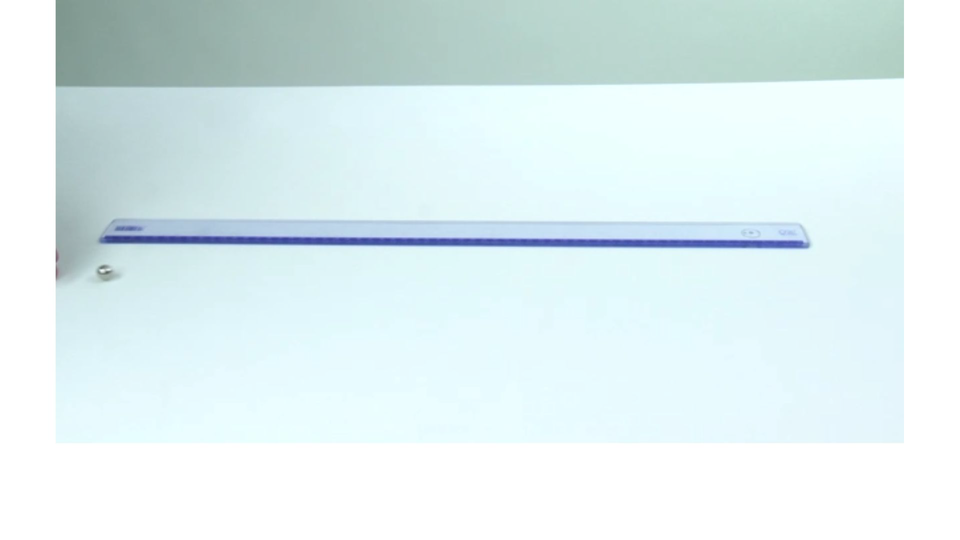
Pokaz multimedialny - Tocząca się kula z uwzględnieniem sił oporu ruchu. Instrukcja obsługi z poziomu klawiatury: 1. Uruchomienie aplikacji - ENTER, 2. Na każdym ze slajdów czytany jest automatycznie tekst alternatywny po polsku, 3. Przy pierwszym uruchomieniu na pierwszym slajdzie, czytanie tekstu po angielsku - TAB, 4. Przejście między slajdami: do następnego slajdu - TAB, do poprzedniego slajdu - TAB + SHIFT, 5. Przejście do czytania napisu po angielsku - strzałka w górę + strzałka w dół (czyta tekst po angielsku widoczny na slajdzie).
Pokaz multimedialny - Tocząca się kula z uwzględnieniem sił oporu ruchu. Instrukcja obsługi z poziomu klawiatury: 1. Uruchomienie aplikacji - ENTER, 2. Na każdym ze slajdów czytany jest automatycznie tekst alternatywny po polsku, 3. Przy pierwszym uruchomieniu na pierwszym slajdzie, czytanie tekstu po angielsku - TAB, 4. Przejście między slajdami: do następnego slajdu - TAB, do poprzedniego slajdu - TAB + SHIFT, 5. Przejście do czytania napisu po angielsku - strzałka w górę + strzałka w dół (czyta tekst po angielsku widoczny na slajdzie).
The following conclusions can be drawn from the presented slides
1. The ball at the initial moment had the maximum speed. 2. The speed of the ball decreased because at regular intervals the distance travelled by the ball was smaller and smaller. 3. The motion of the ball was a decelerated motion. 4. The ball stopped after four seconds of motion. 5. The reason for stopping were contact interactions which counteracted the motion of the ball. 6. The forces of contact interactions which counteracted the motion of the ball are called the forces of resistance to motionresistance to motionresistance to motion (frictionfrictionfriction forces).
All moving bodies in our environment encounter forces that counteract their motion. They may, for example, be the result of resistance of a medium in which the body is moving, or friction between the surface and the moving body. We define them with one common name - resistance to motionresistance to motionresistance to motion.
1. Place the board perpendicular to the surface of the water and then immerse it in water. 2. Start slowly moving it in direction perpendicular to its surface. 3. Move the board faster and faster. 4. Set the board parallel to the water surface, then immerse it. 5. Start moving the board parallel to the water surface. 6. Perform similar experiment in the air.
When you move the immersed board faster and faster, the resistance of the water becomes larger and larger. When you move the board perpendicular to the water surface, you feel greater resistance to motion than if you placed the board parallel. In the air, the experiment has similar result - only the resistance of the air is smaller.
Which answer is true? The plane flies without changing speed or height. The engines push it forward with a force of one hundred and fifty kilonewtons. What is the magnitude of the force of resistance to motion F caused by the air resistance? Możliwe odpowiedzi: 1. F is greater than one hundred and fifty kilonewtons, 2. F is less than one hundred and fifty kilonewtons, 3. F equals one hundred and fifty kilonewtons.
Which answer is true? The plane flies without changing speed or height. The engines push it forward with a force of one hundred and fifty kilonewtons. What is the magnitude of the force of resistance to motion F caused by the air resistance? Możliwe odpowiedzi: 1. F is greater than one hundred and fifty kilonewtons, 2. F is less than one hundred and fifty kilonewtons, 3. F equals one hundred and fifty kilonewtons.
Which answer is true? The plane flies without changing speed or height. The engines push it forward with a force of 150 kN. What is the magnitude of the force of resistance to motion F caused by the air resistance?
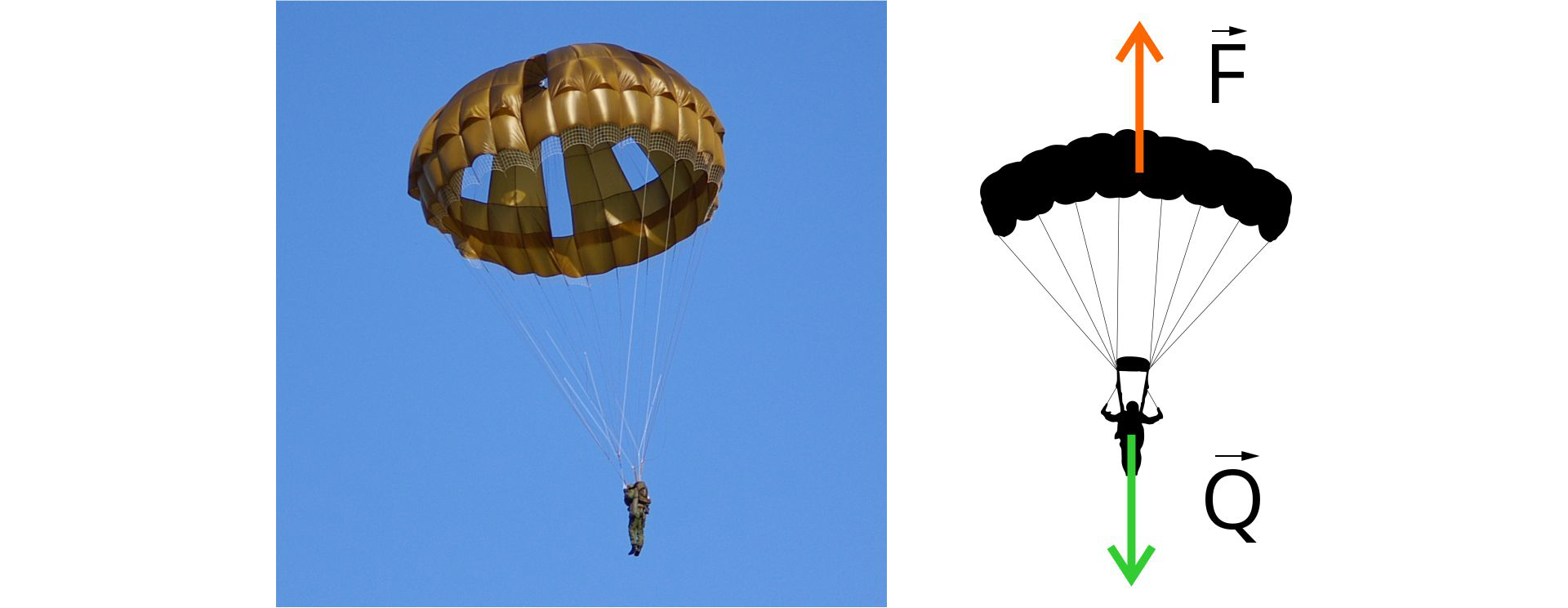
The parachute jumper falls in uniform motion. The weight of the parachute jumper together with the parachute is 800 N. What is the magnitude of the force of air resistance? Draw the forces acting on the jumper.
F - force of air resistance Q - weight of the jumper
RebzM9UkDofHG1
Rysunek przedstawia po lewej zdjęcie skoczka ze spadochronem na tle nieba. Po prawej schemat skoczka ze spadochronem. Na spadochronie narysowana strzałka pionowa skierowana do góry opisana F. Na spadochroniarzu narysowana strzałka pionowa skierowana do dołu opisana Q. Nad F i Q strzałka pozioma skierowana w prawo.
The cause of the jumper movement towards the Earth is the gravitational interactioninteractioninteraction, which manifests itself as the jumper's weight. At the beginning, the movement is uniformly accelerated, and then uniform. In order for the jumper to move in a uniform motion, the force of air resistance F should be equal to the weight of the jumper Q. The direction of the resistance force should be opposite to the weight of the jumper, the magnitude of both forces should be the same. Q = F = 800 N.
The jet aircraft during landing opens the brakingbrakingbraking flaps and opens the braking parachute, which increases its resistance to motion relative to the air.
increases as the speed of the body increases relative to the medium
depends on the shape of the body,
is larger in liquids than in gases,
depends on the density of the medium in which the body moves.
Exercises
RToNLVu8urDo7
Exercise 5
Wersja alternatywna ćwiczenia: Determine which sentences are true. In order to reduce the resistance to motion of the air, skiers use: Możliwe odpowiedzi: 1. the right posture during the jump., 2. suitable aerodynamic overalls., 3. narrow and fairly short skis., 4. special creams., 5. special sprays.
Wersja alternatywna ćwiczenia: Determine which sentences are true. In order to reduce the resistance to motion of the air, skiers use: Możliwe odpowiedzi: 1. the right posture during the jump., 2. suitable aerodynamic overalls., 3. narrow and fairly short skis., 4. special creams., 5. special sprays.
Determine which sentences are true. In order to reduce the resistance to motion of the air, skiers use:
the right posture during the jump.
suitable aerodynamic overalls.
narrow and fairly short skis.
special creams.
special sprays.
Exercise 6
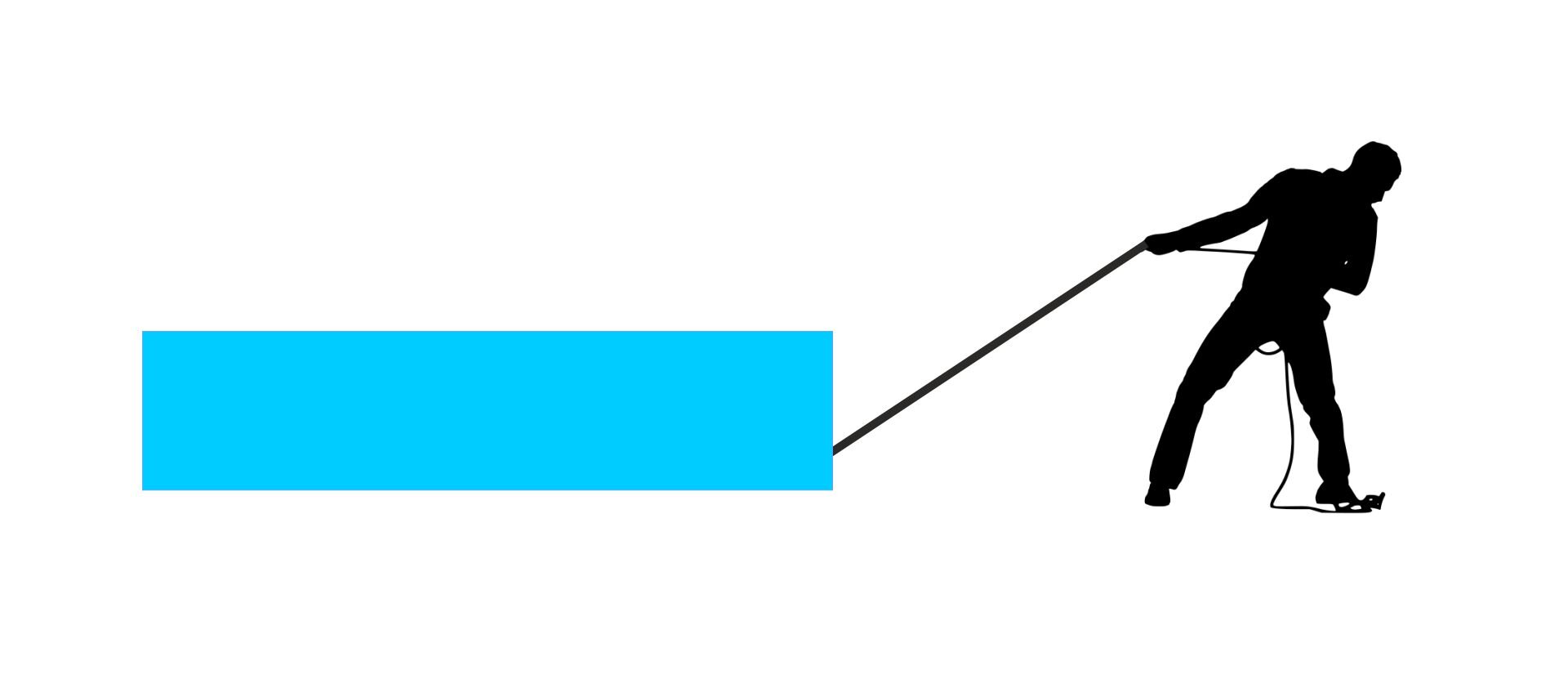
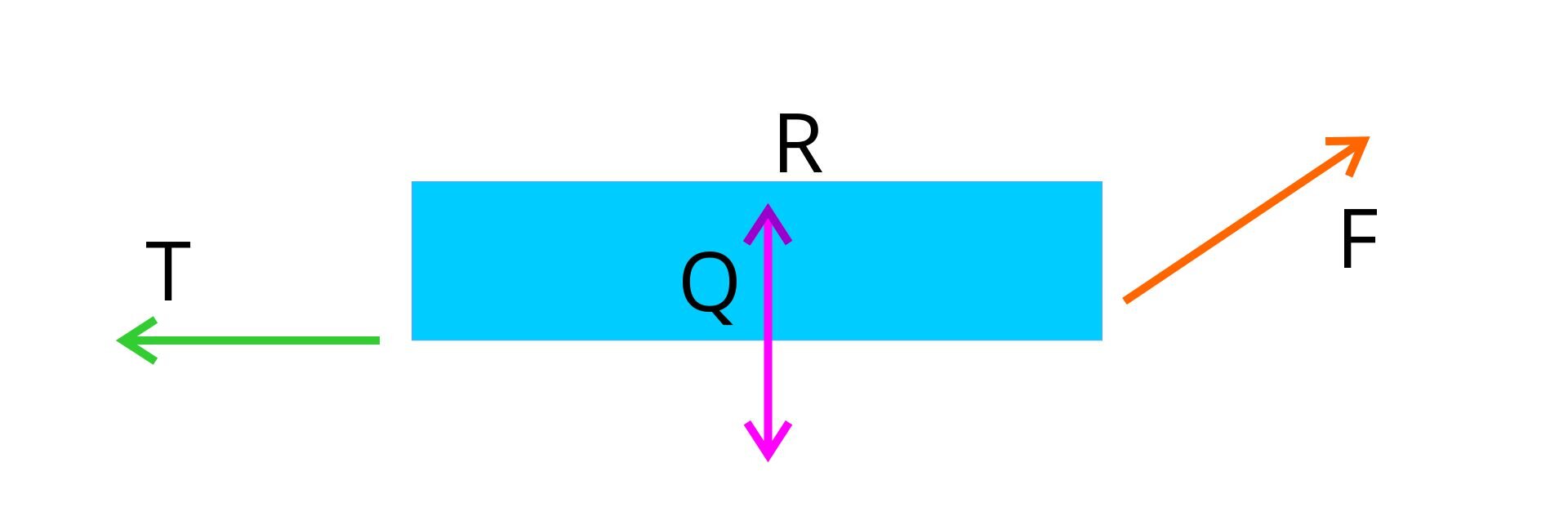
In the situation presented in the picture, mark the vectors showing the forces acting on the block moving in a uniform motion.
R1J1zVKrDKFVz1
Ilustracja prostokątnego klocka ciągniętego przez człowieka trzymającego naprężoną linę.
Source: GroMar, licencja: CC BY 3.0.
RdGtMtzD19fGB1
Ilustracja prostokąta z zaznaczonymi wektorami przedstawiającymi siły działające na niego. Pozioma strzałka skierowana w lewo po lewej stronie klocka narysowana na podłożu opisana T. Pionowa strzałka skierowana w do góry po środku klocka opisana R. Pionowa strzałka skierowana w do dołu po środku klocka opisana Q. Pionowa strzałka skierowana w do góry po środku klocka opisana R. Ukośna strzałka skierowana w do góry w prawo po prawej stronie klocka opisana F.
Source: GroMar, licencja: CC BY 3.0.
T - friction force, Q - gravitational force, R - normal reaction force, F - applied force.
Exercise 7
Write in English two examples from everyday life.
a) Where large resistance to motion is needed?
b) Where small resistance to motion is needed?
Example answer.
a) Emergency braking of the car, parachute jump.
b) Rotation of the bicycle wheel around the bicycle hub, canoeing on the water.
R1A8TL5ywcq8K
Exercise 8
Wersja alternatywna ćwiczenia: Indicate which pairs of expressions or words are translated correctly. Możliwe odpowiedzi: 1. opory ruchu - resistance to motion, 2. oddziaływanie - interaction, 3. opóźnienie - deceleration, 4. tor ruchu - trajectory, 5. hamowanie - friction, 6. tarcie - braking
Wersja alternatywna ćwiczenia: Indicate which pairs of expressions or words are translated correctly. Możliwe odpowiedzi: 1. opory ruchu - resistance to motion, 2. oddziaływanie - interaction, 3. opóźnienie - deceleration, 4. tor ruchu - trajectory, 5. hamowanie - friction, 6. tarcie - braking
Indicate which pairs of expressions or words are translated correctly.
opory ruchu - resistance to motion
oddziaływanie - interaction
opóźnienie - deceleration
tor ruchu - trajectory
hamowanie - friction
tarcie - braking
zadanie
Source: GroMar, licencja: CC BY 3.0.
Rq1lSwIQStgTI1
Interaktywna gra, polegająca na łączeniu wyrazów w pary w ciągu jednej minuty. Czas zaczyna upływać wraz z rozpoczęciem gry. Jeden ruch to odkrywanie najpierw jednej potem drugiej karty z wyrazem. Każdy wyraz jest odczytywany. Kolejny ruch to odkrywanie trzeciej i czwartej karty. W ten sposób odsłuchasz wszystkie wyrazy. Nawigacja z poziomu klawiatury za pomocą strzałek, odsłuchiwanie wyrazów enterem lub spacją. Znajdź wszystkie pary wyrazów.
Interaktywna gra, polegająca na łączeniu wyrazów w pary w ciągu jednej minuty. Czas zaczyna upływać wraz z rozpoczęciem gry. Jeden ruch to odkrywanie najpierw jednej potem drugiej karty z wyrazem. Każdy wyraz jest odczytywany. Kolejny ruch to odkrywanie trzeciej i czwartej karty. W ten sposób odsłuchasz wszystkie wyrazy. Nawigacja z poziomu klawiatury za pomocą strzałek, odsłuchiwanie wyrazów enterem lub spacją. Znajdź wszystkie pary wyrazów.
Match Polish terms with their English equivalents.
opóźnienie
przyspieszenie
resistance to motion
oddziaływanie
opory ruchu
tarcie
deceleration
friction
acceleration
interaction
Source: Zespół autorski Politechniki Łódzkiej, licencja: CC BY 3.0.