Why do you think sparkling mineral water has a slightly sour taste? Write down the answer.
Rd1SQyXqenaeg
Sparkling water has a slightly sour taste (Uzupełnij).
Sparkling water has a slightly sour taste (Uzupełnij).
Task 2
Before you watch the movie „Obtaining sulfurous acid”, write down the research question and hypothesis. During the screening, pay attention to what happens to the compounds used to perform the experiment, and then with the universal indicator. Write down the observations and conclusions.
RLNx9x6Tkh3kh
Analysis of the experiment: "Obtaining sulfurous acid". Research question (Uzupełnij). Hypothesis (Uzupełnij). Observations (Uzupełnij). Conclusions (Uzupełnij).
Analysis of the experiment: "Obtaining sulfurous acid". Research question (Uzupełnij). Hypothesis (Uzupełnij). Observations (Uzupełnij). Conclusions (Uzupełnij).
RJHCG3qSuKEc8
Eksperyment otrzymywanie kwasu siarkowego cztery, Obtaining sulphurous acid. Do realizacji eksperymentu służą woda, oranż metylowy, siarka, metalowa łyżeczka, palnik. Siarka na metalowej łyżeczce podgrzewana jest i zapalana palnikiem, a następnie na łyżeczce wkładana do kolby z wodnym roztworem oranżu metylowego (pomarańczową substancją). Kolba zostaje zamknięta folią aluminiową. W wyniku spalania siarki wydziela się gaz, a substancja zawarta w kolbie staje się czerwona. Pojawia się w lewym górnym rogu napis ha dwa es o trzy.
Eksperyment otrzymywanie kwasu siarkowego cztery, Obtaining sulphurous acid. Do realizacji eksperymentu służą woda, oranż metylowy, siarka, metalowa łyżeczka, palnik. Siarka na metalowej łyżeczce podgrzewana jest i zapalana palnikiem, a następnie na łyżeczce wkładana do kolby z wodnym roztworem oranżu metylowego (pomarańczową substancją). Kolba zostaje zamknięta folią aluminiową. W wyniku spalania siarki wydziela się gaz, a substancja zawarta w kolbie staje się czerwona. Pojawia się w lewym górnym rogu napis ha dwa es o trzy.
Obtaining sulphurous acid
Source: GroMar Sp. z o.o., licencja: CC BY-SA 3.0.
Source: GroMar Sp. z o.o., licencja: CC BY-SA 3.0.
Eksperyment otrzymywanie kwasu siarkowego cztery, Obtaining sulphurous acid. Do realizacji eksperymentu służą woda, oranż metylowy, siarka, metalowa łyżeczka, palnik. Siarka na metalowej łyżeczce podgrzewana jest i zapalana palnikiem, a następnie na łyżeczce wkładana do kolby z wodnym roztworem oranżu metylowego (pomarańczową substancją). Kolba zostaje zamknięta folią aluminiową. W wyniku spalania siarki wydziela się gaz, a substancja zawarta w kolbie staje się czerwona. Pojawia się w lewym górnym rogu napis ha dwa es o trzy.
Task 3
Based on the movie „Obtaining sulfurous acid”, design an experiment that result in formulation of phosphoric acid. Write down your suggestion.
Rkyq0nfJVtjME
Experiment „Obtaining of phosphoric acid" (Uzupełnij).
Experiment „Obtaining of phosphoric acid" (Uzupełnij).
Task 4
And now you will check whether your suggestion of experiment is similar to the instructions below and the pictures demonstration. Write down the research question and hypothesis. Pay attention to what happens to the compounds used to perform the experiment, and then with the universal indicator. Write down the observations and conclusions.
RMYtVoioImhdJ
Analysis of the experiment: "Obtaining phosphoric acid". Research question (Uzupełnij). Hypothesis (Uzupełnij). Observations (Uzupełnij). Conclusions (Uzupełnij).
Analysis of the experiment: "Obtaining phosphoric acid". Research question (Uzupełnij). Hypothesis (Uzupełnij). Observations (Uzupełnij). Conclusions (Uzupełnij).
Will water change its pH when the product of combustion of red phosphorus in oxygen is immersed in it?
Hypothesis
The product of the combustion of red phosphorus in oxygen when immersed in water will change its pH, because its reaction with water will form acid.
You will need
conical flask with previously collected oxygen,
lab spoon with cork,
beaker,
red phosphorus,
water,
universal indicator stripe,
glass rod.
Instruction
Place a small amount of phosphorus on the lab spoon and burn it in the flame of the burner.
Put the spoon with burning phosphorus into the oxygen filled conical flask.
After some time, remove the spoon from the flask, then pour some water into it and shake it.
Put the drops of the solution obtained in this way onto a wet, universal indicator stripe.
Observe the changes.
R1X14sKUyptDa
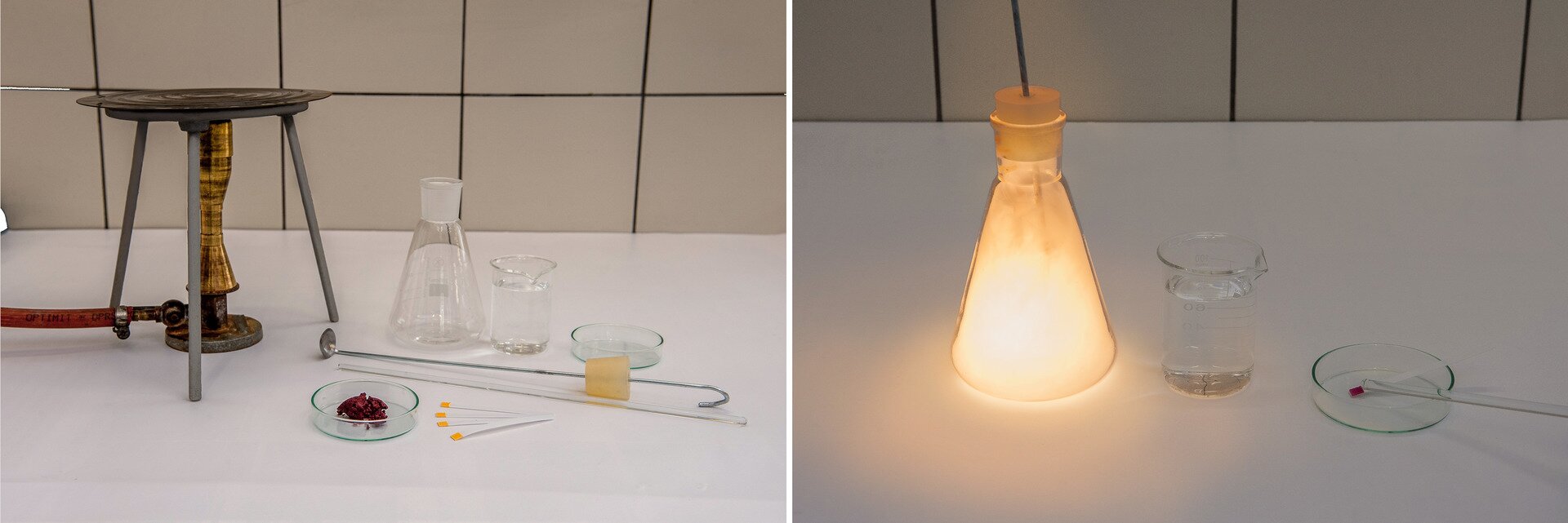
Ilustracja przedstawia przygotowanie kwasu fosforowego pięć phosphoric acid. Ilustracja składa się z dwóch małych obrazków. Na pierwszym obrazku widzimy palnik, trzy szklane pojemnik (jeden o kształcie trójkątnym - kolba stożkowa, drugi przypominający szklankę - zlewka, trzeci płaski szklany spodek w wysokim brzegiem. Wszystkie trzy pojemniki są puste obok leży łyżeczka z długą rączką przeznaczona do spalań. W czwartym spodku znajduje się czerwono-brązowa substancja (fosfor czerwony) oraz szpatułki do mieszania 4. Na drugim obrazku widać płonącą substancję w kolbie zamkniętej korkiem, obok stoi zlewka wypełniona cieczą, na spodeczku leży ubrudzona brązową substancją łyżeczka.
Preparation of phosphoric acid nylon
Summary
As a result of the reaction of combustion of phosphorus (phosphorus forms molecules consisting of four atoms) in oxygen we obtain phosphorus oxide, which has a form of white fumes.
This oxide reacts with water to form acid, as evidenced by the red colour of the universal indicator stripe.
OxoacidoxoacidOxoacid is obtained in the reaction of non‑metal oxide with water:
e.g.
Sulphuric acid is formed in the reaction of sulphur trioxide with oxygen in the presence of catalyst (a substance that accelerates a chemical reaction, without being subject to permanent changes in it):
Some non‑metal oxides do not react with water. Following elements are not subjected to such reaction, for example:
Structure of oxoacids
Names of oxoacids are created by adding an adjectival form of the name of a non‑metal included in the acid residue (with -ic or -ous suffix),
If non‑metal, such as carbon, forms only one oxoacid, its valence is not included in the name. Therefore, the acid with the following formula is called “carbonic acid”.
General formula of acids is:
where: – acid residue (acid residue is composed of an atom or atoms of non‑metal and oxygen atoms), – number of hydrogen atoms in the acid molecule (valency of the acid residue).
R1GTXIuGzyh2O
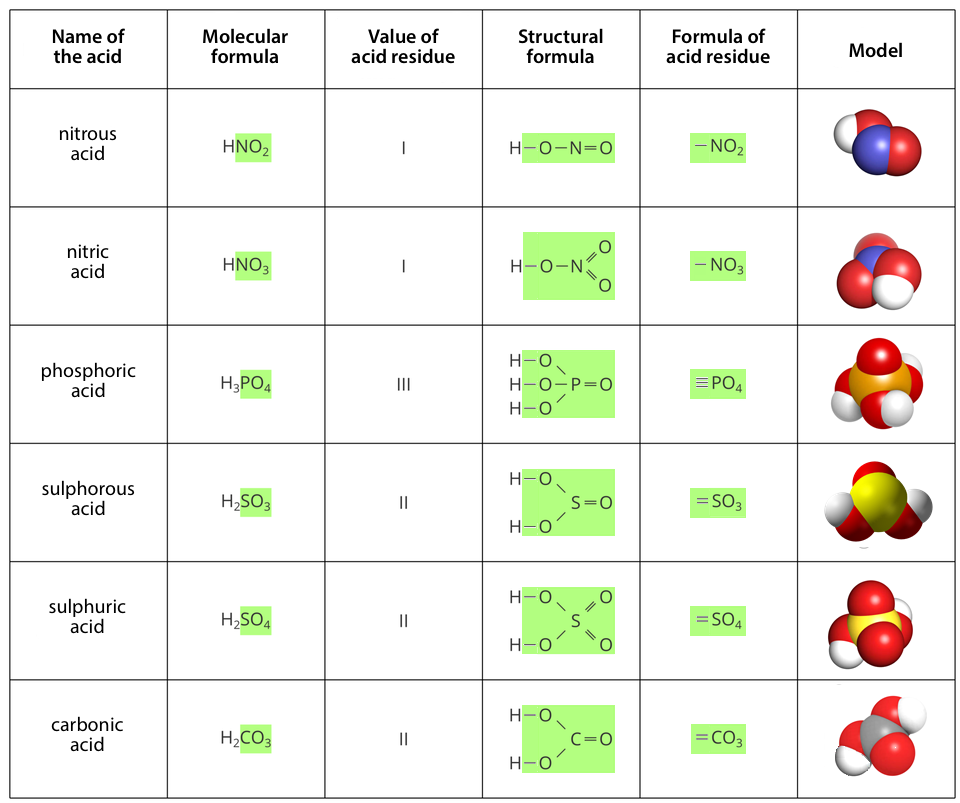
Ilustracja przedstawia tabelę, w której zestawiono cechy sześciu kwasów tlenowych: azotowego trzy, azotowego pięć, fosforowego pięć, siarkowego cztery, siarkowego sześć i węglowego. Wzory sumaryczne tych kwasów to kolejno: ha en o dwa, ha en o trzy, ha trzy pe o cztery, ha dwa es o trzy, ha dwa es o cztery oraz ha dwa ce o trzy. Wartościowość reszty kwasowej pierwszych dwóch związków wynosi jeden, trzeciego trzy, a pozostałych trzech dwa. Tabela zawiera też wzory strukturalne całych kwasów oraz ich reszt kwasowych oraz rysunki przedstawiające graficzne modele cząsteczek.
Oxoacids
Source: Krzysztof Jaworski, licencja: CC BY 3.0.
Acidic oxide – (acid anhydride) is commonly non‑metal oxide, which forms acid in reaction with water.
R189uB37grbOm
Exercise 1
Insert the appropriate formulas or numbers into the empty boxes to make the equations correct. Możliwe odpowiedzi: pe cztery o dziesięć, sześć, dwa ha en o trzy, es o trzy, ha dwa o, ce o dwa, ha dwa es o trzy. 1. Pierwsze równanie reakcji: Uzupełnij dodać Uzupełnij ha dwa o strzałka w prawo przed nawiasem cztery w nawiasie ha trzy pe o cztery 2. Drugie równanie reakcji: en dwa o pięć dodać ha dwa o strzałka w prawo Uzupełnij 3. Trzecie równanie reakcji: Uzupełnij dodać ha dwa o strzałka w prawo ha dwa ce o trzy 4. Czwarte równanie reakcji: es o dwa dodać ha dwa o strzałka w prawo Uzupełnij
Insert the appropriate formulas or numbers into the empty boxes to make the equations correct. Możliwe odpowiedzi: pe cztery o dziesięć, sześć, dwa ha en o trzy, es o trzy, ha dwa o, ce o dwa, ha dwa es o trzy. 1. Pierwsze równanie reakcji: Uzupełnij dodać Uzupełnij ha dwa o strzałka w prawo przed nawiasem cztery w nawiasie ha trzy pe o cztery 2. Drugie równanie reakcji: en dwa o pięć dodać ha dwa o strzałka w prawo Uzupełnij 3. Trzecie równanie reakcji: Uzupełnij dodać ha dwa o strzałka w prawo ha dwa ce o trzy 4. Czwarte równanie reakcji: es o dwa dodać ha dwa o strzałka w prawo Uzupełnij
R1evCmQ7m4eDK
Exercise 2
Select correct answers. Możliwe odpowiedzi: 1. The reaction of dinitrogen pentoxide with water produces nitric acid., 2. Carbonic acid is formed from in the reaction of carbon dioxide with water., 3. Carbon valence is not noted in the carbonic acid name., 4. Hydrochloric acid is an oxoacid., 5. Oxoacid is formed by the reaction of each metal oxide with water.
Select correct answers. Możliwe odpowiedzi: 1. The reaction of dinitrogen pentoxide with water produces nitric acid., 2. Carbonic acid is formed from in the reaction of carbon dioxide with water., 3. Carbon valence is not noted in the carbonic acid name., 4. Hydrochloric acid is an oxoacid., 5. Oxoacid is formed by the reaction of each metal oxide with water.
Summary
Oxoacids are formed as a result of the reaction of some non‑metal oxides with water.
The valency of the acid residue is equal to the number of hydrogen atoms in the molecule of this acid.
R18Tcfx8PL0qw1
Grafika przedstawiająca tablicę szkolną, na której znajdują się zdania do dokończenia. Finish selected sentences. 1 It was easy for me (uzupełnij). 2 It was difficult for me (uzupełnij). 3 Today I learned (uzupełnij). 4 I understood that (uzupełnij). 5 It surprised me (uzupełnij). 6. Today I found out (uzupełnij). 7. I was interested in (uzupełnij). 8. I still have to repeat (uzupełnij).
Grafika przedstawiająca tablicę szkolną, na której znajdują się zdania do dokończenia. Finish selected sentences. 1 It was easy for me (uzupełnij). 2 It was difficult for me (uzupełnij). 3 Today I learned (uzupełnij). 4 I understood that (uzupełnij). 5 It surprised me (uzupełnij). 6. Today I found out (uzupełnij). 7. I was interested in (uzupełnij). 8. I still have to repeat (uzupełnij).
Source: GroMar Sp. z o.o., licencja: CC BY-SA 3.0.
Key words
oxoacids, valence of non‑metal in the molecule of acid, nitrous acid, nitric acid, phosphoric acid, sulphurous acid, sulphuric acid, carbonic acid, general formula of acids
kwas tlenowy – związek chemiczny, którego cząsteczki zbudowane są z jednego atomu lub większej liczby atomów wodoru i reszty kwasowej zawierającej atom(y) tlenu