bg‑azure

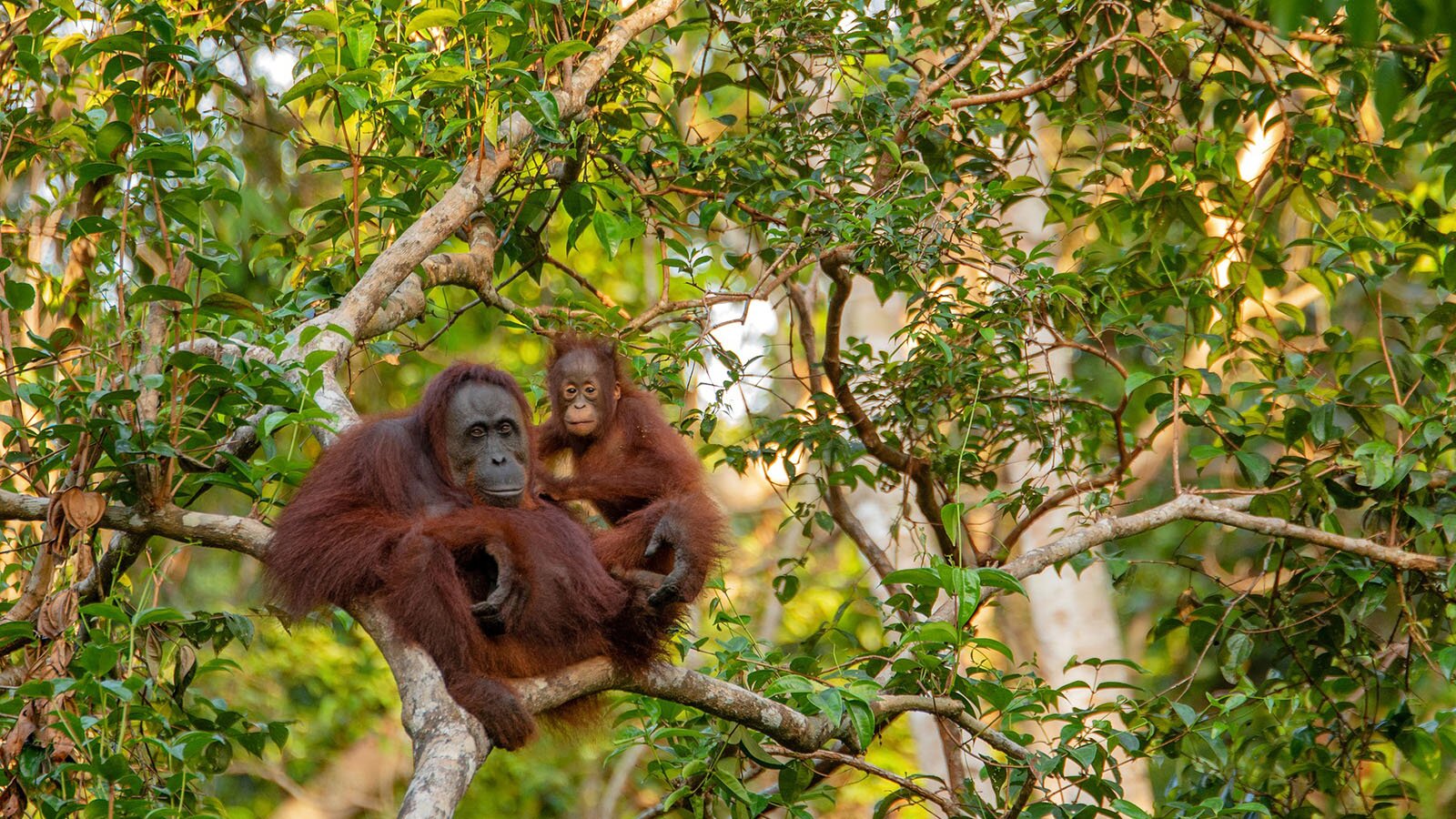
You are now aware of the reasons why animals may face extinction. Study the interactive illustration to find out what animal species are endangered and why it’s important to protect them.

Wiesz już, dlaczego niektóre zwierzęta mogą wkrótce wyginąć. Przestudiuj ilustrację interaktywną, aby dowiedzieć się, jakie gatunki są zagrożone i dlaczego ważna jest ich ochrona.
R1IbpCXmeedqE
Let us live!
Pozwól nam żyć!
Źródło: dostępny w internecie: https://pixabay.com/ [dostęp 17.05.2022], domena publiczna.
Exercise 1
R19VwSlclu74q
It’s got a trunk and tusks. Możliwe odpowiedzi: 1. leopard, 2. dolphin, 3. tiger, 4. rhino, 5. elephant, 6. orangutan, 7. gorilla It’s got spotted skin and is very strong. Możliwe odpowiedzi: 1. leopard, 2. dolphin, 3. tiger, 4. rhino, 5. elephant, 6. orangutan, 7. gorilla It’s got two horns (sometimes three). Możliwe odpowiedzi: 1. leopard, 2. dolphin, 3. tiger, 4. rhino, 5. elephant, 6. orangutan, 7. gorilla It’s got reddish fur and is highly intelligent. Możliwe odpowiedzi: 1. leopard, 2. dolphin, 3. tiger, 4. rhino, 5. elephant, 6. orangutan, 7. gorilla It’s got a broad chest and shoulders and human-like hands. Możliwe odpowiedzi: 1. leopard, 2. dolphin, 3. tiger, 4. rhino, 5. elephant, 6. orangutan, 7. gorilla It’s got smooth grey skin and fins. Możliwe odpowiedzi: 1. leopard, 2. dolphin, 3. tiger, 4. rhino, 5. elephant, 6. orangutan, 7. gorilla It’s the largest cat. It’s got black stripes on orange fur. Możliwe odpowiedzi: 1. leopard, 2. dolphin, 3. tiger, 4. rhino, 5. elephant, 6. orangutan, 7. gorilla
Źródło: GroMar Sp. z o.o., licencja: CC BY-SA 3.0.

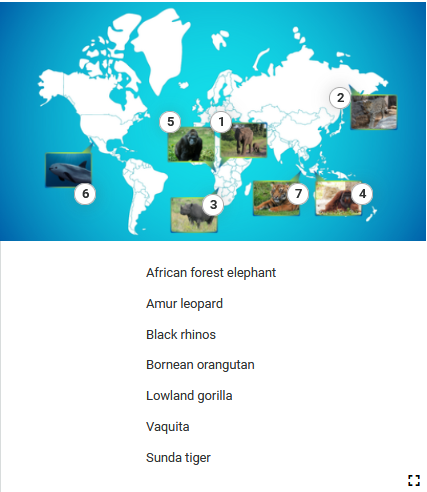
Study the illustration and do the exercises below.
1
R1biEIJP6gCnt
Źródło: GroMar Sp. z o.o., licencja: CC BY-SA 3.0.

Ilustracja przedstawia mapę geograficzną świata, na której umieszczono fotografie zwierząt. Widoczne są zdjęcia orangutana, goryla, tygrysa saudyjskiego, słonia, leoparda, nosorożca czarnego i morświn kalifornijski. Ilustracja posiada siedem punktów interaktywnych, po naciśnięciu których pojawiają się tekst oraz nagrania. Transkrypcja do nagrań znajduje się poniżej.

AFRICAN FOREST ELEPHANT

Zdjęcie nr 1 przedstawia dorosłą słonicę ze słoniątkiem idących piaszczystą drogą.

AMUR LEOPARD

Zdjęcie nr 2 przedstawia dużego kota w cętki.

BLACK RHINOS

Zdjęcie nr 3 przedstawia szarego nosorożca.

BORNEAN ORANGUTAN

Zdjęcie nr 4 przedstawia dużą małpę porośniętą rudą sierścią siedzącą na ziemi.

LOWLAND GORILLA

Zdjęcie nr 5 przedstawia małpę, której sierść jest czarna.

VAQUITA

Zdjęcie nr 6 przedstawia ssaka morskiego.

SUNDA TIGER

Zdjęcie nr 7 przedstawia leżącego w trawie tygrysa.

TRANSCRIPTazurewhite
Exercise 2
R7P9QXdnsOlWz
African forest elephant Możliwe odpowiedzi: 1. Their skins can be sold from 500 to 1,000 $., 2. About 400 individuals left., 3. It would take 75 years for the population to recover., 4. Their parts are used in folk medicine, especially in Vietnam and China., 5. They are sold as pets., 6. Their number fell by 98%, 7. Only about 10 left., 8. Fewer than 100 in the wild., 9. Oil palm plantations have reduced their habitats., 10. The Ebola virus is their greatest threat., 11. Their habitats have shrunk by 55%., 12. Population fell by 62%., 13. Nets are the most dangerous for them., 14. Help to maintain biodiversity. Amur leopard Możliwe odpowiedzi: 1. Their skins can be sold from 500 to 1,000 $., 2. About 400 individuals left., 3. It would take 75 years for the population to recover., 4. Their parts are used in folk medicine, especially in Vietnam and China., 5. They are sold as pets., 6. Their number fell by 98%, 7. Only about 10 left., 8. Fewer than 100 in the wild., 9. Oil palm plantations have reduced their habitats., 10. The Ebola virus is their greatest threat., 11. Their habitats have shrunk by 55%., 12. Population fell by 62%., 13. Nets are the most dangerous for them., 14. Help to maintain biodiversity. Black rhino Możliwe odpowiedzi: 1. Their skins can be sold from 500 to 1,000 $., 2. About 400 individuals left., 3. It would take 75 years for the population to recover., 4. Their parts are used in folk medicine, especially in Vietnam and China., 5. They are sold as pets., 6. Their number fell by 98%, 7. Only about 10 left., 8. Fewer than 100 in the wild., 9. Oil palm plantations have reduced their habitats., 10. The Ebola virus is their greatest threat., 11. Their habitats have shrunk by 55%., 12. Population fell by 62%., 13. Nets are the most dangerous for them., 14. Help to maintain biodiversity. Borneo orangutan Możliwe odpowiedzi: 1. Their skins can be sold from 500 to 1,000 $., 2. About 400 individuals left., 3. It would take 75 years for the population to recover., 4. Their parts are used in folk medicine, especially in Vietnam and China., 5. They are sold as pets., 6. Their number fell by 98%, 7. Only about 10 left., 8. Fewer than 100 in the wild., 9. Oil palm plantations have reduced their habitats., 10. The Ebola virus is their greatest threat., 11. Their habitats have shrunk by 55%., 12. Population fell by 62%., 13. Nets are the most dangerous for them., 14. Help to maintain biodiversity. Lowland gorilla Możliwe odpowiedzi: 1. Their skins can be sold from 500 to 1,000 $., 2. About 400 individuals left., 3. It would take 75 years for the population to recover., 4. Their parts are used in folk medicine, especially in Vietnam and China., 5. They are sold as pets., 6. Their number fell by 98%, 7. Only about 10 left., 8. Fewer than 100 in the wild., 9. Oil palm plantations have reduced their habitats., 10. The Ebola virus is their greatest threat., 11. Their habitats have shrunk by 55%., 12. Population fell by 62%., 13. Nets are the most dangerous for them., 14. Help to maintain biodiversity. Vaquita Możliwe odpowiedzi: 1. Their skins can be sold from 500 to 1,000 $., 2. About 400 individuals left., 3. It would take 75 years for the population to recover., 4. Their parts are used in folk medicine, especially in Vietnam and China., 5. They are sold as pets., 6. Their number fell by 98%, 7. Only about 10 left., 8. Fewer than 100 in the wild., 9. Oil palm plantations have reduced their habitats., 10. The Ebola virus is their greatest threat., 11. Their habitats have shrunk by 55%., 12. Population fell by 62%., 13. Nets are the most dangerous for them., 14. Help to maintain biodiversity. Sunda tiger Możliwe odpowiedzi: 1. Their skins can be sold from 500 to 1,000 $., 2. About 400 individuals left., 3. It would take 75 years for the population to recover., 4. Their parts are used in folk medicine, especially in Vietnam and China., 5. They are sold as pets., 6. Their number fell by 98%, 7. Only about 10 left., 8. Fewer than 100 in the wild., 9. Oil palm plantations have reduced their habitats., 10. The Ebola virus is their greatest threat., 11. Their habitats have shrunk by 55%., 12. Population fell by 62%., 13. Nets are the most dangerous for them., 14. Help to maintain biodiversity.
Źródło: GroMar Sp. z o.o., licencja: CC BY-SA 3.0.
Exercise 3
R10P4F0VIZg4L
  1. The main threat for Borneo orangutans and lowland gorillas is their low reproduction rate. TRUE FALSE
  2. Environmentalists don’t know the exact numbers of African elephants and lowland gorillas. TRUE FALSE
  3. The biggest threats for black rhinos and lowland gorillas are poachers. TRUE FALSE
  4. Bornean orangutans and African elephants are important for biodiversity because they disperse seeds. TRUE FALSE
  5. Special protected areas have been created for Amur leopards and black rhinos.TRUE FALSE
  6. Nets are the biggest threat for the vaquita and lowland gorillas. TRUE FALSE
  7. The parts of the Sunda tiger and black rhino are used in Asian medicine. TRUE FALSE
Źródło: GroMar Sp. z o.o., licencja: CC BY-SA 3.0.
Exercise 4
Roxdxs243ijp2
1. The main reason for hunting elephants is a growing demand for iTu uzupełnij. 2. After passing through the elephant's digestive tract, the seeds of these trees gTu uzupełnij. 3. The Amur leopard's gorgeous, spotted fur is a major dTu uzupełnij for poachers. 4. Because black rhinos have two horns, they are a lTu uzupełnij target for the illegal rhino horn trade. 5. The pet trade for young orangutans is tTu uzupełnij. 6. According to some eTu uzupełnij, Ebola has killed almost one-third of the world's wild lowland gorillas. 7. Because orangutans have such a poor reproduction rate, this poses a serious tTu uzupełnij to natural populations. 8. The vaquita get eTu uzupełnij and drown in the nets which are intended for other marine animals.
Źródło: GroMar Sp. z o.o., licencja: CC BY-SA 3.0.
Exercise 5

Prepare a short speech about two of the endangered species you’ve learnt about in this section. Use some of the following words/phrases:

growing demand for

estimates

lucrative target

major draw

biodiversity

greatest threat

numbers fell

thriving

conservation efforts

R1JbbyNb7TfCa
(Uzupełnij).
Źródło: GroMar Sp. z o.o., licencja: CC BY-SA 3.0.