How Did Europe Change in the First Half of the Nineteenth Century? (revision class)
what was the significance of the French and Industrial Revolutions;
what were the most important ideologies of the first half of the nineteenth century;
what were the most important terms, events and dates pertaining to the turn of the eighteenth century and the first half of the nineteenth century.
In the second half of the nineteenth century, the population of Europe grew by over 40%, and new social forces appeared: the large‑industry
The bourgeoisiebourgeoisie, the intelligentsia, and the proletariat, or the hired workers of industrial plants. Two great political ideologies, liberalism and conservatism, attempted to stand up to the political and economic experiences of the French and Industrial Revolutions. Industrialization and capitalism caused the birth of movements and ideologies postulating the improvement of working conditions and the workers’ lives. They were philanthropy and socialismsocialism, which first aimed to find peaceful methods for the improvement of capitalist social relations. However, the radical ideas of Marx and Engels postulating the abolition of capitalism by means of revolution turned out to be politically stronger.
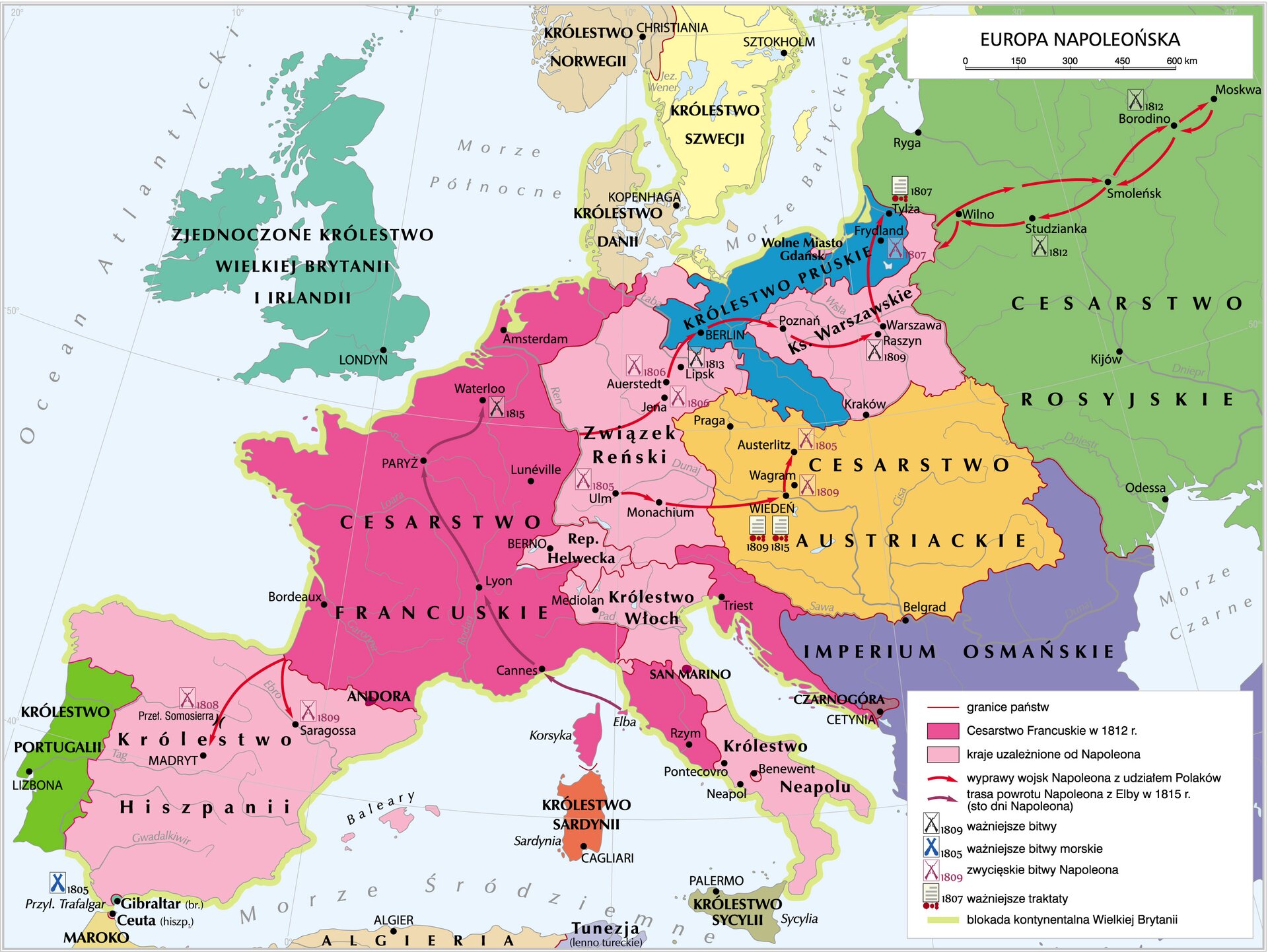
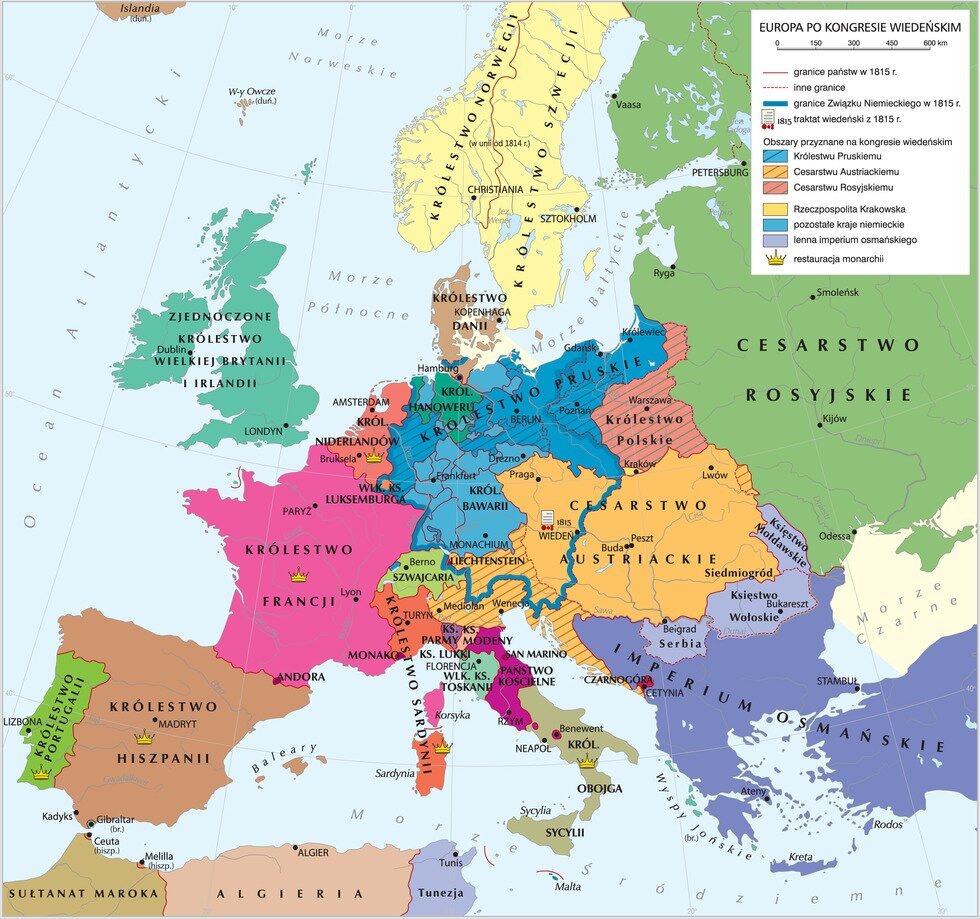
During his rule, Napoleon I won numerous wars against anti‑French coalition. He combined the territories taken from Prussia and Austria into the Duchy of Warsaw. In 1812, he was defeated during his Russian campaign, and after having been defeated in the Battle of Waterloo, he was sentenced to life internment on the island of Saint Helena. In the autumn of 1814, the Congress of Vienna adopted decisions pertaining to the European order. The Holy AllianceHoly Alliance was created in order to combat revolutionary movements in Europe. Russia retook the rule in the Kingdom of Poland, albeit reduced in size. The Grand Duchy of Posen and the Republic of Cracow were created. The violation of civil and national liberties by the Tsar in the Kingdom of Poland led to the November Uprising of 1830, which ended in the Poles’ defeat and the elimination of the state’s autonomous institutions. The emigré Polish Democratic Society attempted to prepare a people’s uprising in all of the three Partitions in 1846; however, the only place where the revolt actually happened was Cracow. At the same time, the Polish peasants of Galicia revolted against the local nobility (the Galician Slaughter). The Republic of Cracow was dissolved and united with Austria.
In 1848‑1849, almost all of Europe witnessed revolutionary uprisings (an event known as the Spring of Nations). In France, as a result of the February Revolution, the monarchy was abolished, and the Second Republic was proclaimed, only to be converted into the Second Empire by Louis‑Napoleon Bonaparte not long afterwards. The Hungarians began the fight for their independence, but were pacified. In the German and Italian states, efforts were undertaken to consolidate the smaller units into the respective two countries. In the Polish territories, revolutionary uprisings took place in the Grand Duchy of Posen and Galicia. They were quelled, but the Poles of Greater Poland earned representation in the Prussian Parliament, and the Austrian authorities enacted an enfranchisement reform in Galicia.
Complete your knowledge of the selected battles of the Napoleonic era.
Which of the following inventions were used in the first half of the nineteenth century in the textile industry, and which in transport? Some of them were used in both. Think about the implications of this fact.
1784 – mechanical textile workshop, 1733 – weaving shuttle, 1807 – steamship, 1769 – steam engine, 1765 – crank-powered spinning frame, 1814 – steam locomotive, 1769 – steam engine, 1779 – mechanical spinning mule
| Textile industry | |
|---|---|
| Transport |
The names and views of the top theorians of liberalism, conservatism and socialism have been scrambled. Put them back in order.
researching the causes of poverty and wealth in the world, he maintained that only the free actions of industrious people who wish to make profit could create a harmonious whole, increasing the wealth of everyone. This is why he advocated the liberty of economic activity., he dreamed of the abolition of the state as an institution of violence, and creating self-governing communities in its place. He called for the elimination of income not being a product of people’s own activity., he counted the proprietors of the means of production – that is, factories, steelworks, and mines – among the exploiters operating in the various fields of the developing capitalism. Initiating a historically-inevitable revolt, the proletarians were to act not only in their own interest, but also for the benefit of all mankind., he thought that the objective of any action should be “the greatest happiness of the greatest number of people”, as everyone is united by the same egoistical need to experience pleasure and avoid suffering., he maintained that politicians should apply careful moderation, due to his limited faith in the power of human reason. He maintained that it would be best to trust the “collective intellect, seeped in ancient wisdom”, and the rhythm of the generations that provies support to social life.
| Adam Smith | |
| Karl Marx | |
| Edmund Burke | |
| Jeremy Bentham | |
| Pierre Joseph Proudhon |
Place the events on the timeline:
Połącz wydarzenia z datami
1846,
1849,
1815,
1789,
1812,
1830
| The beginning of the French Revolution | |
| Napoleon’s Moscow expedition | |
| The conclusion of the Congress of Vienna | |
| The beginning of the November Uprising | |
| The Galician Slaughter | |
| The stifling of the Spring of Nations |
Explain what events, people and phenomena do the following conventional terms refer to:
white gold,
battle of the nations,
Emperor of the French,
Spring of Nations,
Lawyers’ Revolution,
Holy AllianceHoly Alliance,
gendarme of Europe.
Keywords
Communism, pacification, proclamation, socialism
Glossary
Absolutyzm – system władzy w monarchiach wczesnonowożytnych, władzę króla ograniczały tylko prawa naturalne i podstawowe normy ustrojowe, takie jak sukcesja tronu
Bonapartyzm – nazwa systemu politycznego, zaprowadzonego przez Napoleona Bonaparte; rodzaj władzy opartej na autorytecie władcy odnoszącego sukcesy militarne i wprowadzającego rewolucyjne zmiany ustrojowe (konstytucje).
Burżuazja – warstwa wykształconych i majętnych mieszkańców miast
Komunizm – teoria głosząca nieuchronność upadku kapitalizmu i potrzebę działań dla osiągnięcia tego celu; niekiedy stosowane zamiennie z pojęciem socjalizm; w języku potocznym ustrój społeczny w państwach rządzonych przez partie komunistyczne
Orientacja polityczna – zajmowanie określonego stanowiska w kwestii politycznej; odnosi się również do metod walki o niepodległość narodu
Pacyfikacja – brutalne tłumienie buntów i powstań narodowych siłą zbrojną
Proklamacja – ogłoszenie czegoś, obwieszczenie
Socjalizm – zbiorcze określenie ideologii i ruchów społecznych powstałych w XIX w., które chciały oprzeć ład społeczny na zasadach wspólnoty, równości i racjonalnego zarządzania gospodarką
Święte Przymierze – sojusz Rosji, Austrii i Prus z 1815 r., zawarty w celu walki z ruchami rewolucyjnymi w Europie.