A painting by the eminent historical painter Ilya Repin (1844–1930) in the years 1880–1891. It depicts the scene of writing a letter to the sultan in 1676. The painting was created in several versions. Following successes at international exhibitions, it was purchased by Tsar Alexander III. It is currently kept in Saint Petersburg.
Source: Ilja Riepin, Zaporożcy piszą do sułtana tureckiego, 1880-1891, olej na płótnie, Muzeum Rosyjskie w Sankt Petersburgu, domena publiczna.
ZaporizhiaZaporizhiaZaporizhia, called the ‘Wild Fields’ in the 17th century, is an area in southeastern Ukraine, which used to be inhabited by the CossacksCossacksCossacks. These were often fugitives prosecuted by law, peasants seeking freedom, adventurous townspeople, or noblemen deprived of their property. They were led by an atamanAtamanataman.
The Polish king Sigismund II Augustus appreciated the combat value of the Cossacks, and issued the so‑called Cossack register. Registered Cossacks, in return for their service and struggle in defense of the Polish borders, were to receive pay. However, many of them found themselves outside the register which, among other things, led to revolts.
The biggest of them was the uprising which broke out in 1648 and was led by Bohdan Khmelnytsky. Taking advantage of the growing dissatisfaction among the Cossacks, he attacked Poland. He received help from the TatarsTatarsTatars under the command of Tugay Bey, and together with them he won in the Battles of Zhovti Vody and Korsuń. Another defeat of the Poles happened in the Battle of Pyliavtsi. Khmelnytsky managed to reach Lviv and Zamość.
The breakthrough moment for the Poles was the heroic defense of Zbarazh under the command of Jeremi Wiśniowiecki. Next, the Polish army led by King John II Casimir defeated the Cossacks in the Battle of Berestechko. However, this did put an end to the conflict with the Cossacks. In 1654, by virtue of the Cossack‑Russian settlement in Pereyaslav, Ukraine came under the rule of the Tsar. This decision triggered a war between Poland and Russia. It was ended by the Truce of Andrusovo in 1667, under which Ukraine was divided into the Polish part (on the right bank of the Dnieper River) and the Moscow part (on the left bank of the Dnieper River). Poland also lost Smolensk and Kiev.
Task 1
R6cQjWyg3AM70
Ułóż pięć haseł do krzyżówki związanej z malarstwem Kossaka.
Ułóż pięć haseł do krzyżówki związanej z malarstwem Kossaka.
Create a crossword whose answers will be related to the Cossacks.
Task 2
Poszerz swoją wiedzę na temat biografii hetmana Bohdana Chmielnickiego i króla Jana Kazimierza.
Poszerz swoją wiedzę na temat biografii hetmana Bohdana Chmielnickiego i króla Jana Kazimierza.
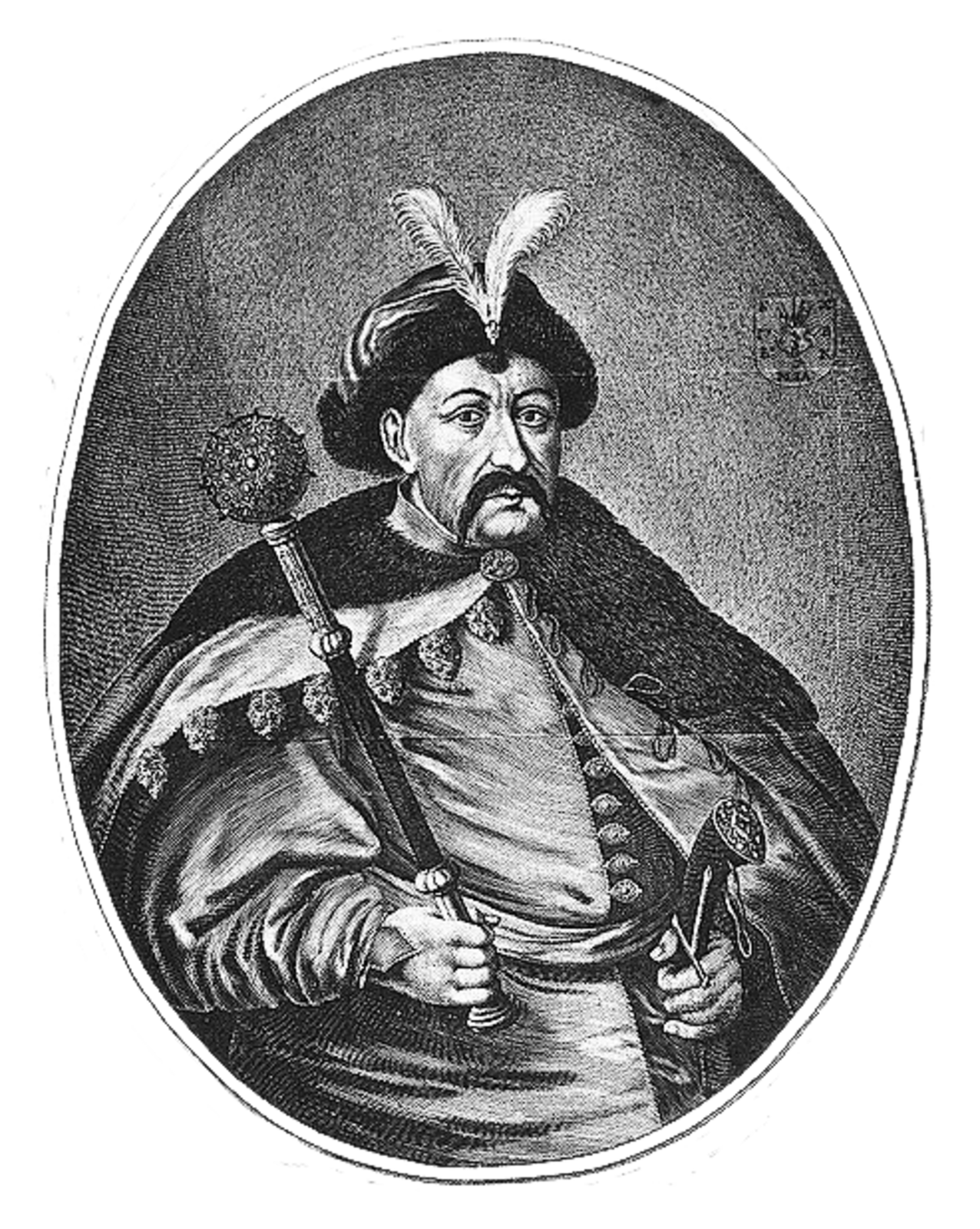
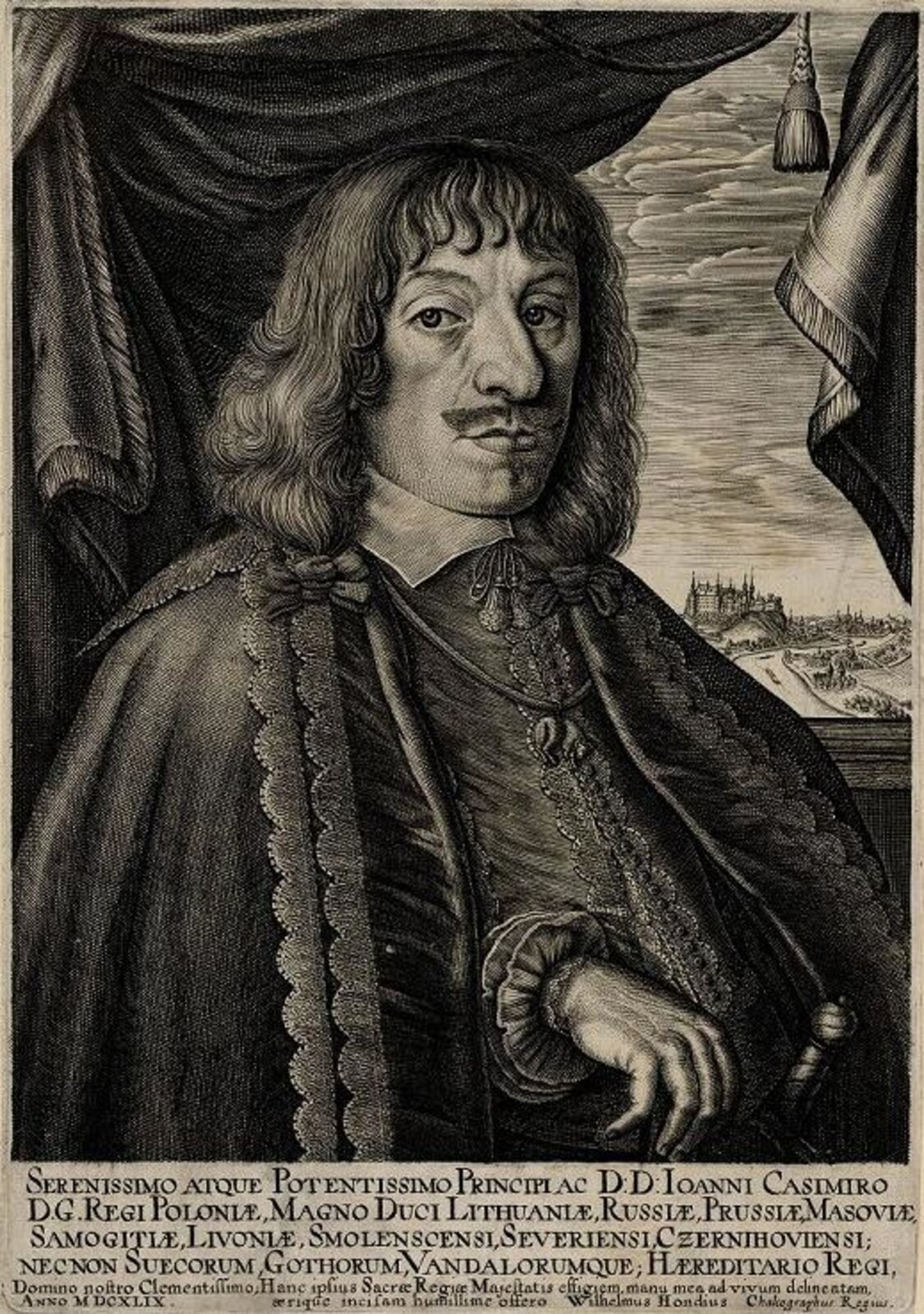
Compare both portraits. Answer the question, what makes so far‑reaching similarity in the way both figures are presented.
R98vBtMc4ikF2
Ilustracja przedstawiająca portret hetmana Bohdana Chmielnickiego.
Portrait of Hetman Bohdan Chmielnicki - engraved by Wilhelm Hondius (1597-1652) a Dutch artist who moved to Commonwealth in 1637 and made a series of portraits of people related to the court of Władysław IV and Jan Kazimierz.
Source: Willem Hondius, domena publiczna.
R1IgHUC4gZQaE
Ilustracja przedstawiająca portret króla Jana Kazimierza.
A portrait of King Jan Kazimierz made by the same artist.
Source: Willem Hondius, domena publiczna.
Task 3
Poszerz swoją wiedzę na temat zasięgu powstania Chmielnickiego, szukając dodatkowych informacji w dostępnych ci źródłach (np. w internecie, encyklopedii lub specjalistycznych publikacjach).
Poszerz swoją wiedzę na temat zasięgu powstania Chmielnickiego, szukając dodatkowych informacji w dostępnych ci źródłach (np. w internecie, encyklopedii lub specjalistycznych publikacjach).
Show the farthest reach of the Chmielnicki Uprising. Which urban centers of the Commonwealth were threatened by Cossacks?
RBKpa95ZVffiX
Grafika mapy przedstawiającej Powstanie Chmielnickiego.
Chmielnicki uprising
Source: Krystian Chariza i zespół, Wikimedia Commons, licencja: CC BY-SA 4.0.
R1RMM0ujeNTYj
Exercise 1
Match the terms to the definitions. Ataman Możliwe odpowiedzi: 1. also known as the ‘Wild Fields’ in the 17th century – an area in southeastern Ukraine., 2. the people living on the Dnieper River, composed of fugitive peasants, impoverished nobility and townsmen, as well as criminals., 3. Cossacks’ military settlement located on the Dnieper River., 4. a kind of a Cossack war camp built of wagons arranged in a triangle or quadrangle., 5. a nomadic people that used to live in the steppes of Central Asia (today’s Mongolia), the area by the Lake Baikal and the Black Sea., 6. the leader of the Sich, and the commander of the Cossacks. Cossacks Możliwe odpowiedzi: 1. also known as the ‘Wild Fields’ in the 17th century – an area in southeastern Ukraine., 2. the people living on the Dnieper River, composed of fugitive peasants, impoverished nobility and townsmen, as well as criminals., 3. Cossacks’ military settlement located on the Dnieper River., 4. a kind of a Cossack war camp built of wagons arranged in a triangle or quadrangle., 5. a nomadic people that used to live in the steppes of Central Asia (today’s Mongolia), the area by the Lake Baikal and the Black Sea., 6. the leader of the Sich, and the commander of the Cossacks. Sich Możliwe odpowiedzi: 1. also known as the ‘Wild Fields’ in the 17th century – an area in southeastern Ukraine., 2. the people living on the Dnieper River, composed of fugitive peasants, impoverished nobility and townsmen, as well as criminals., 3. Cossacks’ military settlement located on the Dnieper River., 4. a kind of a Cossack war camp built of wagons arranged in a triangle or quadrangle., 5. a nomadic people that used to live in the steppes of Central Asia (today’s Mongolia), the area by the Lake Baikal and the Black Sea., 6. the leader of the Sich, and the commander of the Cossacks. Tabor (wagon fort) Możliwe odpowiedzi: 1. also known as the ‘Wild Fields’ in the 17th century – an area in southeastern Ukraine., 2. the people living on the Dnieper River, composed of fugitive peasants, impoverished nobility and townsmen, as well as criminals., 3. Cossacks’ military settlement located on the Dnieper River., 4. a kind of a Cossack war camp built of wagons arranged in a triangle or quadrangle., 5. a nomadic people that used to live in the steppes of Central Asia (today’s Mongolia), the area by the Lake Baikal and the Black Sea., 6. the leader of the Sich, and the commander of the Cossacks. Tatars Możliwe odpowiedzi: 1. also known as the ‘Wild Fields’ in the 17th century – an area in southeastern Ukraine., 2. the people living on the Dnieper River, composed of fugitive peasants, impoverished nobility and townsmen, as well as criminals., 3. Cossacks’ military settlement located on the Dnieper River., 4. a kind of a Cossack war camp built of wagons arranged in a triangle or quadrangle., 5. a nomadic people that used to live in the steppes of Central Asia (today’s Mongolia), the area by the Lake Baikal and the Black Sea., 6. the leader of the Sich, and the commander of the Cossacks. Zaporizhia Możliwe odpowiedzi: 1. also known as the ‘Wild Fields’ in the 17th century – an area in southeastern Ukraine., 2. the people living on the Dnieper River, composed of fugitive peasants, impoverished nobility and townsmen, as well as criminals., 3. Cossacks’ military settlement located on the Dnieper River., 4. a kind of a Cossack war camp built of wagons arranged in a triangle or quadrangle., 5. a nomadic people that used to live in the steppes of Central Asia (today’s Mongolia), the area by the Lake Baikal and the Black Sea., 6. the leader of the Sich, and the commander of the Cossacks.
Match the terms to the definitions. Ataman Możliwe odpowiedzi: 1. also known as the ‘Wild Fields’ in the 17th century – an area in southeastern Ukraine., 2. the people living on the Dnieper River, composed of fugitive peasants, impoverished nobility and townsmen, as well as criminals., 3. Cossacks’ military settlement located on the Dnieper River., 4. a kind of a Cossack war camp built of wagons arranged in a triangle or quadrangle., 5. a nomadic people that used to live in the steppes of Central Asia (today’s Mongolia), the area by the Lake Baikal and the Black Sea., 6. the leader of the Sich, and the commander of the Cossacks. Cossacks Możliwe odpowiedzi: 1. also known as the ‘Wild Fields’ in the 17th century – an area in southeastern Ukraine., 2. the people living on the Dnieper River, composed of fugitive peasants, impoverished nobility and townsmen, as well as criminals., 3. Cossacks’ military settlement located on the Dnieper River., 4. a kind of a Cossack war camp built of wagons arranged in a triangle or quadrangle., 5. a nomadic people that used to live in the steppes of Central Asia (today’s Mongolia), the area by the Lake Baikal and the Black Sea., 6. the leader of the Sich, and the commander of the Cossacks. Sich Możliwe odpowiedzi: 1. also known as the ‘Wild Fields’ in the 17th century – an area in southeastern Ukraine., 2. the people living on the Dnieper River, composed of fugitive peasants, impoverished nobility and townsmen, as well as criminals., 3. Cossacks’ military settlement located on the Dnieper River., 4. a kind of a Cossack war camp built of wagons arranged in a triangle or quadrangle., 5. a nomadic people that used to live in the steppes of Central Asia (today’s Mongolia), the area by the Lake Baikal and the Black Sea., 6. the leader of the Sich, and the commander of the Cossacks. Tabor (wagon fort) Możliwe odpowiedzi: 1. also known as the ‘Wild Fields’ in the 17th century – an area in southeastern Ukraine., 2. the people living on the Dnieper River, composed of fugitive peasants, impoverished nobility and townsmen, as well as criminals., 3. Cossacks’ military settlement located on the Dnieper River., 4. a kind of a Cossack war camp built of wagons arranged in a triangle or quadrangle., 5. a nomadic people that used to live in the steppes of Central Asia (today’s Mongolia), the area by the Lake Baikal and the Black Sea., 6. the leader of the Sich, and the commander of the Cossacks. Tatars Możliwe odpowiedzi: 1. also known as the ‘Wild Fields’ in the 17th century – an area in southeastern Ukraine., 2. the people living on the Dnieper River, composed of fugitive peasants, impoverished nobility and townsmen, as well as criminals., 3. Cossacks’ military settlement located on the Dnieper River., 4. a kind of a Cossack war camp built of wagons arranged in a triangle or quadrangle., 5. a nomadic people that used to live in the steppes of Central Asia (today’s Mongolia), the area by the Lake Baikal and the Black Sea., 6. the leader of the Sich, and the commander of the Cossacks. Zaporizhia Możliwe odpowiedzi: 1. also known as the ‘Wild Fields’ in the 17th century – an area in southeastern Ukraine., 2. the people living on the Dnieper River, composed of fugitive peasants, impoverished nobility and townsmen, as well as criminals., 3. Cossacks’ military settlement located on the Dnieper River., 4. a kind of a Cossack war camp built of wagons arranged in a triangle or quadrangle., 5. a nomadic people that used to live in the steppes of Central Asia (today’s Mongolia), the area by the Lake Baikal and the Black Sea., 6. the leader of the Sich, and the commander of the Cossacks.
Match the terms to the definitions.
the leader of the Sich, and the commander of the Cossacks., Cossacks’ military settlement located on the Dnieper River., the people living on the Dnieper River, composed of fugitive peasants, impoverished nobility and townsmen, as well as criminals., a kind of a Cossack war camp built of wagons arranged in a triangle or quadrangle., a nomadic people that used to live in the steppes of Central Asia (today’s Mongolia), the area by the Lake Baikal and the Black Sea., also known as the ‘Wild Fields’ in the 17th century – an area in southeastern Ukraine.
Carstwo Rosyjskie (Wielkie Księstwo Moskiewskie) – państwo będące kontynuacją Wielkiego Księstwa Moskiewskiego, powstałe w 1547 wraz z koronacją Iwana IV Groźnego na „cara Wszechrusi”. Przestało istnieć w 1721 roku na rzecz Imperium Rosyjskiego, kiedy to Piotr I przyjął tytuł cesarza‑imperatora.