Cnidarians
animals and plants differ, among others, in the way they feed;
the structure of all organisms depends on the living environment.
describe the external structure of cnidarians;
determine if an unfamiliar organism is a representative of cnidarians;
compare the structure of a polyp and a medusa;
describe the way of feeding and breeding of cnidarians;
describe the meaning of cnidarians.
What do you know about cnidarians? Save your associations below.
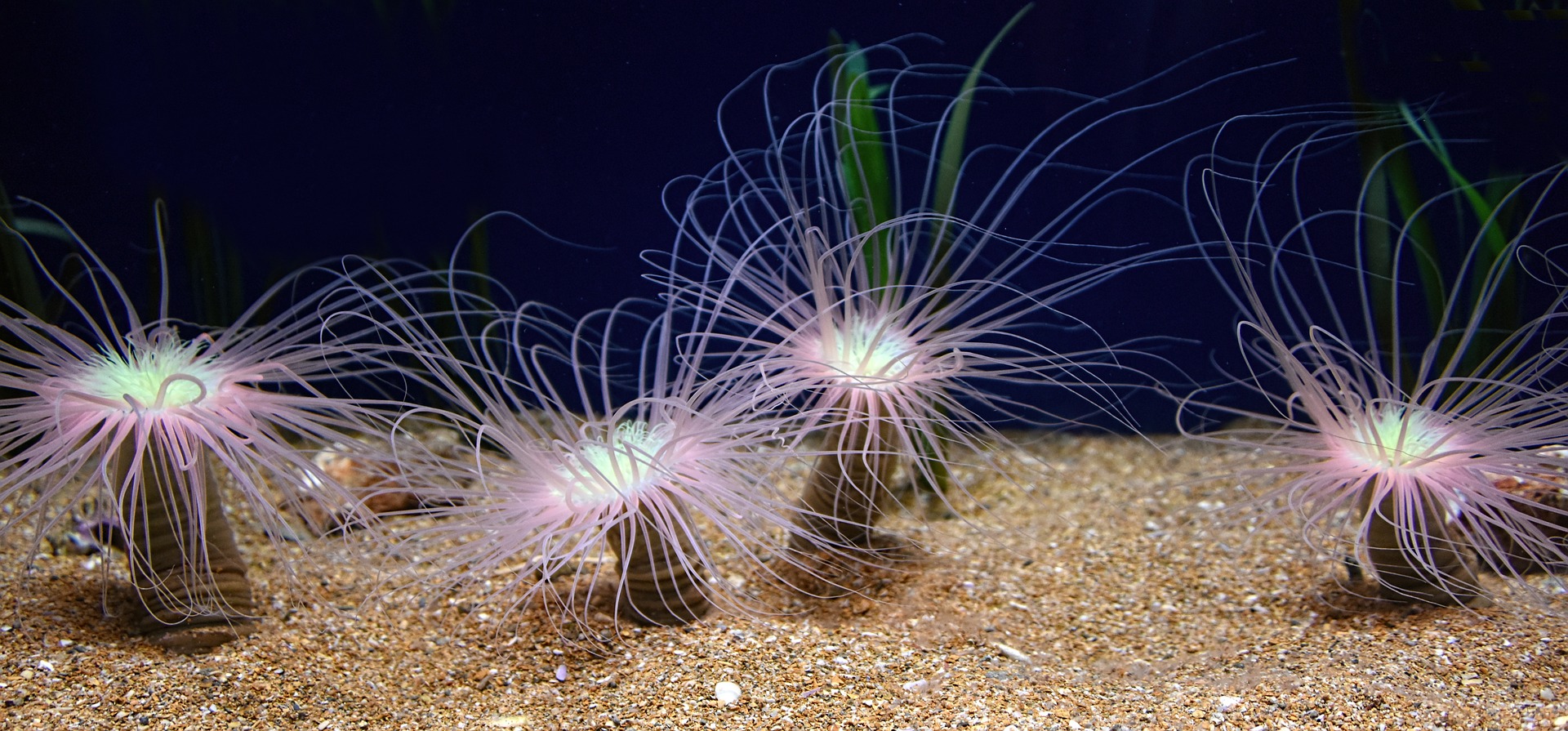
Characteristics of animals
Animals are heterotrophic, unable to produce food on their own. They take the energy required for functioning from food. They feed on plants and other organisms they actively hunt for, or on carrion and organic debris found in water or soil. Most animals travel in search of food or a partner for breeding, while other animals lead a sedentary lifestyle.
Suggest a way to determine whether sea anemone, which belongs to cnidarians, is an animal or perhaps a plant.
What is cnidarians body structure?
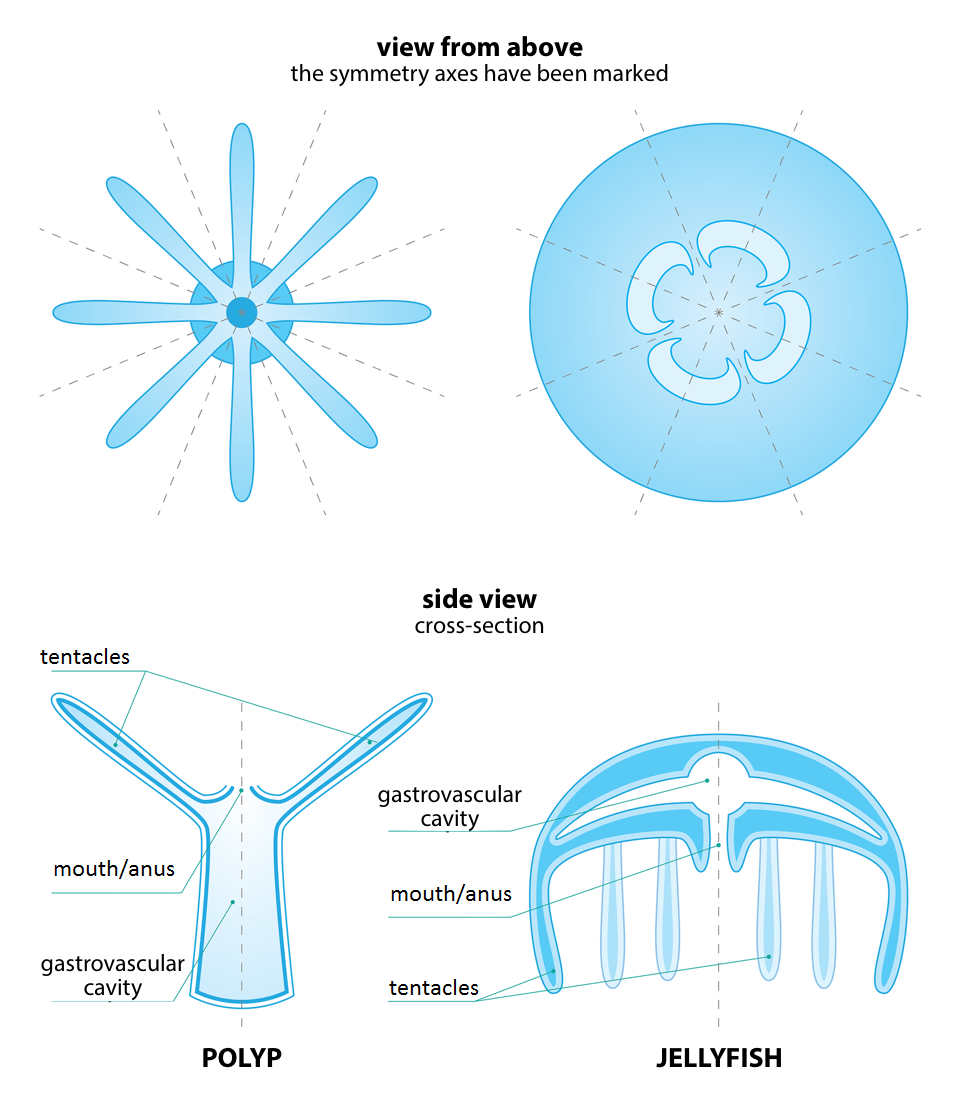
Cnidarians are characterized by a little complicated structure. Their body consists of 2 layers of cells that create tissues with a structure similar to the epithelial and nervous tissues of other animals. They do not have respiratory, cardiovascular and excretory systems. Their nervous and muscular systems are poorly developed. The interior of the body is a large gastrovascular cavitygastrovascular cavity, in which digestion and absorption of food takes place. Undigested remains are removed from the gastrovascular cavity through the mouth.
Adult cnidarians are animals with a radial symmetryradial symmetry. They can be found in two forms – a sedentary polyppolyp and jellyfishjellyfish(medusa) floating in water. However, for most of their life cycle they take only one form.
The body of the polyp looks like a bag attached to the ground. The mouth is located in the top part of the body, it is directed upwards and surrounded by a crown of tentacles, which help them to move and capture food, and to protect against predators. The body of the jellyfish is in the form of a bell. The mouth hole in this form is located in the lower part of the body and is also surrounded by tentacles.
Cnidarians do not have specialized respiratory organs. Does this mean that they do not respire? Explain.
Cnidarians are aquatic organisms
Cnidarians live in all climatic zones, most species in salt water. They are very sensitive to temperature changes and salinity of water. They usually occur in very clean waters, which is why they belong to the so‑called indicator organisms (bioindicators).
Cnidarians, like jellyfish and some polyps, can live alone. However, most polyps form clusters called colonies, which are formed when individuals after division do not move away from each other. Units that form a colony communicate with each other, and sometimes specialize in performing functions that condition the existence of the colony (e.g., some are focused on nutrition and others on reproduction). Polyps most often lead sedentary lives, less often they move on the bottom of water reservoirs, striding or tumbling. When feeding, they stretch the entire length and comb water with their tentacles. If alarmed, they shrink to a small size.
Jellyfish actively swim in water, using the jet propulsion. It is evoked by contractions of their bells that cause rapid ejection of water sucked earlier into the gastrovascular cavity. Jellyfish are classified as planktonic organismsplanktonic organisms because they do not have structures that would allow them to resist the current of water or pursue a victim.
Analysis of the structure and movements of hydra (Hydra vulgaris)
culture of hydra,
a jar with clean water,
magnifying glass.
A few days before the observation, catch the hydra from the breeding and put it in the jar.
Observe the body structure of the hydra using the magnifying glass.
Assess the size of the individuals.
Tap the jar and observe the reactions of the hydra.
Make a schematic drawing reflecting the shape and name the elements that build the body of the polyp.
Hydra vulgaris is only 1‑3 mm long. It attaches to the ground and directs food into its mouth using its tentacles. Threatened, it moves the body.
Cnidocyte
Most cnidarians feed on organic matter suspended in water and small planktonic organisms. Only few species, especially jellyfish and slow‑floating polyps in colonies, like the Portuguese man‑of‑war, can catch larger animals, such as fish.
The name cnidarians comes from cnidocytescnidocytes used to defend, capture and incapacitate the victim. These cells appear on the surface of tentacles. They are a powerful weapon – some species of cnidarians can kill even a human.
The activation of cnidocytes occurs when the victim, passing by an animal, touches its tentacles.
How do cnidarians reproduce?
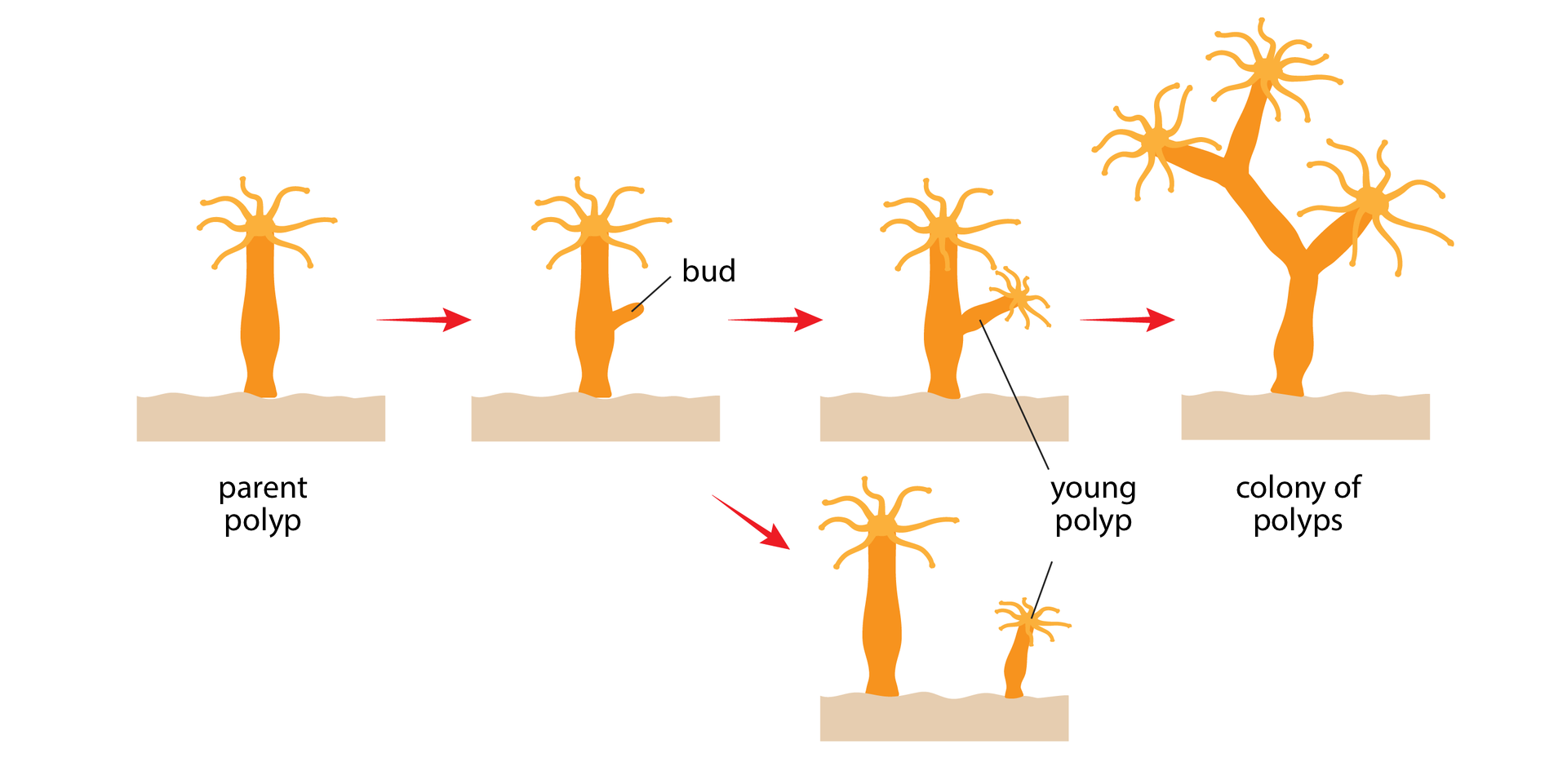
Cnidarians reproduce sexually and asexually. Adult polyps usually reproduce asexually by budding or less frequently by crosswise division. In many species, such as hydra, the descendant is separated from the body of the parent and begins an independent life. In other species, the descendant becomes attached to the parent's body, resulting in the formation of a colony that grows by buddingbudding of another polyps.
Transverse division is the way certain species reproduce, and during this division jellyfish are formed from polyps. Initially, tiny narrowings appear on the body of the polyp, which become clearer and eventually allow the plate‑like structures to be formed – young jellyfish.
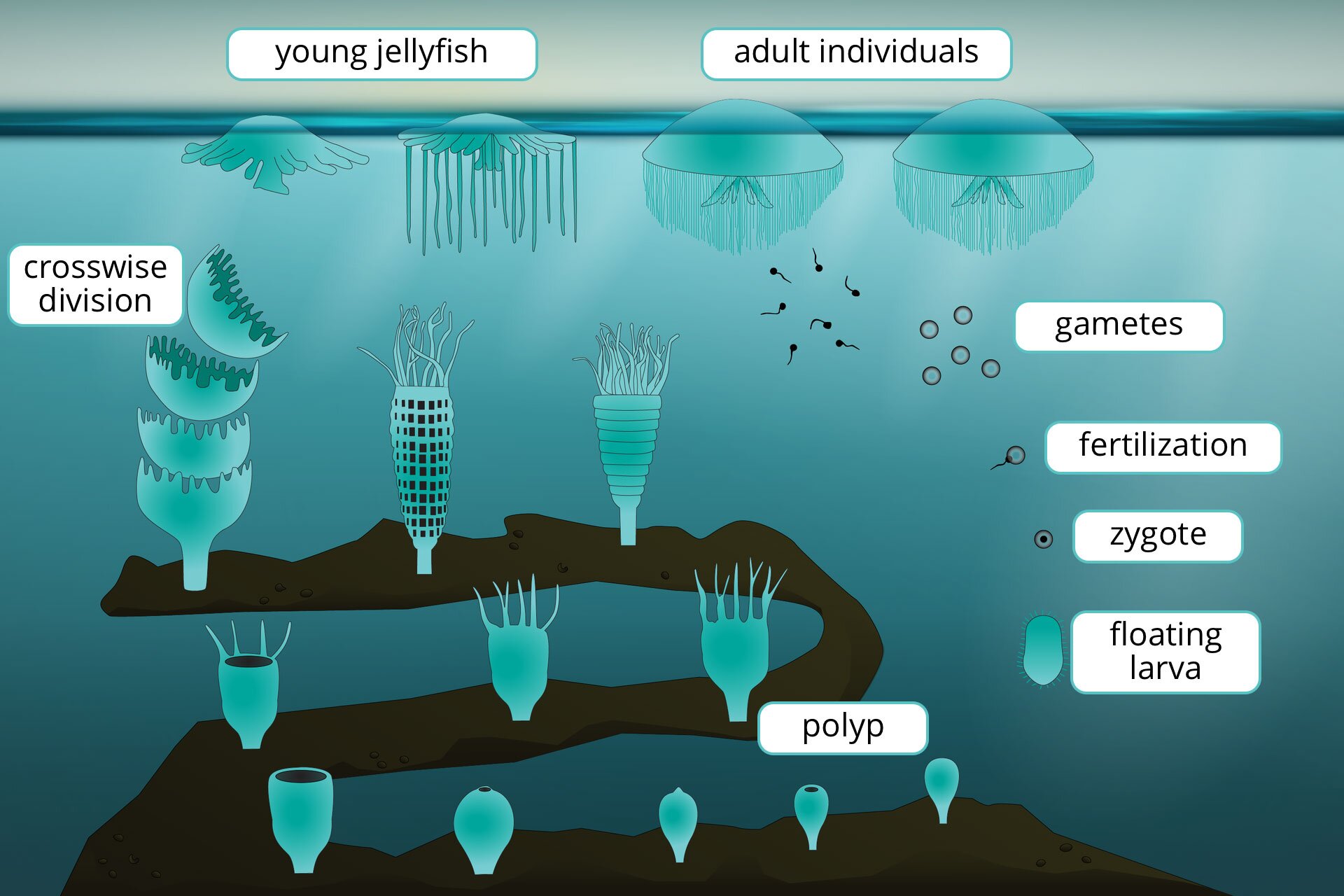
Cnidarians are dioecious organisms and they fertilize externally. During reproduction, males release sperm into water and females egg cells. Reproductive cells (gametes) combine with each other during the fertilization process, resulting in a zygote being formed. A ciliated larva is hatched, which after some time settles at the bottom of a reservoir and transforms into a polyp.
The importance of cnidarians
Among cnidarians, corals have a special significance in nature. They are the only ones that produce hard, limestone external or internal skeletons. After a polyp dies, the skeletons do not decompose but accumulate to form a coral reef, which is the basis for the growth of subsequent generations of corals. Over time, the reef grows so much that it can rise above the water surface and form an island. Hundreds of islands in the Pacific Ocean were formed this way. The growth rate of the reef is extremely slow and amounts to 1 m per 1000 years only.
Coral reefs are the habitat of many organisms. Among the colonies of cnidarians there are numerous species of fabulously colourful fish, crustaceans, snails, starfish and sea urchins. They are also the place of occurrence of many algae and protozoa. Cnidarians are also a source of food for many marine animals. Skeletons of corals, especially the red coral, are used to make jewellery and other decorations. Some species of cnidarians are very dangerous for humans, they can cause burns and even death.
Complete the text.
reef, food, predatory, limestone, colonies, skeletons
Settled cnidarians producing .................. skeletons are corals. Corals live in large ................... The corals are dying, and their .................. form an underwater rock - a coral ................... Cnidarians are ................... Sea anemones, corals and jellyfish are .................. for other animals.
Indicate the error in the description of the cnidarians.
- They include sedentary or free-living predators.
- They live individually or in colonies.
- They are mainly freshwater organisms.
- They can form limestone skeletons.
Please rate the following statements and mark the answer True or False.
| True | False | |
| Cnidarias mainly inhabit ponds, lakes, rivers. | □ | □ |
| Cnidocytes occur on the tentacles. | □ | □ |
| Polip has a shape of an umbrella. | □ | □ |
| Budding is a way to create colonies. | □ | □ |
Watch the video and try to make a medusa model at home.

Film dostępny na portalu epodreczniki.pl
Film obrazujący jak zrobić model meduzy
Summary
Cnidarians are water animals living in both salty and sweet waters.
Cnidarians are tissue animals with a radiant body symmetry; they are found in the forms of a polyp and a medusa.
Polyps lead a sedentary or semi‑sedentary way of life, and medusas float in water.
Cnidarians have a gastrovascular cavity, in which digestion of food and absorption of nutrients obtained there from takes place. It is behind a hole that performs the function of a mouth and an anus.
Cnidarians reproduce asexually by budding or body division, or sexually.
List the characteristics of cnidarians.
Keywords
cnidarians, polyp, medusa
Glossary
jama chłonąco‑trawiąca – przestrzeń wypełniająca wnętrze ciała parzydełkowca, w której zachodzi trawienie pokarmu i wchłanianie składników odżywczych.
komórka parzydełkowa – komórka charakterystyczna dla parzydełkowców, służąca do obrony i polowania, składająca się z pęcherzyka wypełnionego trującą lub paraliżującą substancją i wyrostka czuciowego, którego dotknięcie powoduje wystrzelenie długiej, pustej w środku nici; przez tę nić toksyna dostaje się od organizmu ofiary.
meduza – postać parzydełkowca o kształcie dzwonu; otwór gębowy znajduje się w spodniej części ciała, jest skierowany w dół i otoczony ramionami.
pączkowanie – sposób rozmnażania bezpłciowego występujący m.in. u polipów; na bocznej ścianie ciała polipa powstaje pączek, który stopniowo rośnie i rozwija się w nowego osobnika.
plankton – zespół organizmów biernie unoszących się w toni wodnej, niezdolnych do aktywnego pływania, do których należą m.in. bakterie, drobne protisty i niektóre zwierzęta.
polip – postać parzydełkowca kształtem przypominająca worek; jego podstawa, zwana stopą, jest przytwierdzona do podłoża, a otwór gębowy znajdujący się w części szczytowej ciała jest skierowany ku górze i otoczony wieńcem ramion.
symetria promienista – cecha planu budowy organizmu pozwalająca na wyznaczenie więcej niż jednej płaszczyzny symetrii, występująca u zwierząt osiadłych i planktonicznych oraz roślin naczyniowych.