Smell, taste, touch
information is conducted from the receptors to the effectors along the reflex arc;
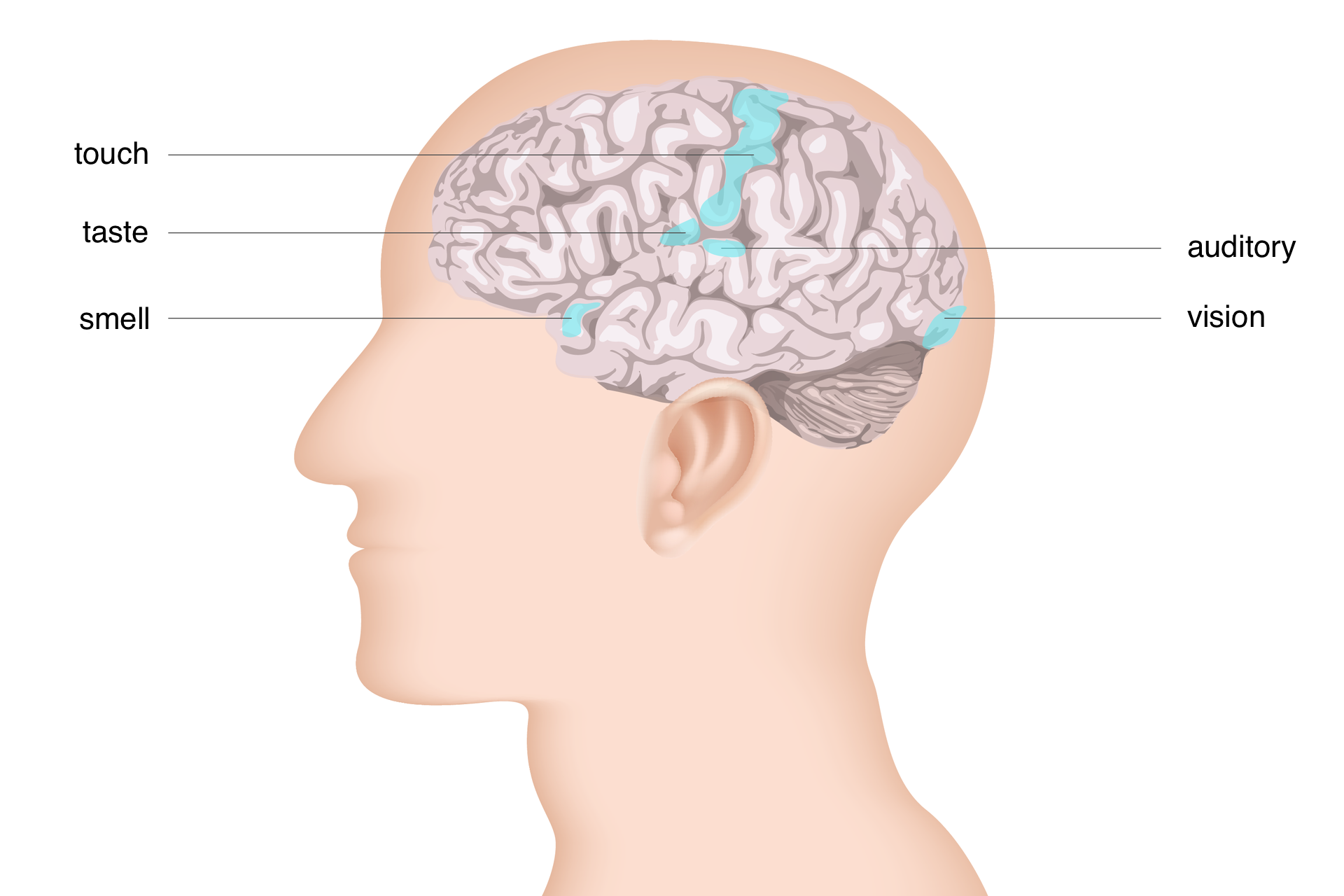
spinal cord transfers information to cerebral cortex, where motor centres and sensory centres can be found;
nervous system allows us to adapt to changing environment.
to explain the functions of the nasal cavity as a sensory organ;
to describe how the olfactory, gustatory and tactile sensations are created.
Sensory organs
The organism maintains contact with its surroundings thanks to sensory organssensory organs: of sight, hearing, balance, smell, taste, touch and feeling the temperature. Each one of them is focused on receiving different type of information, the so‑called stimuli. There are for example mechanical stimuli (touching something or somebody, a hug, a hit), light (brightness and colour of the light), acoustic (increasing pitch of the sound), chemical, thermal. Sensory organ under the influence of the stimuli received by the sensory cells (receptors) create electric impulses.
Sensory organs are composed of an adequate receptor which is to be found at the border of the body sensitive to a specific type of a stimulus and the sensory nerves which conduct the information from the receptor to the encephalon (very often through the spinal cord). The interpretation of the information received takes place in the cerebral cortex. Because of this, a person who suffers from damaged visual cortex (e.g. after an injury to the back of the head), can stop seeing, even thought the eyes and optic nerves function correctly.
Olfactory organ
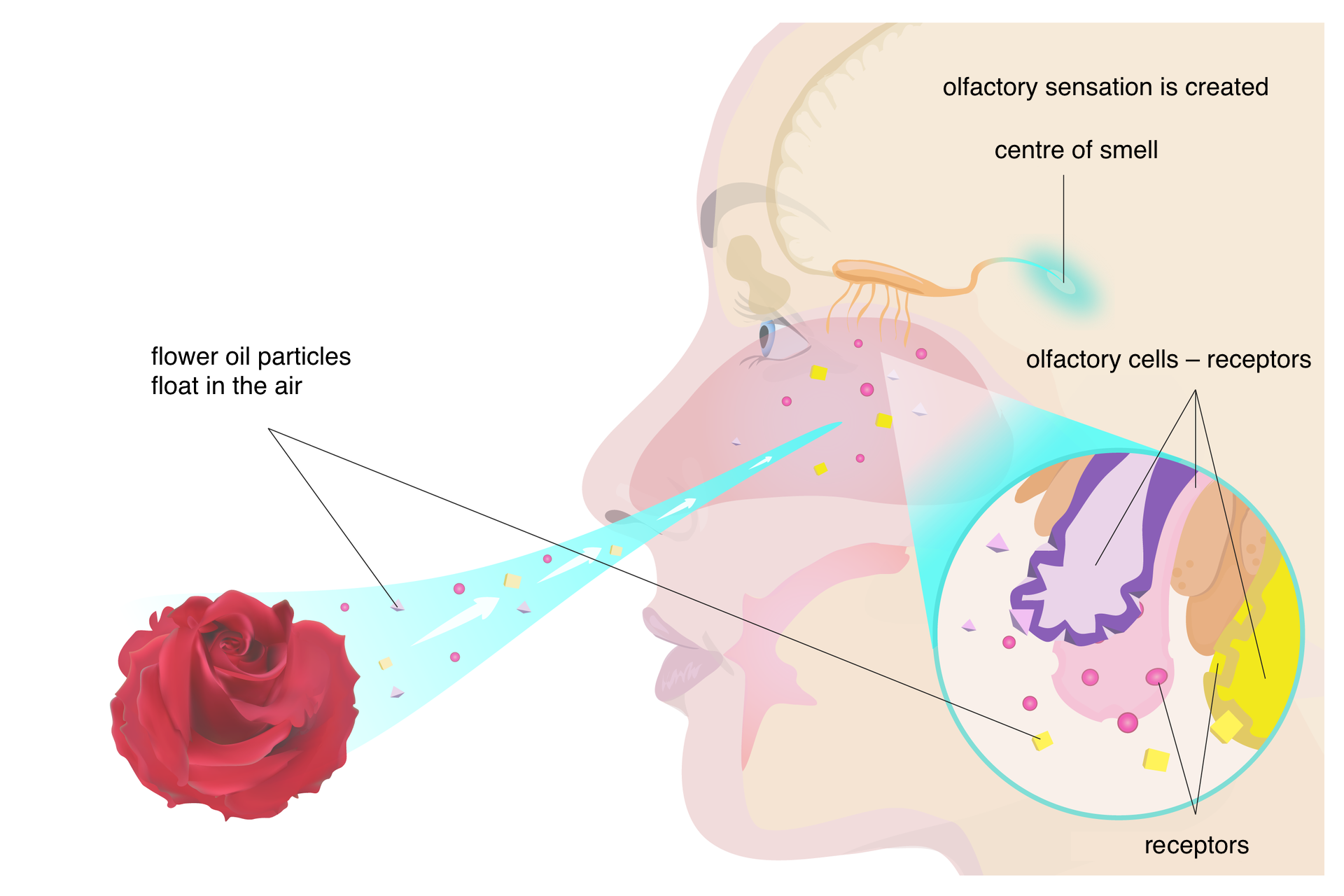
In the air there are numerous chemical compounds floating around and getting into our nasal cavity. In its upper part there is the olfactory epitheliumolfactory epithelium, whose receptor cells (sensory cells) become stimulated when certain chemical compounds are present. Collections of particles of various type and of various composition cause different olfactory sensations.
The molecules of the substances are dissolved in the water that is in mucus produced by the mucous membrane cells. In order to stimulate the olfactory receptors, chemical substances must fit them in shape. They connect to the receptor, which causes a neural impulse. Neural stimulation is transferred via sensory nerves (olfactory) to centres in the cerebral cortex where olfactory sensation is created.
Sense of taste
Chemical stimuli in the form of chemical compounds present in food we eat are received not only by olfactory cells, but also by gustatory cells. They are found mainly on the top surface of the tongue, on the palate and in the throat.
With an unaided eye you can see them on the tongue, where they form small protrusions called gustatory papillae. Each of them has around 200 taste budstaste buds. A single taste bud is a cluster of gustatory cells which react only to the chemical compound particles dissolved in the saliva of the oral cavity. Each gustatory cell has the ability to react only to one of the 5 basic flavours: salty, sweet, sour, bitter and umami (savory). Sweet flavour is associated by the majority of us with something pleasurable. Developing sensitivity to that flavour allowed people to select ripe, nutritious fruit. Umami flavour, so attractive to many people, is connected with protein food that is high in calories and was a reward for hunters who gained nutritious food that saved people from hunger. Bitter flavour is mainly seen as unpleasant, which is characteristic for many toxic substances and which warns us of possible dangers.
Particles of the substances that are in the oral cavity dissolve in water that is in saliva. This is the only time when the gustatory cells can be stimulated and neural impulses are created. They travel through sensory nerves to the centres in the cerebral cortex. Each impulse arriving from a single gustatory cell overlaps each other in the cerebral cortex and creates gustatory sensation.
Gustatory organs and organs of smell receive chemical stimuli and take an important part in the assessment of the quality and freshness of food we eat. They have a very important role for the body - they protect it, because they inform the body of the presence of dangerous substances in the environment.
Sense of touch
Sense of touch is represented by numerous receptor cells found in skin and, for example, inside our oral cavity and at the surface of the eye. From the environment, they receive mechanical stimuli identified as touch, pain, pressure. They are not evenly distributed on the surface of the skin. Most sensitive to stimuli are lips, fingertips, bottoms of the feet and palms. Neural impulses that are created in receptor cells of the skin are transferred to sensory centres in the cerebral cortex.
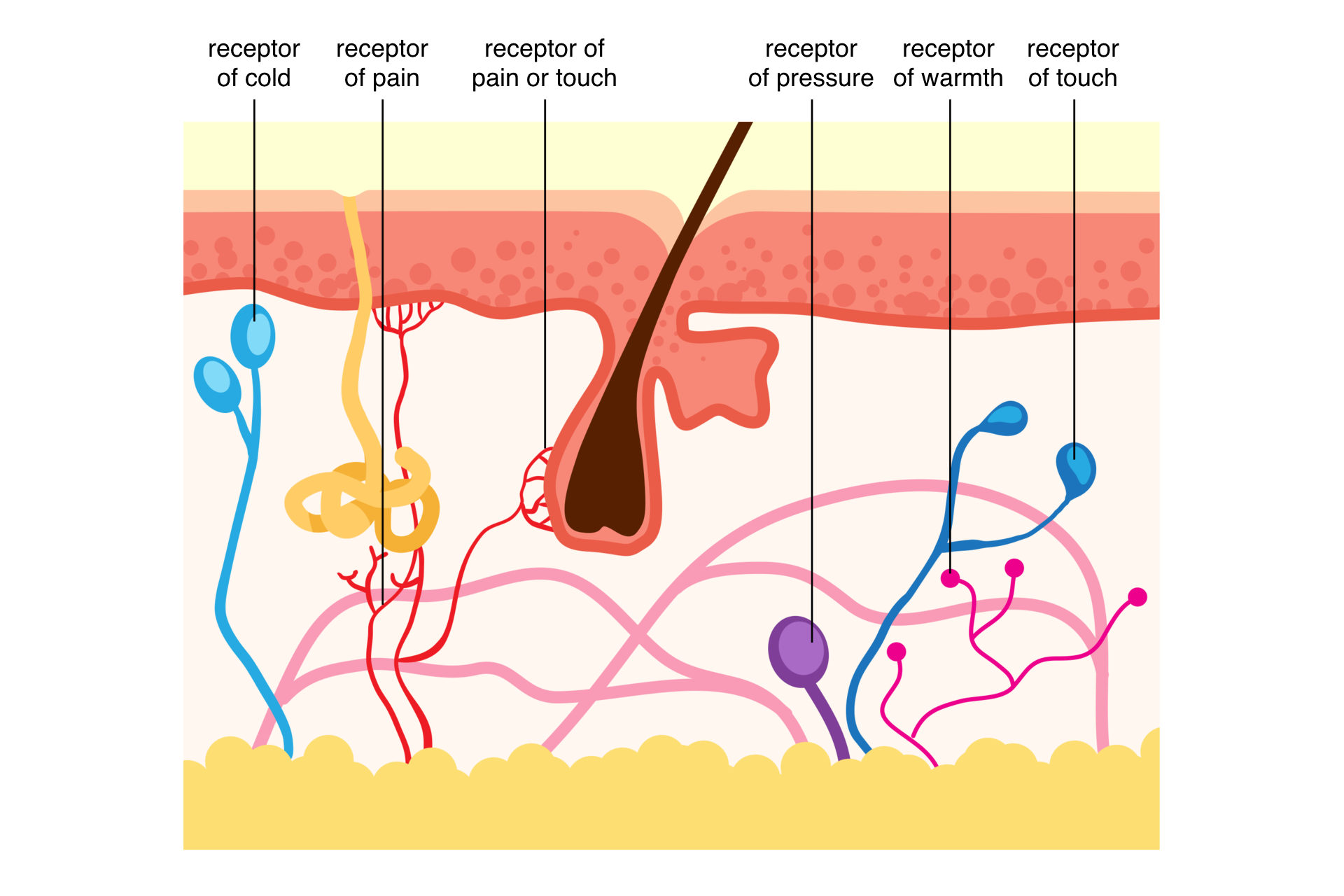
Besides tactile cellstactile cells, skin also has receptors of sensing warmth and cold. They are sensitive to all changes of the temperature of the environment. Feeling of cold and hot is relative. When we put one hand to warm water and the other to cold water, and then we put both hands into a container with lukewarm water, the sensation coming from one hand will have the content “cold water”, whereas the sensations coming from the other hand will say “warm water”.
Tick the correct sentences.
- The associative centres of the sense of touch, pain, smell and taste are only found in the cerebral cortex.
- Chemical stimuli are received by the organ of taste and the organ of smell.
- Particularly high number of receptors can be found in the skin of the fingers and of the face.
- Olfatory organ has defensive significance.
Summary
The organs of smell and taste are responsible for receiving chemical stimuli.
Sense of smell is composed of sensory cells in the olfactory epithelium of the nasal cavity.
The main organ of taste is the tongue, on whose surface we have the taste cells.
Organs of the sense of taste and smell work with each other in feeling the taste of the food we eat.
Only those chemical substances which were dissolved in water can release a neural impulse in the receptor cells of the nasal cavity and of the tongue.
In the skin there are receptors which react to pain, touch, warmth, cold and pressure.
Receptors are unevenly distributed depending on which part of the body they are on.
Keywords
smell, taste, touch
Glossary
ciałka dotykowe – zakończenia nerwów czuciowych znajdujące się w skórze i błonie śluzowej jamy ustnej; odbierają bodźce mechaniczne i termiczne
kubki smakowe – skupienia komórek smakowych na języku; odbierają bodźce w postaci rozpuszczonych w jamie ustnej substancji chemicznych
nabłonek węchowy – nabłonek wyścielający górną część jamy nosowej; znajdują się w nim komórki odbierające bodźce chemiczne i zakończenia nerwu węchowego
narządy zmysłów – narządy przystosowane do odbierania bodźców ze środowiska zewnętrznego i wewnętrznego; w ich skład wchodzą receptory i elementy ułatwiające ich działanie