The consequences of Earth’s rotation
what Earth’s place is in the Solar System;
how Earth is shaped
what Earth’s dimensions are.
explain the concept of solar time and the relation between solar time and Earth's rotation;
describe the Coriolis force and explain the relation between the Coriolis force and Earth’s rotation;
determine the direction of the Coriolis force on a moving body;
give an example of an effect of the Coriolis force.
We know that the Sun’s apparent motion on the Celestial sphere is caused by Earth’s rotation. However, this movement carries on several other consequences for our planet, geographical environment, and all living beings, including humans. One of the most obvious is the succession of day and night. For some time, a part of Earth is turned towards the Sun, resulting in a day. Then Earth turns away from the Sun and night falls in the shadowed area. At the same time, another part of the planet turns to the Sun and the day starts there.
Another consequence of Earth’s rotation is the existence of solar timesolar time. At the same moment, on one of the meridians there is a solar noon, while on the opposite side of the planet – midnight, and on the other ones, all the other times during the day or night cycle.
A difficult to observe, but the scientifically proven consequence of Earth’s rotation is also a small flattening at the poles, resulting from the centrifugal force, causing Earth not to have a spherical shape.
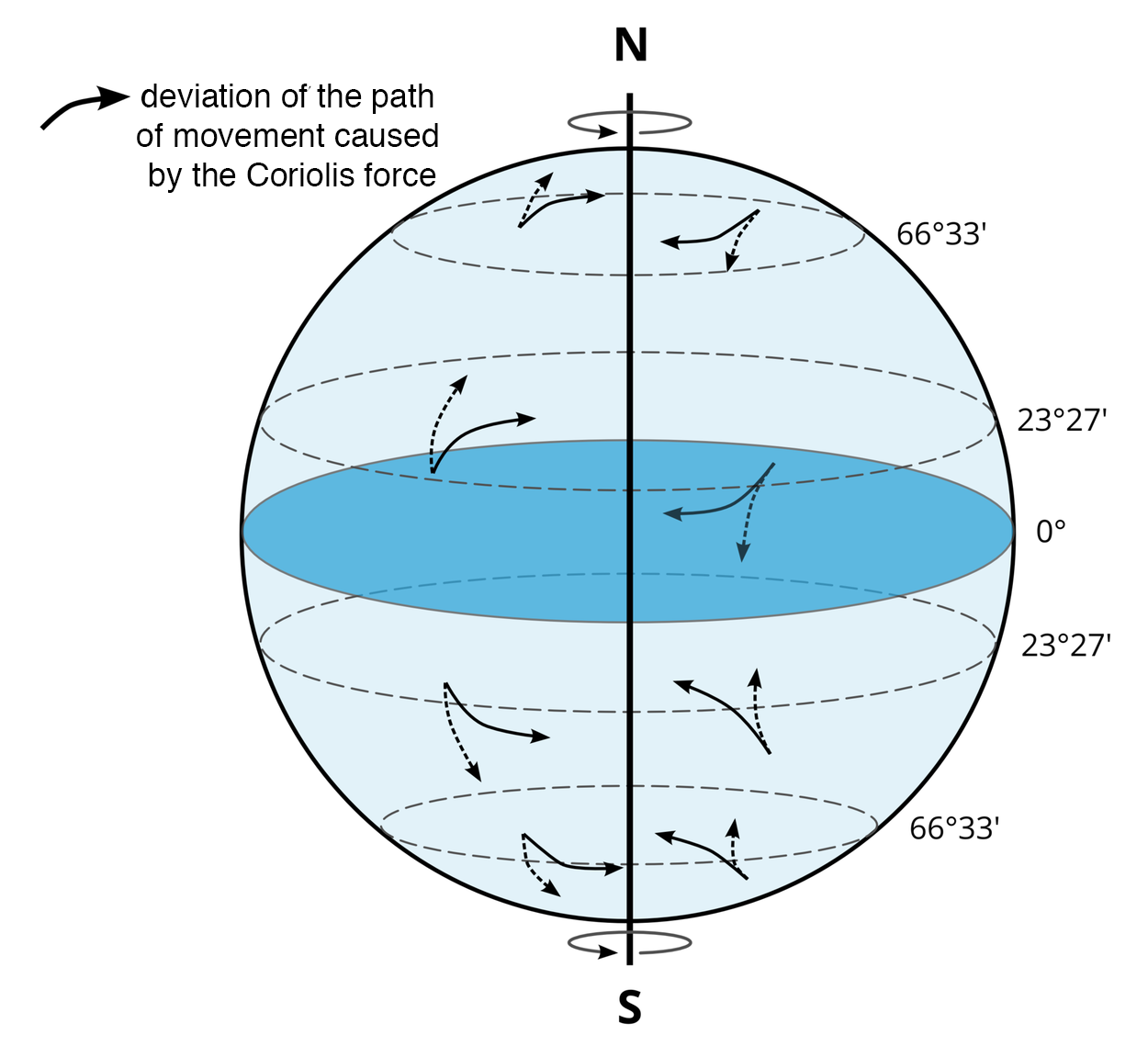
In a rotating system, which is Earth, the trajectory of the body moving on the surface deviates from the straight line, because the body is under the effect of the so‑called Coriolis forceCoriolis force. This force causes the trajectory of the moving objects in the Northern Hemisphere to turn right, and turn left in the Southern Hemisphere. Rivers, winds and currents as well as ships, airplanes and other objects in motion are subject to the Coriolis force. Of course, this force does not work on objects that are at rest.
This phenomenon can be explained by the example of large rivers, whose right banks in the Northern Hemisphere and the left banks in the Southern Hemisphere are more washed off by water.
If the river flows from south to north (in the Northern Hemisphere), the water in it moves from the area where the linear velocity of the rotating (from west to east) Earth is greater, to the place where the linear velocity is smaller. But the water is not rigidly connected to the Earth and, running north, retains its greater linear velocity, turns from west to east, which in result causes a stronger flow on the right (eastern) shore.
If the river runs from north to south (in the Northern Hemisphere), it means that the water in it moves with a smaller linear velocity from the area to a place with a higher linear velocity. It tries to keep the velocity lower, but the river banks move faster (from west to east). So now the right (west) bank of the river will „push” the water, and the water, as a result, will wash it off more.
In the Southern Hemisphere, the phenomenon occurs analogously, only in reverse.
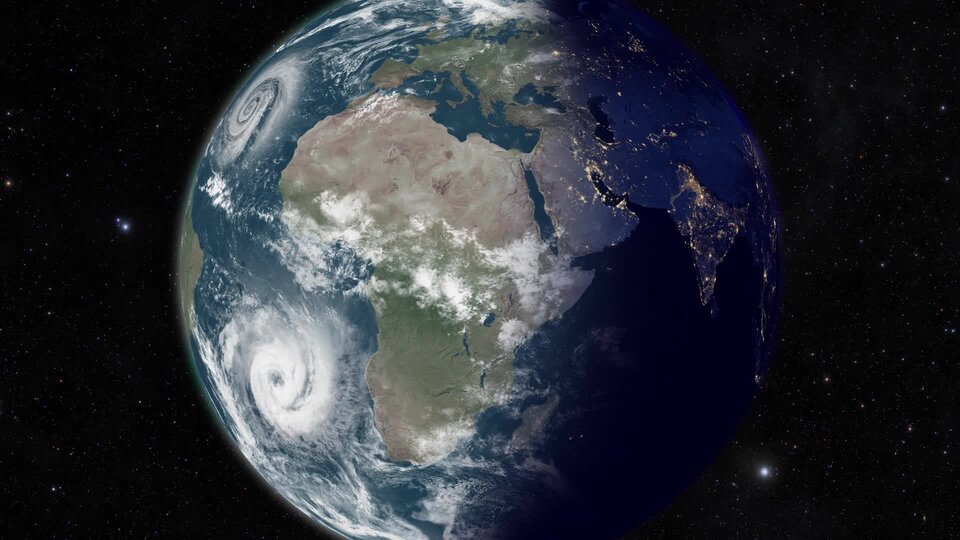
Like the water in larger rivers, even the winds in the Northern Hemisphere will be pushed to the right, and to the left in the Southern Hemisphere. Another consequence of the Coriolis force is the direction of air rotation in cyclones. In the Northern Hemisphere, they rotate counter‑clockwise and clockwise in the Southern Hemisphere.
Film dostępny na portalu epodreczniki.pl
Nagranie filmowe przedstawiające efekt Coriolisa na powierzchni kuli ziemskiej. Na półkuli północnej masy powietrza obracają się przeciwnie do wskazówek zegara, na półkuli południowej zgodnie ze wskazówkami zegara.
Select the true sentence
- The Coriolis force acts on bodies moving on the surface of the Earth because the Earth is not flat (it is shaped like a sphere).
- Only objects moving on land are subject to the Coriolis force. It does not affect objects in the water or air.
- In the Southern Hemisphere, the trajectory of objects moving towards the pole leans to the left, and moving towards the equator - to the right.
- In the Nouthern Hemisphere, the trajectory of objects moving towards the pole and towards the equator leans to the right.
Determine in which direction (N, S, W or E) the Coriolis force pushes the airplane flying from the 50°N, 20°E coordinates to the 10°N, 20°E coordinates.
- north
- south
- west
- east




Determine in which direction (N, S, W or E) the Coriolis force pushes the airplane flying from the 10°S, 20°E coordinates to the 50°S, 20°E coordinates.
- north
- south
- west
- east




Keywords
Celestial sphere, solar time, Coriolis force
Glossary
czas słoneczny (miejscowy) – rachuba czasu związana z lokalnym południkiem miejsca obserwacji; wzdłuż jednego południka czas jest taki sam; obliczamy go na podstawie momentu górowania Słońca nad tym południkiem
sfera niebieska – kulista, istniejąca w wyobraźni sfera o nieokreślonym promieniu, która otacza obserwatora śledzącego ciała niebieskie i daje złudzenie, że wszystkie znajdują się w jednakowej, wielkiej odległości, jakby przylepione do tej sfery
siła Coriolisa – powoduje odchylenie toru ruchu ciała poruszającego się w układzie obracającym się od linii prostej; ponieważ Ziemia obraca się z zachodu na wschód, siła Coriolisa powoduje odchylenie w prawo (z punktu widzenia poruszającego się obiektu) toru ciała poruszającego się na półkuli północnej, a w kierunku lewym na półkuli południowej