On the paved streets of Paris, and beyond – 19th century Polish culture in exile
why the emigrationemigration after the November Uprising has been called ‘Great’;
where Poles emigrated in the first half of the 19th century;
about some outstanding Polish expatriates;
about the fate and work of Adam Mickiewicz, Fryderyk Chopin, Maria Skłodowska‑Curie and Helena Modrzejewska.
In the period of the Partitions of Poland, Poles could not freely develop their culture. The partitioners fought against Polishness through Germanization and Russification. Polish cultural life was, therefore, taking place in exile, mainly in Paris. It was there that, among others, the poet Adam Mickiewicz and the composer Fryderyk Chopin stayed and worked, and also there that Maria Skłodowska‑Curie, the most outstanding Polish and world researcher of the 19th century, pursued her scientific career.
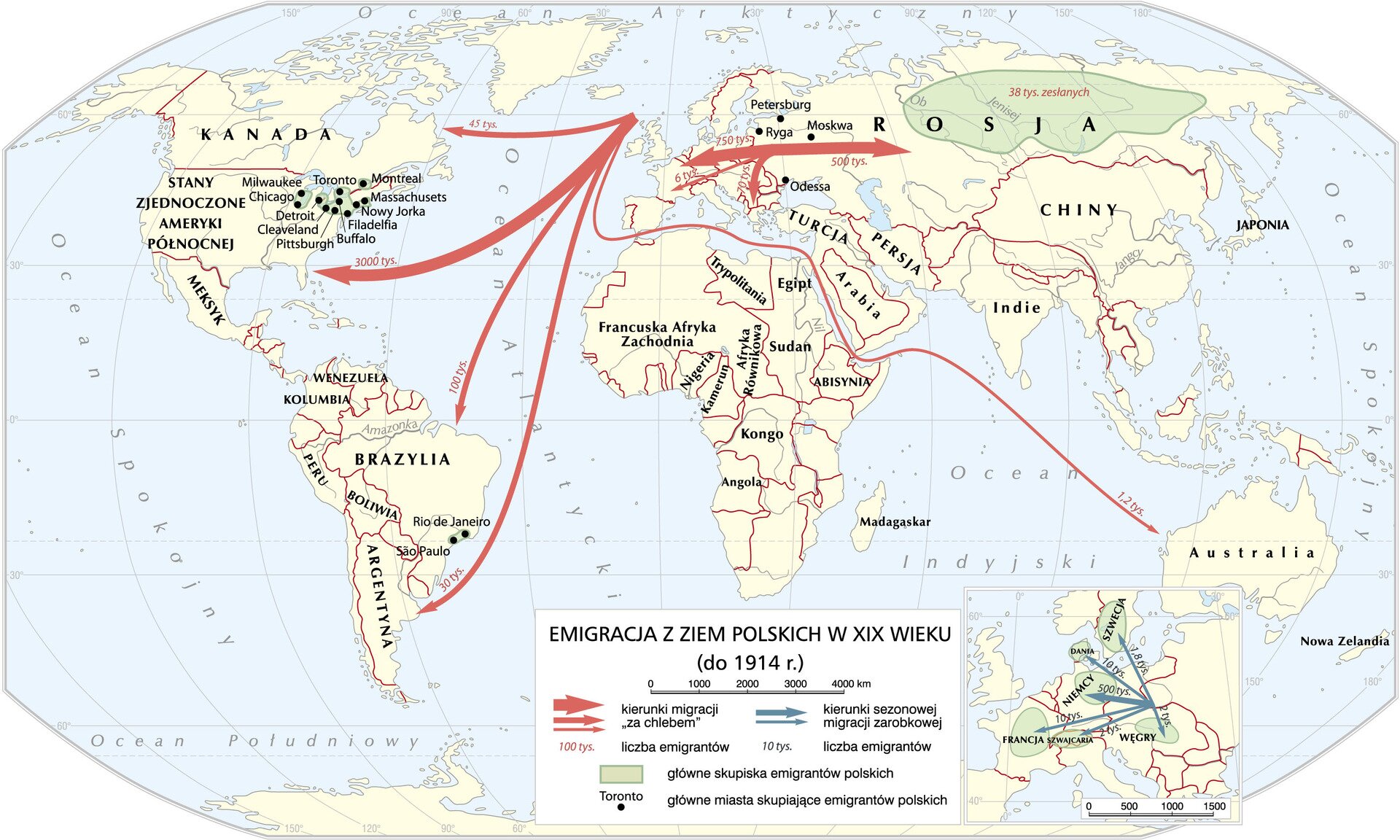
Which of the following countries took in 100,000 or more Polish emigrants in the period of the Partitions of Poland?
- Switzerland
- Germany
- Turkey
- Russia
- Brazil
- Belgium
- USA
- France
- Argentina
- Austria
The most people left Poland ‘seeking bread’ in the period of the last 15 years before the outbreak of World War I in 1914. Nevertheless, the term ‘Great Emigration’ is used after the November Uprising, when the country was abandoned by those who wanted to protect themselves from the repressions of the tsarist regime. Why is this emigration called ‘great’?
- Because Poles went to many countries.
- Because eminent people emigrated who created great works in exile.
- Because it lasted a very long time.
- Because Poles settled in big cities.
Match the terms to the names.
Sorbonne, composer, Shakespeare, Żelazowa Wola, theater, Polish Legion, radioactivity, California, actress, Nobel Prize, polonium, Constantinople, mazurkas, Revolutionary Étude, Pan Tadeusz, romanticism
| Fryderyk Chopin | |
|---|---|
| Adam Mickiewicz | |
| Maria Skłodowska-Curie | |
| Helena Modrzejewska |
Keywords
emigration, Adam Mickiewicz, Fryderyk Chopin, Maria Skłodowska‑Curie, Helena Modrzejewska, Paryż
Glossary
emigracja – wyjazd, opuszczenie kraju na dłuższy czas lub na stałe, może być dobrowolna lub przymusowa.
Wielka Emigracja – emigracja Polaków po klęsce powstania listopadowego w 1831 roku, opuszczających kraj z obawy przed prześladowaniami i represjami carskiej władzy. Została nazwana „wielką” nie tyle ze względu na liczebność, co jej charakter – emigrowali głównie ludzie młodzi i wybitne jednostki, które na emigracji tworzyły wybitne dzieła polskiej kultury.
represje – niesprawiedliwe kary nakładane przez państwo wobec obywateli lub prześladowania w formie odwetu na jakiejś grupie.
rękopis – zapisany odręcznie tekst, a także oryginał jakiegoś dzieła, utworu, kompozycji.
Sorbona – francuski uniwersytet w Paryżu, założony już w XIII wieku.
Adampol – obecnie Polonezkoy – wieś w Turcji na obrzeżach Stambułu założona w 1841 roku przez polskich imigrantów z inicjatywy ks. Adama Czartoryskiego. Była symbolem trwania Polski w tym czasie.