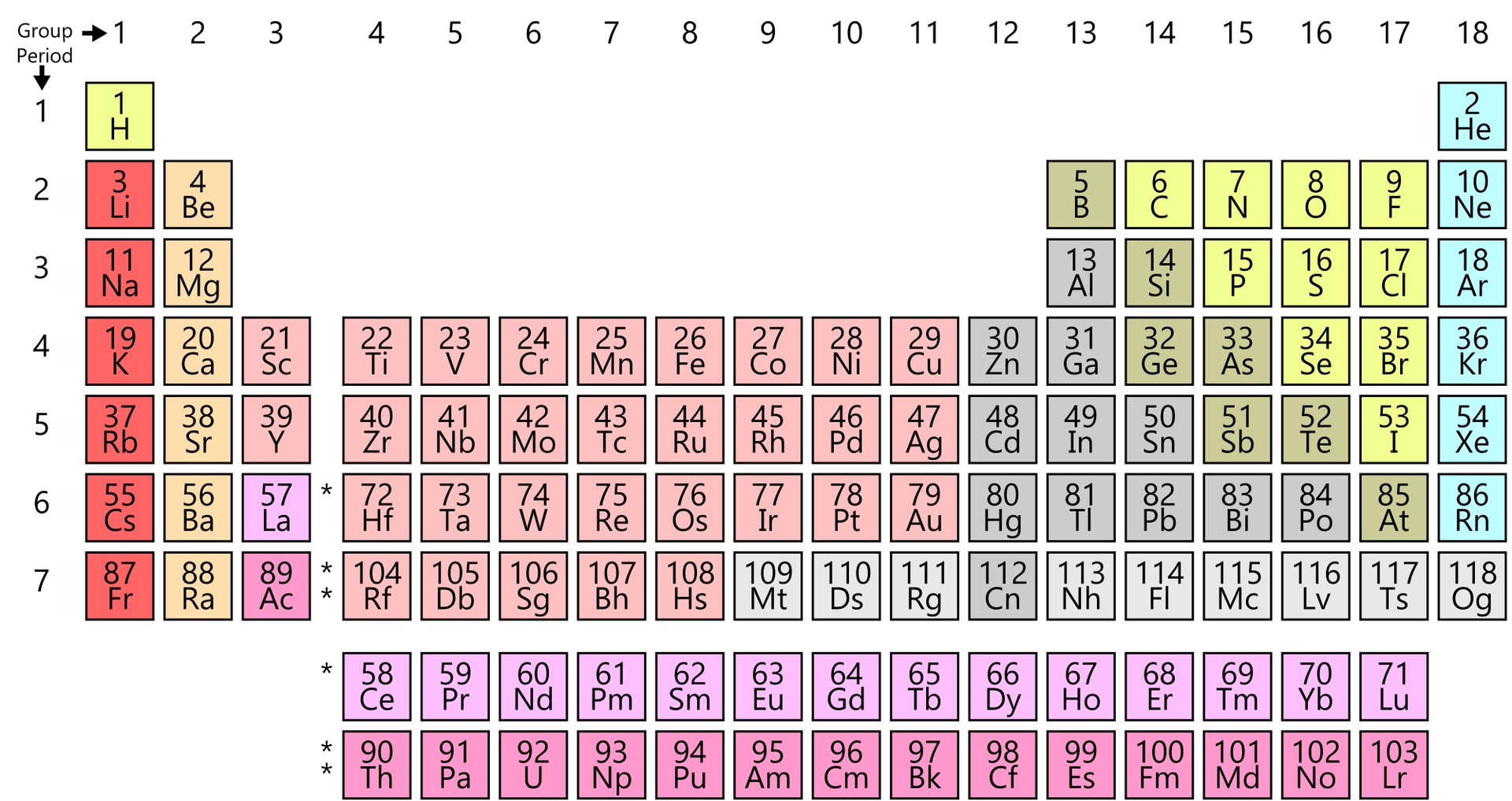
Indicate the place of oxygen in the periodic table. What is the structure of its atom?
R1YdO9uL4TCjH
Układ okresowy pierwiastków. To zestawienie wszystkich pierwiastków chemicznych w postaci tabeli. Są uporządkowane według rosnącej liczby atomowej. Pierwiastki są pogrupowane według cyklicznie powtarzających się podobieństw właściwości. Układ okresowy jest podzielony na grupy (pionowe kolumny) i okresy (rzędy poziome). Pierwiastki należące do tej samej grupy mają taką samą liczbę elektronów walencyjnych i podobne właściwości chemiczne. Nazwy grup pochodzą od pierwiastka rozpoczynającego grupę (z wyjątkiem grupy pierwszej - litowców). Okresów jest siedem. Każdy zaczyna się aktywnym metalem, a kończy gazem szlachetnym.
Periodic table of elements
Source: Bastianow, [online], dostępny w internecie: https://upload.wikimedia.org/wikipedia/commons/thumb/1/1c/Periodic_system_homeopathic_theory_format.svg/1024px-Periodic_system_homeopathic_theory_format.svg.png [dostęp 21.03.2018 r.].
Around 300 years ago air was still thought to be a chemical element or compound and not, as we know today, a gas mixture. Although nitrogen represents as much as 78% of the air volume, its exclusive presence in the atmosphere would mean total lack of life on Earth.
Oxygen is the most common element in nature. It accounts for almost half of the weight of the earth’s crust. It is a part of water, rocks, metal ores, sand.
Oxygen is essential for the life of most organisms, without it, animals and plants die. Decreasing its content in the air from 21 to 15% causes disruption of the body's work, and a drop below 10% may lead to death. Interestingly, in 2010, European scientists discovered the first larger multicellular organisms that do not need oxygen to live. Previously unknown species were found in sediments located in the seabed of the Mediterranean Sea.
Oxygen – obtaining
Oxygen was discovered around 1774 by an Englishman Joseph Priestley and, independently, also by the Swede Karl Scheele. As a result of heating the mercury(II) oxide, gas was emitted and droplets of mercury were deposited on the walls of the vessel. The resulting combustion sustaining gas was oxygen. Watch the film from the e‑textbook, note the origin of the name “oxygen”.
R1AXWjq0qnIeh
Check the information on the timeline and remember the most important events related to the discovery of oxygen. 1. Michał Sędziwój A Polish chemist obtained oxygen through the experimental decomposition of potassium nitrate during its roasting., 2. Joseph Priestley repeated Sędziwój’s experiment. He obtained oxygen by heating mercury two oxide and collecting the gas produced. He published the discovery in seventeen seventy five and it is he who is considered the discoverer of oxygen., 3. Carl Wilhelm Scheele obtained oxygen in the same year as Priestley. His discovery, due to publishing delays, was not published until seventeen seventy seven., 4. Antoine Laurent de Lavoisier extracted oxygen from the air basing on the research of Sędziwój and Priestley. He called it “oxygenium”, meaning “acidifying constituent”., 5. Jędrzej Śniadecki in Poland introduced the name “kwasoród” for oxygen, literally translating the Latin name of the element., 6. Jan Oczapowski student of Śniadecki and a doctor, suggested the name “tlen”, which refers to the word "tlić” (eng. to smolder) and is related to the combustion sustaining property of oxygen., 7. Zygmunt Wróblewski and Karol Olszewski liquefied oxygen.
Check the information on the timeline and remember the most important events related to the discovery of oxygen. 1. Michał Sędziwój A Polish chemist obtained oxygen through the experimental decomposition of potassium nitrate during its roasting., 2. Joseph Priestley repeated Sędziwój’s experiment. He obtained oxygen by heating mercury two oxide and collecting the gas produced. He published the discovery in seventeen seventy five and it is he who is considered the discoverer of oxygen., 3. Carl Wilhelm Scheele obtained oxygen in the same year as Priestley. His discovery, due to publishing delays, was not published until seventeen seventy seven., 4. Antoine Laurent de Lavoisier extracted oxygen from the air basing on the research of Sędziwój and Priestley. He called it “oxygenium”, meaning “acidifying constituent”., 5. Jędrzej Śniadecki in Poland introduced the name “kwasoród” for oxygen, literally translating the Latin name of the element., 6. Jan Oczapowski student of Śniadecki and a doctor, suggested the name “tlen”, which refers to the word "tlić” (eng. to smolder) and is related to the combustion sustaining property of oxygen., 7. Zygmunt Wróblewski and Karol Olszewski liquefied oxygen.
Check the information on the timeline and remember the most important events related to the discovery of oxygen.
In the laboratory, oxygen is obtained in a slightly different way.
Task 2
Watch the film. Note how oxygen can be obtained.
R1U5qF3wCTqB2
Nagranie filmowe eksperymentu Ekstrakcja tlenu i azotu z ciekłego powietrza, The extraction of Nitrogen, Argon and Oxygen from liquid air. Powietrze, air składa się z 78,08% en dwa, 20,95% o dwa, 0,93% A er, 0,04% ce o dwa. W pierwszej fazie następuje filtracja, filtration powietrza w celu usunięcia pyłów i zanieczyszczeń. W drugiej fazie następuję skraplanie, liquefaction, temperatura powietrza jest obniżana do -200 stopni Celsjusza. W tej temperaturze powietrze ma postać płynną. Dwutlenek węgla w temperaturze -79 stopni Celsjusza zamarza. Skraplanie tlenu zachodzi przy -183 stopniach Celsjusza, azotu przy -196 stopniach Celsjusza, argonu przy -186 stopniach Celsjusza. W trzeciej fazie następuje destylacja frakcyjna, fractional distillation. Tlen, azot i argon, które są w postaci płynnej zostają rozdzielone. Dzieje się tak w wyniku podgrzania płynnej mieszaniny pierwiastków z temperatury -200 stopni Celsjusza do temperatury ich skraplania. Zmieniają one wtedy swoją postać z płynnej w lotną i dzięki temu można je rozdzielić. Zastosowanie argonu: żarówki, zabiegi korekcji wzroku, butle nurków. Zastosowanie tlenu: w medycynie, w produkcji stali do usuwania zanieczyszczeń węglem, siarką i fosforem. Zastosowanie azotu: w produkcji amoniaku, w medycynie, w przemyśle spożywczym, np. do pakowania kawy a także płynny azot przy mrożeniu lodów i konserwowaniu mrożonek.
Nagranie filmowe eksperymentu Ekstrakcja tlenu i azotu z ciekłego powietrza, The extraction of Nitrogen, Argon and Oxygen from liquid air. Powietrze, air składa się z 78,08% en dwa, 20,95% o dwa, 0,93% A er, 0,04% ce o dwa. W pierwszej fazie następuje filtracja, filtration powietrza w celu usunięcia pyłów i zanieczyszczeń. W drugiej fazie następuję skraplanie, liquefaction, temperatura powietrza jest obniżana do -200 stopni Celsjusza. W tej temperaturze powietrze ma postać płynną. Dwutlenek węgla w temperaturze -79 stopni Celsjusza zamarza. Skraplanie tlenu zachodzi przy -183 stopniach Celsjusza, azotu przy -196 stopniach Celsjusza, argonu przy -186 stopniach Celsjusza. W trzeciej fazie następuje destylacja frakcyjna, fractional distillation. Tlen, azot i argon, które są w postaci płynnej zostają rozdzielone. Dzieje się tak w wyniku podgrzania płynnej mieszaniny pierwiastków z temperatury -200 stopni Celsjusza do temperatury ich skraplania. Zmieniają one wtedy swoją postać z płynnej w lotną i dzięki temu można je rozdzielić. Zastosowanie argonu: żarówki, zabiegi korekcji wzroku, butle nurków. Zastosowanie tlenu: w medycynie, w produkcji stali do usuwania zanieczyszczeń węglem, siarką i fosforem. Zastosowanie azotu: w produkcji amoniaku, w medycynie, w przemyśle spożywczym, np. do pakowania kawy a także płynny azot przy mrożeniu lodów i konserwowaniu mrożonek.
Extraction of oxygen and nitrogen from liquid air
Source: www.fuseschool.org, licencja: CC BY-NC 4.0.
Source: www.fuseschool.org, licencja: CC BY-NC 4.0.
Nagranie filmowe eksperymentu Ekstrakcja tlenu i azotu z ciekłego powietrza, The extraction of Nitrogen, Argon and Oxygen from liquid air. Powietrze, air składa się z 78,08% en dwa, 20,95% o dwa, 0,93% A er, 0,04% ce o dwa. W pierwszej fazie następuje filtracja, filtration powietrza w celu usunięcia pyłów i zanieczyszczeń. W drugiej fazie następuję skraplanie, liquefaction, temperatura powietrza jest obniżana do -200 stopni Celsjusza. W tej temperaturze powietrze ma postać płynną. Dwutlenek węgla w temperaturze -79 stopni Celsjusza zamarza. Skraplanie tlenu zachodzi przy -183 stopniach Celsjusza, azotu przy -196 stopniach Celsjusza, argonu przy -186 stopniach Celsjusza. W trzeciej fazie następuje destylacja frakcyjna, fractional distillation. Tlen, azot i argon, które są w postaci płynnej zostają rozdzielone. Dzieje się tak w wyniku podgrzania płynnej mieszaniny pierwiastków z temperatury -200 stopni Celsjusza do temperatury ich skraplania. Zmieniają one wtedy swoją postać z płynnej w lotną i dzięki temu można je rozdzielić. Zastosowanie argonu: żarówki, zabiegi korekcji wzroku, butle nurków. Zastosowanie tlenu: w medycynie, w produkcji stali do usuwania zanieczyszczeń węglem, siarką i fosforem. Zastosowanie azotu: w produkcji amoniaku, w medycynie, w przemyśle spożywczym, np. do pakowania kawy a także płynny azot przy mrożeniu lodów i konserwowaniu mrożonek.
Obtaining oxygen from potassium manganate(VII)1
Experiment 1
Research problem
Can oxygen be produced using potassium manganate(VII)()? How can it be identified?
Hypothesis
Oxygen can be obtained by heating potassium manganate(VII)(), as it is obtained from the thermal decomposition of mercury(II) oxide. The gas produced can be identified by means of a burning wooden skewer.
Oxygen is obtained during thermal decomposition of potassium manganate(VII), hydrogen peroxide decomposition (in the presence of a catalyst) or water decomposition due to an electric current (water electrolysis). The industrial method of obtaining oxygen is to distil liquid air.
You will need
stand,
metal holder,
2 test tubes,
plug with an integrated discharge pipe,
crystallizer,
burner,
potassium manganate(VII).
Instruction
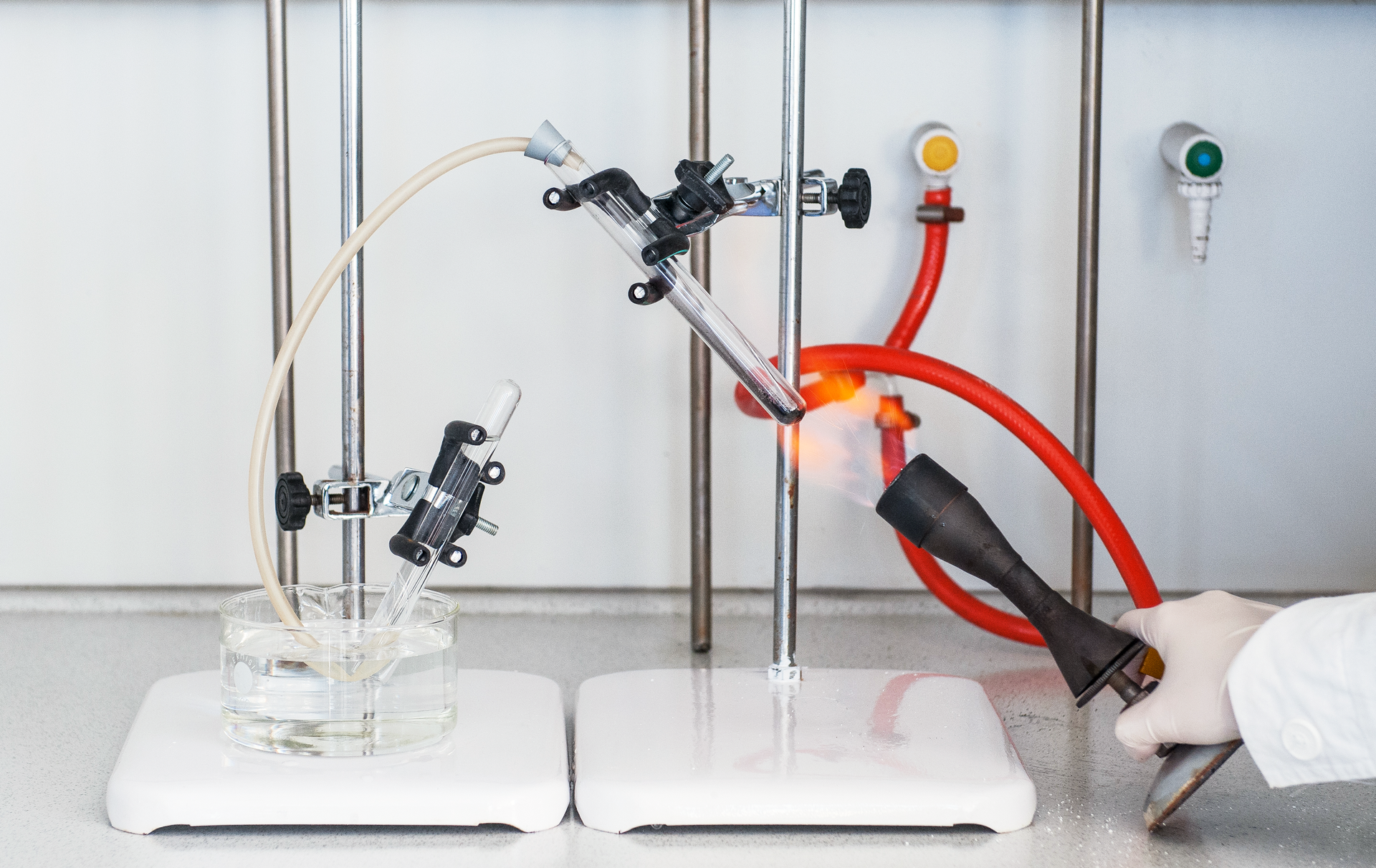
Place a few potassium manganate(VII) crystals in the test tube. Close the test tube using the plug with the discharge tube.
Fill the second test tube with water, close its mouth with your finger and place it, upside down, in the crystallizer filled with water.
Heat the test tube with potassium manganate(VII) in the burner’s flame.
When gas is released, insert the discharge tube into a water‑filled test tube.
Once the gas has been collected in the test tube placed upside‑down, close the tube with the plug and remove it.
RAqu0Hdc2qszq
Ilustracja przedstawia zdjęcie aparatury do otrzymywania tlenu w warunkach laboratoryjnych. Składa się ona z dwóch stojących obok siebie statywów z łapami w których zamocowano probówki. Statyw z prawej strony trzyma długą probówkę ze znajdującymi się w niej fioletowymi drobnymi kryształkami otworem w górę pod kątem około 45 stopni do pionu. Otwór jest zakorkowany, a przez korek przeciągnięta jest gumowa rurka prowadząca do aparatury z lewej strony. Probówka na statywie z lewej strony jest obrócona otworem w dół pod kątem około 30 stopni do pionu. Koniec probówki zanurzony jest w szerokiej szklanej zlewce z wodą. Sama probówka również wypełniona jest wodą. Koniec wężyka z probówki po prawej stronie umieszczony jest w odwróconej probówce po lewej stronie. Dłoń demonstratora trzyma palnik gazowy w taki sposób, że płomień ogrzewa dno probówki po lewej i znajdujące się wewnątrz kryształki. Wydzielający się gaz przepychany przez rurkę zbiera się w probówce po lewej stronie wypierając z niej wodę.
Source: Tomorrow sp z.o.o, licencja: CC BY 3.0.
RH5GrC2HuANpc
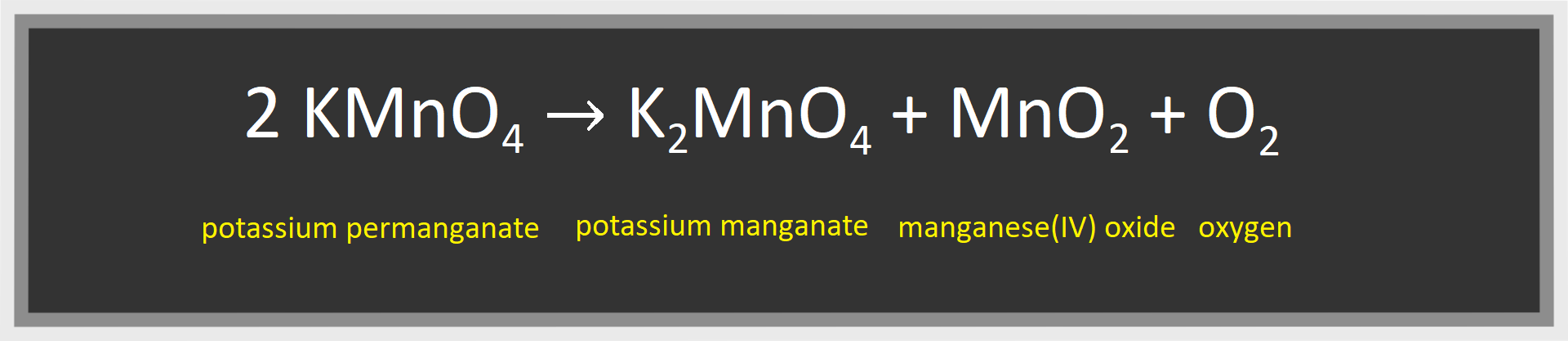
Równanie reakcji: manganian siedem potasu (potassium permanganate) w wyniku reakcji rozkłada się na manganian sześć potasu (potassium manganate), tlenek manganu cztery (manganese four oxide) oraz tlen (oxygen), czyli dwa ka em en o cztery strzałka w prawo ka dwa em en o cztery dodać em en o dwa dodać o dwa
Summary
When potassium manganate(VII) is heated, a gas is released that displaces water from the tube. The gas collected in the test tube is colorless. It is a decomposition reaction. This reaction resulted in a colorless and odorless gas.
Obtaining oxygen from hydrogen peroxide in the presence of yeast1
Experiment 2
Research problem
Does the food yeast allow the decomposition of hydrogen peroxide? How can you identify the gaseous product?
Hypothesis
Yeast causes the decomposition of the hydrogen peroxide solution, allowing identification of the collected oxygen with a burning wooden skewer.
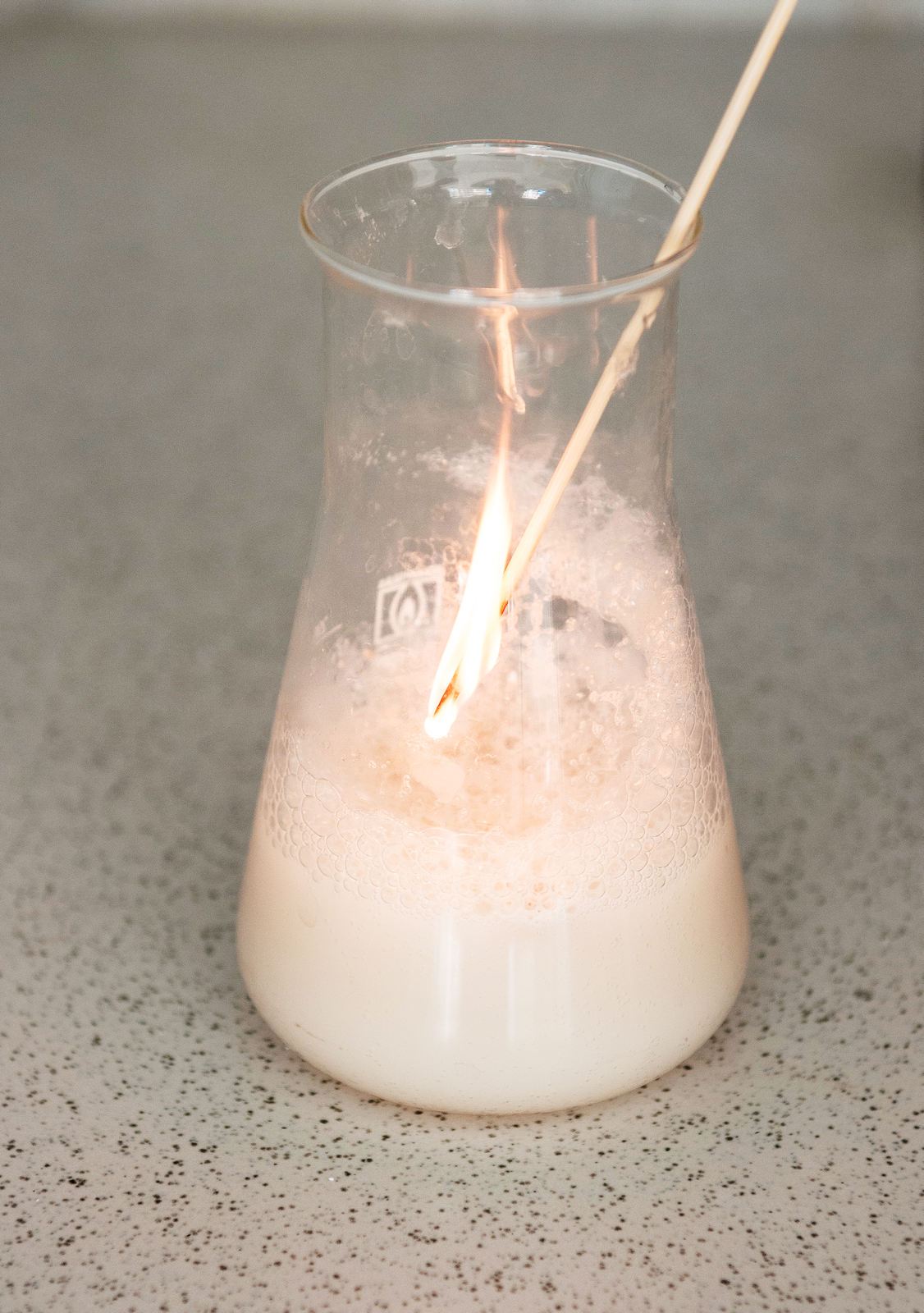
Pour hydrogen peroxide to the flask, add a teaspoon of yeast or diced raw potato.
After a while place a burning wooden skewer in the flask.
Observe the changes that occur.
RPLSdmAITjDTH1
Zmienić opis alt na: Zdjęcie kolby, do której włożone jest zapalone łuczywo. W kolbie biała pieniąca się mieszanina drożdży i wodnego roztworu nadtlenku wodoru.
Summary
As a result of decomposition of hydrogen peroxide(), under the influence of the enzymes contained in the yeast/ potato, a colorless and odorless gas is produced which can be identified by means of a burning wooden skewer.
RWi8QHrbuGTm0
Exercise 1
Indicate statements that are true. Możliwe odpowiedzi: 1. Oxygen accounts for about one fifth of the volume of the Earth's atmosphere., 2. All living organisms need oxygen to live., 3. Breathing oxygen at high concentrations can cause lung damage., 4. As the altitude rises, oxygen becomes thinner on Earth., 5. Oxygen cannot be obtained by decomposition of hydrogen peroxide in the presence of a catalyst., 6. Oxygen sustains combustion., 7. Under normal conditions, oxygen is a colorless, odorless gas that forms bi-atomic molecules.
Indicate statements that are true. Możliwe odpowiedzi: 1. Oxygen accounts for about one fifth of the volume of the Earth's atmosphere., 2. All living organisms need oxygen to live., 3. Breathing oxygen at high concentrations can cause lung damage., 4. As the altitude rises, oxygen becomes thinner on Earth., 5. Oxygen cannot be obtained by decomposition of hydrogen peroxide in the presence of a catalyst., 6. Oxygen sustains combustion., 7. Under normal conditions, oxygen is a colorless, odorless gas that forms bi-atomic molecules.
Mark statements that are true.
Oxygen accounts for about one fifth of the volume of the Earth's atmosphere.
All living organisms need oxygen to live.
Breathing oxygen at high concentrations can cause lung damage.
As the altitude rises, oxygen becomes thinner on Earth.
Oxygen cannot be obtained by decomposition of hydrogen peroxide in the presence of a catalyst.
Oxygen sustains combustion.
Under normal conditions, oxygen is a colorless, odorless gas that forms bi-atomic molecules.
Conclusion
Oxygen is the most common element in nature.
Oxygen is a colorless, odorless, slightly soluble in water, chemically active gas.
Oxygen can be obtained during thermal decomposition of potassium manganate(VII), hydrogen peroxide decomposition (in the presence of a catalyst) or water decomposition due to an electric current (water electrolysis).
The industrial method of obtaining oxygen is to distil liquid air.
R18Tcfx8PL0qw1
Grafika przedstawiająca tablicę szkolną, na której znajdują się zdania do dokończenia. Finish selected sentences. 1 It was easy for me (uzupełnij). 2 It was difficult for me (uzupełnij). 3 Today I learned (uzupełnij). 4 I understood that (uzupełnij). 5 It surprised me (uzupełnij). 6. Today I found out (uzupełnij). 7. I was interested in (uzupełnij). 8. I still have to repeat (uzupełnij).
Grafika przedstawiająca tablicę szkolną, na której znajdują się zdania do dokończenia. Finish selected sentences. 1 It was easy for me (uzupełnij). 2 It was difficult for me (uzupełnij). 3 Today I learned (uzupełnij). 4 I understood that (uzupełnij). 5 It surprised me (uzupełnij). 6. Today I found out (uzupełnij). 7. I was interested in (uzupełnij). 8. I still have to repeat (uzupełnij).
Source: GroMar Sp. z o.o., licencja: CC BY-SA 3.0.
Homework
Task 3.1
Omów fizyczne i chemiczne właściwości tlenu i azotu
Omów fizyczne i chemiczne właściwości tlenu i azotu
Present the physical and chemical properties of oxygen and nitrogen in a table.
nadtlenek wodoru (HIndeks dolny 22OIndeks dolny 22, woda utleniona) – najprostszy nadtlenek (związek z pojedynczym wiązaniem tlen‑tlen); jest stosowany jako utleniacz, środek wybielający i antyseptyczny