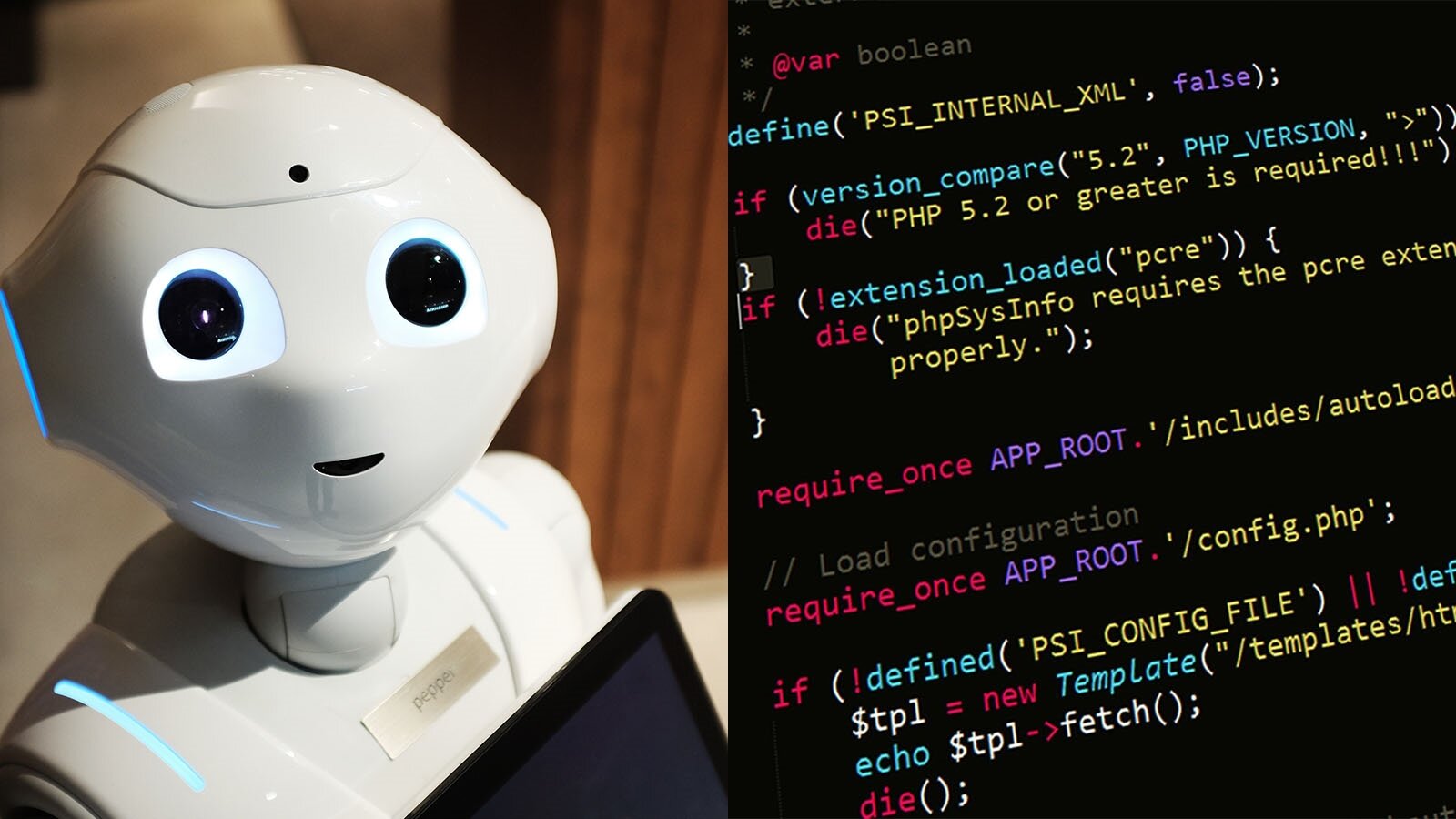
We like to imagine AI as what is shown in the picture on the left, while the reality is much more prosaic and resembles the image on the right. Noam Chomsky, an American linguist, philosopher, and political activist, when asked if he thought AI would ever be able to think, said that AI depends on how people programme it and it will only be able to do what people tell it to do. Does it mean all apocalyptic visions of machines taking control of the world and turning people into their slaves are only that: visions? What do you think? Can AI be creative?
Lubimy wyobrażać sobie sztuczną inteligencję tak, jak przedstawia to fotografia pierwsza od lewej, podczas gdy rzeczywistość jest dużo bardziej prozaiczna i przypomina raczej to, co prezentuje drugie zdjęcie. Noam Chomsky, amerykański lingwista, filozof i aktywista polityczny, zapytany, czy sztuczna inteligencja kiedykolwiek będzie w stanie myśleć, odpowiedział, że sztuczna inteligencja jest programowana przez ludzi, więc zawsze będzie robić tylko to, co ludzie każą jej robić. Czy to oznacza, że wszystkie nasze apokaliptyczne opowieści o maszynach przejmujących władzę nad światem i zamieniających ludzi w niewolników są tylko nierealnymi wizjami? Jak uważasz? Czy sztuczna inteligencja może być kreatywna?
RIL2QwIoDmNKZ
Ilustracja składa się z dwóch zdjęć. Po lewej widoczny robot zbudowany z białego tworzywa posiadający czarne okrągłe oczy i otwór przypominający usta. Po prawej widoczny ekran komputera zawierający skomplikowane rzędy cyfr, znaków i liter.
What’s the real face of AI?
Jakie jest prawdziwe oblicze sztucznej inteligencji?
Źródło: dostępny w internecie: www.pexels.com [dostęp 16.08.2022], domena publiczna.
1
Exercise1
Drag the elements of the sentences to find out what Stephen Hawking, a British theoretical physicist, told the BBC about artificial intelligence.
R4bPBBkHa4nDO
Źródło: GroMar Sp. z o.o., licencja: CC BY-SA 3.0.
Exercise1
R15b24Y6sH6rq
Ilustracja przedstawia napis w języku angielskim: THE DEVELOPMENT OF FULL ARTIFICIAL INTELLIGENCE COULD SPELL THE END OF THE HUMAN RACE.HUMANS, WHO ARE LIMITED BY SLOW BIOLOGICAL EVOLUTION, COULDN'T COMPETE, AND WOULD BE SUPERSEDED. W tle widoczna dłoń zaciśnięta w pięść oraz liczne atomy.
Ilustracja przedstawia napis w języku angielskim: THE DEVELOPMENT OF FULL ARTIFICIAL INTELLIGENCE COULD SPELL THE END OF THE HUMAN RACE.HUMANS, WHO ARE LIMITED BY SLOW BIOLOGICAL EVOLUTION, COULDN'T COMPETE, AND WOULD BE SUPERSEDED. W tle widoczna dłoń zaciśnięta w pięść oraz liczne atomy.
Źródło: dostępny w internecie: www.pexels.com [dostęp 16.08.2022], domena publiczna.
Study the text and do the exercises below.
Can AI Be Creative?
Anna Posyniak‑DutkaCan AI Be Creative?
To be able to address this questionaddress this question [address something]address this question we need to define the two main concepts it comprisescomprises [comprise]comprises – artificial intelligence and creativity. Starting with AI, we already stumble uponstumble uponstumble upon a challenge as definitions of it are many and varied. A dictionary entrydictionary entrydictionary entry for AI points out that it’s a study of how to create machines with human‑like qualitieshuman‑like qualities [human‑like quality]human‑like qualities such as the ability to understand information, recognise images, learn, and solve problems. According to a more technical approach, AI is a set of algorithmsset of algorithmsset of algorithms designed to mimic human intelligencemimic human intelligencemimic human intelligence. Yet another explanation states that AI is an interdisciplinary scienceinterdisciplinary scienceinterdisciplinary science aimed at constructing smart machines. Creativity is defined as the ability to create something new and valuable. InventivenessinventivenessInventiveness, in other words. Can these two concepts be put together into one physical form?
We like to personifypersonifypersonify the world around us. We are much more likely to see human traitshuman traits [human trait]human traits in machines which have been given faces and limbslimbs [limb]limbs than in computer screens. All that regardless of the fact that the softwaresoftwaresoftware behind both machines might be identical. We are likely to ignore the fact that the physical form does not make machines any more akin toakin toakin to humans.
Nowadays machines can perform lots of tasks which have all the hallmarks ofhave all the hallmarks ofhave all the hallmarks of creativity. They can compose music or write poems out of elements provided by humans. Is it real inventiveness, though? True creativity originatesoriginateoriginates from a brain. Machines can only do what people programme them to do. It’s impossible for a computer to come up withcome up withcome up with a truly original idea despite the fact that machines’ capacity for data intakecapacity for data intakecapacity for data intake and processing is incomparablyincomparablyincomparably bigger than ours.
For that very reason it’s the machine and human cooperation that produces the most spectacular outcomes. At the moment, AI is treated as a partner (another case of personification) in the human creative process. Artificial intelligence is commonly used in areas such as art, music, dance, design, and publishing where computer systems fed enormous amounts of datacomputer systems fed enormous amounts of data [computer system fed enormous amount of data]computer systems fed enormous amounts of databoost human creativityboost human creativityboost human creativity. How? For instance by generating ideasgenerating ideas [generate an idea]generating ideas which are later refinedrefined [refine]refined and customisedcustomised [customise]customised by human creators. It can help some artists overcome artist’s blockovercome artist’s blockovercome artist’s block. Experts, however, question AI’s ability to create noveltycreate noveltycreate novelty without human guidancehuman guidancehuman guidance.
Alan Turing, a British mathematician who contributed tocontributed to [contribute to]contributed to breaking the Enigma code during World War II, was one of the first to formulate the question whether or not machines can think. He took it a step further, and he designed a test, the aim of which is to determine if a machine can demonstrate a human‑like intelligence and deceive an observer into thinkingdeceive an observer into thinking [deceive somebody into thinking]deceive an observer into thinking that it is a human being. The test, also referred to as an imitation gameimitation gameimitation game, is a three‑party written conversationthree‑party written conversationthree‑party written conversation in which two interlocutorsinterlocutors [interlocutor]interlocutors answer questions asked by an interrogatorinterrogatorinterrogator who at the same time observes and tries to figure out which one is a machine. AI still hasn’t passed the test yet. The moment it does will mark a major step forward in its development.
Coming back to the original question, although the boundary between human creativity and what AI is capable of is becoming mighty fine, it seems that for the time being the answer is no. However, things which were considered unthinkableunthinkableunthinkable years ago, are our reality now, and nobody questions their existence. Time will telltime will tellTime will tell what future developments in terms of artificial intelligence will bring, and these will definitely be exciting discoveries! For now, it remains fertile groundfertile groundfertile ground for science‑fiction creators.
1 Źródło: Anna Posyniak‑Dutka, licencja: CC BY-SA 3.0.
Exercise2
Analyse the text about artificial intelligence and answer the questions below. There is only one correct answer in each case.
R15VaiaT8bRGP
Which definition of AI is NOT mentioned in the first paragraph? Możliwe odpowiedzi: 1. a) AI is the subject of research into how to give machines human-like features., 2. b) AI is a sequence of instructions encoded in computers aimed at imitating human cognitive processes., 3. c) AI is a branch of science which combines a few different bodies of knowledge., 4. d) AI is the machines’ ability to create new concepts.
Źródło: GroMar Sp. z o.o., licencja: CC BY-SA 3.0.
R1TUGVZHJvtFp
Which statement defines creativity according to the information from the first paragraph? Możliwe odpowiedzi: 1. a) Creativity is the capacity to bring original and unprecedented concepts into existence., 2. b) Creativity is the ability to imitate other intelligent beings., 3. c) Creativity is the knowledge of how to invent new words., 4. d) Creativity is the skill to combine different concepts.
Źródło: GroMar Sp. z o.o., licencja: CC BY-SA 3.0.
RohpWQYzqUk56
How are people likely to perceive machines which look like humans? Możliwe odpowiedzi: 1. a) They think all machines should have faces, arms, and legs., 2. b) They attribute human-like features to such machines., 3. c) They like machines which resemble people more than those which don’t., 4. d) They have a higher regard for machines with human features.
Źródło: GroMar Sp. z o.o., licencja: CC BY-SA 3.0.
R1XXqTtDMXHZn
Which statement is TRUE about contemporary machines? Możliwe odpowiedzi: 1. a) They are maintained by scientists., 2. b) They can process much more data than humans., 3. c) They create truly original art., 4. d) They are much bigger than they used to be.
Źródło: GroMar Sp. z o.o., licencja: CC BY-SA 3.0.
RJQ5FQxfo7IWZ
What’s the best use of AI in the form it is currently available? Możliwe odpowiedzi: 1. a) To publish books., 2. b) To enter huge volumes of data into computers., 3. c) To adapt computer-generated solutions to human needs., 4. d) To collaborate with humans in creating original content.
Źródło: GroMar Sp. z o.o., licencja: CC BY-SA 3.0.
R14zIzctjVgBW
What’s the purpose of the Turing test? Możliwe odpowiedzi: 1. a) To check if machines can predict their interrogators’ questions., 2. b) To demonstrate that people are better interlocutors than machines., 3. c) To verify if a machine can have cognitive agility equal to humans., 4. d) To prove that conversations between people and machines are possible.
Źródło: GroMar Sp. z o.o., licencja: CC BY-SA 3.0.
R1JpuZRcBBB0J
What does the author of the text say in the last paragraph about the current state of AI? Możliwe odpowiedzi: 1. a) AI is becoming more and more mighty., 2. b) People ask a lot of questions about the existence of AI., 3. c) AI concepts provide sci-fi authors with a lot of ideas for their work., 4. d) AI is expected to make some exciting discoveries in the future.
Źródło: GroMar Sp. z o.o., licencja: CC BY-SA 3.0.
Exercise3
R290h4SnTKvGw
Match the definitions below with the words and phrases from the text. To come across, to encounter something or someone unexpectedly Możliwe odpowiedzi: 1. stumble upon, 2. originate, 3. incomparably, 4. personify, 5. overcome artist’s block, 6. inventiveness, 7. akin to The ability to come up with lots of creative ideas, creativity Możliwe odpowiedzi: 1. stumble upon, 2. originate, 3. incomparably, 4. personify, 5. overcome artist’s block, 6. inventiveness, 7. akin to To imagine that something has human-like features Możliwe odpowiedzi: 1. stumble upon, 2. originate, 3. incomparably, 4. personify, 5. overcome artist’s block, 6. inventiveness, 7. akin to Similar to Możliwe odpowiedzi: 1. stumble upon, 2. originate, 3. incomparably, 4. personify, 5. overcome artist’s block, 6. inventiveness, 7. akin to To create something new and unprecedented Możliwe odpowiedzi: 1. stumble upon, 2. originate, 3. incomparably, 4. personify, 5. overcome artist’s block, 6. inventiveness, 7. akin to Not possible to be compared to anything Możliwe odpowiedzi: 1. stumble upon, 2. originate, 3. incomparably, 4. personify, 5. overcome artist’s block, 6. inventiveness, 7. akin to To break the artist's inability to create due to lack of inspiration Możliwe odpowiedzi: 1. stumble upon, 2. originate, 3. incomparably, 4. personify, 5. overcome artist’s block, 6. inventiveness, 7. akin to
Match the definitions below with the words and phrases from the text. To come across, to encounter something or someone unexpectedly Możliwe odpowiedzi: 1. stumble upon, 2. originate, 3. incomparably, 4. personify, 5. overcome artist’s block, 6. inventiveness, 7. akin to The ability to come up with lots of creative ideas, creativity Możliwe odpowiedzi: 1. stumble upon, 2. originate, 3. incomparably, 4. personify, 5. overcome artist’s block, 6. inventiveness, 7. akin to To imagine that something has human-like features Możliwe odpowiedzi: 1. stumble upon, 2. originate, 3. incomparably, 4. personify, 5. overcome artist’s block, 6. inventiveness, 7. akin to Similar to Możliwe odpowiedzi: 1. stumble upon, 2. originate, 3. incomparably, 4. personify, 5. overcome artist’s block, 6. inventiveness, 7. akin to To create something new and unprecedented Możliwe odpowiedzi: 1. stumble upon, 2. originate, 3. incomparably, 4. personify, 5. overcome artist’s block, 6. inventiveness, 7. akin to Not possible to be compared to anything Możliwe odpowiedzi: 1. stumble upon, 2. originate, 3. incomparably, 4. personify, 5. overcome artist’s block, 6. inventiveness, 7. akin to To break the artist's inability to create due to lack of inspiration Możliwe odpowiedzi: 1. stumble upon, 2. originate, 3. incomparably, 4. personify, 5. overcome artist’s block, 6. inventiveness, 7. akin to
Źródło: GroMar Sp. z o.o., licencja: CC BY-SA 3.0.
Exercise4
Type your answers to the questions in 4–5 sentences in each case.
Based on the information from the text, formulate your own definition of AI.
What is the Turing test?
RlTlqarUmVle6
(Uzupełnij).
Źródło: GroMar Sp. z o.o., licencja: CC BY-SA 3.0.
AI, which stands for…, is a complex… I would define AI as… which draws on… to… Coding, so creating…, is an… The overall aim is to… which perhaps one day will…
The Turing test, designed by a…, has the purpose to… It is determined by means of a… in which two interlocutors, a… and a…, in writing… posed by… The… goal is to figure out which… No… has ever… this test yet.
AI, which stands for artificial intelligence, is a complex concept. I would define AI as an interdisciplinary science which draws on many different areas of knowledge to study the possibilities of machines gaining human‑like cognitive abilities. Coding, so creating more and less complex algorithms, is an essential part of this process. The overall aim is to construct so called smart machines which perhaps one day will possess human intelligence.
The Turing test, designed by a British mathematician after whom it was named, has the purpose to figure out if machines can have human‑like intelligence. This is determined by means of a conversation in which two interlocutors, a human being and a computer, answer questions posed by an interrogator in writing. The interrogator’s goal is to figure out which interlocutor is a machine. No machine has ever passed this test yet.