Promised lands - industrial development on the Polish lands
to characterize the transmission revolution, its effects and consequences;
to explain why Łódź was called the „Polish Manchester”;
to characterize the most important branches of industry in particular Partitions;
to explain the concepts of urbanizationurbanization and migration.
The divided Polish lands – like other European countries – had seen industrialization. However, the extent to this process was much less than in the Western countries. Individual partitions remained countries of mostly agricultural character. The Russian partition was the most industrialized one (two large industrial centres: Warsaw and Łódź – called “the Polish Manchaster”). The oil industry emerged in Galicia. Coal mining and steel industry developed in Silesia.
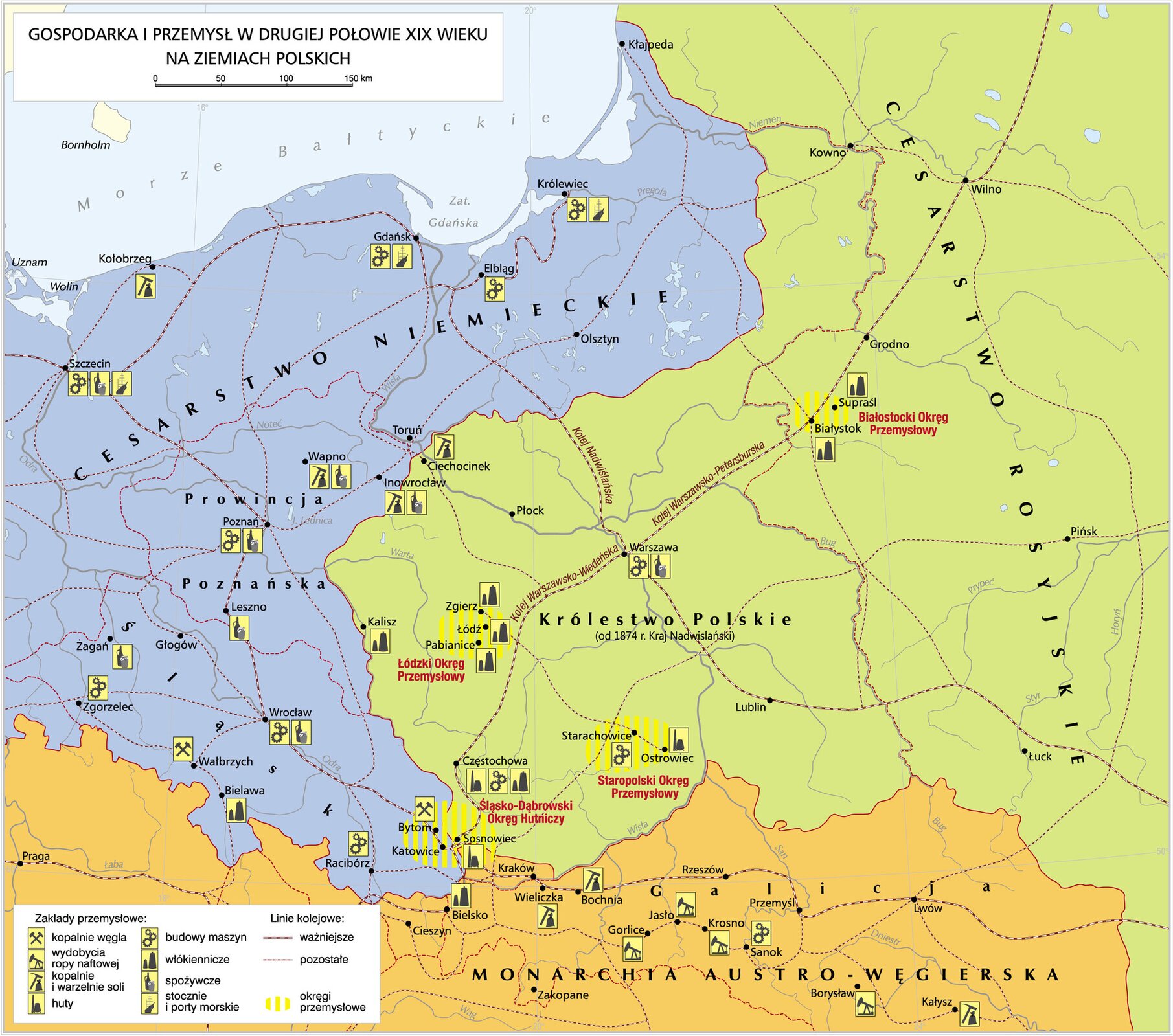
Fill in the text in empty places.
salt mine, the textile industry, Jasło and Krosno, spinning mill, Starachowice or Kielce, Poznań, Königshütte
Galvanizing plants and rolling mills of the Old-Polish Industrial Region are awaiting new employees. You may live at a workers' housing estate in such towns as .............................................
Do you want to become a steel worker? Come to ............................................!
The most modern extraction industry –oil fields and refineries are employing workers in .............................................
The modern ............................................ in Żyrardów is urgently looking for night shift workers.
Are you looking for a job in ............................................? Move to Łódź, the most rapidly growing town in the Kingdom of Poland.
Cegielski Factory in ............................................ is employing workers for production of locomotives.
The new ............................................ in Inowrocław is looking for workers. Previous experience in work in Wieliczka or Bochnia is welcome.
What industries developed in the individual partitions?
food industry, petroleum industry, textile industry
| Austrian | |
| Russian | |
| German |
Year | Population |
1810 | 514 |
1815 | 799 |
1821 | 1855 |
1830 | 4343 |
1850 | 15,764 |
1857 | 27,890 |
1860 | 32,639 |
1865 | 40,121 |
1872 | 100,000 |
1886 | 232,000 |
1897 | 283 206 |
1900 | 314 020 |
See the figure and learn more about Łódź in the 19th century.
Enter appropriate words in the empty fields.
Łódź, Cracow, Max Baum, railway, 150 years, 90 years, textile industry, steel industry, Karol Scheibler, Manchester, Warsaw, 19th, 18th, road, Munich, Częstochowa
................................ century was a period of rapid growth of industry on the Polish lands. In Russian Partition, its beginning is connected with development of ................................ network. It lead to enormous government contracts and cash flows, which enabled the construction of new rolling mills and coke plants as well as production modernization. In ................................, a rail car factory was established then which was the largest in the Russian Empire. However, it was the ................................ that remained the most important industrial sector. Such industrial centres developed, among othersm in Zgierz and Żyrardów and ................................ experienced continued rapid growth. At the end of the 19th century, it became a well-known industrial centre, called the Polish ................................. It resulted in a over 600-fold increase of the town's population within ................................ only, giving rise to the multi-language and multi-nationality community. The largest plants belonged there to so called cotton kings – Israel Poznański, Ludwik Geyer and .................................
Keywords
industry, industrial revolution, promised lands
Glossary
Przemysł – odbywająca się na wielką skalę produkcja materiałów (dóbr) z zasobów przyrody, za pomocą podziału pracy i maszyn. Pełni wiele funkcji, m.in. produkcyjną – pozyskiwania i wytwarzania; społeczną – miejsca pracy i polepszanie warunków życia; przestrzenną – rozwój miast i zmiana środowiska oraz ekonomiczną – produkcja dóbr, energii i wydobycie surowców.
Fabryka – zakład pracy, w którym proces produkcji odbywa się maszynowo przy udziale robotników. Powstające tam produkty są identyczne i wysokiej jakości.
Rafineria – zakład przemysłowy wytwarzający głównie paliwa i smary oraz inne produkty z ropy naftowej.
Urbanizacja – zmiana, wzrost ludności miejskiej oraz zwiększanie się liczby miast, najczęściej kosztem wsi. Urbanizacją nazywamy również proces przekształcania wsi w maista.
Eksplozja demograficzna – szybkie tempo wzrostu liczby ludności w danym miejscu. Najczęściej mówi się o niej jeśli w ciągu jednej generacji (24 lat) nastąpi podwojenie populacji.
Migracja – proces przemieszczania się ludności związany ze zmianą ich zamieszkania lub czasowego pobytu. Możemy podzielić ją na wewnętrzną – w granicach państwa/obszaru lub zewnętrzną.
Emigracja – wyjazd, opuszczenie kraju na dłuższy czas lub na stałe, może być dobrowolna lub przymusowa.