An atom is a piece of matter that uniquely defines an element. Atoms have very complex structurestructurestructure.
Almost all of the mass of an atom is concentrated within a tiny and extremely dense nucleusnucleusnucleus which carries a positive electric charge. The value of this charge is known as the atomic numberatomic numbernumber of the element.
The empty space around the nucleus is occupied by electrons carrying negative electric charge of 1,6022 · 10Indeks górny -19-19 C. This charge is called an elementary charge. The mass of an electron is extremely small and is 9,109390 · 10Indeks górny -31-31 kg. Electrons behave as quantum particles and that means that its location at any moment cannot be determined. Instead of electrons location we speak of the probabilityprobabilityprobability of founding an electron in an atom space. The atom radiusatom radiusatom radius is a measure of the size of the atom and usually is the mean distance from the centre of nucleusnucleusnucleus to the boundary in which the electron can be found with 95% probability. Atomic radii are typically 30‑300 pm.
Ribj9czS6Vw3u
W lewej części ilustracji interaktywnej pokazany jest symbolicznie atom w postaci kuli, w środku której znajduje się niewielki punkt oznaczony numerem 1. Wnętrze kuli oznaczone jest numerem 2, okrąg znajdujący się prawie na obwodzie kuli oznaczony jest numerem 3. Pod kulą zaznaczony jest rozmiar atomu 10 do potęgi minus 10 m. W prawej części ilustracji interaktywnej znajduje się powiększenie punktu znajdującego się w środku kuli, czyli jądra atomowego. Na powiększeniu zaznaczone są składowe jądra czyli protony (czerwone kulki) oraz neutrony (zielone kulki). Pod nim zaznaczony jest rozmiar 10 do potęgi minus 15 m. Na ilustracji widoczne są numery, a na nich podpisy. 1. nucleus {audio}, 2. electron cloud {audio}, 3. 95% probability of electron confinement {audio}.
W lewej części ilustracji interaktywnej pokazany jest symbolicznie atom w postaci kuli, w środku której znajduje się niewielki punkt oznaczony numerem 1. Wnętrze kuli oznaczone jest numerem 2, okrąg znajdujący się prawie na obwodzie kuli oznaczony jest numerem 3. Pod kulą zaznaczony jest rozmiar atomu 10 do potęgi minus 10 m. W prawej części ilustracji interaktywnej znajduje się powiększenie punktu znajdującego się w środku kuli, czyli jądra atomowego. Na powiększeniu zaznaczone są składowe jądra czyli protony (czerwone kulki) oraz neutrony (zielone kulki). Pod nim zaznaczony jest rozmiar 10 do potęgi minus 15 m. Na ilustracji widoczne są numery, a na nich podpisy. 1. nucleus {audio}, 2. electron cloud {audio}, 3. 95% probability of electron confinement {audio}.
The nucleusnucleusnucleus is composed of two types of particles: protons and neutrons. Protons are positively charged and their charge is exactly the same as the value of the electron charge, but of opposite sign. In every electrically neutral atom the number of protons and electrons is equal.
Mass of proton is 1,6726 · 10Indeks górny -27-27 kg. Proton is 1837 times heavier than electron.
Neutron has no charge. Its mass is almost the same as that of proton: 1,674929 · 10Indeks górny -27-27 kg. Most nuclei contain roughly equal numbers of neutrons and protons.
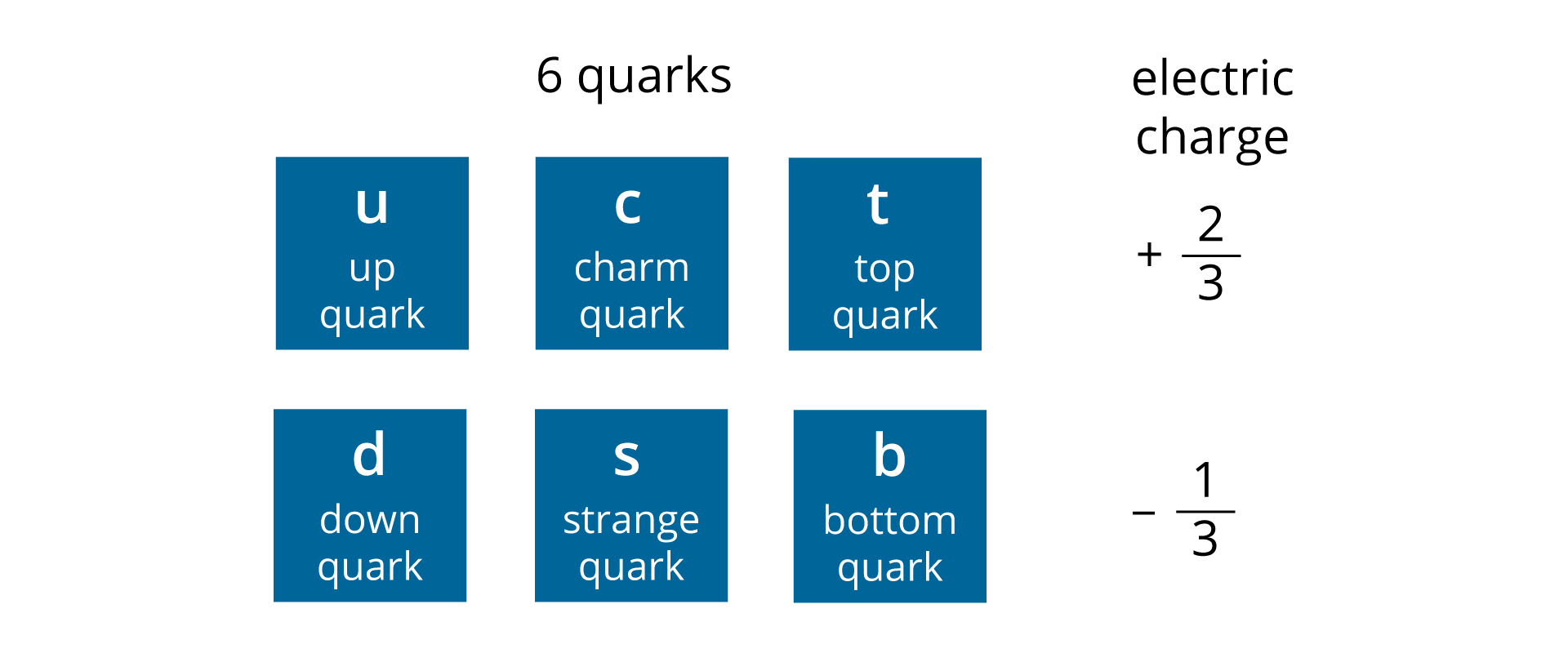
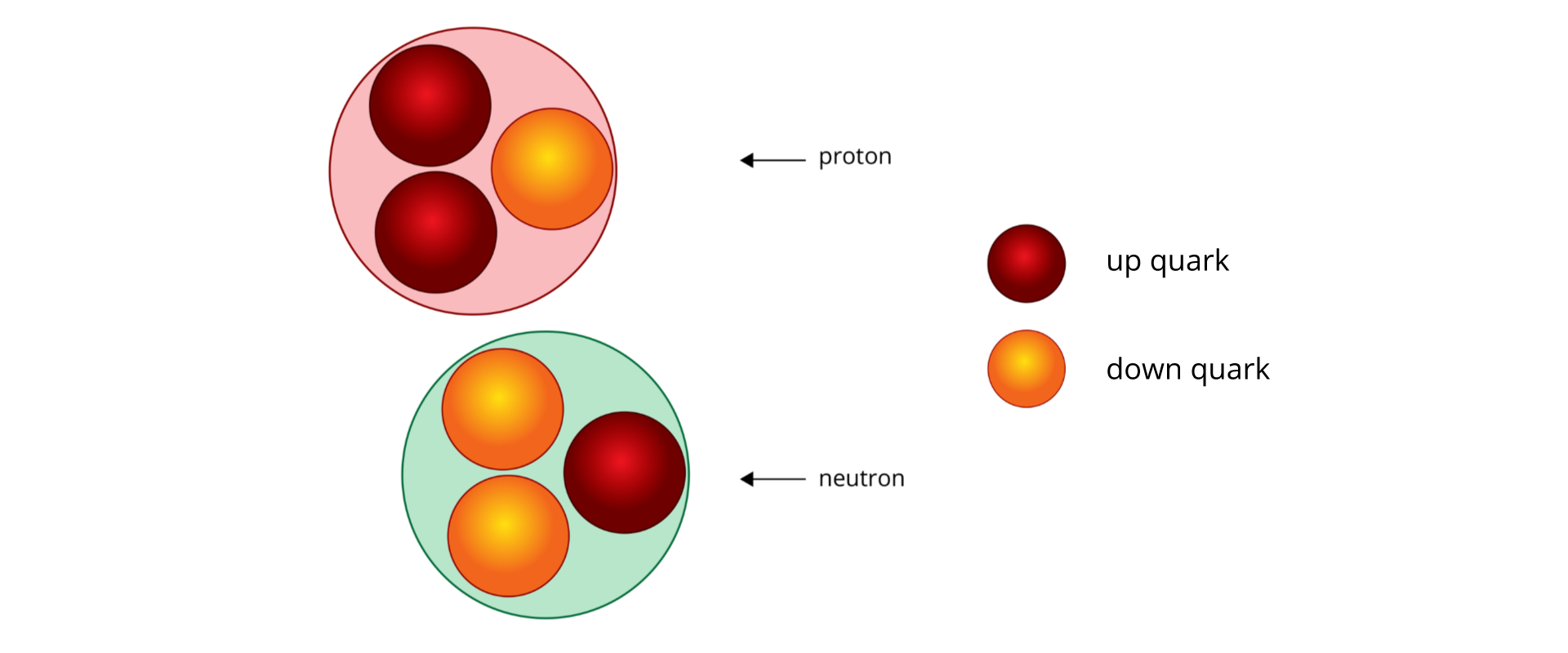
A quarkquarkquark is an elementary particle, that is the smallest indivisible particle of matter. Protons and neutrons are composed of quarks. There are six quarks and they are considered in terms of three pairs: up/down, charm/strange, and top/bottom. Protons are made of two up and one down quark. The neutron is made of two down and one up quark. The up quarks have a charge of of the elementary charge, and the down quarks have a charge of of the elementary charge.
R1ZOhzJVyhk2N
Na rysunku zaznaczone są schematycznie kwarki występujące w przyrodzie. Obrazuje je 6 niebieskich kwadratów opisanych 6 quarks, na których naniesiony jest symbol i nazwa kwarku, w pierwszym wierszu: u - up quark, c - charm quark, t - top quark, w drugim wierszu: d - down quark, s - strange quark, b - bottom quark. Po prawej stronie obrazka zaznaczony jest niesiony przez nie ładunek elektryczny, electric charge: w pierwszym wierszu znak plus ułamek dwie trzecie, w drugim wierszu znak minus ułamek jedna trzecia.
Diagram showing six quarks
Source: GroMar, licencja: CC BY 3.0.
RkoapnIeNjJcS
Po lewej stronie rysunku narysowany jest symbolicznie proton i neutron za pomocą kół, w których w każdym znajdują się po trzy kulki. W protonie dwie kulki czerwone, jedna pomarańczowa. W neutronie dwie kulki pomarańczowe, jedna czerwona. Kulka pomarańczowa obrazuje kwark dolny, opisana down quark. Kulka czerwona obrazuje kwark górny, opisana up quark.
Structure of proton and neutron
Source: GroMar, licencja: CC BY 3.0.
R4NFi0QPFnRYu
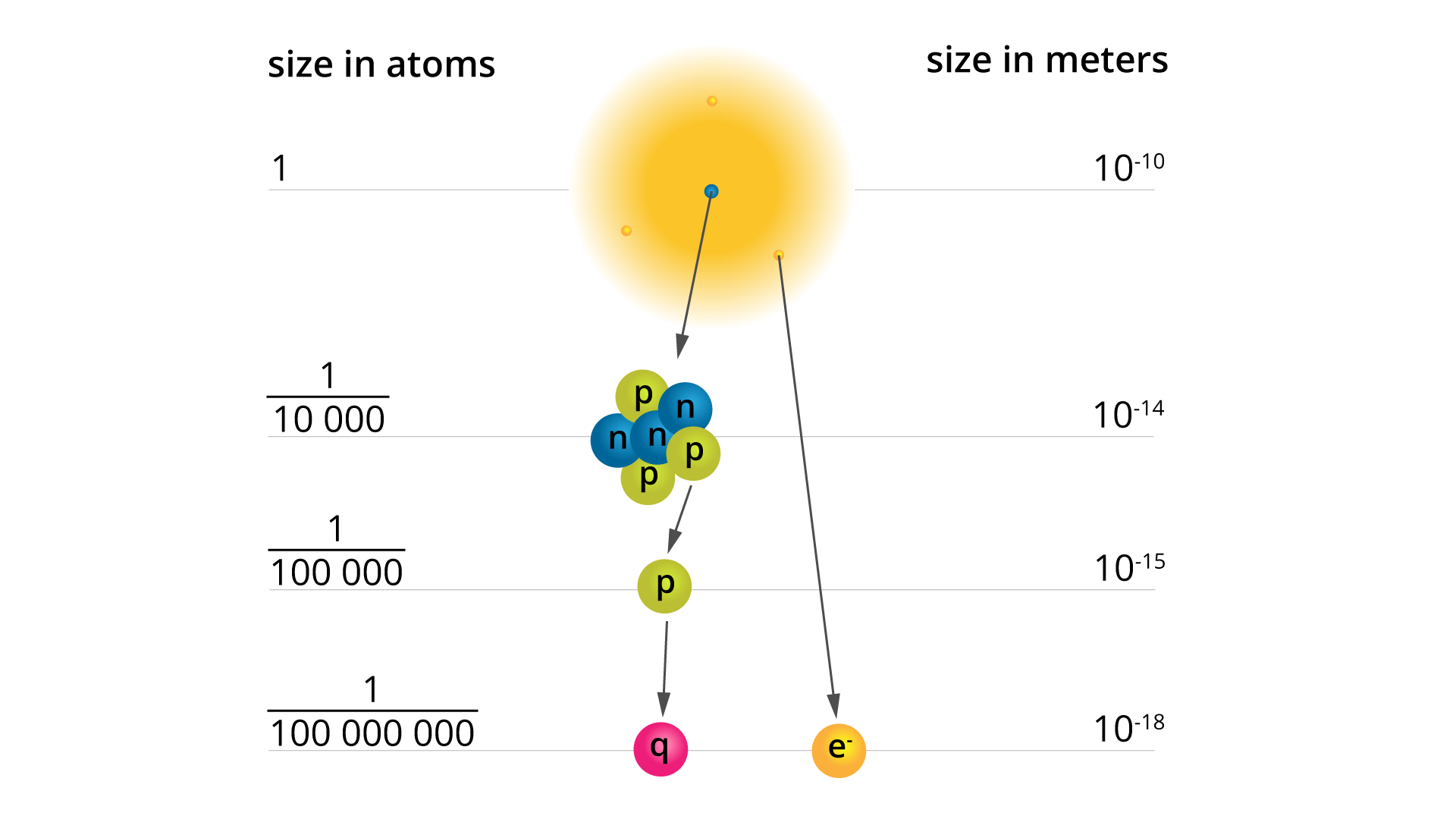
W środkowej części rysunku umieszczone są jeden po drugim symbolicznie narysowane w postaci kółek: atom, protony i neutrony zbite w jądro atomowe, proton oraz równolegle umieszczone na tej samej linii kwark oraz elektron. W lewej części rysunku zaznaczone są rozmiary poszczególnych elementów, opisane size in atoms, odniesione do rozmiaru atomu. Rozmiar atomu oznaczony jest jako 1, protonów i neutronów zbitych w jądro atomowe ułamek 1 przez 10000, protonu ułamek 1 przez 100000, kwarku i elektronu ułamek 1 przez 100000000. Po prawej stronie rysunku te same wymiary wyrażone w metrach opisane size in meters. Rozmiar atomu oznaczony jest jako 10 do potęgi minus 10, protonów i neutronów zbitych w jądro atomowe 10 do potęgi minus 14, protonu 10 do potęgi minus 15, kwarku i elektronu 10 do potęgi minus 18.
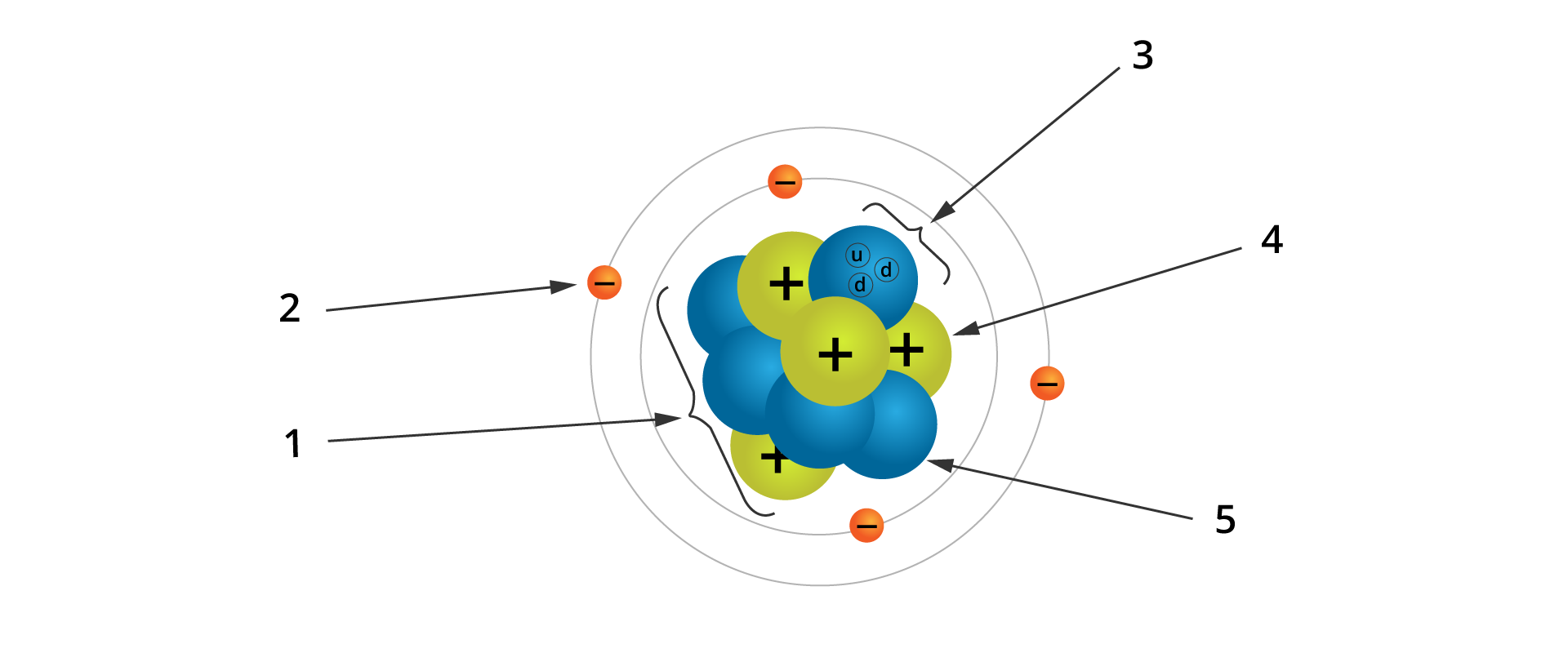
Label the parts of the atom shown in the picture below.
RADJgWMlfNhbC
Rysunek przedstawia symbolicznie strukturę atomu. Powłoki elektronowe (dwie) zaznaczone są za pomocą koncentrycznych kół, na których zaznaczone są elektrony wraz z ujemnym ładunkiem jako minusem, w centrum zaznaczone są protony i neutrony. Na protonach zaznaczone są plusy symbolizujące ich dodatni ładunek. Jeden z neutronów ma zaznaczone wewnątrz kwarki w postaci kółeczek z odpowiednimi symbolami u, d, d. Numerem 1 oznaczony jest środek atomu, numerem 2 oznaczone jest koło ze znakiem minus znajdujące się na okręgu, numerem 3 oznaczone jest kółko z kółeczkami wewnątrz numerem 4 oznaczone jest kółko ze znakiem plus, numerem 5 oznaczone jest kółko bez znaku w środku.
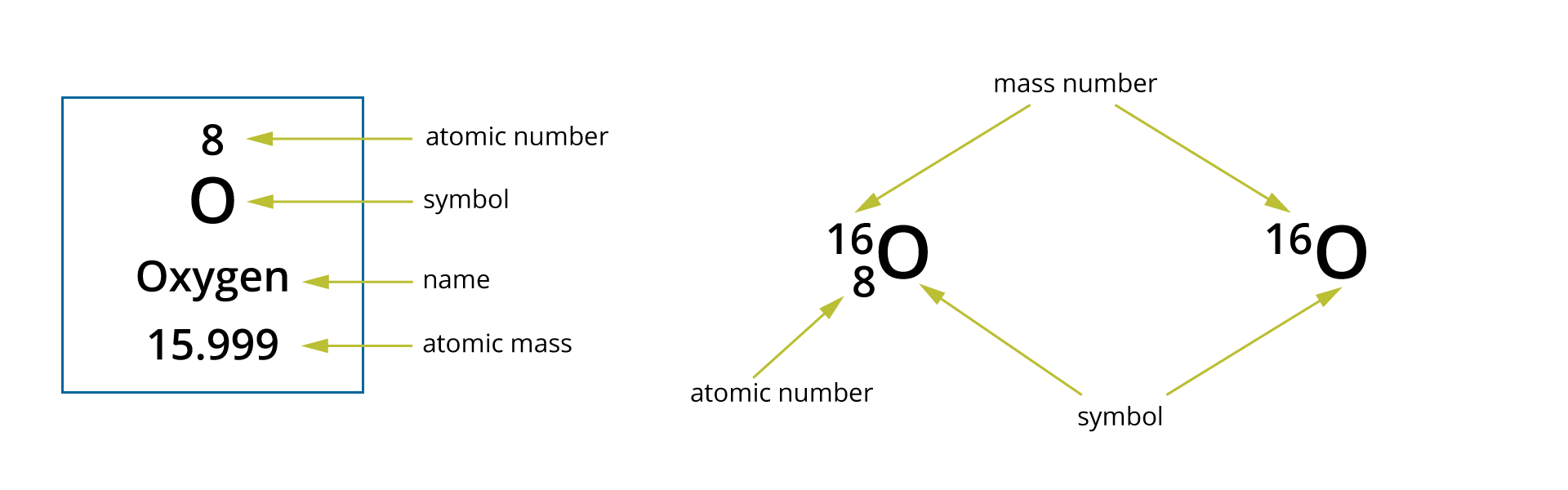
The number of protons in the nucleusnucleusnucleus is called the atomic numberatomic numberatomic number and is denoted by the symbol Z. The Z protons within the nucleus correspond to the Z electrons in outer part of an atom.
The sum of the number of protons and the neutrons in the nucleusnucleusnucleus is called the mass numbermass numbermass number. It is represented by the symbol A.
where: Z - is the number of protons, N - the number of neutrons.
If an element is denoted by X, then the following notation is in use:
If the mass numbermass numbermass number and atomic numberatomic numberatomic number of an element is known, it is very easy to calculate the number of neutrons in nuclei.
In some notation only mass number occurs.
R1PLDLTB21EVP
Na rysunku zaznaczone są trzy notacje dotyczące atomu tlenu. Po lewej notacja stosowana w układzie okresowym pierwiastków – w ramce umieszczone są pionowo, jedno pod drugim: atomic number - 8, symbol - O, name - Oxygen, atomic mass - 15.999. Druga notacja znajdująca się w środku rysunku to symbol pierwiastka O z zaznaczoną po prawej stronie w indeksie górnym liczbą masową - 16, a pod nią w indeksie dolnym liczbą atomową - 8, po prawej stronie rysunku ta sama notacja, lecz bez liczby atomowej. Opisana liczba masowa - mass number, symbol - symbol i liczba atomowa - atomic number.
Different notations of oxygen
Source: GroMar, licencja: CC BY 3.0.
Different styles of the atomic structurestructurestructure notation for oxygen: (from left) the periodic table; mass numbermass numbermass number and atomic numberatomic numberatomic number are shown; only mass number is shown.
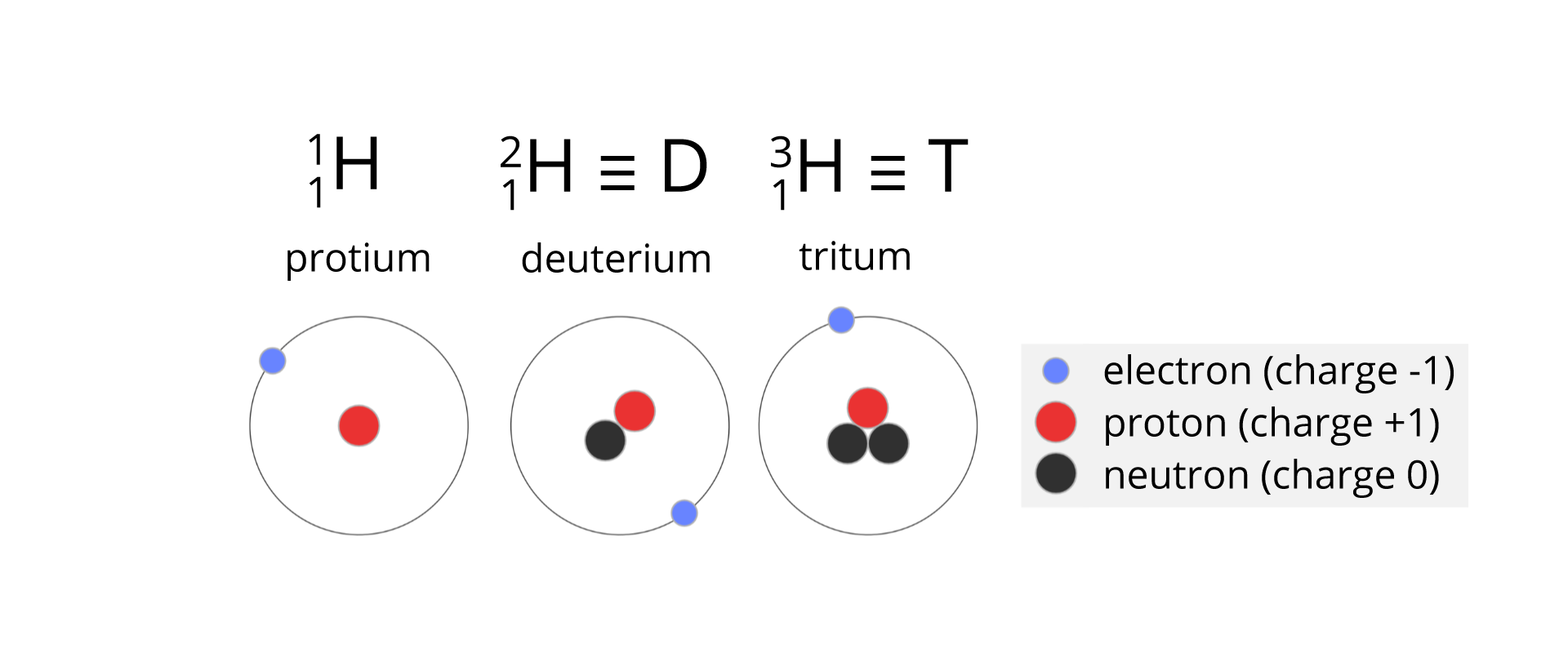
Nuclides are atomic nuclei with a certain atomic number Z and the mass number A. Two nuclides with the same atomic numberatomic numberatomic number but different mass numbers are known as isotopes.
More than 300 nuclides are found naturally on Earth.
Some examples of isotopes.
The simplest element - hydrogen – has two heavy isotopes, called deuterium and tritium. They have own symbols: D (deuterium) and T (tritium).
Carbon occurs mainly as . IsotopeisotopeIsotope is a little more than 1%. All other carbon isotopes are radioactive.
R1KHp0zWusVMU
Rysunek przedstawia trzy izotopy wodoru: proton, deuter i tryt. Są one przedstawione jako koła, na których obwodzie zaznaczony jest niebieskim kółkiem elektron, a w środku jądro atomowe. W nim jako kółko czerwone zaznaczona liczba protonów i jako kółko lub kółka czarne liczba neutronów. Nad każdym kołem jest nazwa izotopu oraz symbol. Po lewej proton - koło z jednym protonem, protonium, H, z prawej strony w indeksie górnym 1, w indeksie dolnym 1. Po środku deuter - koło z jednym protonem i jednym neutronem, deuterium, H, z prawej strony w indeksie górnym 2, w indeksie dolnym 1, znak trzy poziome kreski pod sobą D. Po prawej tryt - koło z jednym protonem i dwoma neutronami, tritum, H, z prawej strony w indeksie górnym 2, w indeksie dolnym 1, znak trzy poziome kreski pod sobą T. Po prawej stronie rysunku znajduje się legenda: niebieskie kółko - electron (charge -1), czerwone kółko - proton (charge +1), czarne kółko neutron (charge 0).
1. What part of the atom has no charge? 2. What is the relation between the number of protons and electrons in an atom? 3. What are the constituents of proton and neutron? 4. What determines the mass numbermass numbermass number?
Do following steps and determine to which element the following atom belongs.
1. Draw five protons in the nucleusnucleusnucleus of the atom. Mark their charge with the appropriate symbol. 2. Draw six neutrons in the nucleus of the atom. 3. Draw two electrons in the first energy level. Mark their charge with the appropriate symbol. 4. Draw three electrons in the second energy level. Mark their charge with the appropriate symbol. 5. What element is represented by the diagram?
Every nuclidenuclidenuclide is characterised by mass number and atomic numberatomic numberatomic number.
Two nuclides with the same atomic number but different mass numbers are known as isotopes.
Exercises
R17lj7fOfg12m
Exercise 2
Determine which sentence is true. Możliwe odpowiedzi: 1. The number of electrons in orbit around the nucleus determines the atomic number of an atom., 2. Carbon’s atomic number is 6. C w indeksie górnym 14 has 8 neutrons., 3. Neutrons are negative with smaller mass while protons are positive and much heavier.
Determine which sentence is true. Możliwe odpowiedzi: 1. The number of electrons in orbit around the nucleus determines the atomic number of an atom., 2. Carbon’s atomic number is 6. C w indeksie górnym 14 has 8 neutrons., 3. Neutrons are negative with smaller mass while protons are positive and much heavier.
Determine which sentence is true.
The number of electrons in orbit around the nucleus determines the atomic number of an atom.
Carbon’s atomic number is 6. 14C has 8 neutrons.
Neutrons are negative with smaller mass while protons are positive and much heavier.
Exercise 3
Answer the question and write them to your notebook.
1. What does the atomic number represent? 2. What does the mass number represent? 3. How can be the number of neutrons in an atom figured out?
1. Protons and electrons. 2. The sum of protons and neutrons. 3. The difference of mass number and atomic number.
Exercise 4
Describe in English the structurestructurestructure of an atom.
RSZQLer2lNfQT
Exercise 5
Wersja alternatywna ćwiczenia: Indicate which pairs of expressions or words are translated correctly. Możliwe odpowiedzi: 1. jądro - nucleus, 2. struktura - structure, 3. składnik - constituent, 4. liczba atomowa - atomic number, 5. kwark - isotope, 6. nuklid - quark
Wersja alternatywna ćwiczenia: Indicate which pairs of expressions or words are translated correctly. Możliwe odpowiedzi: 1. jądro - nucleus, 2. struktura - structure, 3. składnik - constituent, 4. liczba atomowa - atomic number, 5. kwark - isotope, 6. nuklid - quark
Indicate which pairs of expressions or words are translated correctly.
jądro - nucleus
struktura - structure
składnik - constituent
liczba atomowa - atomic number
kwark - isotope
nuklid - quark
zadanie
Source: GroMar, licencja: CC BY 3.0.
Rxbrczj10PZB71
Interaktywna gra, polegająca na łączeniu wyrazów w pary w ciągu jednej minuty. Czas zaczyna upływać wraz z rozpoczęciem gry. Jeden ruch to odkrywanie najpierw jednej potem drugiej karty z wyrazem. Każdy wyraz jest odczytywany. Kolejny ruch to odkrywanie trzeciej i czwartej karty. W ten sposób odsłuchasz wszystkie wyrazy. Nawigacja z poziomu klawiatury za pomocą strzałek, odsłuchiwanie wyrazów enterem lub spacją. Znajdź wszystkie pary wyrazów.
Interaktywna gra, polegająca na łączeniu wyrazów w pary w ciągu jednej minuty. Czas zaczyna upływać wraz z rozpoczęciem gry. Jeden ruch to odkrywanie najpierw jednej potem drugiej karty z wyrazem. Każdy wyraz jest odczytywany. Kolejny ruch to odkrywanie trzeciej i czwartej karty. W ten sposób odsłuchasz wszystkie wyrazy. Nawigacja z poziomu klawiatury za pomocą strzałek, odsłuchiwanie wyrazów enterem lub spacją. Znajdź wszystkie pary wyrazów.
Match Polish terms with their English equivalents.
liczba atomowa
atomic number
nucleus
liczba masowa
składnik
struktura
structure
mass number
constituent
jądro
Source: Zespół autorski Politechniki Łódzkiej, licencja: CC BY 3.0.