Effects of the Earth’s revolution around the Sun
that the Earth rotates on its own axis and revolves around the Sun;
that Earth’s axis is tilted and what the consequences of this tilt are;
when the equinox and solstice phenomena occur;
what the apparent motion of the Sun through the sky at different latitudes looks like.
to explain the effects of the Earth’s revolution;
to distinguish the two most important calendars on Earth – the Julian and Gregorian calendars;
to state the consequences of seasonal variation in sunlight levels on the Earth over the year;
to describe the course and range of polar day and polar night phenomena;
to explain the causes and course of the Sun and Moon eclipses.
The Julian and Gregorian calendars
In the year currently referred to as 45 BC, a new calendar named after Caesar – Julian was introduced. Its main objectives were: establishing 1 January as the beginning of the year; setting length of the month at 30 or 31 days - except for February, which counted only 28 days; introducing every 4 years a leap yearleap year – which was one day longer, i.e. it had 29 February. It was then assumed that the year was 365 days and 6 hours. But it is actually around 11 minutes shorter. This error accumulated for hundreds of years, until it grew to around 10 days in 1582. The beginnings of the seasons no longer coincided with the calendar. Pope Gregory XIII introduced a reform that is still in force today. Firstly, he decided that once 4 October was followed by 15 October, which removed the excess days. Secondly, it assumed that an ordinary year has 365 days, that every 4 years there is a leap year, and that 29 February is added then, but that every 100 years there is a year that is supposed to be a leap year, but that it is an ordinary one and it has 365 days. However, every 400 years, despite a full hundred years, there is a leap year. This calendar is called Gregorian and dominates the world, although there are a few other equally important calendars.
Illumination zones on Earth
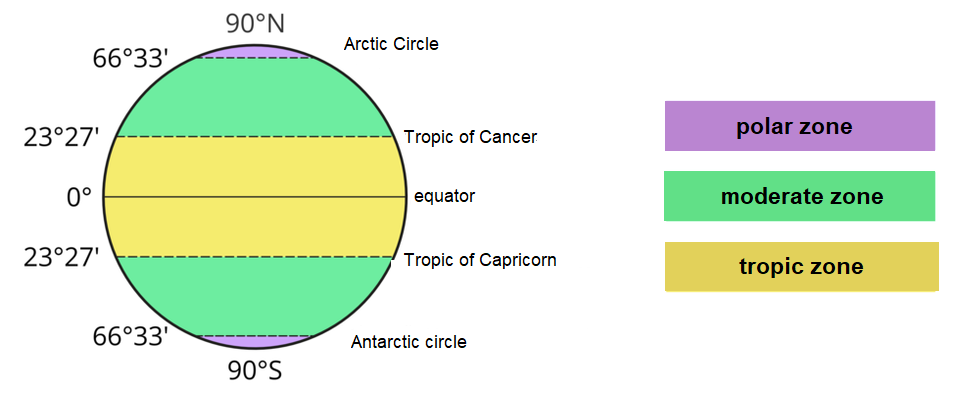
Why do polar day and night occur? A year's movement around the Sun results in the creation of five illumination zones on Earth. Their limits are determined by the tropics and polar circles. The most illuminated zone is the tropics. It stretches between the Tropic of Cancer in the north and the Tropic of Capricorn in the south. The Equator runs through its centre. Only in this zone we can observe the Sun culminating at the zenith. Every 24 hours there is both day and night. On the Equator their length is almost identical and amounts to approximately 12 hours each, and in the vicinity of the tropics the difference between day and night is at maximum 2 hours. Two moderate zones are located between the tropics and the polar circles – the Tropic of Cancer and the Arctic Circle in the north, as well as the Tropic of Capricorn and the Antarctic Circle in the south, which makes them less illuminated. In these zones the Sun never culminates at the zenith, but every day there is both day and night. The altitude of the Sun at its upper culmination varies significantly. It can range from approx. 43° to almost 90° close to the tropics and from approx. 0° to max. 43° close to the polar circles. There is also a very large variation in the length of day and night during the year. The areas the least illuminated by the Sun are the polar zones, located between the polar circles and the poles.
Where do the eclipses of the Sun and Moon come from?
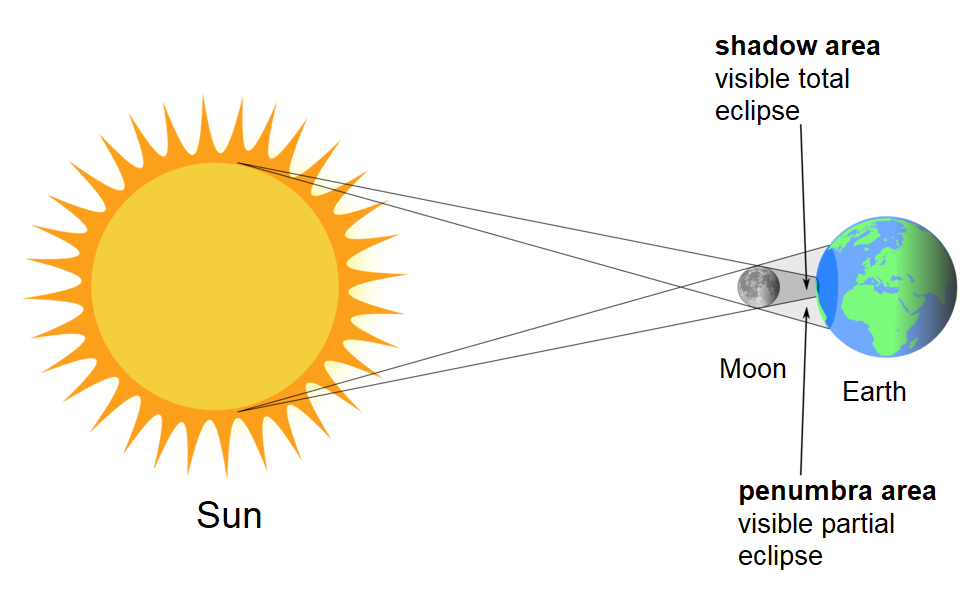
At least twice a year (and up to four or five times a year), there is an astronomical phenomenon in which the Moon stands on a line between the Earth and the Sun and obscures the sunlight. This phenomenon is called a solar eclipsesolar eclipse. In the scale of the entire Earth it occurs quite frequently, but it is always visible on a relatively small area, in a belt less than 300 km wide and several thousand kilometres long. As a result, only once in several years we have a chance to see a partial solar eclipse from Poland, and a total eclipse occurs on our territory every several hundred years. The nearest total eclipse of the Sun will be visible from Poland on 7 October 2135.
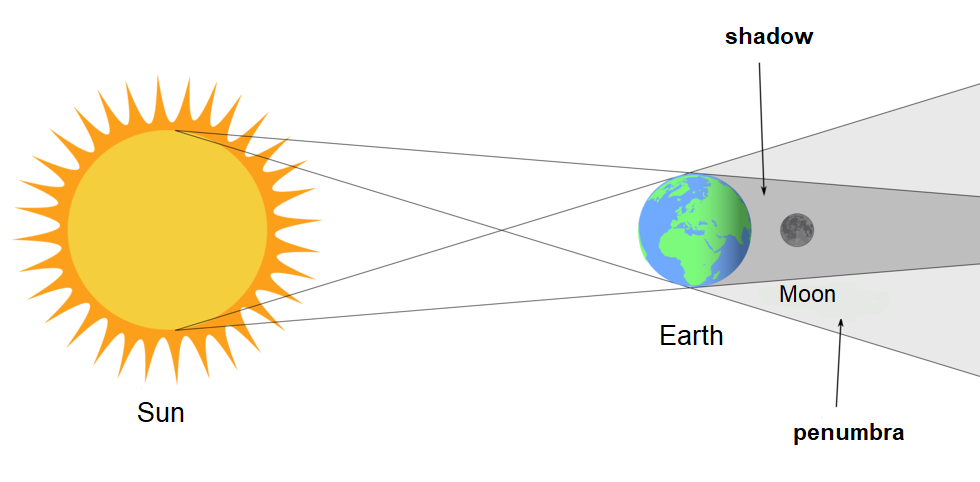
When the Earth is in line between the Sun and the Moon, the phenomenon of a lunar eclipselunar eclipse can take place. The shadow or partial shadow cast by the Earth obscures the sunlight, which is observed as a dark circle obscuring part or all of the Moon's illuminated disc.
What are the consequences of the Earth’s revolution around the Sun?
In the last two topics, various phenomena resulting from the Earth’s revolving around the Sun have been discussed many times. Some of them are of great importance, while others are of little importance to humans.
The effects of the Earth’s revolution around the Sun and the inclination of the Earth's axis to the plane of the ecliptic
The phenomenon of the year, which is one of the basic measures of time and for people means the necessity of using a calendar.
Variation in the Sun's altitude at noon during the year.
Change of the location of sunrise and sunset on the horizon line during the year.
Polar day and night, which significantly hamper people’s functioning outside the polar circles.
Emergence of 5 illumination zones, which offer very varied living and farming conditions.
The emergence of climate zones, which are the diverse illumination of the Earth and, in addition, have a strong impact on the zonal distribution of plants and soils.
The volatility of the seasons has an impact mainly on agriculture but also on other sectors of the economy.
In the list below mark all the phenomena which are the consequences of the Earth's revolution around the Sun and inclination of the Earth to the plane of the ecliptic.
- volatility of the seasons
- day and night
- different illumination zones of the Earth
- the phenomena of polar day and night
- changes of the Sun’s altitude during the day
- changes of the Sun’s altitude at culmination during the year
Summary
The Earth’s revolution around the Sun has numerous consequences for the natural environment and human beings.
Several different calendars are used on Earth at the same time.
Currently the most commonly used calendar on Earth is the Gregorian calendar.
Earth’s revolution around the Sun in conjunction with the inclination of the Earth's axis to the plane of the ecliptic causes the following phenomena: changes of the Sun’s altitude at culmination as well of the place of sunrise and sunset during the year, astronomical seasons, polar day and night, the differentiation of Earth’s illumination zones, which leads to the climate, plant and soil zones.
The movement of our star, planet and the only natural satellite with respect to each other cause the phenomena of solar and lunar eclipses.
Keywords
leap year, lunar eclipse, solar eclipse
Glossary
rok przestępny - rok kalendarzowy, który ma 366 zamiast 365 dni
zaćmienie księżyca - zjawisko astronomiczne obserwowane w momencie, gdy Ziemia znajduje się między Słońcem a Księżycem
zaćmienie słońca - zjawisko astronomiczne obserwowane w momencie, gdy Księżyc znajduje się między Słońcem a Ziemią