The birth of a superpower. USA in the second half of the 19th century
The economic, cultural and political achievements of the United States;
The growth factors of the United States’ power and the dark pages of its history.
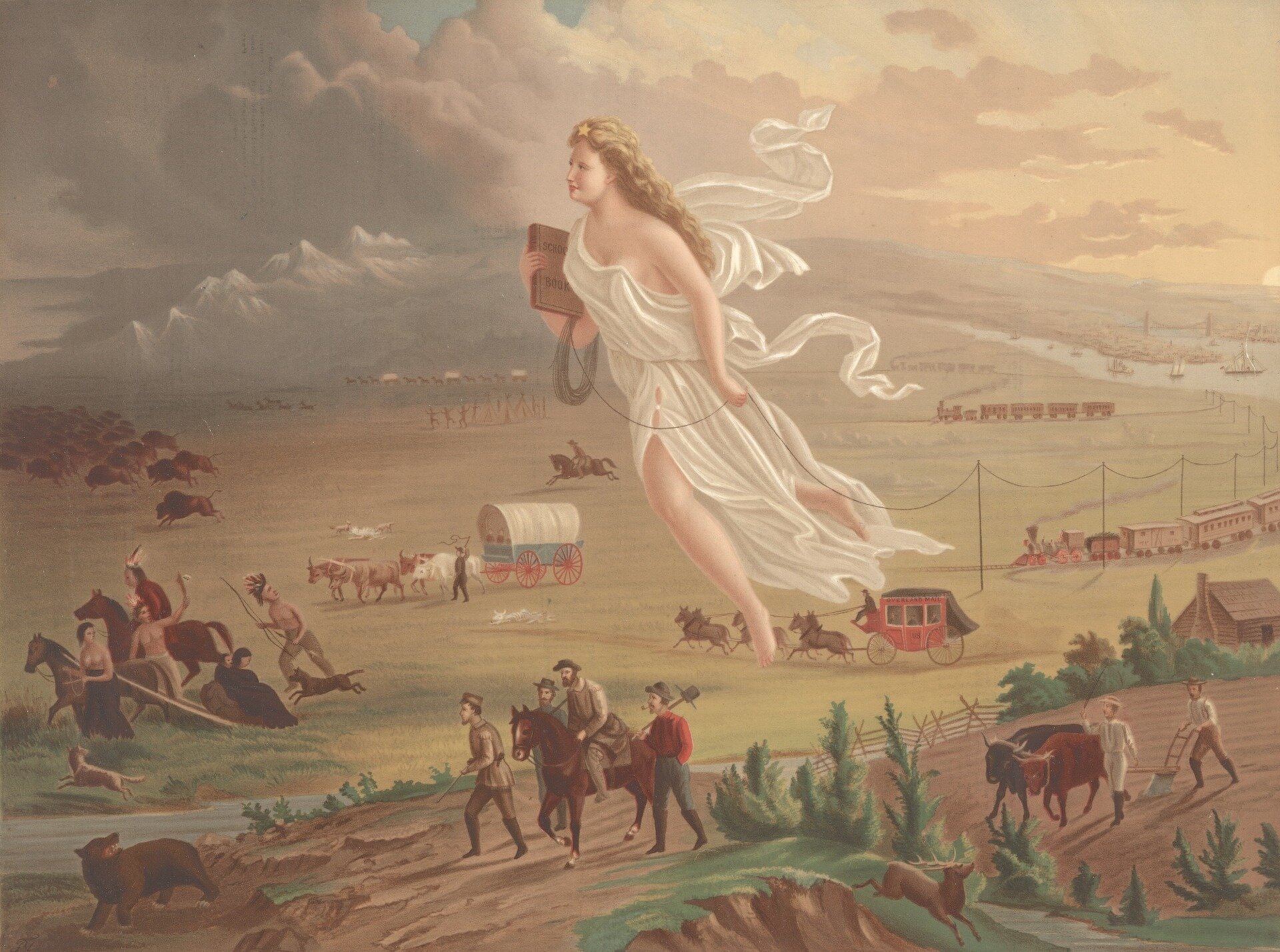
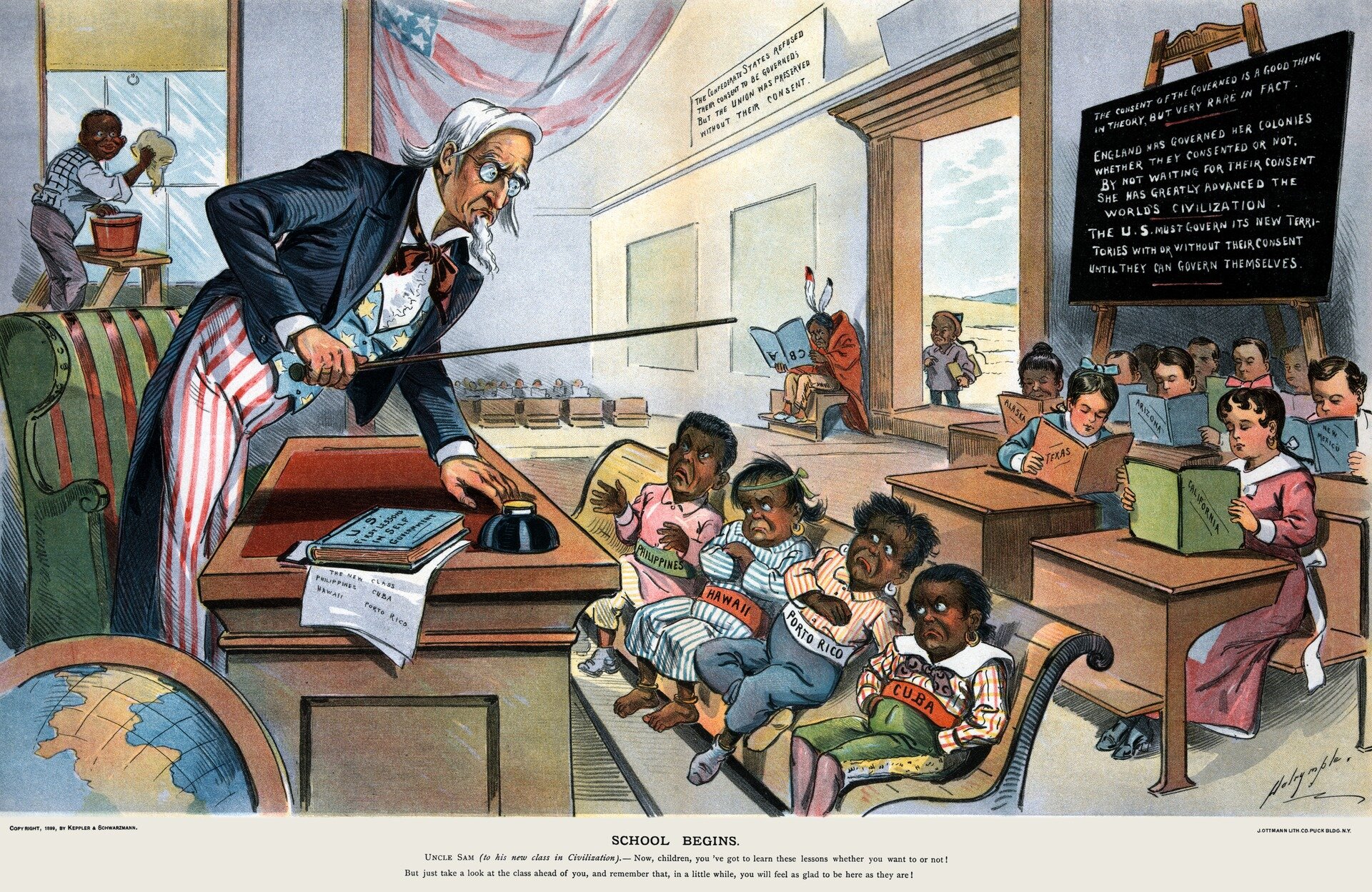
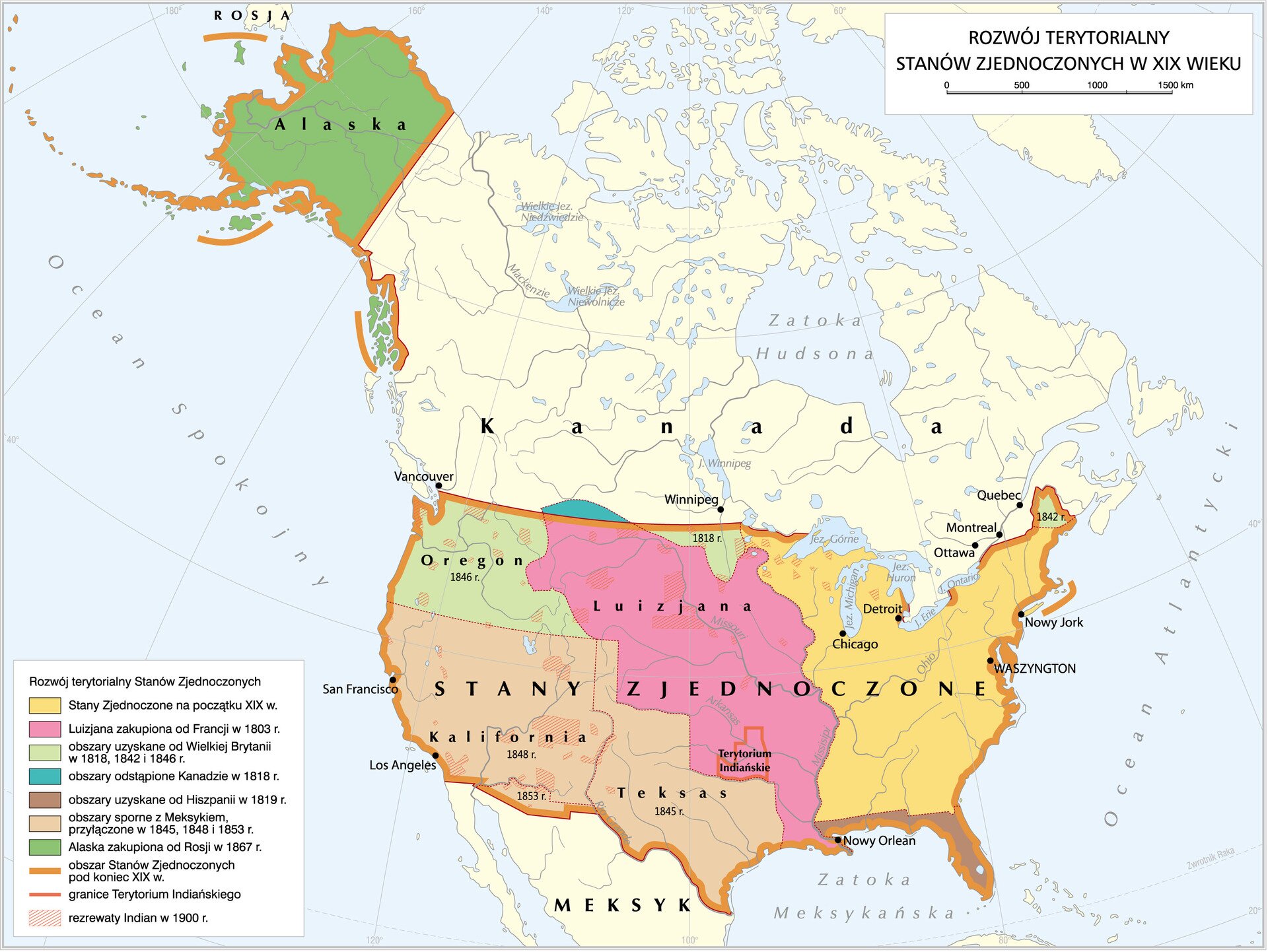
The United States was a country rich in raw materials, with fertile land and, above all, because of its location, it was not exposed to attacks from the outside. The development of technology, as well as of railways and mining equipment, facilitated the use of abundant resources of raw materials. In the 19th century, the United States’ territory more than tripled. This was the result of purchases and conquests. A tragic consequence of colonisation of the western areas of the American continent was exterminationextermination of the Indiansof the Indians. Since 1865, the Indians have been fighting the federal army. The fight lasted until the 1890s. The expansion was also supported by the rapid economic development and demographic growth. The latter included both a significant increase in natural population and growing emigration from Europe. The United States has become a power not only because of its impressive economic development, but also because of its entry into world politics, including colonial politics, and its influence expansion into China and the Pacific.
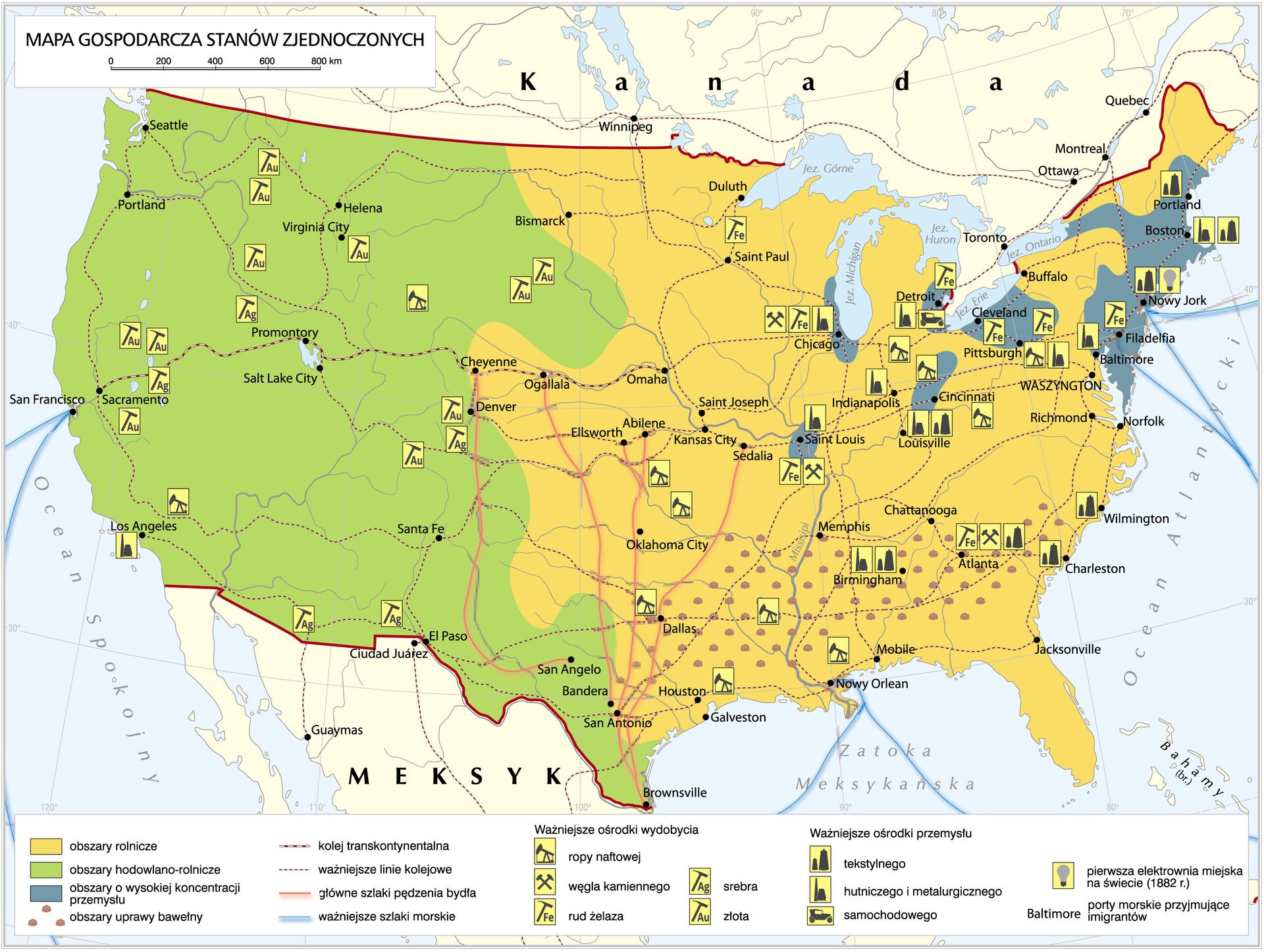
Make a short note.
Analyse the information in the table and then do the exercise.
Iron production in the years 1850‑1913 (in thousands of tons)
Country | 1850 | 1900 | 1913 |
France | 590 | 2 714 | 5 200 |
Germany | 300 | 7 570 | 19 300 |
Russia | 240 | 2 934 | 4 600 |
USA | 565 | 14 200 | 31 500 |
Great Britain | 2 250 | 9 100 | 10 400 |
Fill in the missing parts of the text.
In the mid-nineteenth century, the ............................ dominated the rest of the world in iron production. At the turn of the 20th century, the current leader in iron production was excelled by the ........................... Before the outbreak of World War I, the second place in the world in this category belonged to ...............
Listen to the program and complete the knowledge about the American fortune creator, whose name has become synonymous with wealth.
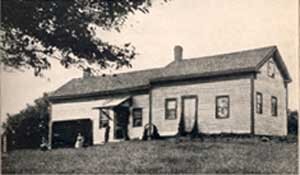
He was one of the richest people in the world. He built the first corporation, and the business solutions applied by him are still functioning today. His contemporaries, however, had seen him not as an economic visionary, but as an unprincipled sweater. John Davidson Rockefeller was born in 1839 into a poor, large family. He spent his youth in a small American town of Richford. His father William led a carefree life of a ranger as a wandering merchant. That is why his mother, Eliza, played a much greater role in his life. She was a strong believer and a committed Baptist. She instilled the cult of work, economy, and devotion into her six children.
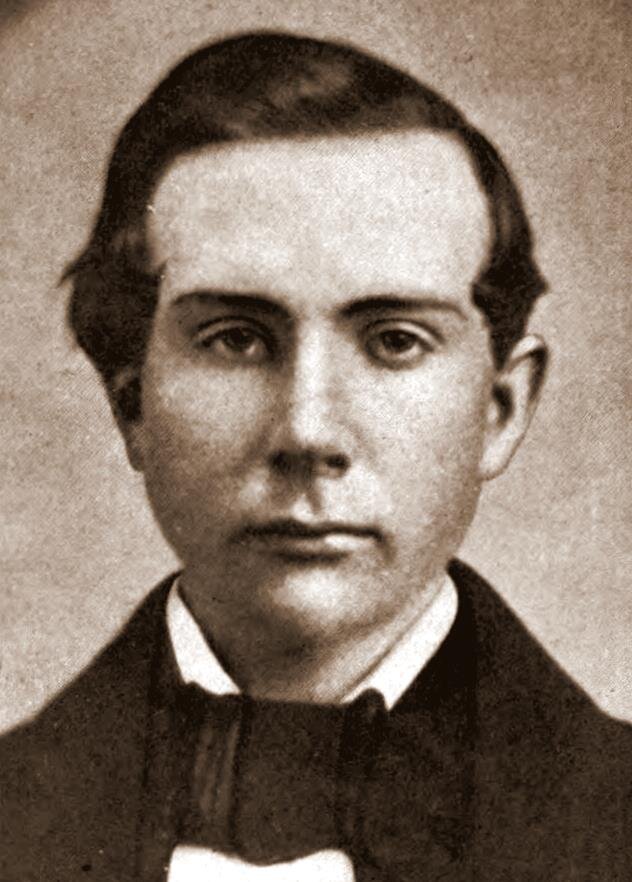
The young Rockefeller was disciplined and respected the Biblical commandments, but he has also shown a spirit of business since he was a child. For example, he bought sweets, then divided them into smaller portions and resold them to his siblings with profit. One day, he had traced the nest of a wild turkey, took it away and reared the chicks that he later sold. When he was 12, at his mother's instigation, he lent the $50 he had saved to a neighbor. After a year, he has reimbursed the debt, plus 7% interest. It made a big impression on the boy. It is said that it was then that he decided that in future it would be money that would work for him, not him working for money. Besides, as for a poor from the agricultural regions of America, John managed to get quite a good education. He graduated from high school and an accounting course.
He found his first job as an assistant accountant at a small agricultural trade and forwarding company, where he learned the principles of office work. After a few years and setting aside a certain amount of money, he started doing business on his own, trading in flour and pork. Soon, thanks to further savings, he became a co‑owner of a company trading in agricultural produce together with his acquaintance, Maurice B. Clark. They came at the good time, because after the outbreak of the American Civil War in 1861, the Union's army began to order large quantities of food products.
However, Rockefeller and Clark soon began trading in a completely different, more forward‑looking commodity. In the middle‑west, in the Allegheny Mountains, oil extraction began. It was used for lighting and lubrication. As the whale oil used for this so far was becoming more expensive and more difficult to obtain, the popularity of its replacement was growing. The oil industry began to grow rapidly, and Rockefeller and Clark decided to join the oil fever. They joined the company with a chemist - Samuel Andrews and two brothers of Clark’s and built a refinery.
Although it quickly became clear that the oil market was variable and uncertain despite promising beginnings, the entrepreneurial Rockefeller did not lose his head. In order to stay on the surface and without affecting the price of the raw material, he started to look for savings in other places, among others by producing himself the barrels necessary to transport oil. The future millionaire decided to devote himself entirely to oil. In 1865, he bought the shares of his partners and dissolved his first food trading company. „That day decided about my whole later career” – he stated after years. Rockefeller's management revealed all the qualities of his company, which contributed to his great financial success: diligence, meticulousness, economy and attention to seemingly insignificant details.
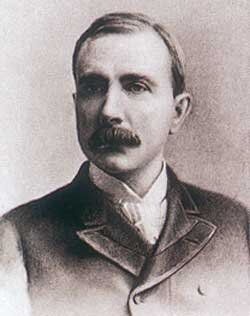
Soon, despite the decrease in oil prices, – by concluding favourable agreements with railway companies, which allowed him to reduce transport costs – he became richer. His company, consisting of two refineries in Cleveland and a representative office in New York (he wanted to establish contacts with Europe and start exporting his products there), was already the largest oil company in the world at that time. Rockefeller focused on finding new markets, new uses of oil products and - of course - on saving. He continued to invest until he opened the Standard Oil Company in 1870 and then, offered consolidation to other oilers. He was convinced that the company's large size brought benefits and therefore decided to take over other refineries in Cleveland as well. In two years Rockefeller bought 23 companies. In his company, he introduced modern management methods and introduced the owners of the acquired companies to the management board. His richness began to arouse jealousy and rage, and he himself began to sleep with a charged revolver under his pillow and had to employ armed bodyguards. It was only the government that put the consolidation drive to a stop - as he managed to transform Standard Oil into a trust and control 90% of the oil market. A special prosecutor appointed by President Theodore Roosevelt ordered Rockefeller to split the company up. However, this did not reduce his private fortune, as he still held ¼ of the company's shares.
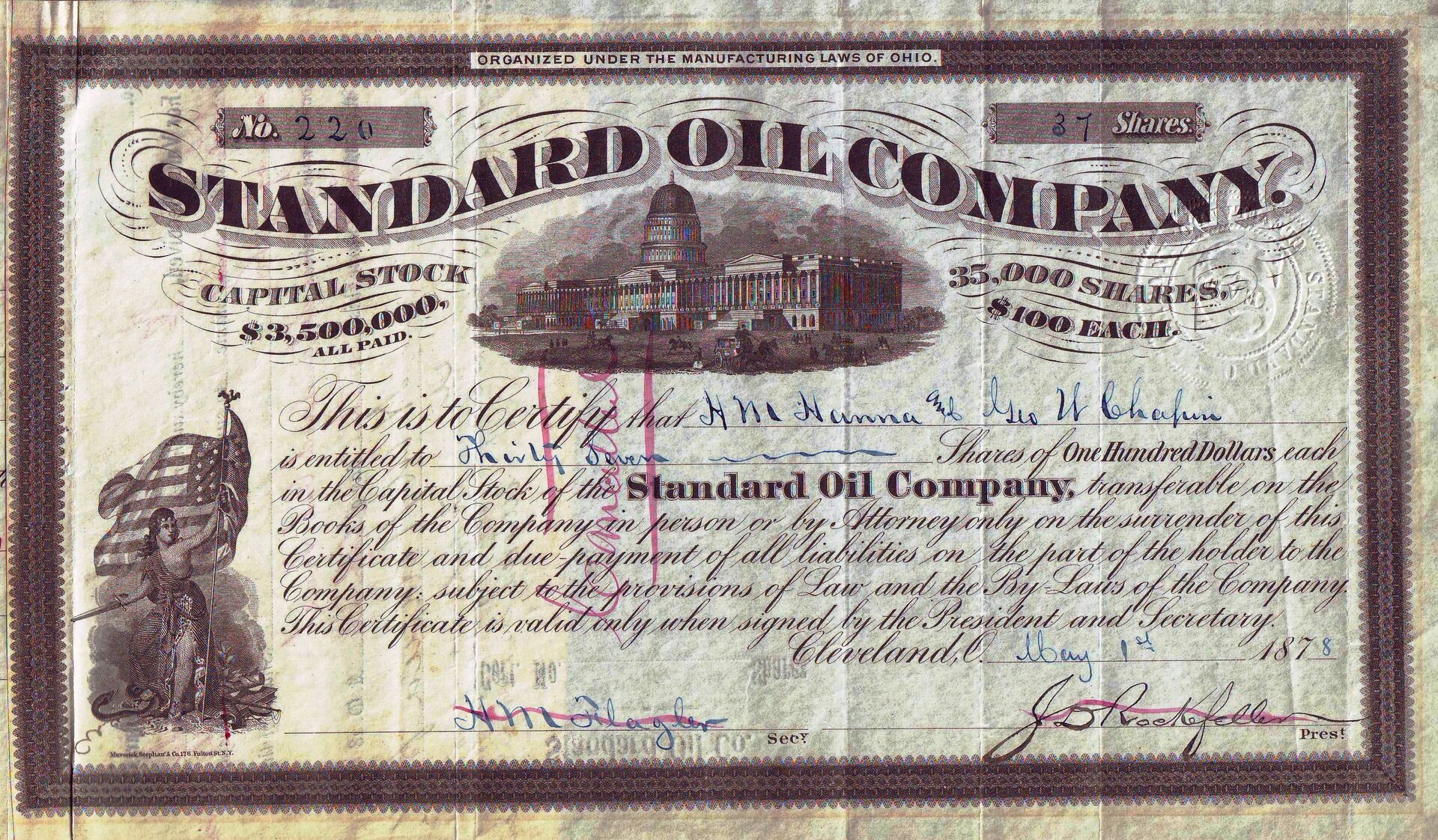
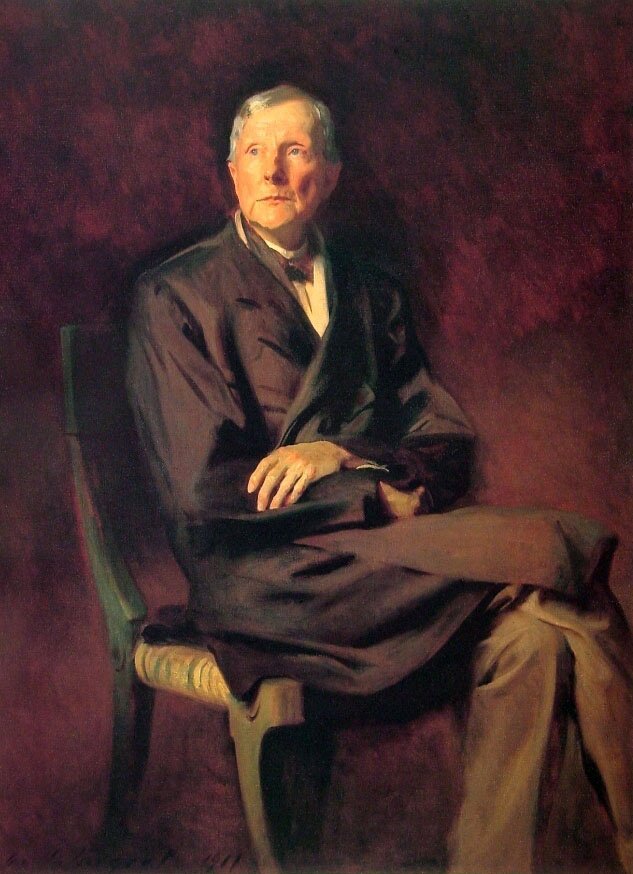
In 1913, his fortune was estimated at 900 million dollars. In today's conditions, this is equivalent to around USD 130 billion. He was one of the richest people in the USA and the world. At the time of the split of the Standard Oil, the millionaire had not been managing the company alone for a long time, for health reasons. Both he and his associates handed over the management of the combine to a group of younger full‑time managers. After he retired, he was involved in charity. In 1892 he founded the University of Chicago, which soon, from a small Baptist college turned to a world‑class university. He also established a foundation that donated millions of dollars to education and health around the world. Rockefeller spent the last 20 years of his life in his estate playing golf and gardening. He died in 1937 at the age of 97. In the social consciousness in the USA, however, he was - and probably still is - a predatory capitalist, a monopolist corrupting officials and a man entangling the state with influence.
Based on Paweł Stachnik, He had made so much money that his name became synonymous with wealth, TwojaHistoria.pl
Read the source material and indicate the reasons for the extinction of the Indian population. Who was responsible for initiating the armed conflicts between the Indians and the Americans? What can be seen from the date of this report? How would you measure its meaning?
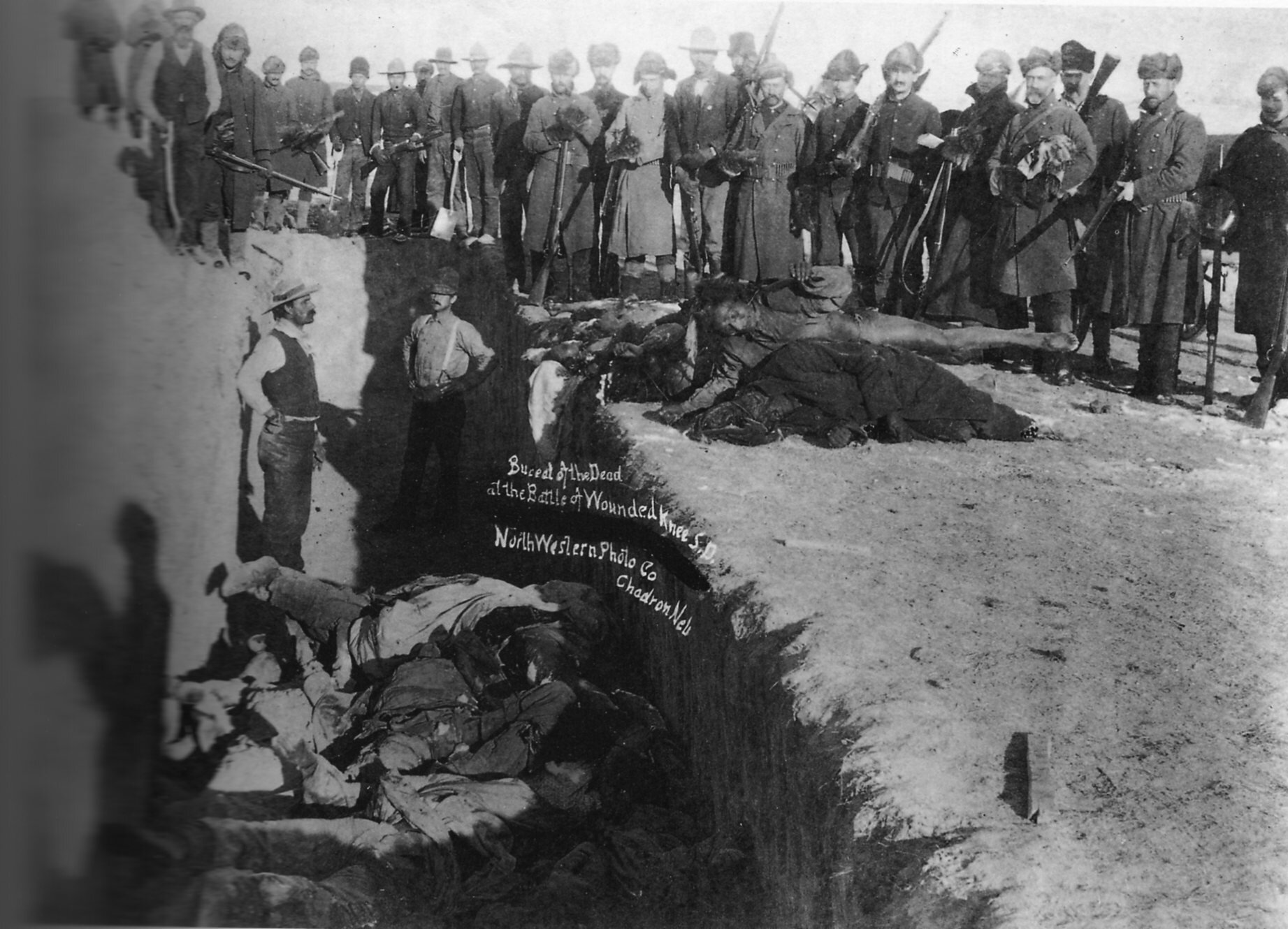
Raport komisji Kongresu Stanów Zjednoczonych (styczeń 1867) - fragmentKomitet doszedł do następujących wniosków:
Wszędzie, z wyjątkiem Indian zamieszkałych na Terytorium Indiańskim, bardzo szybko zmniejsza się populacja Indian. Przyczyny tego stanu są różne: choroby, nieumiarkowanie w piciu alkoholu, wojny międzyplemienne oraz z białymi, nasilająca się także migracja białych osadników na terytoria leżące na zachodzie kontynentu, przez co ziemie Indian ulegają ograniczeniu, a Indianie przesuwają się na niezasiedlone jeszcze obszary, wyniszczenie zwierzyny łownej, która stanowi podstawę życia i utrzymania plemion, i niepowstrzymany konflikt między wyższą i niższą rasą […]
Wojny Indian z białymi. Komitet wyraża opinię, że przyczyną większości wojen z Indianami jest bezprawna agresja białych. Zawsze odnosi się to do pogranicza lub linii osadniczej dzielącej dzikie i cywilizowane życie. Taki jest osąd większości doświadczonych oficerów armii Stanów Zjednoczonych i wszystkich tych, którzy długo się zajmują sprawami Indian […]. Jakiekolwiek mogą być przyczyny wojny, czy to między różnymi plemionami Indian, czy między Indianami i białymi, wszystkie one są bardzo wyniszczające. Nie tylko godzą w życie zaangażowanych w konflikt wojowników, ale także kobiet i dzieci, często stając się wojnami typowo eksterminacyjnymi […].
Innej przyczyny degradacji Indian należy szukać w utraceniu przez nich terenów łowieckich i wyniszczaniu zwierzyny łownej, która była podstawą ich utrzymania. To wyniszczenie zwierzyny w ostatnim czasie bardzo się nasiliło […]. Odkrycie złota i srebra w Kalifornii i na wielu górskich obszarach doprowadziło jednak do przybywania żaądnych tych minerałów górników, którzy, idąc przez prerie, wchodzili we wszystkie doliny i parowy górskie od wschodu.
Source: Raport komisji Kongresu Stanów Zjednoczonych (styczeń 1867) - fragment, [w:] Wiek XIX. Teksty źródłowe, oprac. Grzegorz Chomicki, Leszek Śliwa, Kraków 2001, s. 86–90.
Match the pairs: English words with Polish definition.
przyłączenie, najczęściej siłą, przez jedno państwo części lub całości terytorium innego państwa, państwo posiadające silny potencjał gospodarczy i ekonomiczny, wyjazd, opuszczenie kraju na dłuższy czas lub na stałe, może być dobrowolna lub przymusowa, wyspa u wybrzeży USA, na południowy zachód od Manhattanu, ludobójstwo, masowa zagłada ludzi, proces przemieszczania się ludności związany ze zmianą ich zamieszkania lub czasowego pobytu, szybkie tempo wzrostu liczby ludności w danym miejscu, rdzenni mieszkańcy Ameryki
| Indians | |
| extermination | |
| Ellis Island | |
| Power | |
| Migration | |
| Emmigration | |
| Demographic explosion | |
| annexation |
Keywords
USA, New York, The United States
Glossary
Indianie – rdzenni mieszkańcy Ameryki
Exterminacja – ludobójstwo, masowa zagłada ludzi
Wyspa Ellis – wyspa u wybrzeży USA, na południowy zachód od Manhattanu, w granicach stanu Nowy Jork; od schyłku XIX wieku do 1943 r. wielki port pasażerski i siedziba urzędu imigracyjnego
Mocarstwo – państwo posiadające silny potencjał gospodarczy i ekonomiczny, które pozwalają mu na pełnienie dominującej roli w swoim regionie lub na całym świecie (supermocarstwo).
Migracja – proces przemieszczania się ludności związany ze zmianą ich zamieszkania lub czasowego pobytu. Możemy podzielić ją na wewnętrzną – w granicach państwa/obszaru lub zewnętrzną.
Emigracja – wyjazd, opuszczenie kraju na dłuższy czas lub na stałe, może być dobrowolna lub przymusowa.
Eksplozja demograficzna – szybkie tempo wzrostu liczby ludności w danym miejscu. Najczęściej mówi się o niej jeśli w ciągu jednej generacji (24 lat) nastąpi podwojenie populacji.
Aneksja – przyłączenie, najczęściej siłą, przez jedno państwo części lub całości terytorium innego państwa. Dokonywana jest najczęściej w wyniku wygranej wojny.