When a sufficient amount of energy is delivered to an atom, an electron can be removed from its orbit, leaving the atom ionized (atom is positively charged). Energy required to remove an electron from its orbit is in the range of 5‑20 eV. IonisationionisationIonisation is associated with the absorption of radiationradiationradiation.
If the incident energy is low, then the atom absorbs it and gets excitedexcitedexcited. When the atom comes back to the ground state, nonionizing radiation is emitted. Nonionizing radiation comes in the form of light, radio waves, microwaves and radar waves. These forms of radiation usually are not dangerous for human tissues, quite opposite to the ionizing radiation.
RjPiUWeqMq6QU
Ilustracja interaktywna przedstawia schematycznie różnicę między promieniowaniem niejonizacyjnym i jonizacyjnym. Po lewej stronie ilustracji interaktywnej przedstawione jest jądro atomowe złożone z małych niebieskich kulek symbolizujących neutrony oraz zielonych kulek symbolizujących protony. Wokół jądra narysowane są trzy okręgi symbolizujące orbity, na których znajdują się kulki koloru pomarańczowego symbolizujące elektrony. Jedna z kulek na drugim okręgu jest szara, od niej strzałka przerywana do kulki pomarańczowej na zewnętrznym okręgu. Do szarej kulki poziomy ‘wężyk’ z podpisem Energy is low. Lewa strona podpisana nonionizing radiation i oznaczona numerem 1. Po prawej stronie ilustracji interaktywnej przedstawione jest jądro atomowe złożone z małych niebieskich kulek symbolizujących neutrony oraz zielonych kulek symbolizujących protony. Wokół jądra narysowane są trzy okręgi symbolizujące orbity, na których znajdują się kulki koloru pomarańczowego symbolizujące elektrony. Jedna z kulek na zewnętrznym okręgu jest szara, od niej strzałka przerywana do kulki pomarańczowej znajdującej się poza okręgami. Do szarej kulki poziomy ‘wężyk’ z podpisem Energy is high. Prawa strona podpisana ionizing radiation i oznaczona numerem 2. Na ilustracji widoczne są numery, a na nich podpisy. 1. energy is low and is absorbed by electrons {audio}, 2. energy is high enough to completely knock electrons out of orbit {audio}.
Ilustracja interaktywna przedstawia schematycznie różnicę między promieniowaniem niejonizacyjnym i jonizacyjnym. Po lewej stronie ilustracji interaktywnej przedstawione jest jądro atomowe złożone z małych niebieskich kulek symbolizujących neutrony oraz zielonych kulek symbolizujących protony. Wokół jądra narysowane są trzy okręgi symbolizujące orbity, na których znajdują się kulki koloru pomarańczowego symbolizujące elektrony. Jedna z kulek na drugim okręgu jest szara, od niej strzałka przerywana do kulki pomarańczowej na zewnętrznym okręgu. Do szarej kulki poziomy ‘wężyk’ z podpisem Energy is low. Lewa strona podpisana nonionizing radiation i oznaczona numerem 1. Po prawej stronie ilustracji interaktywnej przedstawione jest jądro atomowe złożone z małych niebieskich kulek symbolizujących neutrony oraz zielonych kulek symbolizujących protony. Wokół jądra narysowane są trzy okręgi symbolizujące orbity, na których znajdują się kulki koloru pomarańczowego symbolizujące elektrony. Jedna z kulek na zewnętrznym okręgu jest szara, od niej strzałka przerywana do kulki pomarańczowej znajdującej się poza okręgami. Do szarej kulki poziomy ‘wężyk’ z podpisem Energy is high. Prawa strona podpisana ionizing radiation i oznaczona numerem 2. Na ilustracji widoczne są numery, a na nich podpisy. 1. energy is low and is absorbed by electrons {audio}, 2. energy is high enough to completely knock electrons out of orbit {audio}.
In living organisms exposed to radiation which energy is sufficient to induce ionisationionisationionisation the chemical bonds can be affected. Living organisms are able to correct damages caused by small amounts of radiation. But in case, when the radiation amount is large, the damages are huge and can lead to genetic defects, cancer or, in the worst case, to radiation sickness.
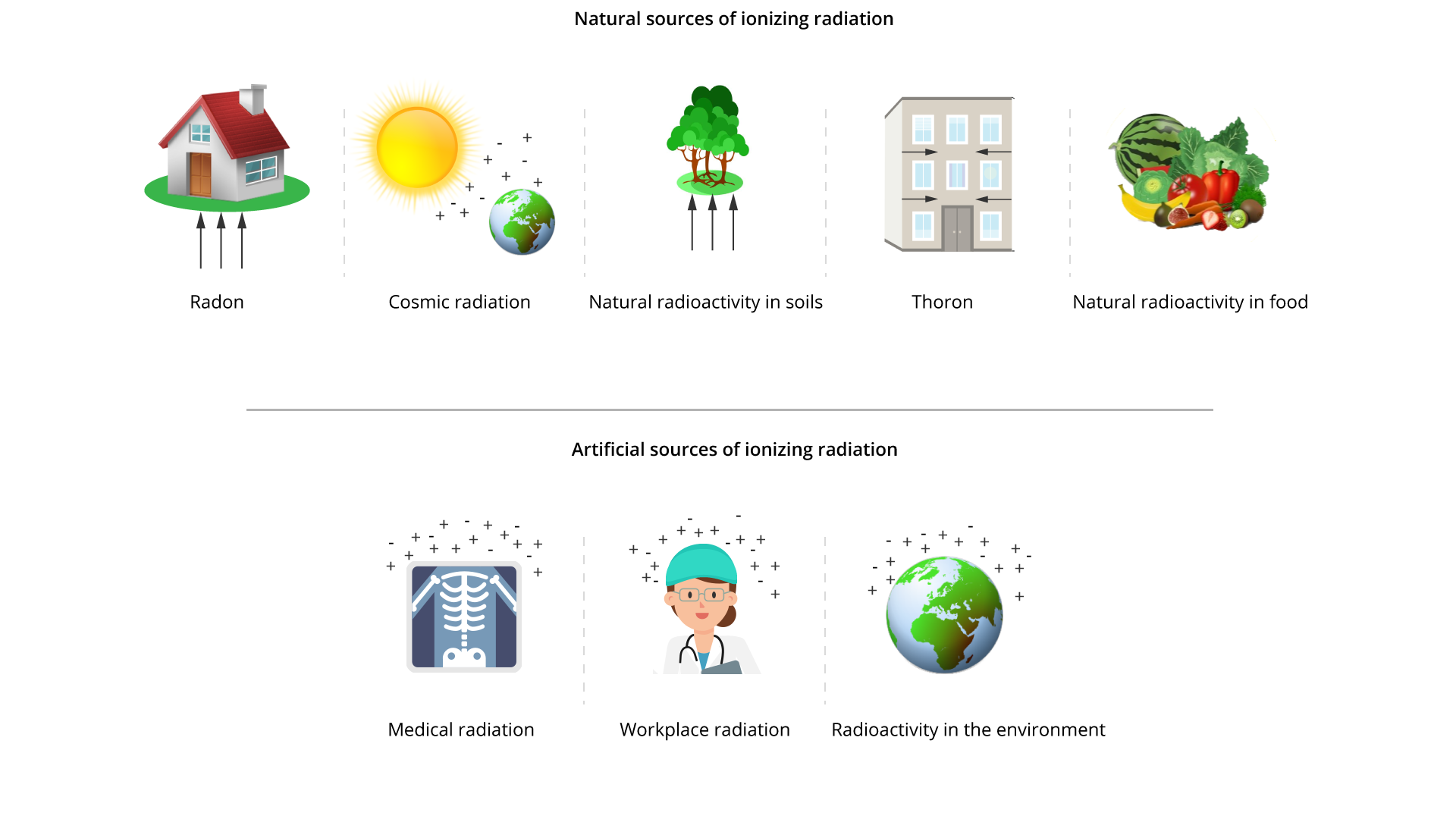
Radon is a naturally occurring radioactive gas which is colorless and odorless. It is produced from the uranium that is present in rocks and soils, well water and building materials. Exposure to radon radiation increases the risk of lung cancer.
High‑energy radiationradiationradiation from either the Sun (solar radiation) or from outside the Solar System (galactic radiation) are constantly passing through the Earth. This radiation is called cosmic radiation. Radiation doses from cosmic radiation are greater at higher altitudes. People who are often flying are getting higher doses of radiation.
Radionuclides of uranium, thorium and potassium are relatively abundant in rocks and soils. The gamma radiation emitted from these radionuclides gives us all a radiation dosedosedose.
Thoron is a radon isotope, which is a naturally occurring radioactive gas. The main sourcesourcesource of thoron in indoor air is building materials. Radiation doses coming from thoron are much lower than those from radon.
All foods contain natural radioactivity, which is transferred from the soil to the plants on land, to animals eating these plants and from water to fish in rivers, lakes, seas and oceans.
RvbZanCnwH3Im
Górna część rysunku przedstawia naturalne źródła promieniowania, podpisane Natural sources of ionizing radiation: od lewej strony – radon, podpisane Radon (narysowany jest dom, a w stronę jego fundamentów skierowane są strzałki symbolizujące kierunek promieniowania), promieniowanie kosmiczne, podpisane Cosmic radiation (narysowane jest słońce i kula ziemska, a promieniowanie zaznaczone jest w postaci chmury plusów i minusów), naturalne promieniowanie z gleby, podpisane Natural radioactivity in soils (narysowane jest drzewo, a od podłoża w stronę jego korzeni strzałki wskazujące kierunek promieniowania), toron, podpisane Thoron (narysowany jest budynek oraz strzałki skierowane od ścian do jego wnętrza), żywność, podpisane Natural radioactivity in food (narysowane są różne owoce i warzywa). Dolna część rysunku to sztuczne źródła promieniowania, podpisane Artificial sources of ionizing radiation: od lewej strony – promieniowanie używane w medycynie, podpisane Medical radiation (narysowany jest szkielet, a nad nim chmura plusów i minusów), promieniowanie występujące w miejscu pracy, podpisane Workplace radiation (narysowana jest lekarka, a nad nią chmura plusów i minusów), promieniowanie występujące w środowisku naturalnym, podpisane Radioactivity in the environment (narysowana jest kula ziemska, a nad nią chmura plusów i minusów).
Many procedures in medical diagnosis involve exposure to radiationradiationradiation. The procedures that involve the use of radiation are: radiology, angiocardiograms, CT scans and nuclearnuclearnuclear medicine. All exposures to radiation used in medicine should be clinically justified.
Radioactivity is also present in our environmentenvironmentenvironment due to nuclearnuclearnuclear weapons testing, accidents at nuclear facilities and radioactive wastes from nuclear and other facilities.
Review the following sources of radiation and indicate where you might encounter them. Indicate whether the sourcesourcesource is non‑ionising radiation or ionising radiation.
Sources of radiation
Location
Characteristics
security scanners
Radon
smoke detectors
wireless technology
computed tomography (CT) scanners
Answer
Sources of radiation
Location
Characteristics
security scanners
airports, courthouses
ionising
Radon
outdoors, buildings
ionising
smoke detectors
home, public institutions
ionising
wireless technology
home, work
non - ionising
computed tomography (CT) scanners
hospitals, diagnostic laboratories
ionising
Radiation quantities and units
There are different units and quantities for measuring radioactivity and its effects.
Radioactivity (A) refers to the amount of ionizing radiation released by a radioactive material. This represents how many atoms in the material decay in a given time period. The SI unit is becquerel (Bq).
where: - N - is a number of decays, - t - time.
Exposure describes the amount of radiation travelling through the air. The unit is .
Absorbed dosedosedose (D) refers to the amount of radiation absorbed by an object or person. The SI unit is gray (Gy).
where: - E - energy of radiation absorbed by the body, - m - mass of the body.
Historical unit of absorbed dose is rad, 1 Gy = 100 rad.
Effective dose describes the amount of radiationradiationradiation absorbed by human tissues and organs. It takes into account the type and energy of radiation and its impact on particular organs. The SI unit is sievert (Sv).
R19jbUyowXwh1
W lewej części rysunku w pionie wymienione są źródła promieniowania naturalnego, podpis Natural radiation i ich dawka w mSv. Od góry do dołu: niezwykle wysoka dawka promieniowania naturalnego w Guarapari w Brazylii, podpis Unusually high natural radiation dose in downtown Guarapari, Brazil, ikona ciągnika (10), przeciętna roczna dawka przypadająca na załogę latającą powyżej 800 godzin w ciągu roku, podpis Average annual dose to aircrew flying 800 hours per year, ikona samolotu (5), roczna dawka naturalnego promieniowania, podpis Annual natural background radiation, na którą składa się jedzenie/napoje, podpis Food/drinks, ikona noża i widelca, promienowanie radonowe z podłoża, podpis Radon gas from ground, ikona domu, promieniowanie kosmiczne, podpis Cosmic rays, ikona dwie przecinające się elipsy z kropką w środku oraz promieniowanie z budynków/podłoża, podpis Buildings/soil, ikona bloku (2,4). Po prawej stronie rysunku pokazane są źródła promieniowania wytworzone przez człowieka, podpis Man-made radiation: od góry do dołu – roczna dawka przypadająca na pracownika mającego do czynienia z promieniowaniem, podpis Annual dose limit for radiation worker, ikona głowy i ramion człowieka ze stetoskopem (20), średnia efektywna dawka z badań tomograficznych, podpis Average effective dose from CT scan, ikona głowy i ramion leżącego człowieka wewnątrz okręgu (6,6), limit rocznej dawki przypadającej na osobę (za wyłączeniem ekspozycji w zabiegach medycznych), podpis Annual dose limit for general public (except medical exposure), ikona trzech głów (1,0), przeciętna dawka roczna pochodząca z ekspozycji organów wewnętrznych na promieniowanie rentgenowskie, podpis Average effective dose from single abdominal x-ray, ikona człowieka z ekranem na wysokości klatki piersiowej, w którym widać kości (0,6), efektywna roczna dawka spowodowana przez mammografię, podpis Average effective dose from mammogram, ikona pani z podniesioną ręką (0,13), roczna dawka przypadająca na rentgenowskie prześwietlenia płuc, podpis Average effective dose from single chest x-ray, ikona człowieka z ekranem na wysokości klatki piersiowej, w którym widać kości (0,05). W środku rysunku zaznaczony jest równoramienny trójkąt skierowany wierzchołkiem do dołu, podpis Effective dose [mSv], na którym zaznaczone są jednostki skali dawki efektywnej podanej w mSv (od 10 do 0,01).
There are two types of radiationradiationradiation: ionising and non‑ionising.
Non‑ionising radiation is usually harmless to living organisms while an exposure to ionising radiation can lead to severe damages in tissues.
Exercises
Rq477h0CtLSNo
Exercise 3
Wersja alternatywna ćwiczenia: Determine which sentences are true. Możliwe odpowiedzi: 1. As isotopes decay they can turn into completely different elements., 2. Exposure to ionizing radiation can cause cancer., 3. The X-rays used at the dentist are non-ionising radiation., 4. Ionization energy is the energy required to remove an electron from an atom.
Wersja alternatywna ćwiczenia: Determine which sentences are true. Możliwe odpowiedzi: 1. As isotopes decay they can turn into completely different elements., 2. Exposure to ionizing radiation can cause cancer., 3. The X-rays used at the dentist are non-ionising radiation., 4. Ionization energy is the energy required to remove an electron from an atom.
Determine which sentences are true.
As isotopes decay they can turn into completely different elements.
Exposure to ionizing radiation can cause cancer.
The X-rays used at the dentist are non-ionising radiation.
Ionization energy is the energy required to remove an electron from an atom.
Exercise 4
Find out in available sources what the different types of nuclear medicine scans are and how the nuclear medicine works.
Exercise 5
Explain in English why ionising radiation is dangerous.
RWWwDkiNnTACd
Exercise 6
Wersja alternatywna ćwiczenia: Indicate which pairs of expressions or words are translated correctly. Możliwe odpowiedzi: 1. jonizacja - ionisation, 2. promieniowanie - radiation, 3. jądrowy - nuclear, 4. dawka - dose, 5. emisja - excited, 6. źródło - environment
Wersja alternatywna ćwiczenia: Indicate which pairs of expressions or words are translated correctly. Możliwe odpowiedzi: 1. jonizacja - ionisation, 2. promieniowanie - radiation, 3. jądrowy - nuclear, 4. dawka - dose, 5. emisja - excited, 6. źródło - environment
Indicate which pairs of expressions or words are translated correctly.
jonizacja - ionisation
promieniowanie - radiation
jądrowy - nuclear
dawka - dose
emisja - excited
źródło - environment
zadanie
Source: GroMar, licencja: CC BY 3.0.
R2iMLn8FCz9mP1
Interaktywna gra, polegająca na łączeniu wyrazów w pary w ciągu jednej minuty. Czas zaczyna upływać wraz z rozpoczęciem gry. Jeden ruch to odkrywanie najpierw jednej potem drugiej karty z wyrazem. Każdy wyraz jest odczytywany. Kolejny ruch to odkrywanie trzeciej i czwartej karty. W ten sposób odsłuchasz wszystkie wyrazy. Nawigacja z poziomu klawiatury za pomocą strzałek, odsłuchiwanie wyrazów enterem lub spacją. Znajdź wszystkie pary wyrazów.
Interaktywna gra, polegająca na łączeniu wyrazów w pary w ciągu jednej minuty. Czas zaczyna upływać wraz z rozpoczęciem gry. Jeden ruch to odkrywanie najpierw jednej potem drugiej karty z wyrazem. Każdy wyraz jest odczytywany. Kolejny ruch to odkrywanie trzeciej i czwartej karty. W ten sposób odsłuchasz wszystkie wyrazy. Nawigacja z poziomu klawiatury za pomocą strzałek, odsłuchiwanie wyrazów enterem lub spacją. Znajdź wszystkie pary wyrazów.
Match Polish terms with their English equivalents.
radiation
nuclear
jonizacja
emission
emisja
dawka
jądrowy
dose
promieniowanie
ionisation
Source: Zespół autorski Politechniki Łódzkiej, licencja: CC BY 3.0.
![W lewej części rysunku w pionie wymienione są źródła promieniowania naturalnego, podpis Natural radiation i ich dawka w mSv. Od góry do dołu: niezwykle wysoka dawka promieniowania naturalnego w Guarapari w Brazylii, podpis Unusually high natural radiation dose in downtown Guarapari, Brazil, ikona ciągnika (10), przeciętna roczna dawka przypadająca na załogę latającą powyżej 800 godzin w ciągu roku, podpis Average annual dose to aircrew flying 800 hours per year, ikona samolotu (5), roczna dawka naturalnego promieniowania, podpis Annual natural background radiation, na którą składa się jedzenie/napoje, podpis Food/drinks, ikona noża i widelca, promienowanie radonowe z podłoża, podpis Radon gas from ground, ikona domu, promieniowanie kosmiczne, podpis Cosmic rays, ikona dwie przecinające się elipsy z kropką w środku oraz promieniowanie z budynków/podłoża, podpis Buildings/soil, ikona bloku (2,4). Po prawej stronie rysunku pokazane są źródła promieniowania wytworzone przez człowieka, podpis Man-made radiation: od góry do dołu – roczna dawka przypadająca na pracownika mającego do czynienia z promieniowaniem, podpis Annual dose limit for radiation worker, ikona głowy i ramion człowieka ze stetoskopem (20), średnia efektywna dawka z badań tomograficznych, podpis Average effective dose from CT scan, ikona głowy i ramion leżącego człowieka wewnątrz okręgu (6,6), limit rocznej dawki przypadającej na osobę (za wyłączeniem ekspozycji w zabiegach medycznych), podpis Annual dose limit for general public (except medical exposure), ikona trzech głów (1,0), przeciętna dawka roczna pochodząca z ekspozycji organów wewnętrznych na promieniowanie rentgenowskie, podpis Average effective dose from single abdominal x-ray, ikona człowieka z ekranem na wysokości klatki piersiowej, w którym widać kości (0,6), efektywna roczna dawka spowodowana przez mammografię, podpis Average effective dose from mammogram, ikona pani z podniesioną ręką (0,13), roczna dawka przypadająca na rentgenowskie prześwietlenia płuc, podpis Average effective dose from single chest x-ray, ikona człowieka z ekranem na wysokości klatki piersiowej, w którym widać kości (0,05). W środku rysunku zaznaczony jest równoramienny trójkąt skierowany wierzchołkiem do dołu, podpis Effective dose [mSv], na którym zaznaczone są jednostki skali dawki efektywnej podanej w mSv (od 10 do 0,01).](https://static.zpe.gov.pl/portal/f/res-minimized/R19jbUyowXwh1/1/3KaGz4zFtRGPgriqMSjK0uRzqbKn8bUm.png)