To understand what breathing is all about, we need to find out what combustion is. It is a chemical reaction of various substances with oxygen, during which energy is released – that is why we feel warmth and see light. CombustioncombustionCombustion enables us to obtain the energy needed to heat a home and cook a meal. To release the energy contained in wood, for example, oxygen from the air is required. We will prove it by performing an experiment.
R2PAqn9A4sJHO
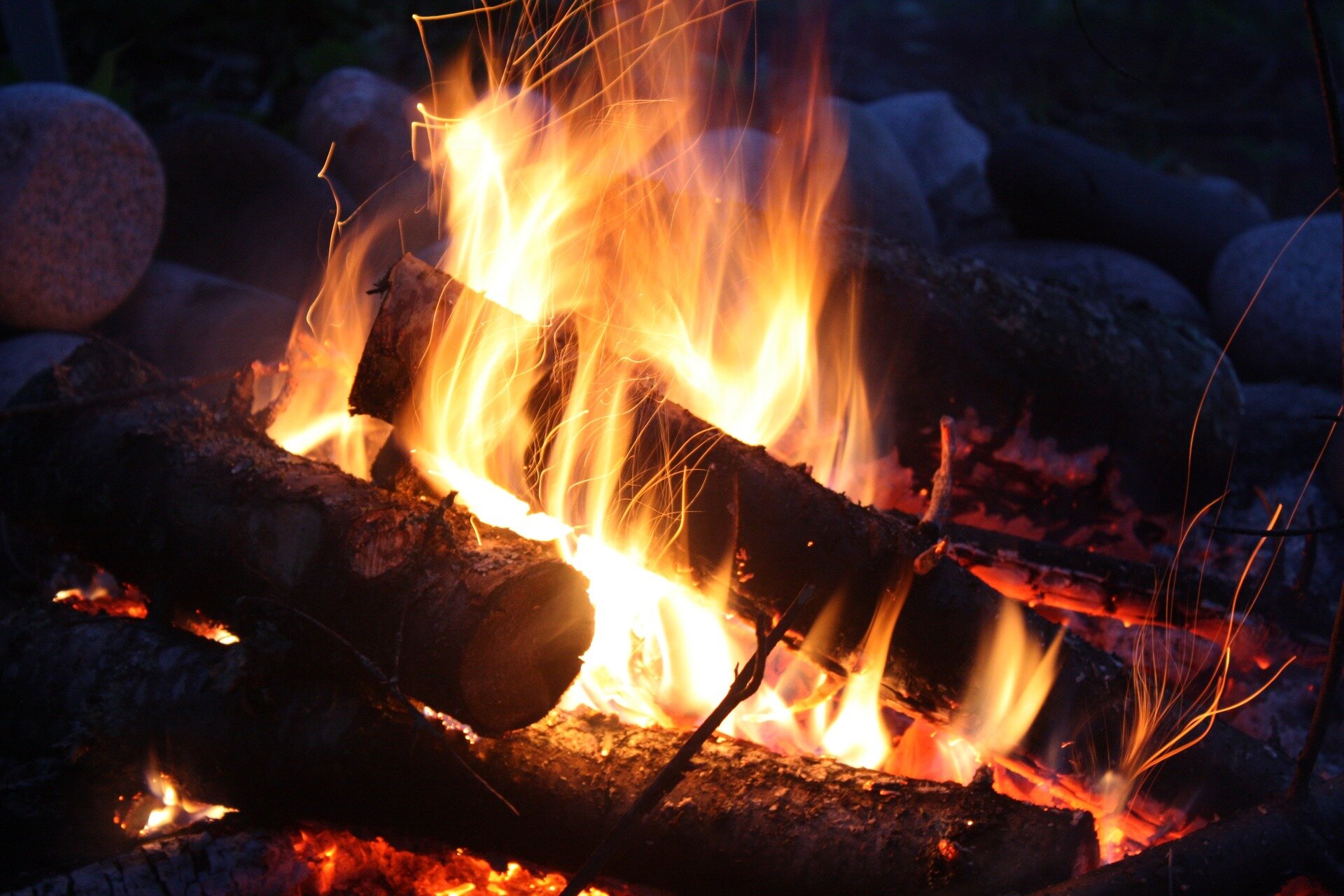
Zdjęcie pokazuje ognisko z palącymi się jasnym płomieniem polanami drewna.
Combustion of wood releases energy, which we can feel as warmth. Due to this process, we can also see light.
Source: Jameel Winter, www.flickr.com, licencja: CC BY 2.0.
Task 1
Before you watch a film entitled “Oxygen is necessary for combustion and breathing”, write down a research question and a hypothesis. Watching the film, write down your observations and, finally, your conclusions.
RSnK9dxhatWxX
Wykonaj ćwiczenie zgodnie z poleceniem.
Analysis of the experiment
Research question (Uzupełnij). Hypothesis (Uzupełnij). Observations (Uzupełnij). Conclusions (Uzupełnij).
Wykonaj ćwiczenie zgodnie z poleceniem.
Analysis of the experiment
Research question (Uzupełnij). Hypothesis (Uzupełnij). Observations (Uzupełnij). Conclusions (Uzupełnij).
Analysis of the experiment
R1478xZry13hS
Film przedstawia eksperyment, który ma udowodnić, że tlen jest niezbędny do spalania i oddychania Najpierw rozpalamy świeczkę i przykrywamy ją słoikiem, włączamy stoper i odliczamy 10 sekund. Do dalszego eksperymentu potrzebujemy świeczki, zapalniczki, gumki recepturki, plasteliny, torebki plastikowej, plastikowej butelki z wyciętym dnem. Krawędzie wyciętego dna butelki obklejamy plasteliną. Na górną część butelki zakładamy torebkę plastikową. Do mocowania używamy gumki recepturki. Zapalamy świeczkę i na nią kładziemy butelkę. Po 30 sekundach świeczka gaśnie. Wdmuchujemy powietrze do torebki plastikowej i ponownie zapalamy świeczkę, na którą kładziemy butelkę. Po 11 sekundach świeczka gaśnie.
Film przedstawia eksperyment, który ma udowodnić, że tlen jest niezbędny do spalania i oddychania Najpierw rozpalamy świeczkę i przykrywamy ją słoikiem, włączamy stoper i odliczamy 10 sekund. Do dalszego eksperymentu potrzebujemy świeczki, zapalniczki, gumki recepturki, plasteliny, torebki plastikowej, plastikowej butelki z wyciętym dnem. Krawędzie wyciętego dna butelki obklejamy plasteliną. Na górną część butelki zakładamy torebkę plastikową. Do mocowania używamy gumki recepturki. Zapalamy świeczkę i na nią kładziemy butelkę. Po 30 sekundach świeczka gaśnie. Wdmuchujemy powietrze do torebki plastikowej i ponownie zapalamy świeczkę, na którą kładziemy butelkę. Po 11 sekundach świeczka gaśnie.
Oxygen is necessary for combustion and breathing
Source: GroMar Sp. z o.o., licencja: CC BY-SA 3.0.
Source: GroMar Sp. z o.o., licencja: CC BY-SA 3.0.
Film przedstawia eksperyment, który ma udowodnić, że tlen jest niezbędny do spalania i oddychania Najpierw rozpalamy świeczkę i przykrywamy ją słoikiem, włączamy stoper i odliczamy 10 sekund. Do dalszego eksperymentu potrzebujemy świeczki, zapalniczki, gumki recepturki, plasteliny, torebki plastikowej, plastikowej butelki z wyciętym dnem. Krawędzie wyciętego dna butelki obklejamy plasteliną. Na górną część butelki zakładamy torebkę plastikową. Do mocowania używamy gumki recepturki. Zapalamy świeczkę i na nią kładziemy butelkę. Po 30 sekundach świeczka gaśnie. Wdmuchujemy powietrze do torebki plastikowej i ponownie zapalamy świeczkę, na którą kładziemy butelkę. Po 11 sekundach świeczka gaśnie.
Cellular respiration
In the human body a process takes place by which cells use oxygen to break down food molecules to release their stored energy. This process occurs in every cell of the body and this is why it is called cellular respirationcellular respirationcellular respiration. It is typical for all living organisms. In most of them, oxygen is involved in this process. Cellular respiration is very similar to combustion, but there are two important differences:
cellular respiration does not occur as rapidly as combustion;
the energy produced from respiration does not dissipate in the form of light and heat, but is stored by the body.
The nutrients involved in the process of cellular respiration mainly include sugars and fats. Therefore, foods rich in these nutrients are called energy‑yielding foods. Both nutrients and oxygen are transported to the cells by the blood. As a result of cellular respiration, energy is released; and by‑products are also produced: carbon dioxide and water. The body uses energy for various life processes, e.g. moving, maintaining body temperature or growth. Carbon dioxide is removed during gas exchange, while water can be used up by the body.
The composition of inhaled and exhaled air
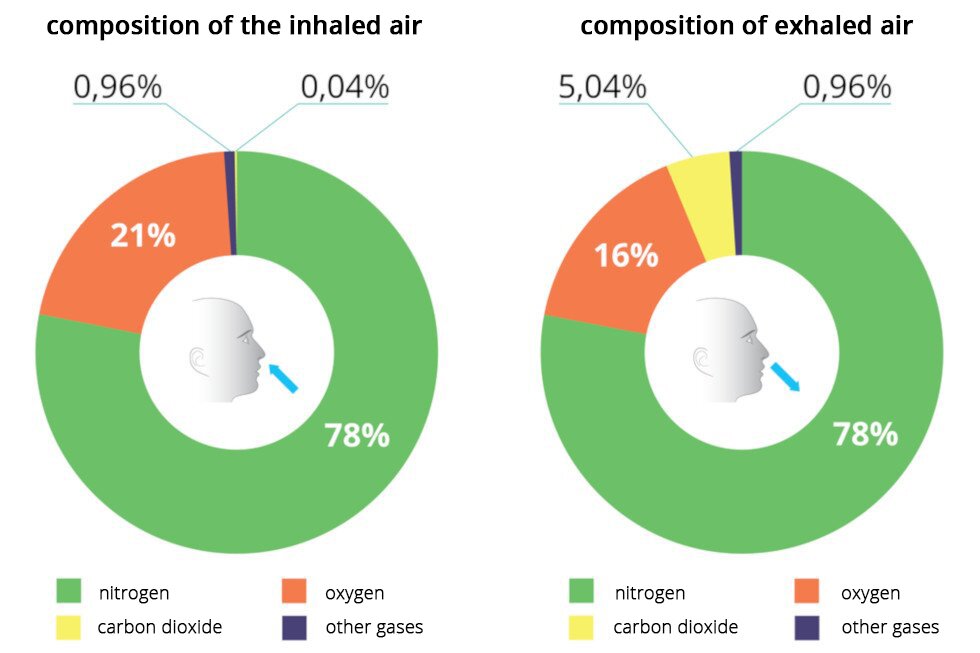
The air consists mainly of nitrogen and oxygen. It also contains small amounts of carbon dioxide and other gases. Of these ingredients, only oxygen supports the combustion process and is used during cellular respiration. The content of oxygen in exhaled air decreases because a part of it was used to break down food nutrients. Instead, there is more carbon dioxide and water (in the form of water vapour) – substances produced as a result of cellular respiration. The amount of other air components does not change.
R1MsQVN0156FN
Ilustracja przedstawia skład wdychanego i wydychanego powietrza. Podpisano: Composition of the inhaled air Composition of exhaled air , Nitrogen, Carbon dioxide, Oxygen, Other gases. Po lewej stronie widnieje schemat kołowy składu powietrza wdychanego. Na zielono oznaczono 78% azotu, na brązowo 21% tlenu, na żółto 0,96 % dwutlenku węgla, kolorem granatowym 0,04% innych gazów. Po prawej stronie znajduje się schemat kołowy składu powietrza wydychanego: azot 78%, Tlen 16%, Dwutlenek węgla 5,04%, inne gazy 0,96%.
The composition of inhaled and exhaled air
Source: Dariusz Adryan, licencja: CC BY 3.0.
R1OXfTc9HfbID
Exercise 1
Indicate the source of energy which is produced during cellular respiration. Możliwe odpowiedzi: 1. oxygen, 2. food, 3. carbon dioxide, 4. water
Indicate the source of energy which is produced during cellular respiration. Możliwe odpowiedzi: 1. oxygen, 2. food, 3. carbon dioxide, 4. water
Indicate the source of energy which is produced during cellular respiration.
oxygen
food
carbon dioxide
water
R4ZkKTJpHHFpV
Exercise 2
Choose the statement that most accurately explains what cellular respiration is. Możliwe odpowiedzi: 1. breakdown of nutrients into water and carbon dioxide, 2. release of energy from food molecules in the presence of oxygen, 3. gas exchange in the lungs, 4. uptake of oxygen by cells and removal of carbon dioxide
Choose the statement that most accurately explains what cellular respiration is. Możliwe odpowiedzi: 1. breakdown of nutrients into water and carbon dioxide, 2. release of energy from food molecules in the presence of oxygen, 3. gas exchange in the lungs, 4. uptake of oxygen by cells and removal of carbon dioxide
Choose the statement that most accurately explains what cellular respiration is.
breakdown of nutrients into water and carbon dioxide
release of energy from food molecules in the presence of oxygen
gas exchange in the lungs
uptake of oxygen by cells and removal of carbon dioxide
R1VXsk8M8wXaI
Exercise 3
Match words and definitions. cellular respiration Możliwe odpowiedzi: 1. reakcja chemiczna polegająca na rozkładzie substancji, w wyniku czego powstaje energia w postaci ciepła i światła; spalanie odbywa się najczęściej z udziałem tlenu, 2. reakcja chemiczna polegająca na rozkładzie pokarmu, zachodząca w żywych komórkach w obecności tlenu; podczas reakcji uwalniana jest energia, a produktami ubocznymi są dwutlenek węgla i woda combustion Możliwe odpowiedzi: 1. reakcja chemiczna polegająca na rozkładzie substancji, w wyniku czego powstaje energia w postaci ciepła i światła; spalanie odbywa się najczęściej z udziałem tlenu, 2. reakcja chemiczna polegająca na rozkładzie pokarmu, zachodząca w żywych komórkach w obecności tlenu; podczas reakcji uwalniana jest energia, a produktami ubocznymi są dwutlenek węgla i woda
Match words and definitions. cellular respiration Możliwe odpowiedzi: 1. reakcja chemiczna polegająca na rozkładzie substancji, w wyniku czego powstaje energia w postaci ciepła i światła; spalanie odbywa się najczęściej z udziałem tlenu, 2. reakcja chemiczna polegająca na rozkładzie pokarmu, zachodząca w żywych komórkach w obecności tlenu; podczas reakcji uwalniana jest energia, a produktami ubocznymi są dwutlenek węgla i woda combustion Możliwe odpowiedzi: 1. reakcja chemiczna polegająca na rozkładzie substancji, w wyniku czego powstaje energia w postaci ciepła i światła; spalanie odbywa się najczęściej z udziałem tlenu, 2. reakcja chemiczna polegająca na rozkładzie pokarmu, zachodząca w żywych komórkach w obecności tlenu; podczas reakcji uwalniana jest energia, a produktami ubocznymi są dwutlenek węgla i woda
Match words and definitions.
reakcja chemiczna polegająca na rozkładzie pokarmu, zachodząca w żywych komórkach w obecności tlenu; podczas reakcji uwalniana jest energia, a produktami ubocznymi są dwutlenek węgla i woda, reakcja chemiczna polegająca na rozkładzie substancji, w wyniku czego powstaje energia w postaci ciepła i światła; spalanie odbywa się najczęściej z udziałem tlenu
cellular respiration
combustion
Summary
During combustion of substances, heat and light are released. Combustion usually takes place in the presence of oxygen.
During cellular respiration, the energy contained in the food is released in the presence of oxygen. Unlike the combustion process, it is a gradual process, in which energy is stored and then it is utilized to perform various life activities.
Exhaled air contains less oxygen and more carbon dioxide and water vapor than inhaled air.
oddychanie komórkowe – reakcja chemiczna polegająca na rozkładzie pokarmu, zachodząca w żywych komórkach w obecności tlenu; podczas reakcji uwalniana jest energia, a produktami ubocznymi są dwutlenek węgla i woda
spalanie – reakcja chemiczna polegająca na rozkładzie substancji, w wyniku czego powstaje energia w postaci ciepła i światła; spalanie odbywa się najczęściej z udziałem tlenu