How is the food digested?
the digestive system consists of the digestive tract and glands: salivary glands, liver and pancreas.
the digestive tract begins in oral cavity and finishes in rectum in large intestine;
the walls of the esophagus and the stomach are composed of smooth muscle tissue;
the contractions of smooth muscles cause peristalsis, which moves food along the digestive tract.
to list the functions of the enzymes, hydrochloric acid and bile in digestive process;
to describe the cooperation between the digestive and the cardiovascular system;
to explain the path of the food in the digestive tract and changes the food undergoes.
Nagranie dostępne na portalu epodreczniki.pl
Nagranie dźwiękowe dotyczące funkcji układu trawiennego człowieka.
Functions of the digestive system
In the digestive tract the food is digested to the form that can easily be absorbed by cells, and then the food is absorbed. Mechanical processing of food begins in the oral cavity and is based on processing the portions of food. Thanks to this, during the next stage the enzymes that participate in the chemical digestion have easier access to them. Chemical digestionChemical digestion is an enzymatic (chemical) process of breaking down the ingredients of food, during which complex organic compounds are broken down into simple compounds that can be absorbed by the body. Digestive enzymes are secreted by secreting cells:
salivary glands,
wall of the stomach,
pancreas,
small intestine walls.
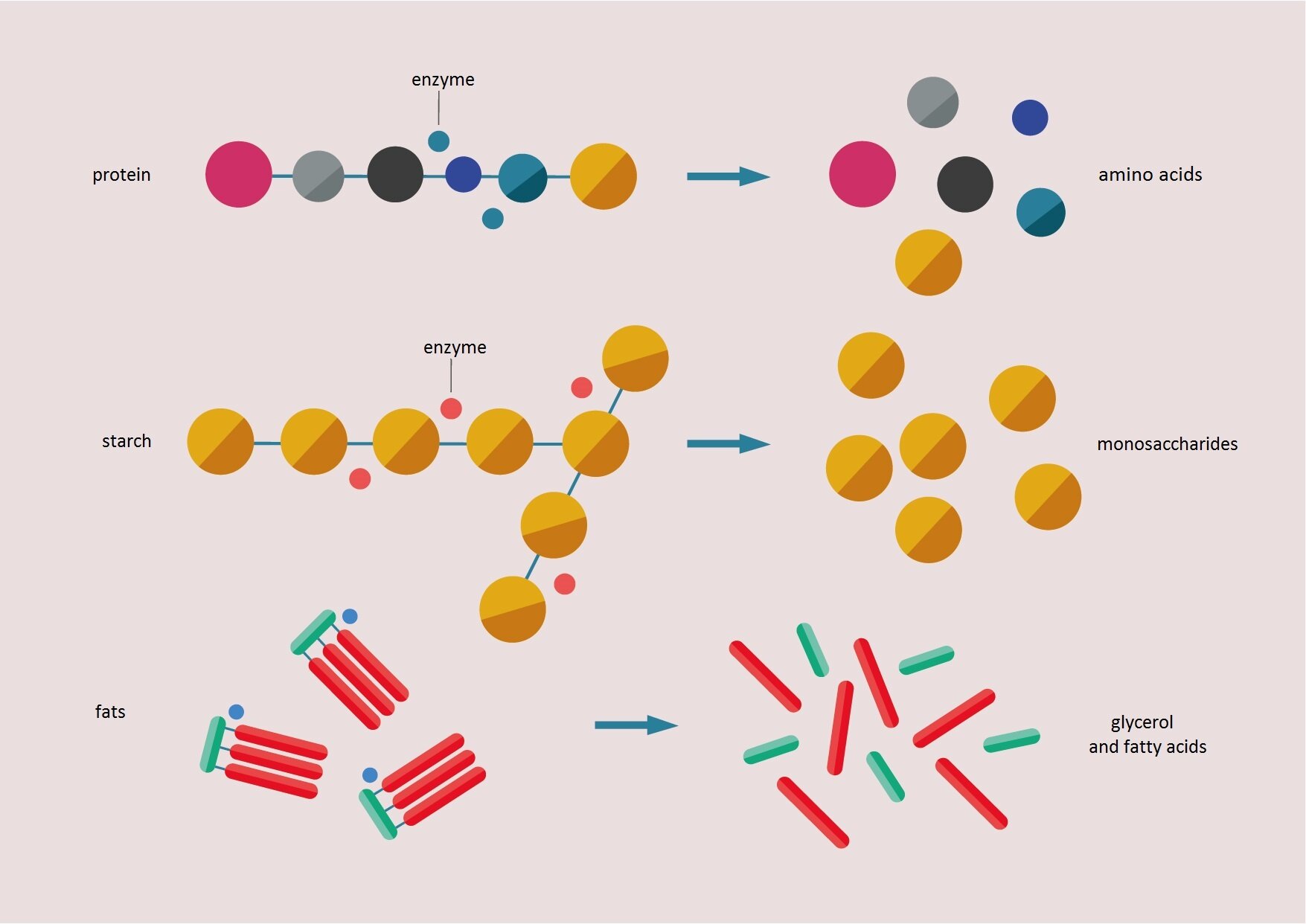
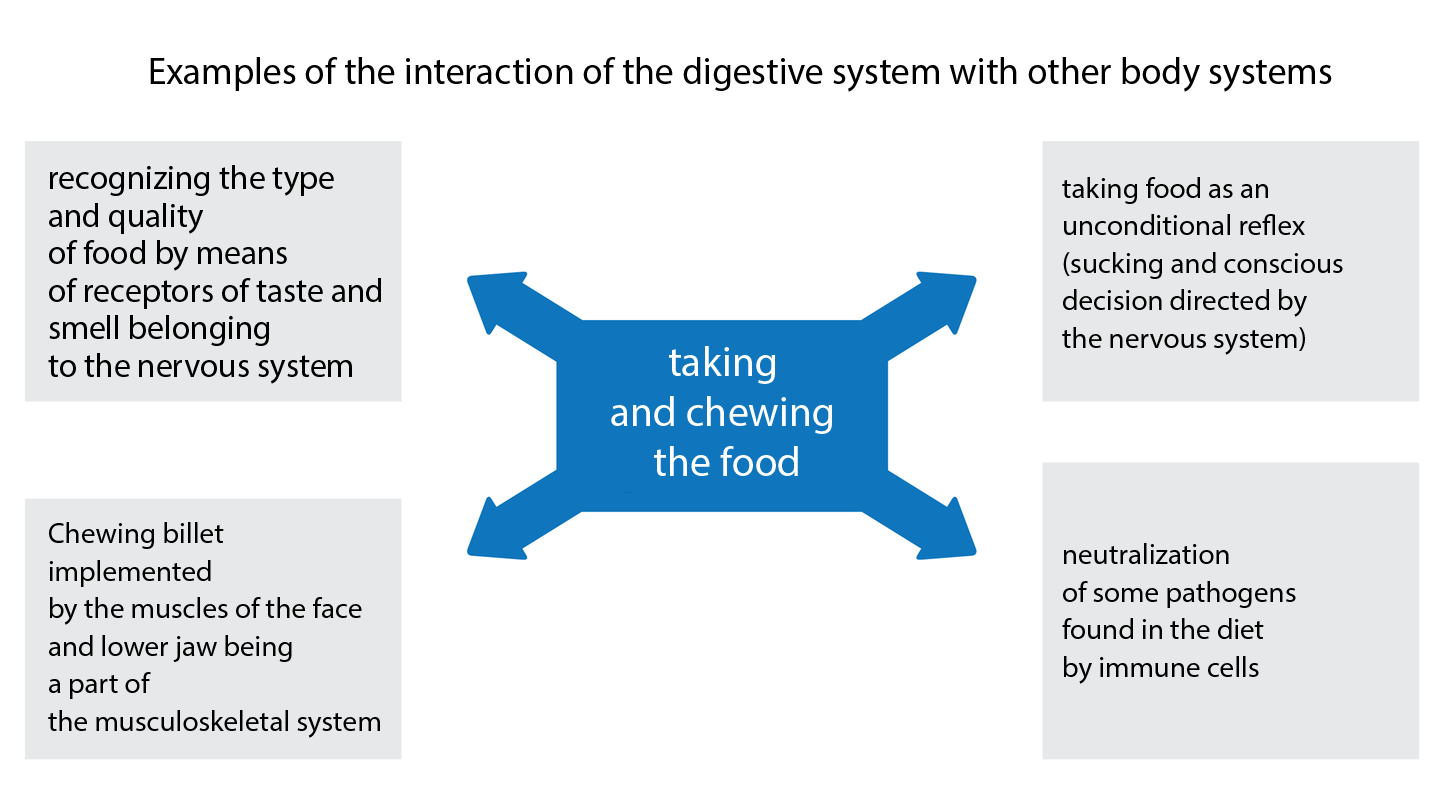
Digested food in form of chemical compounds that can be used by the cells (e.g. amino acids, monosaccharides, glycerol and fatty acids) is absorbed by the intestinal cells into blood vessels and lymph vessels. Through them, food reaches the liver, and then all the tissues in the body. Undigested food is expelled out of the organism in the form of faeces. Working, the digestive system cooperates with other systems of our body.
Chemical digestion
Chemical digestion takes place because of digestive enzymes. These are the substances that work inside the digestive system, and which, with the help of water, allow to break down complex chemical compounds into simpler elements.
In the oral cavity the process of breaking down polysaccharides (starch, glycogen) into monosaccharides is initiated. This is possible thanks to the fact that saliva includes an enzyme called salivary amylasesalivary amylase. It works on food while it passes through the oesophagus. It works only for a short time, so the saccharides are not completely broken down.
Stomach wall cells secrete gastric juice, which, besides hydrochloric acid includes also an enzyme that breaks down proteins - pepsin. PepsinPepsin cuts long strings of proteins into smaller fragments. Both hydrochloric acid and pepsin can be dangerous for the stomach, whose tissues are composed of proteins. Because of this, the hydrochloric acid is secreted only when the stomach receives food that irritates the stomach walls, whereas digestive enzymes work only in the presence of the hydrochloric acid.
Proteins, saccharides and fats are digested in the duodenum. Liver secretes bilebile which breaks down fats into small drops that are easily accessible for the enzymes that digest fats.
Pancreas secretes a number of enzymes, such as pancreatic amylasepancreatic amylase (that digests saccharides), lipaselipase (that digests fats), nucleasenuclease (that digest nucleic acids), trypsintrypsin (that digests proteins). Trypsin cuts long strings of proteins into shorter ones, peptides, and then other digestive enzymes break them down into even smaller particles. The final product of the digestion of proteins are amino acids.
nutrients that are digested | products of digestion | section of the digestive tract | digestive enzymes |
polysaccharides (starch, glycogen) | monosaccharides (glucose) | oral cavity | salivary amylase |
small intestine | pancreatic amylase | ||
proteins | aminoacids | stomach | pepsin |
small intestine (duodenum) | trypsin | ||
fats | glycerol, fatty acids | small intestine | pancreatic lipase |
Absorbtion, use and storing of nutrients
Food remains in the duodenum long enough so that most of the compounds with large particles are digested to the point when they become monosaccharides, amino acids, glycerol and fatty acids.
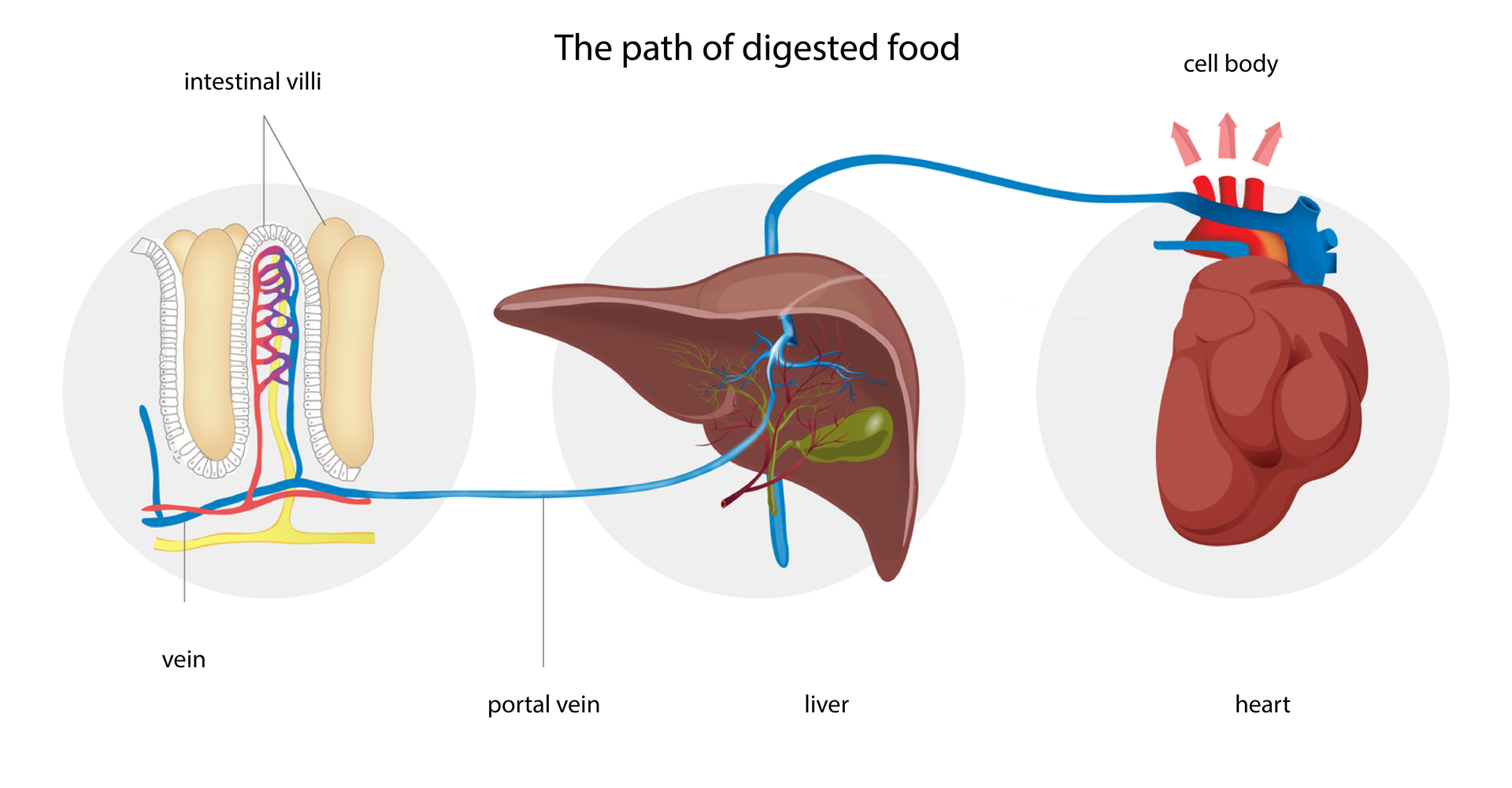
Liquid contents of the digestive system are transported to the next of the small intestine which is surrounded by a very dense net of blood vessels and lymph vessels. That is where the products of digestion are absorbed through the walls of the small intestine into the blood and the lymph.
Blood vessels of the intestinal villi absorb glucose and amino acids, which then are transported to liver and then to body cells as energy source. Excess glucose is converted by the liver and the muscles into glycogen, spare sugar, and stored there. Mineral salts and vitamins are dissolved in water and transported into blood vessels. The result of the digestion of fats, fatty acids and glycerol, pass from the intestine into lymph vessels and then into blood, with which they flow to all the cells of the body. There, they will be used to build the cell membrane and as energy. Excess of fat is stored in adipocytes. Together with fatty acids, lymph received vitamins that are dissolved in fats.
Expulsion of undigested food
Digestive enzymes cannot digest certain ingredients of the food. One of such ingredients is dietary fiber, an ingredient of vegetables. It is moved to the large intestine. The large intestine is inhabited by many types of bacteria, which feed of undigested food and break them down in fermentation processes. Bacteria are about 80% of the mass of the faeces that is expelled from the body through rectum with a constrictor. Water, mineral salts and vitamins are absorbed from the faecal mass in the large intestine.
Select the correct sentences.
- Digestive glands are liver, pancreas and salivary gland.
- Shredded food enters the digestive glands.
- Liver produces bile and lipase that digests fats.
- Pancreas secretes digestive enzymes that digest proteins, fats and carbohydrates (with the participation of bile).
- Enzymes are proteins that facilitate the breaking down of complex chemical substances into simple ones.
- Absorbtion of digested food takes place in the stomach.
- In large intestine water is absorbed and the remaining waste material is stored as feces, next removed by defecation.
Summary
The digestive tract is where the food is processed and where chemical digestion and absorption take place.
Preliminary digestion of polysaccharides take place in the oral cavity.
The digestion of proteins is initiated in the acidic environment of the stomach.
Intense digestion of sugars, proteins and fats takes place in the small intestine.
Liver secretes bile which destroys large particles of fat into small drops.
The products of digestion of sugars, proteins and fats are absorbed in the small intestine.
The large intestine is where the water is absorbed and where faecal mass is thickened.
Undigested food is expelled from the body in form of faeces.
How was this lesson? Did you like it? Finish selected sentences.
Keywords
digestion, digestive enzymes, intestinal villi, absorbtion
Glossary
amylaza ślinowa – enzym trawienny wydzielany przez ślinianki, rozkładający cukry złożone do cukrów prostszych
amylaza trzustkowa – enzym trawienny wydzielany przez trzustkę, rozkładający cukry
enzymy trawienne – grupa białek biorących udział w rozkładzie złożonych związków pokarmowych do związków prostych; działają jako katalizatory, przyspieszając reakcje biochemiczne; każdy enzym kieruje przebiegiem określonej reakcji chemicznej i działa tylko na określony substrat
lipaza – enzym trawienny wydzielany przez trzustkę i jelito cienkie, rozkładający tłuszcze do glicerolu i kwasów tłuszczowych
nukleazy – enzymy trawienne wydzielane przez trzustkę, rozkładające kwasy nukleinowe
pepsyna – enzym trawienny wydzielany przez komórki ściany żołądka, rozkładający białka na krótsze łańcuchy białkowe
trawienie chemiczne – zachodzi w przewodzie pokarmowym pod wpływem enzymów trawiennych; polega na chemicznym rozkładzie związków o dużych cząsteczkach do substancji prostych, przyswajalnych przez komórki
trypsyna – enzym trawienny wydzielany przez trzustkę, rozkładający białka
żółć – wydzielina wątroby będąca mieszaniną różnych związków rozbijających tłuszcze na drobne kropelki i ułatwiających ich trawienie