to classify substances due to their heat conduction ability and explain the role of thermal insulation in English.
Introductory questions.
What is the temperature?
Is there a relationship between the temperature of the body and the kinetic energy of the moving molecules/atoms from which the body is built?
What condition must be met to let the heat flow between the two bodies?
Compare your answers with the conclusion presented below.
Conclusion
Temperature is a physical quantity describing the condition of the body. It characterizes the average kinetic energy of moving and vibrating molecules and atoms from which the body is built and the energy of interactions between them. The higher the temperature of the body, the higher the average kinetic energy of the moving atoms and molecules in it. If, on the other hand, the body temperature drops, then also the molecules and atoms of the body move more slowly.
1. Attach the beads to the rod at equal distances using paraffin: one at the end and the other two at the distance 15 and 30 cm from this end. Leave the other end of the rod free. 2. Secure the rod on a tripod in the horizontal position. 3. Light the burner and put the end of the rod on which there is no bead in the flame. 4. Observe the behavior of beads attached to the rod. Make a note of your observations.
1. The observations made show that the temperature of the entire rod gradually increases, even though only one of its ends is placed in the flame.
2. We do not observe any movement of the entire rod, even though energy is transported through the rod. This method of energy transport is called thermal conductivity.
The average kinetic energy of the molecules in the body with a higher temperature is higher than the energy in the body with lower temperature. When particles collide, some of the kinetic energy is transferred to another molecule. At any moment there are a lot of such collisions and energy is successively passed from the body with a higher temperature to the body with a lower temperature.
Exercise 1
Answer the questions.
1. What is the direct cause of heat conduction? 2. Describe the mechanism of energy transfer in the thermal conduction process. 3. Is the mass transfer over distance during thermal conduction? 4. What conditions must be met for the energy transfer process to cease?
1. The temperature difference. 2. Higher temperature body molecules collide with lower temperature body molecules. During such collisions, kinetic energy is transmitted. 3. There is no mass transfer. 4. The energy transfer process ceases when the particle temperature is the same.
1. The time in which the beads came away from the bars was nonidentical for each bar. This means that the speed at which thermal energy is transported is different for various materials. We say that various materials have different thermal conductivity coefficients.
2. The beads attached to the aluminum rod came away from it earlier then the beads attached to the steel one. This means that heat energy is transported faster in aluminum.
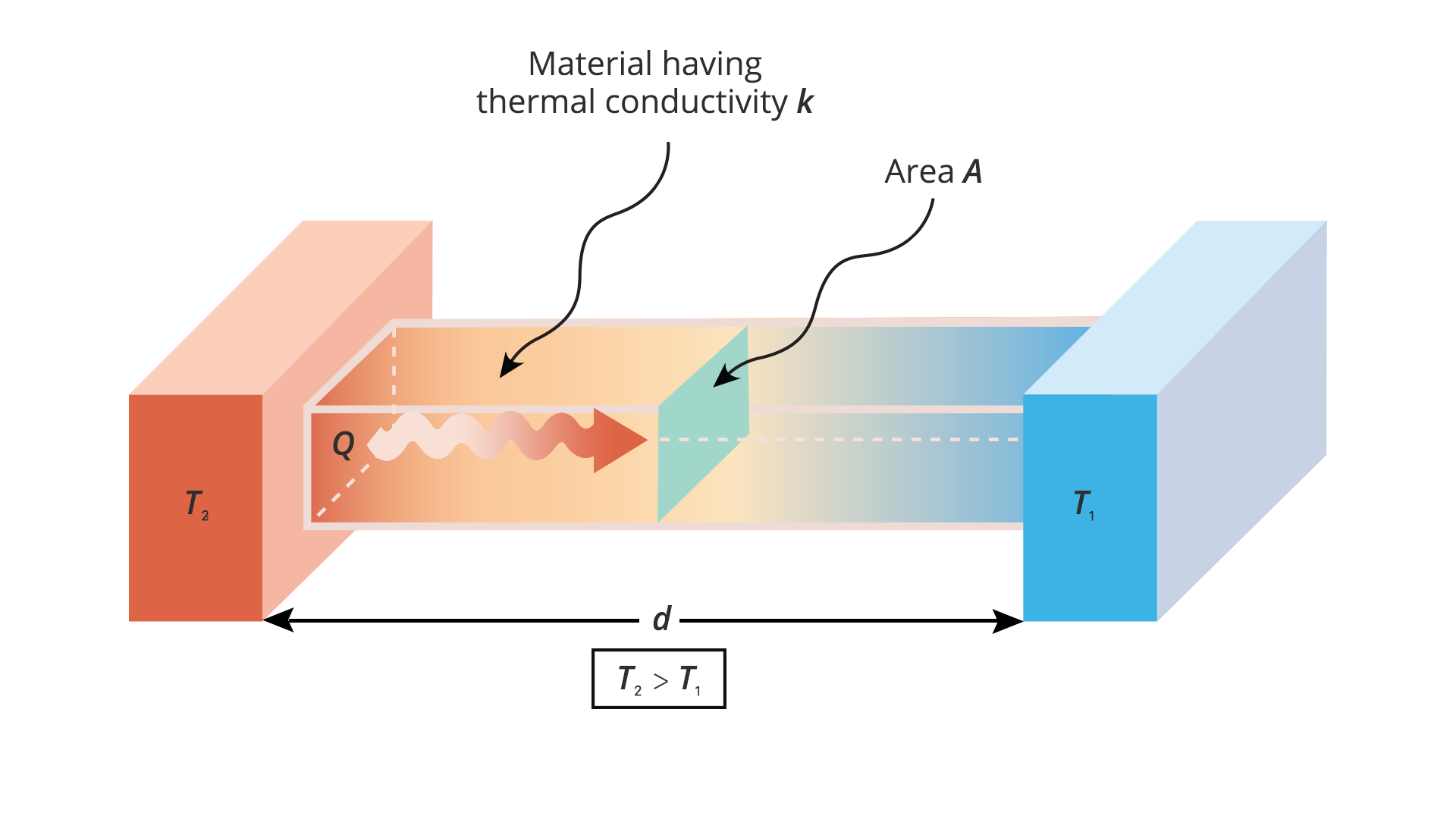
There are four factors which influence how quickly heat is transferred through an object. The mathematical relationship that has been observed and tested experimentally is expressed by the following formula:
The letter Q stands for the amount of heat that was transferred at time t, k is the thermal conductivity coefficient of the material, A is the area of the cross sectioncross sectioncross section of the body, ΔT is the temperature differencetemperature differencetemperature difference at its ends, and d the distance that the heat must be transferred over.
R18OqTa2yFAZ81
Ilustracja przedstawia przedstawia zjawisko przewodnictwa cieplnego. Po lewej stronie prostopadłościan pomarańczowy opisany T z indeksem dolnym 2. Po prawej stronie prostopadłościan niebieski opisany T z indeksem dolnym 1. Między nimi zaznaczona odległość d, poniżej podpisa T z indeksem dolnym 2 większe od T z indeksem dolnym 1. Pomiędzy prostopadłościanami trzeci prostopadłościan poziomy, od lewej pomarańczowy przechodzący w żółty na środku, po prawej niebieski, podpisany Material having thermal conductivity k. Wewnątrz niego na środku prostokąt narysowany (przekrój poprzeczny) podpisany Area A. Od prostopadłościanu po lewej do prostokąta narysowana strzałka opisana Q.
Source: GroMar, licencja: CC BY 3.0.
R1KDhCTVS6ywJ
Ilustracja interaktywna przedstawia model układu doświadczalnego, w którym można zaobserwować proces przewodnictwa cieplnego. Na środku pręt poziomy oznaczony numerem 1, o długości d oznaczonej numerem 7 i przekroju poprzecznym A oznaczonym numerem 8. Prawa strona pręta oznaczona numerem 4, lewa strona pręta oznaczona numerem 5. Kolor pręta od prawej pomarańczowy, symbolizujący pręt ogrzany, przechodzi płynnie do niebieskiego po lewej symbolizujący pręt zimny. Na pręcie umieszczone trzy koraliki równomiernie rozłożone oznaczone numerem 3. Na każdym koraliku parafina oznaczona numerem 2. Nad nimi termometry wskazujące od prawej: 48 stopni Celsjusza, 32 stopnie Celsjusza, 17 stopni Celsjusza. Pod prawym końcem pręta palnik oznaczony numerem 6. Po lewej stronie pręta uchwyt mocujący go w pozycji poziomej. Na ilustracji widoczne są numery, a na nich podpisy. 1. pręt - bar, made of a material with a coefficient of thermal conductivity k {audio}, 2. parafina - paraffin {audio}, 3. koraliki - beads used in the experiment {audio}, 4. koniec pręta z wyższą temperaturą - the end of the bar with a higher temperature {audio}, 5. koniec pręta z niższą temperaturą - end of the bar with lower temperature {audio}, 6. źródło ciepła - source of heat {audio}, 7. długość pręta - d - the length of the heated rod {audio}, 8. przekrój pręta - A - cross-section {audio}.
Ilustracja interaktywna przedstawia model układu doświadczalnego, w którym można zaobserwować proces przewodnictwa cieplnego. Na środku pręt poziomy oznaczony numerem 1, o długości d oznaczonej numerem 7 i przekroju poprzecznym A oznaczonym numerem 8. Prawa strona pręta oznaczona numerem 4, lewa strona pręta oznaczona numerem 5. Kolor pręta od prawej pomarańczowy, symbolizujący pręt ogrzany, przechodzi płynnie do niebieskiego po lewej symbolizujący pręt zimny. Na pręcie umieszczone trzy koraliki równomiernie rozłożone oznaczone numerem 3. Na każdym koraliku parafina oznaczona numerem 2. Nad nimi termometry wskazujące od prawej: 48 stopni Celsjusza, 32 stopnie Celsjusza, 17 stopni Celsjusza. Pod prawym końcem pręta palnik oznaczony numerem 6. Po lewej stronie pręta uchwyt mocujący go w pozycji poziomej. Na ilustracji widoczne są numery, a na nich podpisy. 1. pręt - bar, made of a material with a coefficient of thermal conductivity k {audio}, 2. parafina - paraffin {audio}, 3. koraliki - beads used in the experiment {audio}, 4. koniec pręta z wyższą temperaturą - the end of the bar with a higher temperature {audio}, 5. koniec pręta z niższą temperaturą - end of the bar with lower temperature {audio}, 6. źródło ciepła - source of heat {audio}, 7. długość pręta - d - the length of the heated rod {audio}, 8. przekrój pręta - A - cross-section {audio}.
Materials which slowly transport thermal energy are called thermal insulators.
Summary
Thermal conductivity consist in transferring energy between touching bodies or areas of one body, which temperatures are different.
As a result of this phenomenon the temperature of the body, or a part of the body, tends to equalize. The mechanism of thermal conductivity is based on direct transfer of kinetic energy between molecules or atoms of matter.
Taking the ability to transport thermal energy into account, we divide the substances into:
heat conductors - thermal energy is transported in them quickly and easily,
thermal insulators - transport of thermal energy takes place slowly.
The best heat conductors are: metals (also liquid) and diamond.
Good heat insulators are: gases, glass wool, cork or polystyrene.
Exercises
Zapoznaj się z treścią abstraktu i na podstawie uzyskanych informacji wymień trzy substancje, które są dobrymi przewodnikami ciepła i trzy, które nie są dobrymi przewodnikami ciepła.
Zapoznaj się z treścią abstraktu i na podstawie uzyskanych informacji wymień trzy substancje, które są dobrymi przewodnikami ciepła i trzy, które nie są dobrymi przewodnikami ciepła.
RsVHQMIoktb7S
Exercise 2
Wersja alternatywna ćwiczenia: There are several types of substances: aluminum, steel, gold, coal, wood, styrofoam, concrete. Use the table in which the values of thermal conduction coefficients are placed and arrange these substances from those which are the best heat conductors to those that are the worst ones. Elementy do uszeregowania: 1. gold, 2. wood, 3. concrete, 4. carbon, 5. styrofoam, 6. steel, 7. aluminum
Wersja alternatywna ćwiczenia: There are several types of substances: aluminum, steel, gold, coal, wood, styrofoam, concrete. Use the table in which the values of thermal conduction coefficients are placed and arrange these substances from those which are the best heat conductors to those that are the worst ones. Elementy do uszeregowania: 1. gold, 2. wood, 3. concrete, 4. carbon, 5. styrofoam, 6. steel, 7. aluminum
There are several types of substances: aluminum, steel, gold, coal, wood, styrofoam, concrete. Use the table in which the values of thermal conduction coefficients are placed and arrange these substances from those which are the best heat conductors to those that are the worst ones.
wood
concrete
gold
carbon
aluminum
styrofoam
steel
Exercise 3
Heat penetrates the walls of the apartment at the speed of 200 kJ per second. The temperature outside is -20°C, and the temperature inside the apartment is 20°C. How much heat will penetrate the walls of the house within 1 h when:
a) the outside temperature increases to -10°C and the temperature inside the apartment does not change?
b) the outside temperature increases to -5°C and the temperature in the apartment is reduced twice?
a)
b)
Exercise 4
Present a brief answer in English to each question.
1. What is the reason for using two sheets of glass separated by an empty space in the double‑pane window construction? Is this space really empty?
2. On a cold day it is advisable to dress like „an onion”, i.e. dressing several layers of clothing. This gives a better insulation than a single layer of thick clothing. Why?
3. Using metal utensils to drink beverages can cause burns. Why does this happen?
1. There is usually gas under very small pressure between the glass sheets. The layer of this gas is a very poor heat conductor and it limits the heat transfer to the outside.
2. Between the layers of clothes there is a very thin layer of air i.e. a very poor heat conductor. This limits the flow of heat from the body to the environment.
3. The walls, which are made of a very good conductor, are the cause of very quick heat transfer. The temperature of the container walls increases in a very short time. It can cause burns during the direct contact with your hands.
REjucELZXCqCP
Exercise 5
Wersja alternatywna ćwiczenia: Indicate which pairs of expressions or words are translated correctly. Możliwe odpowiedzi: 1. przepływ ciepła - heat flow, 2. szybkość przepływu ciepła - heat flow rate, 3. różnica temperatur - temperature difference, 4. przewodnik - conductor, 5. izolator - kinetic energy, 6. przewodnik cieplny - phenomenon
Wersja alternatywna ćwiczenia: Indicate which pairs of expressions or words are translated correctly. Możliwe odpowiedzi: 1. przepływ ciepła - heat flow, 2. szybkość przepływu ciepła - heat flow rate, 3. różnica temperatur - temperature difference, 4. przewodnik - conductor, 5. izolator - kinetic energy, 6. przewodnik cieplny - phenomenon
Indicate which pairs of expressions or words are translated correctly.
przepływ ciepła - heat flow
szybkość przepływu ciepła - heat flow rate
różnica temperatur - temperature difference
przewodnik - conductor
izolator - kinetic energy
przewodnik cieplny - phenomenon
zadanie
Source: GroMar, licencja: CC BY 3.0.
R1aNnDIfIcVFP1
Interaktywna gra, polegająca na łączeniu wyrazów w pary w ciągu jednej minuty. Czas zaczyna upływać wraz z rozpoczęciem gry. Jeden ruch to odkrywanie najpierw jednej potem drugiej karty z wyrazem. Każdy wyraz jest odczytywany. Kolejny ruch to odkrywanie trzeciej i czwartej karty. W ten sposób odsłuchasz wszystkie wyrazy. Nawigacja z poziomu klawiatury za pomocą strzałek, odsłuchiwanie wyrazów enterem lub spacją. Znajdź wszystkie pary wyrazów.
Interaktywna gra, polegająca na łączeniu wyrazów w pary w ciągu jednej minuty. Czas zaczyna upływać wraz z rozpoczęciem gry. Jeden ruch to odkrywanie najpierw jednej potem drugiej karty z wyrazem. Każdy wyraz jest odczytywany. Kolejny ruch to odkrywanie trzeciej i czwartej karty. W ten sposób odsłuchasz wszystkie wyrazy. Nawigacja z poziomu klawiatury za pomocą strzałek, odsłuchiwanie wyrazów enterem lub spacją. Znajdź wszystkie pary wyrazów.
Match Polish terms with their English equivalents.
szybkość przepływu ciepła
thermal insulation
różnica temperatur
temperature difference
przepływ ciepła
thermal conductor
heat flow rate
izolator cieplny
heat flow
przewodnik ciepła
Source: Zespół autorski Politechniki Łódzkiej, licencja: CC BY 3.0.