Social and economic revolution on the lands of the Piast dynasty in the 13th century.
to characterize changes in the 13th century agriculture;
settlerssettlers and what their contributions were;
to characterize socio‑economic changes;
to explain the impact of settlement development on the economic recovery.
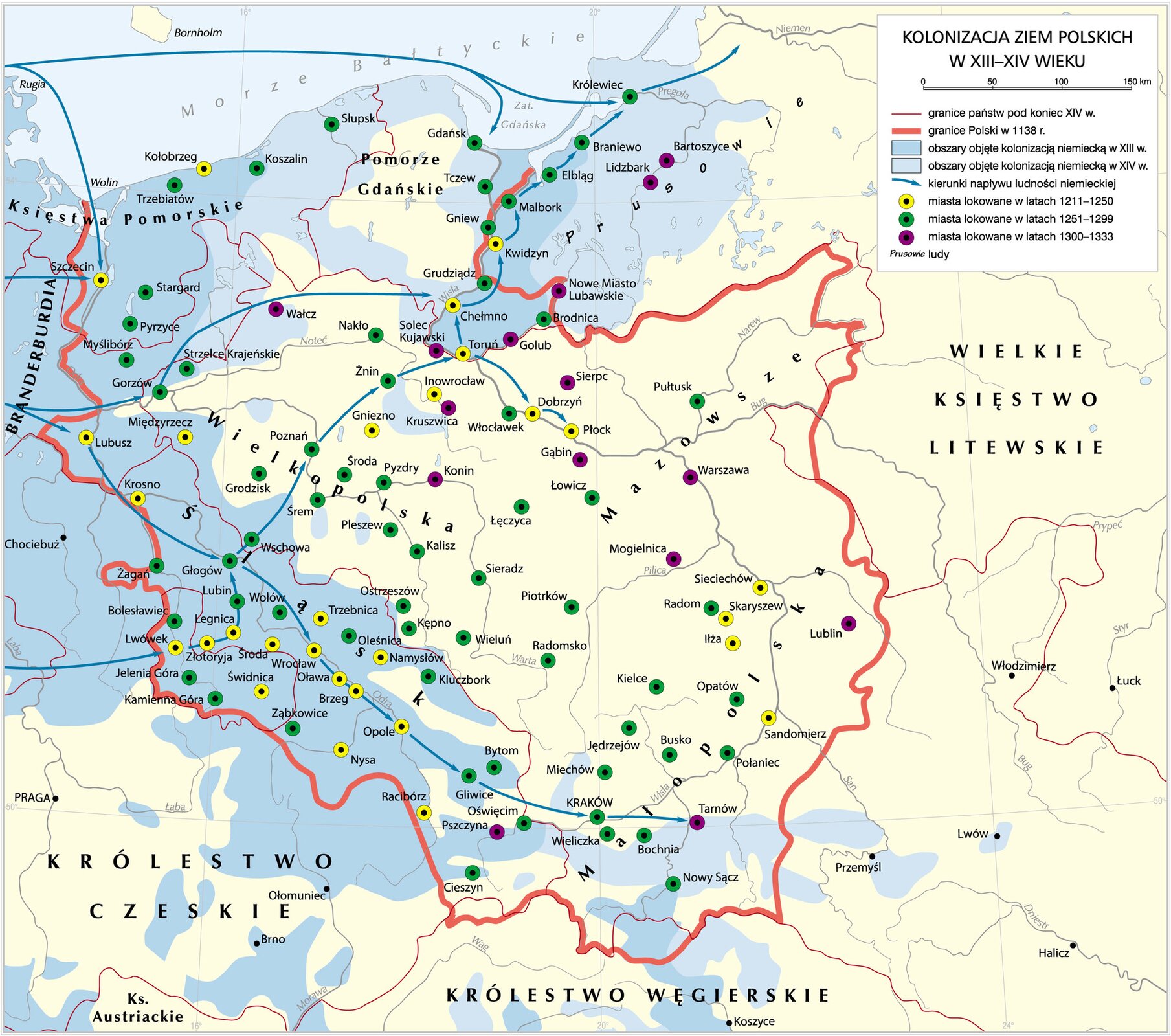
The changes that began to take place in western Europe between the 11th and 13th century in time also reached the Polish lands. The growing number of subjects of the Piast dynasty rulers and the frequent visits of the latter to western courts contributed to the transfer of many standards to Poland. However, as in the entire Europe, the most important problem was to provide food for all the subjects. Not only society as a whole was unable to function without food, but food was also a method of payment. Economic self‑sufficiency and the barter system were the most important features of the economy of the Piast dynasty until the middle 13th century. During this period, changes in agriculture began to slowly take place in Poland. Introduction of the new system of land cultivation – the three‑field rotationthe three‑field rotation, which replaced the less efficient two‑field rotationtwo‑field rotation, allowed to increase the acreage of fields and contributed to milder effects of a possible crop failure. Changes also happened in the cultivation techniques. The widespread use of heavy ploughplough and horse‑collar helped to increase soil fertility and to improve yields, while the increasingly frequent mills made it possible to turn more grain into flour of better quality and to reduce the number of people involved in the process. In addition to the political weakening of the Piast dynasty, the steadily deepening district breakdown also had other effects. Shrinking principalities meant reduced income to their rulers, which in turn increased their interest in introducing beneficial changes. This contributed to the aforementioned changes in cultivation, but also to encouraging foreign newcomers (settlers) to settle on Polish lands as well as develop cities, wastelands and underdeveloped areas. The Silesian princes played a decisive role in this by establishing the first cities, Złotoryja and Środa Śląska, which were vested with town rights according to Magdeburg law. These changes quickly brought the intended effect - an increase in the income of princes and the development of trade and monetary economy, and thus of cities. As a result, the homogeneous society began to change. However, ethnic diversity in individual regions did not cause bigger social tensions. On the contrary, the assimilation of newcomers with the local population was quite often. Only the Jewish community, culturally and religiously distinct, remained largely unaffected by these changes. Deprived of the possibility to own land and to become involved in trade and craft, the Jewish community concentrated its efforts on financial services. This sometimes caused riots against them and was the reason why they were oppressedoppressed. The Piast dynasty rulers tried to prevent such events from happening by giving the Jews, who were paying high taxes, the status of „princely people” - any aggression against them had severe consequences. The changes taking place in the 13th century led to the growth of population and the „Europeanization” of Poland. However, the price to be paid for these changes was the weakening of bonds between Slavs living in different Piast principalities.
Read the source text and do the following exercise.
Anonima tzw. Galla, Kronika polskaAnonima tzw. Galla charakterystyka Polsk [...] ponieważ kraj Polaków oddalony jest od szlaków pielgrzymich i mało komu znany poza tymi, którzy za handlem przejeżdżają [tamtędy] na Ruś [...], parę słów na ten temat powiem [...]. Kraj to wprawdzie bardzo lesisty, ale niemało przecież obfituje w złoto i srebro, chleb i mięso, w ryby i miód, a pod tym zwłaszcza względem zasługuje na wywyższenie nad inne, że choć otoczony przez tyle wyżej wspomnianych ludów chrześcijańskich i pogańskich [...] nigdy przecież nie został przez nikogo ujarzmiony w zupełności; kraj, gdzie powietrze zdrowe, rola żyzna, las miodopłynny, wody rybne, rycerze wojowniczy, wieśniacy pracowici, konie wytrzymałe, woły chętne do orki, krowy mleczne, owce wełniste.
Source: Anonima tzw. Galla, Kronika polska, tłum. R. Grodecki, Wrocław 2003, s. 9–10.
Complete the following sentence: Presenting Poland to the reader, Gallus Anonymus stressed that Poland:
- had a large number of wealthy cities.
- had copious natural resources.
- was famous for its numerous trade routes.
Time for brainstorming! Consider what changes could be made to the economy of the Piast country to make it yield more profits for the rulers, the Church and the knighthood.
Divide into three groups corresponding to these three groups of great landowners.
Each group will present its proposals, one by one, for changes that the prince, the church or the knighthood could have made.
After one group presents its proposals, other groups should point out the strengths and weaknesses of the proposed solutions.
The group that proposes changes should respond to the criticism of others by either accepting or rejecting it. If the group does not agree with the criticism, it should come up with its own arguments that weaken the critical argumentation.
The final evaluation of the proposed changes is carried out by the teacher, who can choose the winners, i.e. those, whose proposals have gained the greatest acceptance or who successfully defended their ideas against criticism.
Listen carefully to the recording about the foundationfoundation of Radlin, a town (once a village) existing to this day and located in Wielkopolska (Greater Poland Voivodeship).
After that, answer what duties towards the court and the church the village inhabitants had. How long did the wola last, i.e. the free‑of‑charge use of the liege's land? What was the function of the founderfounder of the village and what powers did he have?
Location document of the village of Radlin issued in 1291In the name of the Lord. Amen.
In order to ensure that human actions do not lose their significance in the course of time, the prudent gravity of the wise ordered that deeds worth remembering should be strengthened by the defense of witnesses or the dignity of what is written. That is why I, komes [Polish title used for administrative and military district commanders] Jan, son of Czechosiaw from Galewo, together with my brother Wojciech, want each of those who look at this Charter, living now or in the future, to know that our heritage, Radlino, as it is commonly called, has been given to Marcin from Staniewo and his heirs in order to be settled with German law, that is the law which the townspeople of Nowy Targ and the town itself have adopted. The arrangement is as follows: on Saint Martin's Day, the inhabitants of the promised village, from each small łan [old Polish unit of field measurement], shall pay 2 measures of wheat, 4 measures of rye, 6 measures of oat according to the measurement system of the Pyzdry poviat as well as a wiardunek [Mediaeval Central European unit of mass] of silver and shall bring this payment to our closest court. In order that those cultivating the promised village may pay out all this, they shall be free from all tributes and fees for the period of 9 years. (...)
The aforementioned sołtys [head of a municipality] Marcin and his heirs, under the settlement with German law, shall receive the seventh łan with the enjoyment of all the usual powers and privileges derived from the title of its ownership. The sołtys and his heirs shall take possession of the two gardens in the promised village, reaping full benefits from them. They shall also receive every third denarius from each trial case. I have also vested the aforementioned sołtys Michał and his heirs with the right to place as many mills on their territory as they deem fit; they shall own an inn, a butcher's house and a pond with the right to fish referred to above; moreover, they shall have the right to sell cloth pieces (...)
I hereby give sołtys Marcin and his heirs the power to judge (...) those who would be at fault in the aforementioned village. At the same time, if a case or a complaint is filed against the sołtys with me as the judge, he shall be held responsible on the basis of the German law. Moreover, I wish it so that the aforementioned sołtys and his heirs have the right to catch hares, partridges, and pheasants as well as to fish in the waters of the mentioned estate - in any part thereof. Also, they shall have full freedom in doing so. Finally, the inhabitants of the aforementioned village shall bring us a cart pulled by 2 horses in the event of a war expedition, while the church shall also receive 2 free łan. And so that one of our descendants, driven by some foolish audacity, does not dare to question the content of this legally made donation, I have hereto set my hand and affixed my seal.
Signed in Koźminek in the year 1291, on the day of St. Urban Pope and Martyr, in the presence of John, [...] sołtys of Staniewo, Piotr Łaziebnik.
Source: Location document of the village of Radlin issued in 1291.
Read a fragment of Henryk I Brodaty's document from 1221 and mark the duties of the new settlers and the current Polish peasants in the text.
new settlers Polish peasants
My, Henryk, z Bożej łaski książę Śląska, na prośbę opata [klasztoru] Świętej Marii [Panny z Piasku] we Wrocławiu [...] nadajemy prawo niemieckie gościom mieszkającym w Krzydlinie, Budziszowie, Tyńcu, Oleśniczce, Sobótce, Wirach, Zebrzydowie [...] w ten sposób, że będą wolni od posług, do których zobowiązani są Polacy według zwyczaju krajowego, a które pospolicie nazywa się: przewóz, ślad, przesieka, i od danin, które powinny być pobierane, to jest stróża, podworowe i tym podobne. Zastrzegamy jednak, że z każdego łanu płacącego [daninę] opatowi pobierać będziemy dwie miary, jedną pszenicy, drugą owsa. Przy budowie grodów pomagać mają w wypadkach koniecznych, na wyprawy wojenne chodzić będą tak, jak inni Niemcy.
Read the following text and then complete the sentence in the following exercise.
National conflicts on the German-Slavic border in the 13th and 14th centuries and their social rangeThe main and generally sole objective of the rulers [....] was [...] melioration terrae [land improvement], i.e. better management of the country's territory - done by increasing population density, improving farming methods, establishing new relations between lords and subjects, revitalising urban life, trade, etc. The ruler identified the good of the country with his own [...]. The prince gained the gratitude and support of the colonists and could count on them in his conflicts with the representatives of old nobility and clergy who opposed him.
Source: National conflicts on the German-Slavic border in the 13th and 14th centuries and their social range, [w:] B. Zientara, Przegląd Historyczny, 1968, s. 203.
According to the historian, the princes by supporting economic and social revolutions...
- took care of the country in order to also strengthen their power.
- acted under the coercion of the nobility.
- disregarded the interests of their country.
Keywords
organisation, foundation, privilege, immunity, settlers, Piast dynasty, social revolution, economic revolution
Glossary
Dwupolówka – system uprawy ziemi polegający na podziale jej na 2 części – jedną część obsiewano zbożem jarym (wiosną) lub ozimym (jesienią), druga część była ugorem (odpoczywała).
Trójpolówka – system uprawy ziemi polegający na podziale jej na 3 części – na jednej siano zboże ozime (jesienią), na drugiej jare (wiosną), a trzecia odpoczywała. Po roku następowała zmiana.
Żarna – urządzenie do ręcznego mielenia ziarna złożone z dwóch kamieni.
Radło – narzędzie rolnicze służące do spulchniania ziemi bez jej odwracania.
Pług – narzędzie rolnicze służące do wykonywania orki, następca radła.
Osadnicy – osoby przybywające z innego regionu kraju lub zza granicy na tereny słabo rozwinięte i zaludnione, których celem jest ich rozwój gospodarczy. Często nazywani są również kolonistami.
Urbanizacja – proces polegający na zwiększaniu się udziału ludności miejskiej w ogólnej liczbie ludności danego terytorium lub państwa.
Zasadźca – w średniowiecznej Polsce osoba, która otrzymywała od właściciela ziemi (feudała) dokument lokacyjny wsi lub miasta, a następnie zajmował się ich organizacją. Zasadźca najczęściej zostawał wójtem lub sołtysem i pełnił funkcję pośrednika między feudałem a osadnikami.
Wójt – w średniowiecznej Polsce urzędnik stojący na czele miasta, który reprezentował pana feudalnego. Do jego zadań należało pobieranie czynszów, obrona miasta oraz zapewnienie w nim porządku.
Sołtys – chłop stojący na czele wsi, któremu właściciel ziemi powierzył jej organizację.
Czynsz – w okresie feudalizmu stałe świadczenie (opłata) wnoszone przez chłopów na rzecz właściciela gruntów w zamian za ich użytkowanie.
Dzierżawa – umowa na użytkowanie jakiejś rzeczy lub terenu. Chłopi płacili za użytkowanie ziemi właściciela.
Lokacja – organizowanie wsi i miast, przeważnie już istniejących, na podstawie przywilejów opartego na prawie lokacyjnym.
Przywilej – prawa nadawane przez władcę określonej grupie społecznej (szlachcie, duchowieństwu) obowiązujące na danym terenie lub w całym kraju.
Immunitet – w średniowieczu przywilej nadawany przez władcę feudałowi. Dzielił się na sądowy i ekonomiczny.
Prześladowania – celowe nękanie, szykanowanie i wyrządzanie krzywdy wybranym osobom lub grupie osób, którego celem jest ich upokorzenie lub wyniszczenie.