In the maze of information
Nowadays we live in an information society - where the creation, distribution, use, integration and manipulation of information is a significant economic, political, and cultural activity.
Sometimes it is very difficult to tell facts and opinions apart.
You will be able to tell the difference between an opinion‑forming newspaper and a tabloid.
You will understand the role of both types of newspapers in a democracy.
You will be able to create effective information.
Traditional papers can be divided into two broad categories: opinion‑forming newspapers, and popular newspapers, called tabloids. Tabloids use screaming headlines, bluntblunt language, big pictures, short and emotional texts. They are addressed at a mass reader, they express his opinions, cater to his average tastecater to his average taste, feed him with rumoursrumours about celebrities, scandals, sometimes make stories upmake stories up. There is no space here for multilateral analysismultilateral analysis or nuancesnuances. However, the popular newspapers are also important in a democracy. They present every event, new law, an economic phenomenon from the point of view of a common man. They help calculate the consequences of the economic changes for the home budget. They control and criticise the government. Nowadays the papers are slowly being replaced with the internet.
How to create information? A well created piece of information should answer six questions:
Create a message about an event at your school, neighbourhood or about a family occasion. Present the information in the form of an invitation, a poster, a flyer or an advertisement. Use the catalogue of six questions.
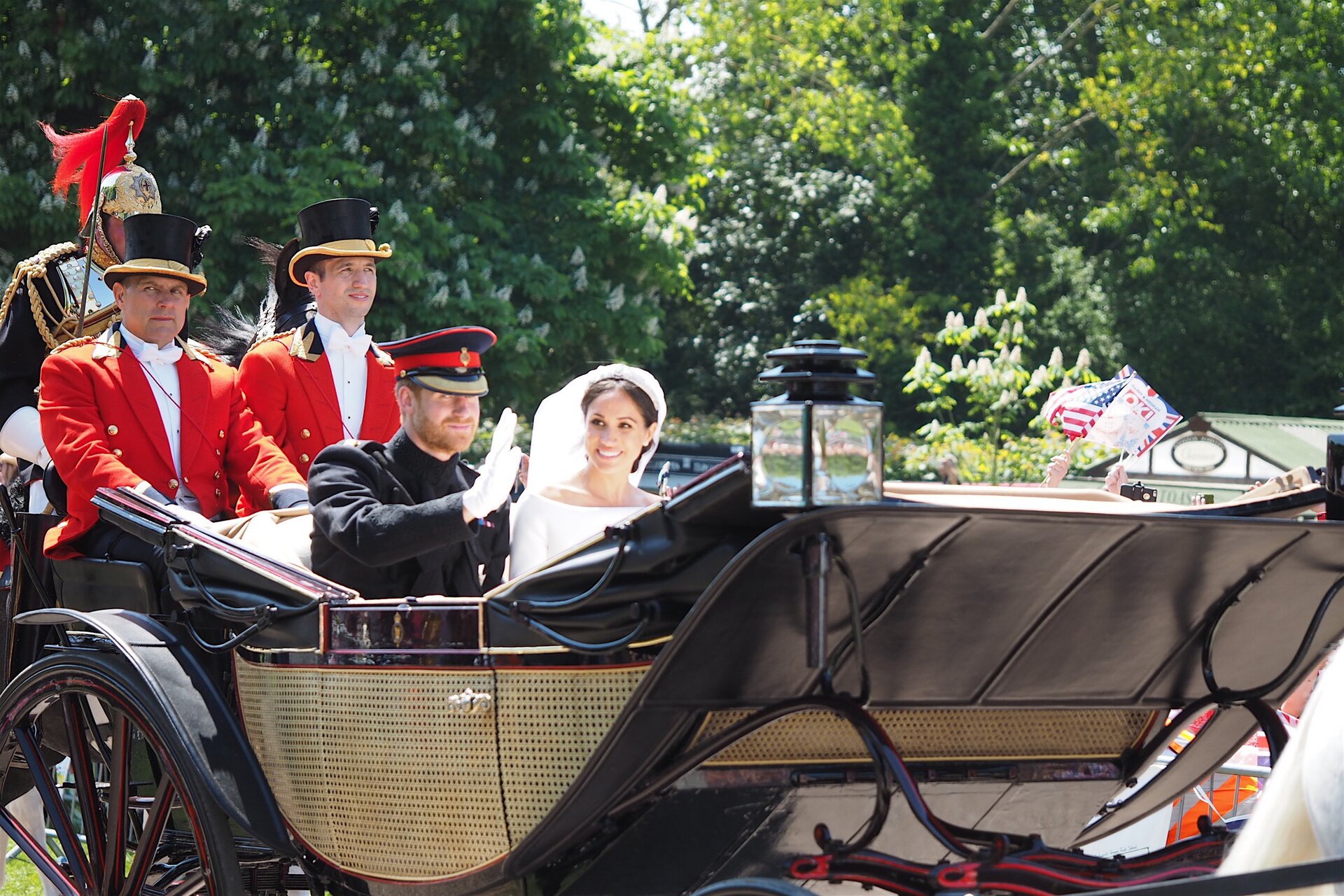
The picture below presents the wedding of Prince Harry and Meghan Markle. Look up some information on this event online and write a short article on the subject for an opinion‑forming newspaper or for a tabloid. Depending on which type of article you decide to write you might consider the bride’s age, occupation, ethnicity, education, social activism, citizenship, clothes, look, etc., and their consequences for the British monarchy.
Listen to the abstract recording to review the material and new vocabulary. Then do the vocabulary exercise. Match the pairs: English and Polish words.
wielostronna analiza, radzić sobie, schlebiać jego przeciętnemu gustowi, niuans, dosadny, wymyślać historie, plotki
| to manage | |
| blunt | |
| to cater to his average taste | |
| rumors | |
| to make stories up | |
| multilateral analysis | |
| nuance |
Keywords
opinion‑forming newspaper, tabloid
Glossary
radzić sobie
dosadny
schlebiać jego przeciętnemu gustowi
plotki
wymyślać historie
wielostronna analiza
niuans