Erudition and joy – postmodernism according to Umberto Eco
you will explain the differences between high culturehigh culture and popular culturepopular culture
you will discuss fragments of the novel by Umberto Eco entitled „Imię róży” (The Name of the Rose) and to consider different levels of its interpretation
Before the lesson
Read a fragment of the novel „Imię róży” (The Name of the Rose) enclosed in e‑textbook.
PostmodernPostmodern Literature. Semiotic Thinking
Talk about high culture and popular culture. Answer the questions.
What are the differences between high culture and popular culture?
Which type of culture do you encounter more often?
Do you agree with the derogatory valuation of popular culture?
Basing on the information below, create a mind map representing The Name of the Rose novel. Consider the possible interpretation levels of the work.

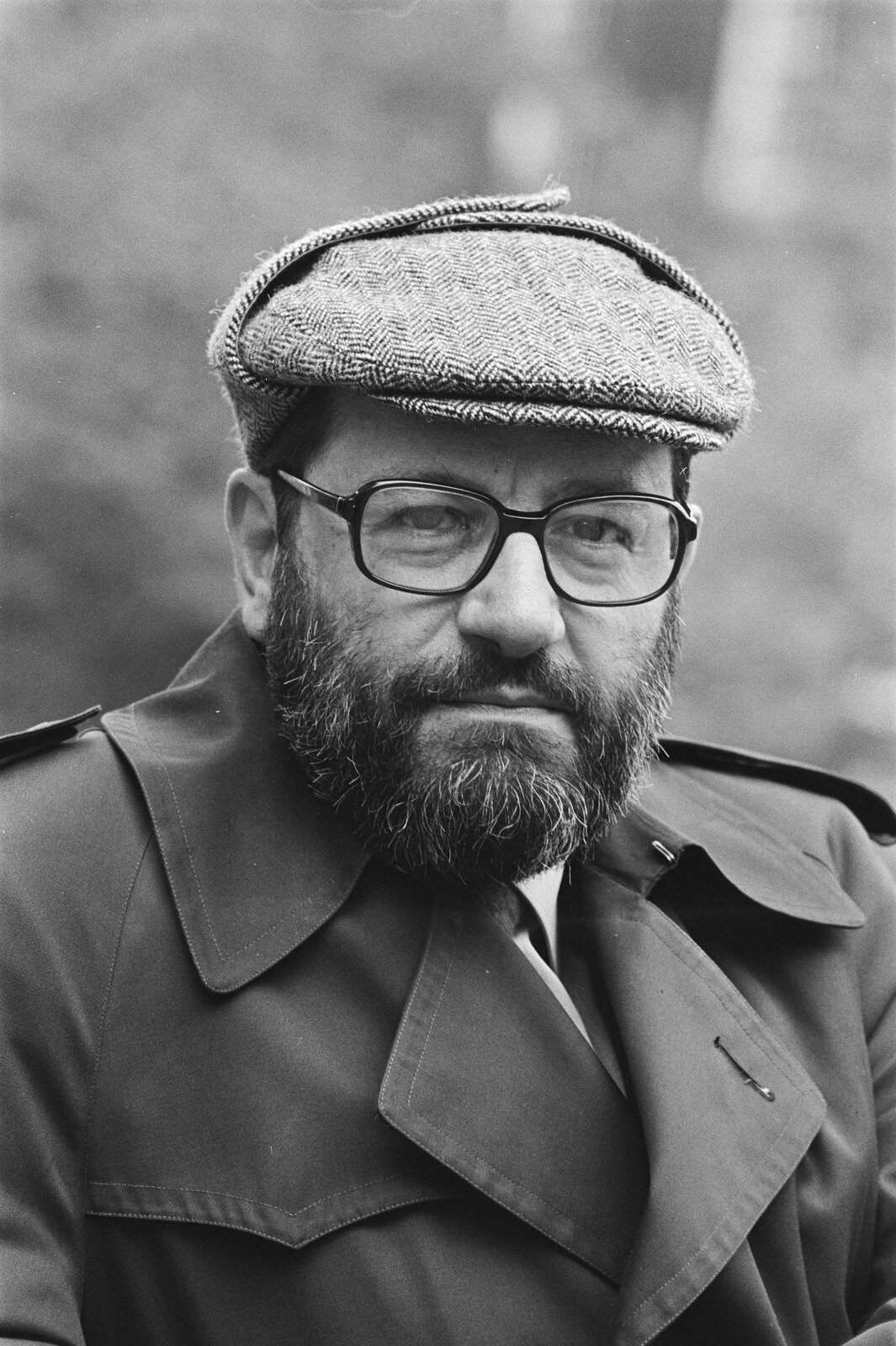
Umberto Eco
1932–2016
An Italian writer, essayist, columnist, philosopher. He was a professor at universities in Florence and Bologna. Author of best‑sellers like: Imię róży (The Name of the Rose)(1980) and Wahadło Foucaulta (Foucault's Pendulum)(1988), Wyspa dnia poprzedniego (The Island of the Day Before) (1994), Baudolino (2000) and Cmentarz w Pradze (The Prague Cemetery)(2011). Columns written in the weekly Milan magazine „L’Expresso” and collected in volumes of Zapiski na pudełku od zapałek were just as popular. Moreover, Umberto Eco is an author of significant scientific papers, such as Dzieło otwarte (The Open Work) (1962), Lector in fabula (1979), Sztuka i piękno w średniowieczu (Art and Beauty in the Middle Ages) (1994).
Imię róży (The Name of the Rose) is the most famous work of Umberto Eco. Millions of sold copies, translation in dozens languages and presence on school reading lists illustrate well the striking popularity of the book.
The novel was written in such a manner that almost everyone will find something of interest while reading it. It was the intent of the author that Imię róży could be read on several levels.
On the most basic level, the book is intended for a reader of best‑sellers, an enthusiast of thrilling intriguesintrigues. The story is shrouded in history of a mysterious book and shocking events, including several murders and suicides. Umberto Eco uses verified schemes and well‑known genres like crimecrime, detectivedetective, gothic and romance novels.
On the next level, the novel can be read as a concealed story about contemporary events. When Umberto Eco wrote the book dramatic events unfolded connected with the political terror of “Red Brigades” which murdered Aldo Moro, the leader of the Christian‑Democratic Party and three‑time Prime Minister of Italy.
The last level is more nuanced and complex. It is meant for professional readers whose literary competence enables them to recognise hidden quotes and literary allusions in the text. In this regard, Imię róży was designed to be a full realisation of an intertextualintertextual postmodern work, created from other works.
The last feature is best illustrated by the portrayal of Wilhelm of Baskerville who holds opinions and findings of Roger Bacon, Wilhelm Ockham, Marsilius and... Umberto Eco himself. In any manner does he resemble a stereotypical medieval monkmonk. He is a literary character through and through since he evokes the character of Sherlock Holmes.
On the basis of the fragment read at home, complete the tasks:
Reconstruct the mindset of Wilhelm of Baskerville in the fragment with Brunellus.
What enabled Wilhelm to figure out what happened with the horse?
Why the approach of Wilhelm brings reading to Adso’s mind?
Watch a film scene of a discussion between Wilhelm and Jorge about laughter (The Name of the Rose (1986), 30’-34’40”) and answer the questions:
Why was Jorge opposed to comedy and laughter?
How does Wilhelm of Baskerville defend laughter?
Why does Jorge undermine the value of doubt?
Why, in the last fragment, does Wilhelm warn Adso about prophets and those who are willing to die for the truth?
Why does the protagonist talk about „an unhealthy passion for the truth”?
Take part in a discussion on the following topic: „Can laugher be educational?”. Refer to the cultural texts known to you.
Listen to the abstract recording to review the material and new vocabulary. Then do the vocabulary exercise. Match the pairs: English and Polish words.
semiolog, erudycja, opactwo, intertekstualność, nowicjusz, proroctwo, kultura wysoka, kultura popularna
| abbey | |
| high culture | |
| popular culture | |
| intertextuality | |
| novice | |
| prophecy | |
| scholarship | |
| semiologist |
Keywords
postmodernism, crime story, detective story, myth, high culture, popular culture
Glossary
opactwo
powieść kryminalna
powieść detektywistyczna
kultura wysoka
inkwizycja
intertekstualność
intryga
mnich
nowicjusz
kultura popularna
postmodernizm
proroctwo
erudycja
semiolog