Przeczytaj
The picture below shows young people performing live music in the street. It is quite a common sight in our cities, especially in summer. In this section you are going to read a text about live music in different contexts. Did you know that musical education leads to better test scores in exams? Read on to learn some other interesting facts!
Poniższa ilustracja przedstawia młodych ludzi, którzy występują na ulicy. To dość powszechny widok w większych miastach, szczególnie w lecie. W tej sekcji przeczytasz tekst o muzyce na żywo w różnych kontekstach. Czy wiedziałeś/wiedziałaś, że nauka muzyki wpływa na lepsze wyniki na sprawdzianach z innych przedmiotów? Czytaj dalej, aby poznać inne interesujące fakty!
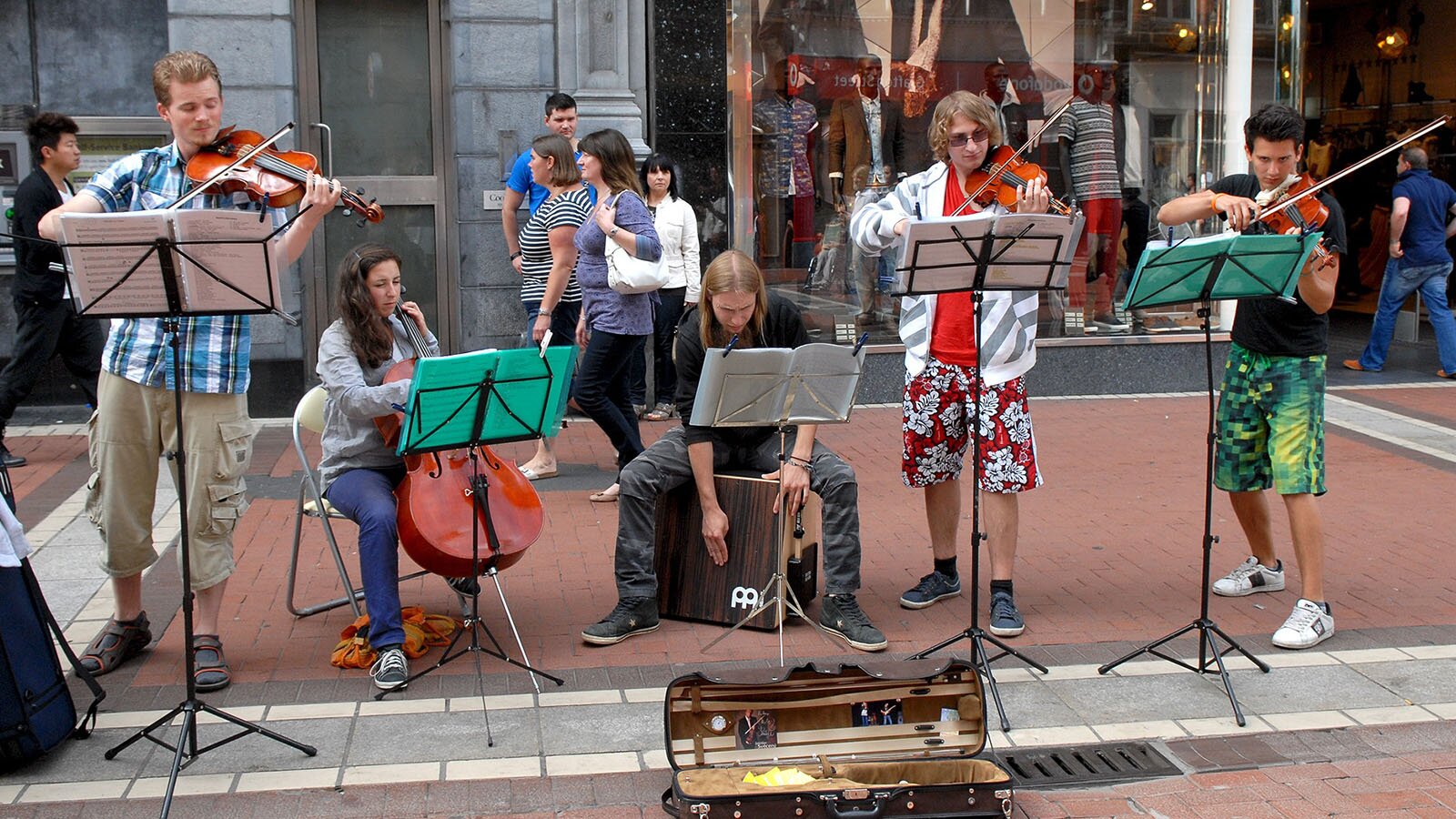
Drag and drop the labels to the correct places in the picture.
Now read the text about different kinds of live music.
Live Music Is Life ItselfThey say music is a universal language, and there must be something in it. Who wouldn’t like a tunetune that makes your feet taptap? It is also a social phenomenon traditionally experienced together in a live concert. Whether it is mainstream musicmainstream music, or classical music, or something avant‑garde, it inspires listeners to attend live concerts, even though they could enjoy listening to recordings in their homes, which would be both cheaper and more convenient. What is there to choose from?
The most popular types of live music are concerts of rock, pop, or heavy metal bands that give a performancegive a performance in big venuesvenues such as arenas, stadiums, parks, or fields. Hundreds of fans attend these events to feel, dance, sing, and experience the music together. Did you know that heavy metal and classical music fans have similar personality traits? According to a study by Heriot‑Watt University in Scotland, lovers of both types of music genresmusic genres tend to be creative, at ease with themselves, and introverted. For these people, live concerts are the way to connect to the bands and artists on an emotional, in‑person level that can’t be achieved or mimicked with streamingstreaming or a recording.
Classical music concerts, with an orchestraorchestra of musicians playing various musical instrumentsmusical instruments under the guidance of a conductorconductor, or a solo recitalrecital of a talented pianist or other instrumentalist, are also very popular. Even though they usually follow a rigid formatrigid format, they have millions of fans all over the world. Additionally, a new generation of young classical musicians often breaks away from standard content and they incorporateincorporate new elements relatable to young people. For example, they become YouTubers and increase the popularity of classical music by combining it with trendy challenges or games.
There is also a renewed interest in choirschoirs and glee clubsglee clubs. Largely thanks to the Fox’s hit comedy “Glee” about a group of teenage misfitsmisfits in a high school glee club, these musical groups are gaining more and more popularity, especially at American high schools. In glee clubs people practise part songpart song (called the glee), and it is a real pleasure for an audience to listen to how beautifully they sing in tunesing in tune together. Interestingly, multiple studies show that singing in a group is soothingsoothing and raises one’s spiritsraises one’s spirits because our bodies release feel‑good hormones like oxytocinoxytocin.
And what about all these talented people in the street who can play by earplay by ear any music we ask them? Street music is the essence of authentic joy of performing live for people. We got used to listening to buskersbuskers in tube stationstube stations or town streets (although some of them sing out of tunesing out of tune), but think about all the street live performances of artists from various cultures, which in fact are cultural experiences. Can you imagine the world without the New Orleans jazz scene or grunge rock without the first garage shows in Seattle? More than 50% of Americans attend live music concerts every year. When concert‑goers were asked in the Live Nation study what defines them most as a person, they ranked music above religion, politics, race, or hometown. It only proves that live shows are more than just a good time. They influence music fans and shape the world around them.
Źródło: Agnieszka Sękiewicz-Magoń, licencja: CC BY-SA 3.0.
a) makes people come to concerts despite expenses or discomfort.
b) makes people speak the same language.
c) is more comfortable to listen to than recorded music.
2. Heavy metal fans share character features with classical music fans because
a) they both love socialising.
b) they both like experiencing music together.
c) they both have a special attitude towards live music.
3. Nowadays, classical music musicians
a) have a limited number of fans all over the world.
b) only try to keep up the standards.
c) promote it in innovative ways.
4. A glee club is a place where
a) people with problems can sing songs.
b) people sing songs in different parts.
c) people sing happy songs.
5. According to the findings of the Live Nation study,
a) music is not more important to concert-goers than politics or religion.
b) music shapes a concert-goer more than anything else.
c) music is defined more easily by concert-goers than other things.
2. My favourite form of group singing is 1. buskers, 2. give a performance, 3. part song, 4. give a recital, 5. venues, 6. rigid format, 7. conductors, when the singers' voices intertwine with each other and sound beautiful in unison.
3. Do you know when the band will 1. buskers, 2. give a performance, 3. part song, 4. give a recital, 5. venues, 6. rigid format, 7. conductors in our city?
4. Some music students don’t like the 1. buskers, 2. give a performance, 3. part song, 4. give a recital, 5. venues, 6. rigid format, 7. conductors of classical music and turn to jazz or pop music instead.
5. The band performed at the biggest 1. buskers, 2. give a performance, 3. part song, 4. give a recital, 5. venues, 6. rigid format, 7. conductors in the country.
6. The Chopin contest winner is going to 1. buskers, 2. give a performance, 3. part song, 4. give a recital, 5. venues, 6. rigid format, 7. conductors for classical music lovers in the concert hall next week.
7. There are only a few world-class 1. buskers, 2. give a performance, 3. part song, 4. give a recital, 5. venues, 6. rigid format, 7. conductors who could perform this symphony.
Answer the questions. Write 2‑3 sentences to each question.
Do you attend live concerts? Why? Why not?
Which type of live music do you prefer and why?
Słownik
/ ˈbʌskəz / / ˈbʌskə /
uliczni artyści [uliczny artysta], grajkowie [grajek]
/ kənˈdʌktəz / / kənˈdʌktə /
dyrygenci/dyrygentki [dyrygent/dyrygentka]
/ ˈkwaɪəz / / ˈkwaɪə /
chóry [chór]
/ ɡɪv ə pəˈfɔːməns /
dawać występ
/ ɡliː klʌbz / / ɡliː klʌb /
towarzystwa śpiewacze [towarzystwo śpiewacze]
/ ɪnˈkɔːpəreɪt /
włączać
/ ˈmeɪnstriːm ˈmjuːzɪk /
muzyka głównego nurtu
/ ˈmɪsfɪts / / ˈmɪsfɪt /
odmieńcy [odmieniec], osoby niepotrafiące przystosować się do otoczenia [osoba niepotrafiąca przystosować się do otoczenia]
/ ˈmju:zɪkl ˈɪnstrʊmənts / / ˈmju:zɪkl ˈɪnstrʊmənt /
instrumenty muzyczne [instrument muzyczny]
/ ˈmju:zɪk ˈʒɑːnrəz / / ˈmju:zɪk ˈʒɑːnrə /
gatunki muzyczne [gatunek muzyczny]
/ ˈɔːkɪstrə /
orkiestra
/ ˌoksəˈtousən /
oksytocyna (hormon)
/ pɑ:t sɒŋ /
śpiewanie na głosy
/ pleɪ ˈbaɪ ɪə /
grać ze słuchu
/ ˈreɪzɪz wʌnz ˈspɪrɪts /
poprawiać nastrój, podnosić na duchu
/ rɪˈsaɪtl̩ /
recital, występ solisty
/ ˈrɪdʒɪd ˈfɔːmæt /
sztywny format
/ sɪŋ ɪn tjuːn /
śpiewać czysto
/ sɪŋ aʊt əv tjuːn /
fałszować
/ ˈsuːðɪŋ /
kojące, uspokajające
/ ˈstriːmɪŋ /
przesyłanie obrazu na żywo
/ tæp /
wystukiwać rytm
/ ˈtju:b ˈsteɪʃn̩z / / ˈtju:b ˈsteɪʃn̩ /
stacje metra [stacja metra]
/ tjuːn /
melodia
/ ˈvenjuːz / / ˈvenjuː /
miejsca [miejsce]
Źródło: GroMar Sp. z o.o., licencja: CC BY‑SA 3.0