Types of elemental carbon
that chemists call simple substances chemical elements, e.g., , , ;
that carbon is part of many inorganic compounds and all organic substances.
to discuss the location of carbon in the periodic table of elements;
to discuss the structure of the carbon atom;
to explain the concept of elemental allotropy;
to list and discuss the properties and the application of diamond, graphite, fullerenes and graphene;
to list and discuss the use of allotropic phosphorus and sulphur species;
to justify the dependence of properties and applications of diamond, graphite, fullerene and graphene on their internal structure.
Allotropy
Some chemical elements, mainly non‑metals, come in various forms that have different physical properties and chemical activity. These forms called allotropes differ in the crystalline structure (e.g. diamond, graphite, fullerenes, graphene) and the number of atoms in the molecule (e.g. – dioxygen, – trioxygen, ozone, – tetraoxygen, red oxygen). This phenomenon is called allotropy, Greek: allos (other) and tropos (type).
Graphite – carbon that you can write with
Before you watch the movie “Testing electrical and thermal conductivity of graphite”, formulate a research question and hypothesis.
Film dostępny na portalu epodreczniki.pl
Film pokazuje eksperyment. Problem badawczy: Czy grafit przewodzi prąd elektryczny i ciepło? Hipoteza: Grafit to odmiana alotropowa węgla, która przewodzi prąd elektryczny i ciepło. Będziesz potrzebować: pręcik grafitowy z baterii, dioda typu LED, przewody z zaciskami typu krokodylki, bateria dziewięć volt, kartka papieru, ołówek, palnik spirytusowy, termometr, szczypce. Instrukcja: Zbuduj obwód elektryczny składający się z baterii, diody, przewodów elektrycznych zakończonych krokodylkami. Umieść w nim pręcik grafitowy z płaskiej baterii. Sprawdź, czy po zamknięciu obwodu płynie prąd elektryczny. Na kartce papieru narysuj grubą kreskę ołówkiem (najlepiej miękkim – typu „be”). Na tak narysowanej kresce połóż krokodylki wcześniej zmontowanego obwodu elektrycznego. Czy dioda się zaświeciła? Jeden koniec pręcika grafitowego umieść w płomieniu palnika i ogrzewaj przez około dwóch minut. Po tym czasie zmierz temperaturą drugiego końca elektrody, przykładając do niego termometr. Zwróć też uwagę na to, jak szybko grafit się ochładza.
Can graphite conduct electricity and heat?
Graphite is an allotropic form of carbon that conducts electricity and heat.
graphite rod from batteries,
LED diode,
cables with alligator clips,
9V battery,
a piece of paper,
pencil,
a spirit burner,
thermometer,
pliers.
Build an electric circuit consisting of batteries, diodes, electric wires with alligator clips on endings. Place a graphite rod from a flat battery in it. Check if there is an electric current after closing the circuit.
On a sheet of paper, draw a thick line with a pencil (preferably soft – type „B”). Place the alligator clips of the previously assembled electrical circuit on the line drawn in this way. Has the diode turned on?
Place one end of the graphite rod in the flame of the torch and heat for about 2 minutes. After this time, measure the temperature of the other end of the electrode by applying a thermometer to it. Also pay attention to how quickly graphite cools down.
Graphite forms the most stable structure of carbon. Its structure is made of flat layers arranged one above the other. Each layer resembles the honeycomb structure. Carbon atoms are arranged in regular hexagons with common sides. Within each layer, the atoms are connected by strong covalent bonds with three neighbouring atoms of this element. However, between the layers there are only weak bonds (van der Waals), therefore graphite crystals are soft and easy to decorticate. Distances between planes are almost 2.5 times greater than the length of bonds between carbon atoms in rings, hence the strength of bonds between layers is small. Therefore, the individual layers of graphite are relatively easy to separate, which we use every time, pressing the pencil to the sheet of paper.
Graphite is a variety of carbon with a black‑greyish colour and metallic gloss. It is very soft (the hardness of the graphite on the Mohs scale is 1), susceptible to abrasion and brittle. It has excellent lubricating properties, is greasy to touch and resistant to high temperatures. It has high mechanical resistance to compression and small resistance to stretching. In addition, graphite and graphite products do not dissolve in water, are characterized by low chemical activity, easy storage and disposal and no negative impact on the environment. Due to these features, it is a modern and ecological material.
This very inconspicuous mineral has various applications in everyday life. Already in the medieval times it was used to write and produce crucibles used in the laboratories of alchemists. Today, we also write with pencils with graphite styli and crucibles and refractory materials (e.g. bricks, carbon blocks, graphite concretes) are still made of it. In addition, this variety is used for the production of: carbon brushes, braking pads in cars, dry lubricants, anti‑corrosive paints, electrodes used for the electrolytic production of metals and electrodes for the production of batteries, moderators (neutron retarding rods) in atomic reactors and construction materials, e.g. graphite composites (these found application for the production of tennis racquets and Formula 1 car components).
Diamond – a symbol of wealth, beauty and charm
For centuries, diamonds delight people with their perfect beauty, rarity and unusual properties. The diamond is made of carbon atoms forming a regular spatial network, shaped like a regular tetrahedron, in which each atom binds with four other carbon atoms. Evenly distributed, short and strong covalent bonds affect the very high hardness of this allotropic type (the Mohs hardness of the diamond is 10).
Pure diamonds usually create colourless, transparent crystals. Because the ions of other elements, e.g. boron, nitrogen, manganese, iron, often occur in their crystalline structure, the vast majority of quarried rocks are coloured. Yellow, red, blue, purple diamonds can be distinguished. There are even black diamonds known, so‑called carbonado. Diamonds are used for cutting glass, due to their greatest hardness among all minerals. It was calculated that a diamond weighing 1 carat – 0.2 g – would be enough to cut a glass panel with a length greater than the distance from Earth to the moon. The fascinating play of lights determines the uniqueness of diamonds among other minerals. After grinding, so‑called brilliant is formed that strongly refract light and also break these down.
Due to its structure, the diamond does not conduct electricity, but it is a very good heat conductor. It is chemically passive. The word diamond comes from the Greek adamas, which means invincible, but it is fragile, and when heated to a temperature of 1100 K it burns.
Discuss the differences between diamond and graphite.
Fullerenes – the most fascinating form of carbon
In 1985, the experiment of scientists Harold Kroto, Richard Smalley and Robert Curl led to the discovery of another variant of allotropic carbon – fullerenes. These are molecules composed of an even number: from 28 to about 1500 carbon atoms, which form a closed block. The most popular fullerene looks like a football ball and is made up of 60 atoms, which form 12 five‑atoms rings and 20 six‑atoms rings. Such geodesic structures resembling molecules were once constructed by R. Buckminster Fuller and the name of this variety originated from the name of this American architect, mathematician and philosopher. This discovery showed a completely new face of carbon – an element that seemed to be perfectly known until now. In addition to fullerenes, nanotubes and nanoballs were also obtained.
What structure requires the smallest amount of materials, e.g. construction, to close a specific space into one whole?
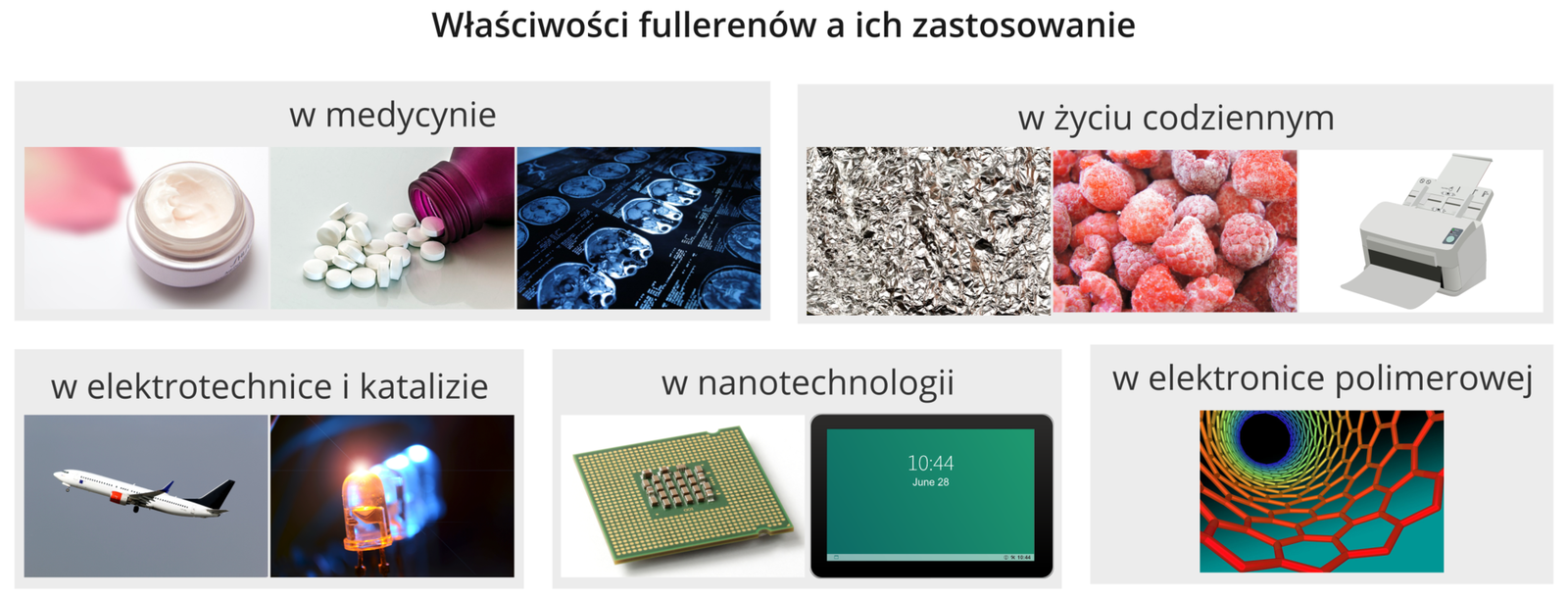
1. Fullerene properties and its application
2. medicine
3. everyday life
4. electronics and catalysis
5. nanotechnology
6. polymer electronics
Graphene – the way to miniaturization
An unusual variant of carbon is also graphene, a layer of graphite with a thickness of one atom. Because the graphene layer is extremely thin, it is applied to other materials, which gives them unusual properties. Graphene was obtained in 2004 by Andre Geim and Kostya Novoselov. It is an extremely promising substance. It turned out that the newly discovered form of carbon is the hardest (harder than the diamond) and also the most stretchable known material. It's a great heat conductor – ten times better than silver. As graphite, it is also a very good conductor of electric current, but if it is bonded with hydrogen atoms, it creates a new material, called a graphane, which is a great insulator. Compared with steel, the new material has five to six times lower density, is twice as hard, 13 times more flexible and 100 times more resistant to stretching. Its atomic bonds are so tight that it does not even pass bacteria. Graphene is like a modern philosopher's stone – it also fuels hopes and imaginations, only that we can produce it. Its story is connected with our country, because it is to Polish scientists that we owe the development of industrial technology to receive this extraordinary substance. It is currently the most expensive material, but due to its excellent properties it will certainly replace silicon in the future.
Sulphur allotropy
Sulphur forms the most allotropes among the elements – over 30, the most important of which is rhombic sulphur () and monoclinic sulphur (). Both varieties are made of eight‑atom rings () differing in the way atoms are arranged in crystals. Rhombic sulphur is stable up to a temperature of 95.6°C. At this temperature, it transforms into monoclinic sulphur. At a temperature of 119.6°C, the monoclinic sulphur melts and becomes a mobile bright yellow liquid -- . When the temperature rises, the sulphur turns brown and thickens – is formed. Raising the temperature to above 200°C causes the sulphur viscosity to drop, the liquid becomes smooth again without changing the colour. At 445°C, the sulphur boils, giving orange steams made of particles, which during further heating dissociate into smaller and smaller particles (successively into and ). The slow cooling of sulphur causes the reverse order of transformation until the rhombic sulphur is obtained. In contrast, rapid cooling of molten sulphur leads to so‑called plastic sulphur, which has the form of a brown mass. Quickly cooled sulphur vapours condense in the form of a fine yellow powder, called a flower of sulphur.
Allotropy of phosphorus and other elements
Phosphorus was discovered in 1669 by the German alchemist Hennig Brandt, who, when searching for a philosopher's stone, roasted concentrated urine with sand without air. During one of these attempts, Brandt received a substance that aroused great interest, mainly because it shone in the dark. In this way, white phosphorus was discovered. Today we know that phosphorus also creates varieties: red, violet and black. These varieties differ not only in some physical properties but also in chemical activity. The white variety is the most active and the chemically passive one is black.
Less well‑known elements occurring in the form of allotropes are: arsenic, antimony, tin, manganese, selenium, uranium, iron.
Solve the crossword and explain the resulting clue.
- The hardest substance of known natural substances.
- In the molecule of this variety, carbon atoms form pentagonal and hexagonal rings.
- The element that forms the most allotropic types, over 30.
- These are obtained from graphene and are used in bioengineering and medicine.
- The most active allotropic phosphorus type.
- It has four varieties: white, red, violet and black.
- Graphene is a layer of graphite with a thickness of ... atom.
- In the internal structure of this type of carbon, each plane resembles a honeycomb.
- The type of structure that diamond has...
| 1 | ||||||||||||||||
| 2 | ||||||||||||||||
| 3 | ||||||||||||||||
| 4 | ||||||||||||||||
| 5 | ||||||||||||||||
| 6 | ||||||||||||||||
| 7 | ||||||||||||||||
| 8 | ||||||||||||||||
| 9 |
Summary
The occurrence of the element in types differing in properties is allotropy.
Graphite, diamond, fullerene and graphene are allotropic types of carbon.
Graphite has a layered structure. It is soft, conducts electricity and heat well. It is also resistant to high temperatures and its chemical activity is small.
In the crystalline structure of a diamond, each carbon atom is connected by bonds of the same length to four other atoms of this element. The diamond is very hard, it does not conduct electricity, but it conducts heat well. After polishing it gives multi‑coloured light effects. Its chemical activity is small.
Fullerene is a molecular type of carbon. These exhibit superconducting and semiconductor properties as well as greater chemical activity in comparison to graphite.
Graphene is a layer of graphite with a thickness of one atom. It is a very durable and flexible material, preferably conducting an electric current, and after the connection of hydrogen atoms becomes an insulator.
Allotropic carbon types find many important applications, including in electronics, medicine, industry.
The official discovery of carbon nanotubes is attributed to the Japanese - Sumio Iijima, who in 1991 announced their existence. Explain what these structures are and what they have already been used for. What are nanobulbs?
Keywords
Allotropy, graphite, diamond, fullerenes, allotropes, graphene
Match the pairs: English words with Polish definition.
odmiany tego samego pierwiastka, różniące się sposobem rozmieszczenia atomów w przestrzeni lub liczbą atomów w cząsteczce, w związku z czym różnią się właściwościami, minerał, odmiana alotropowa węgla będąca najtwardszą znaną substancją występującą w przyrodzie, minerał, odmiana alotropowa węgla, zjawisko występowania tego samego pierwiastka chemicznego w kilku odmianach, które różnią się między sobą strukturą krystaliczną lub liczbą atomów w cząsteczce, co powoduje ich odmienne właściwości, forma alotropowego węgla o płaskiej strukturze grubości jednego atomu, cząsteczki węgla składające się z parzystej liczby atomów tworzące zamkniętą, pustą w środku bryłę
| allotropy | |
| graphite | |
| diamond | |
| fullerenes | |
| graphene | |
| allotropes |
Glossary
alotropia – zjawisko występowania tego samego pierwiastka chemicznego w kilku odmianach, które różnią się między sobą strukturą krystaliczną lub liczbą atomów w cząsteczce, co powoduje ich odmienne właściwości
grafit – minerał, odmiana alotropowa węgla
diament – minerał, odmiana alotropowa węgla będąca najtwardszą znaną substancją występującą w przyrodzie
fullereny – cząsteczki węgla składające się z parzystej liczby atomów tworzące zamkniętą, pustą w środku bryłę
grafen – forma alotropowego węgla o płaskiej strukturze grubości jednego atomu
odmiany alotropowe – odmiany tego samego pierwiastka, różniące się sposobem rozmieszczenia atomów w przestrzeni lub liczbą atomów w cząsteczce, w związku z czym różnią się właściwościami