a) What physical phenomena indicate the molecular structure of the liquid? b) What is the measure of all interactions? c) What type: near or long‑range interactions are intermolecular interactionsintermolecular interactionsintermolecular interactions? d) In which state of matter the intermolecular interactions will be the largest, and in which the smallest?
a) Brownian motion proves the molecular structure of the liquid. The existence of free surface of liquid indicates the existence of internal forces attracting liquid moleculesliquid moleculesliquid molecules to each other. The incompressibility of the liquid indicates the repulsion of the liquid molecules during the compression of the liquid and the appearance of attractive forces when attempting to expand the liquid.
b) The measure of all interactions is force.
c) Intermolecular interactions are classified as short‑range forces.
d) Intermolecular interactions will be greatest in solids and the smallest in gases.
Cohesive forces - forces of mutual attraction of molecules of the same substance, e.g. water or plexiglas.
Exercise 2
R1bYTTzAooivr1
Pokaz multimedialny - Siły spójności w cieczach. Instrukcja obsługi z poziomu klawiatury: 1. Uruchomienie aplikacji - ENTER, 2. Na każdym ze slajdów czytany jest automatycznie tekst alternatywny po polsku, 3. Przy pierwszym uruchomieniu na pierwszym slajdzie, czytanie tekstu po angielsku - TAB, 4. Przejście między slajdami: do następnego slajdu - TAB, do poprzedniego slajdu - TAB + SHIFT, 5. Przejście do czytania napisu po angielsku - strzałka w górę + strzałka w dół (czyta tekst po angielsku widoczny na slajdzie).
Pokaz multimedialny - Siły spójności w cieczach. Instrukcja obsługi z poziomu klawiatury: 1. Uruchomienie aplikacji - ENTER, 2. Na każdym ze slajdów czytany jest automatycznie tekst alternatywny po polsku, 3. Przy pierwszym uruchomieniu na pierwszym slajdzie, czytanie tekstu po angielsku - TAB, 4. Przejście między slajdami: do następnego slajdu - TAB, do poprzedniego slajdu - TAB + SHIFT, 5. Przejście do czytania napisu po angielsku - strzałka w górę + strzałka w dół (czyta tekst po angielsku widoczny na slajdzie).
a) Cohesive forces have combined four streams of water into one because the lateral surface of one resultant stream of water is smaller than the lateral surfaces of four separate streams of water.
b) Cohesive forces occur between molecules of the same substance.
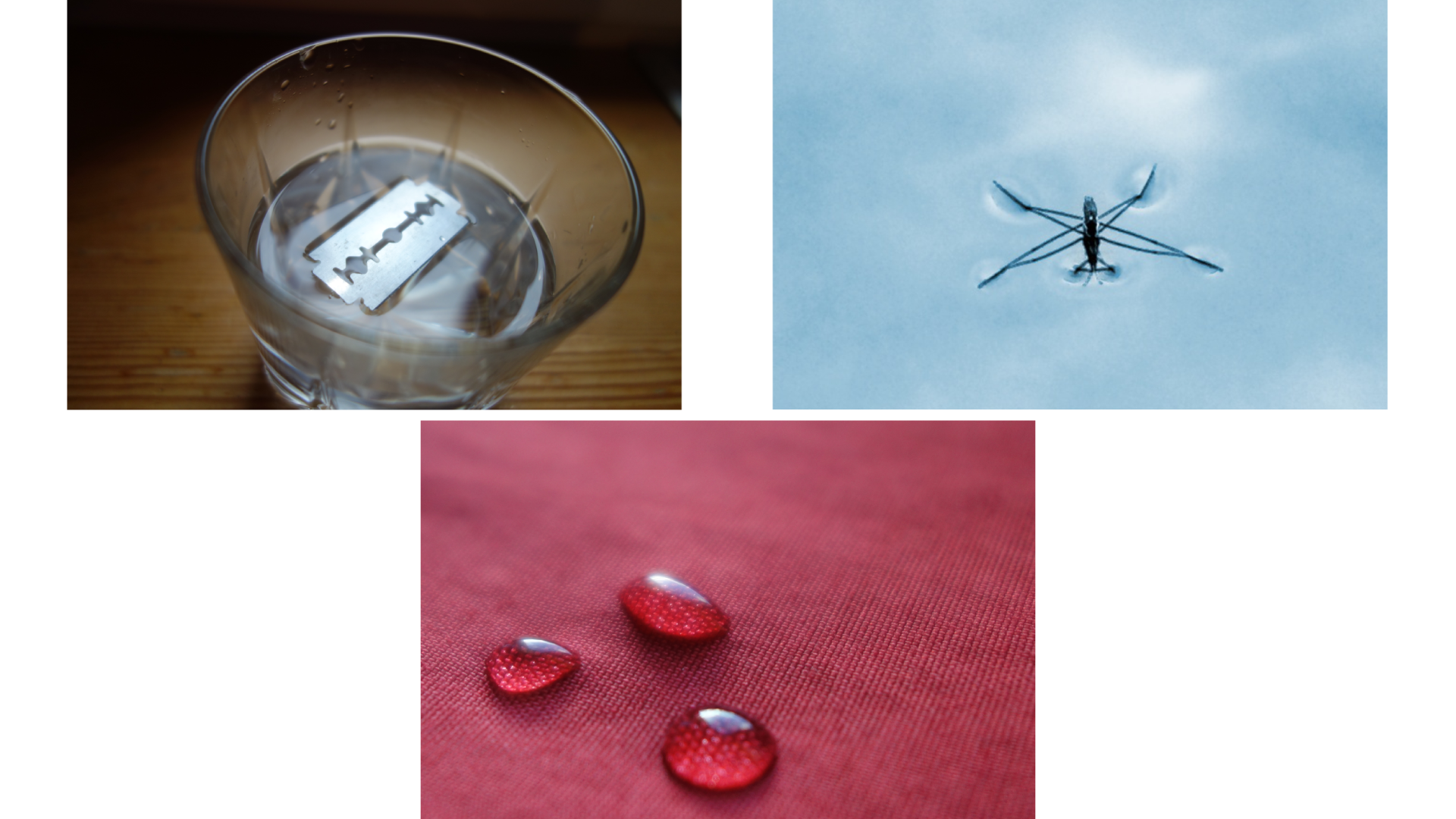
Watch the pictures below and think about the cause of the phenomena presented.
RvslAr5tKttwA
Rysunek przedstawia trzy zdjęcia obrazujące zjawisko fizyczne określane jako napięcie powierzchniowe. Zdjęcie szklanki z wodą, na powierzchni której pływa żyletka. Zdjęcie nartnika (owad z czterema długimi odnóżami) znajdującego się na powierzchni wody. Zdjęcie trzech kropel wody na powierzchni materiału, w który nie wsiąkają cząsteczki wody.
Floating razor blade, a strider walking on the water surface, drops on a hydrophobic surface (surface to which water molecules do not stick)
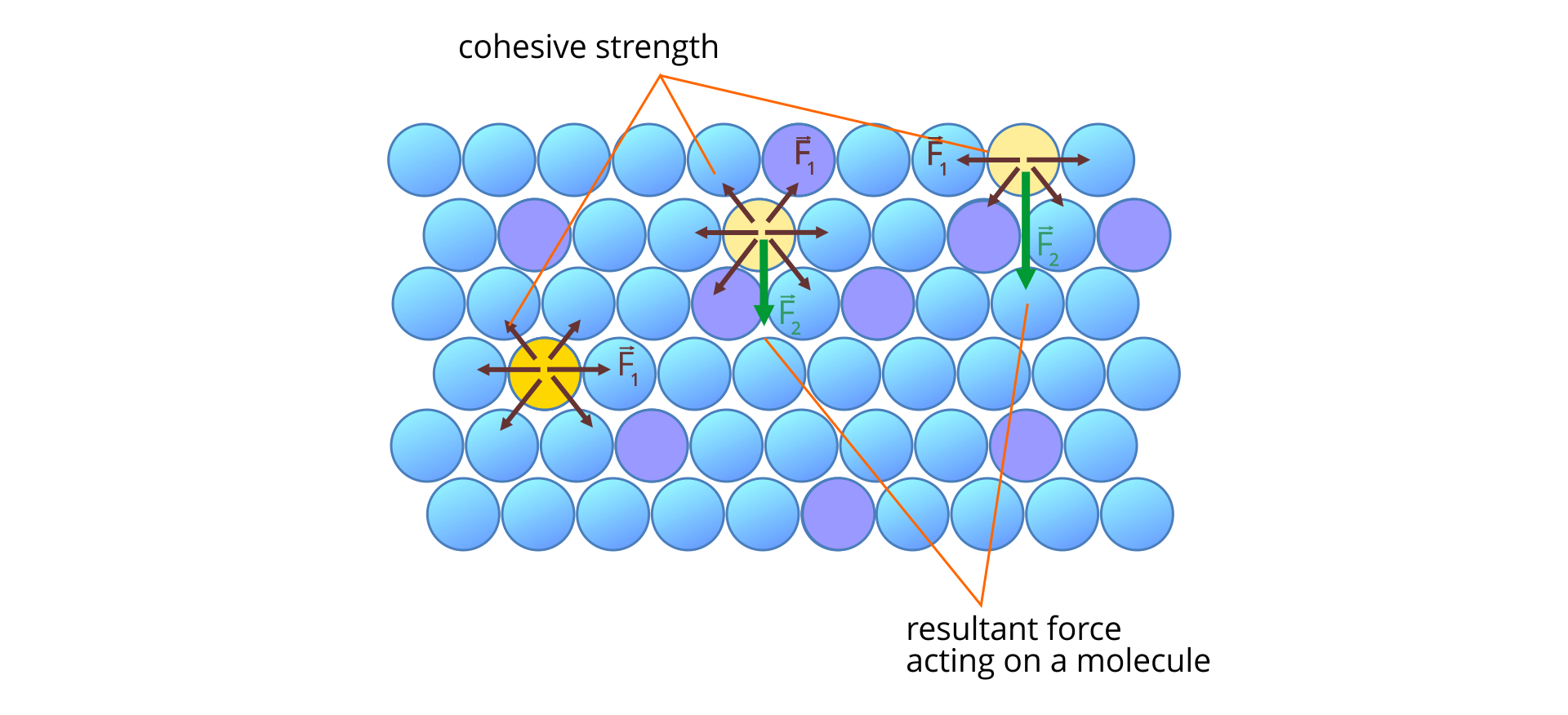
See illustration “Diagram of interactions occurring on the surface of the liquid”. Suggest an explanation of the observed phenomenon.
R1dioybVVwInP
Rysunek przedstawia schemat oddziaływań zachodzących na powierzchni cieczy i w jej wnętrzu. ciesz narysowana jest jako kółka równomiernie ułożone. Trzy kółka są wyróżnione, z nich narysowane są strzałki. Brązowe strzałki opisane F z indeksem dolnym 1 to oddziaływania tylko z najbliższymi sąsiadami - podpisane cohesive strength, zielone strzałki opisane F z indeksem dolnym 2 to wypadkowa sił działających na wyróżnioną cząsteczkę ze strony najbliższych sąsiadów i bliskich sąsiadów (czyli wypadkowa sił spójności) - podpisane resultant force acting on a molecule. Z wyróżnionego kółka znajdującego się po lewej mniej więcej w środku wysokości cieczy narysowane są strzałki brązowe skierowane we wszystkich kierunkach. Z wyróżnionego kółka znajdującego się na środku pod powierzchnią cieczy narysowane są strzałki brązowe skierowane we wszystkich kierunkach i trochę dłuższa strzałka zielona skierowana pionowo w dół. Z wyróżnionego kółka znajdującego się po prawej na powierzchni cieczy narysowane są strzałki brązowe skierowane poziomo i w dół oraz znacznie dłuższa strzałka zielona skierowana pionowo w dół. Na każdą literą F strzałka pozioma skierowana w prawo.
Diagram of interactions occurring on the surface of the liquid and inside it. Brown arrows are interactions only with the closest neighbours, green arrows are the resultant forces acting on the given molecule from the nearest neighbours and close neighbours (i.e. a resultant of cohesive forces).
The effect that the neighbouring particles exert on the molecule inside the volumevolumevolume of the liquid is small, because the cohesive forces coming from its surroundings almost completely balancebalancebalance. It is completely different when the molecule is on the surface of the liquid. Then the cohesive forces originating from the molecules inside the liquid act on the molecule. The attractive forces from the liquid moleculesliquid moleculesliquid molecules make the resultant force acting on this molecule direct to the interior of the liquid, perpendicular to its surface. A thin layer of liquid with this property is called a surface filmsurface filmsurface film.
a) Separation of dry plates does not require additional effort. b) Separation of plates moistened with water is difficult and requires additional force.
Conclusion
There are intermolecular forces between liquid and solid molecules.
Familiarize yourself with illustration “Different types of meniscus”meniscusmeniscus”.
RHTuUBZkeqNFP
Rysunek przedstawia trzy probówki (prostokąt z zaokrąglonymi rogami ucięty od góry) obok siebie. Mniej więcej w połowie ich wysokości narysowana linia przerywana pozioma, symbolizująca poziom cieczy, do niej probówki są pokolorowane. Probówka A przedstawia menisk wklęsły - nad linią przerywaną cieczy jest więcej przy ściankach naczynia. Probówka B przedstawia menisk wypukły - pod linią przerywaną cieczy jest mniej przy ściankach naczynia. Probówka C przedstawia brak menisku - ciecz kończy się na linii przerywanej.
Concave meniscus (A), convex meniscus (B) lack of meniscus (C)
Source: GroMar, licencja: CC BY 3.0.
RSAH39uPlVBRZ
Ilustracja interaktywna schematycznie przedstawia mechanizm powstawania menisku na powierzchni cieczy w znajdującej się w naczyniu. Narysowane są trzy probówki (prostokąt z zaokrąglonymi rogami ucięty od góry). Mniej więcej w połowie ich wysokości narysowana linia przerywana pozioma, symbolizująca poziom cieczy, do niej probówki są pokolorowane. Probówka A przedstawia menisk wklęsły - nad linią przerywaną cieczy jest więcej przy ściankach naczynia. Obok zbliżenie miejsca, w którym ciecz styka się ze ścianką naczynia. Narysowana jest linia ukośna skierowana w dół w prawo styczna do powierzchni cieczy w miejscu zagięcia. Narysowane są strzałki, symbolizujące siły działające na ciecz w tym miejscu, wychodzące z jednego miejsca powyżej linii przerywanej: strzałka zielona skierowana poziomo w lewo, strzałka fioletowa skierowana w dół w lewo, strzałka czarna skierowana w dół w prawo. Strzałka zielona i czarna tworzą dwa boki równoległoboku, strzałka fioletowa przekątną równoległoboku. Probówka B przedstawia menisk wypukły - pod linią przerywaną cieczy jest mniej przy ściankach naczynia. Obok zbliżenie miejsca, w którym ciecz styka się ze ścianką naczynia. Narysowana jest linia ukośna skierowana w dół w lewo styczna do powierzchni cieczy w miejscu zagięcia. Narysowane są strzałki, symbolizujące siły działające na ciecz w tym miejscu, wychodzące z jednego miejsca poniżej linii przerywanej: strzałka zielona skierowana poziomo w lewo, strzałka fioletowa skierowana w dół w prawo, strzałka czarna skierowana w dół w prawo. Strzałka zielona i czarna tworzą dwa boki równoległoboku, strzałka fioletowa przekątną równoległoboku. Probówka C przedstawia brak menisku - ciecz kończy się na linii przerywanej. Obok zbliżenie miejsca, w którym ciecz styka się ze ścianką naczynia. Narysowana jest linia pozioma styczna do powierzchni cieczy. Narysowane są strzałki, symbolizujące siły działające na ciecz w tym miejscu, wychodzące z jednego miejsca poniżej linii przerywanej: strzałka zielona skierowana poziomo w lewo, strzałka fioletowa skierowana pionowo w dół, strzałka czarna skierowana w dół w prawo. Strzałka zielona i czarna tworzą dwa boki równoległoboku, strzałka fioletowa przekątną równoległoboku. Po prawej stronie ilustracji opis: strzałka zielona opisana F z indeksem dolnym a oznaczona numerem 1, strzałka czarna opisana F z indeksem dolnym c oznaczona numerem 2, strzałka fioletowa opisana F z indeksem dolnym w oznaczona numerem 3. Na ilustracji widoczne są numery, a na nich podpisy. 1. adhesive force {audio}, 2. cohesive force {audio}, 3. resultant force (perpendicular to the surface of the liquid) {audio}.
Ilustracja interaktywna schematycznie przedstawia mechanizm powstawania menisku na powierzchni cieczy w znajdującej się w naczyniu. Narysowane są trzy probówki (prostokąt z zaokrąglonymi rogami ucięty od góry). Mniej więcej w połowie ich wysokości narysowana linia przerywana pozioma, symbolizująca poziom cieczy, do niej probówki są pokolorowane. Probówka A przedstawia menisk wklęsły - nad linią przerywaną cieczy jest więcej przy ściankach naczynia. Obok zbliżenie miejsca, w którym ciecz styka się ze ścianką naczynia. Narysowana jest linia ukośna skierowana w dół w prawo styczna do powierzchni cieczy w miejscu zagięcia. Narysowane są strzałki, symbolizujące siły działające na ciecz w tym miejscu, wychodzące z jednego miejsca powyżej linii przerywanej: strzałka zielona skierowana poziomo w lewo, strzałka fioletowa skierowana w dół w lewo, strzałka czarna skierowana w dół w prawo. Strzałka zielona i czarna tworzą dwa boki równoległoboku, strzałka fioletowa przekątną równoległoboku. Probówka B przedstawia menisk wypukły - pod linią przerywaną cieczy jest mniej przy ściankach naczynia. Obok zbliżenie miejsca, w którym ciecz styka się ze ścianką naczynia. Narysowana jest linia ukośna skierowana w dół w lewo styczna do powierzchni cieczy w miejscu zagięcia. Narysowane są strzałki, symbolizujące siły działające na ciecz w tym miejscu, wychodzące z jednego miejsca poniżej linii przerywanej: strzałka zielona skierowana poziomo w lewo, strzałka fioletowa skierowana w dół w prawo, strzałka czarna skierowana w dół w prawo. Strzałka zielona i czarna tworzą dwa boki równoległoboku, strzałka fioletowa przekątną równoległoboku. Probówka C przedstawia brak menisku - ciecz kończy się na linii przerywanej. Obok zbliżenie miejsca, w którym ciecz styka się ze ścianką naczynia. Narysowana jest linia pozioma styczna do powierzchni cieczy. Narysowane są strzałki, symbolizujące siły działające na ciecz w tym miejscu, wychodzące z jednego miejsca poniżej linii przerywanej: strzałka zielona skierowana poziomo w lewo, strzałka fioletowa skierowana pionowo w dół, strzałka czarna skierowana w dół w prawo. Strzałka zielona i czarna tworzą dwa boki równoległoboku, strzałka fioletowa przekątną równoległoboku. Po prawej stronie ilustracji opis: strzałka zielona opisana F z indeksem dolnym a oznaczona numerem 1, strzałka czarna opisana F z indeksem dolnym c oznaczona numerem 2, strzałka fioletowa opisana F z indeksem dolnym w oznaczona numerem 3. Na ilustracji widoczne są numery, a na nich podpisy. 1. adhesive force {audio}, 2. cohesive force {audio}, 3. resultant force (perpendicular to the surface of the liquid) {audio}.
Mechanism of the formation of the concave meniscus
a) When the cohesive forces of the liquid moleculesliquid moleculesliquid molecules are greater than the adhesive forces between the liquid molecules and the vessel molecules, a convex meniscus is formed. b) When the cohesive forces of the liquid molecules are greater than the adhesive forces between the liquid molecules and the vessel molecules, a concave meniscus is formed. c) When the cohesive forces of the liquid molecules are equal to the adhesive forces between the liquid molecules and the vessel molecules, there is no meniscusmeniscusmeniscus.
Interactions occurring between molecules of the same substance are cohesive forces.
Intermolecular interactionsintermolecular interactionsIntermolecular interactions occurring between molecules of different substances are adhesive forces.
The mutual relations between adhesive and cohesive forces lead to the formation of a meniscus. When the cohesive forces between the liquid moleculesliquid moleculesliquid molecules outweigh the adhesive forces, a convex meniscus is formed. When the adhesive forces are greater than the cohesive forces, a concave meniscusmeniscusmeniscus is formed.
The surface of the liquid tends to occupy the smallest possible area. This is manifested in a situation where this area will increase (e.g., the surface will bend). Then, surface tensionsurface tensionsurface tension forces occur, striving to reduce the surface area (e.g. by restoring its flat shape).
Exercises
RcJiu7pP7H6tf
Exercise 4
Wersja alternatywna ćwiczenia: Each phenomenon is assigned to intermolecular interactions that accompany this phenomenon. Determine which sentences are true. Możliwe odpowiedzi: 1. Washing up with soap and water is accompanied by a small surface tension of the washing solution., 2. The duck feathers are covered with fat and do not absorb water, this is accompanied by the formation of a convex meniscus at the border of water and feathers., 3. The strider walks on the surface of the water because the water cohesive forces are small., 4. Mercury in the thermometer creates a convex meniscus because the cohesive forces are greater in it than the adhesive forces between mercury and glass.
Wersja alternatywna ćwiczenia: Each phenomenon is assigned to intermolecular interactions that accompany this phenomenon. Determine which sentences are true. Możliwe odpowiedzi: 1. Washing up with soap and water is accompanied by a small surface tension of the washing solution., 2. The duck feathers are covered with fat and do not absorb water, this is accompanied by the formation of a convex meniscus at the border of water and feathers., 3. The strider walks on the surface of the water because the water cohesive forces are small., 4. Mercury in the thermometer creates a convex meniscus because the cohesive forces are greater in it than the adhesive forces between mercury and glass.
Each phenomenon is assigned to intermolecular interactions that accompany this phenomenon. Determine which sentences are true.
Washing up with soap and water is accompanied by a small surface tension of the washing solution.
The duck feathers are covered with fat and do not absorb water, this is accompanied by the formation of a convex meniscus at the border of water and feathers.
The strider walks on the surface of the water because the water cohesive forces are small.
Mercury in the thermometer creates a convex meniscus because the cohesive forces are greater in it than the adhesive forces between mercury and glass.
zadanie
Source: GroMar, licencja: CC BY 3.0.
Exercise 5
Provide a way how you can change the surface tension of water.
The surface tension of water can be lowered by adding a few drops of washing‑up liquid to the water. In the past, oil was poured on the water surface to calm the waves. As a result, a thin layer of oil formed on the surface of water, increasing the surface tension, which reduced waves on the sea surface.
Exercise 6
Write in English why a 2‑penny coin placed on water does not sink?
If the coin presses on the liquid surface, then this surface will be deflected (cohesive forces will not allow the molecules to move away). The deflected surface film will, however, have a tendency to reduce its surface and surface tension forces will appear, trying to straighten it. The result will be an resultant force acting upwards, which will not let the coin sink.
R14Dh3zZH0Wd4
Exercise 7
Wersja alternatywna ćwiczenia: Indicate which pairs of expressions or words are translated correctly. Możliwe odpowiedzi: 1. menisk - meniscus, 2. błona powierzchniowa - surface film, 3. równowaga - balance, 4. prostopadle - perpendicularly, 5. siła przylegania - cohesive force, 6. siła spójności - adhesive force
Wersja alternatywna ćwiczenia: Indicate which pairs of expressions or words are translated correctly. Możliwe odpowiedzi: 1. menisk - meniscus, 2. błona powierzchniowa - surface film, 3. równowaga - balance, 4. prostopadle - perpendicularly, 5. siła przylegania - cohesive force, 6. siła spójności - adhesive force
Indicate which pairs of expressions or words are translated correctly.
menisk - meniscus
błona powierzchniowa - surface film
równowaga - balance
prostopadle - perpendicularly
siła przylegania - cohesive force
siła spójności - adhesive force
zadanie
Source: GroMar, licencja: CC BY 3.0.
RPgbPfmSbzEsI1
Interaktywna gra, polegająca na łączeniu wyrazów w pary w ciągu jednej minuty. Czas zaczyna upływać wraz z rozpoczęciem gry. Jeden ruch to odkrywanie najpierw jednej potem drugiej karty z wyrazem. Każdy wyraz jest odczytywany. Kolejny ruch to odkrywanie trzeciej i czwartej karty. W ten sposób odsłuchasz wszystkie wyrazy. Nawigacja z poziomu klawiatury za pomocą strzałek, odsłuchiwanie wyrazów enterem lub spacją. Znajdź wszystkie pary wyrazów.
Interaktywna gra, polegająca na łączeniu wyrazów w pary w ciągu jednej minuty. Czas zaczyna upływać wraz z rozpoczęciem gry. Jeden ruch to odkrywanie najpierw jednej potem drugiej karty z wyrazem. Każdy wyraz jest odczytywany. Kolejny ruch to odkrywanie trzeciej i czwartej karty. W ten sposób odsłuchasz wszystkie wyrazy. Nawigacja z poziomu klawiatury za pomocą strzałek, odsłuchiwanie wyrazów enterem lub spacją. Znajdź wszystkie pary wyrazów.
Match Polish terms with their English equivalents.
cohesive force
intermolecular interactions
meniscus
surface tension
adhesive force
siła przylegania
siła spójności
menisk
napięcie powierzchniowe
oddziaływania międzycząsteczkowe
Source: Zespół autorski Politechniki Łódzkiej, licencja: CC BY 3.0.