Romantic individualism
to define empiricism and rationalism
to define the terms: rebellionrebellion, madnessmadness, individualismindividualism
to compare and contrast between a romantic and enlightenment hero
to list the features of a romantic heroromantic hero
to characterise two attitudes: WertherismWertherism and ByronismByronism
Romantic individualism was a kind of a rebellion which arose in opposition to the tradition roles assigned to an individual in a society where human nature was associated with what is general, social, mass, publicly available, and common. A man's essence began to be seen in his own being.
Try to remember what was important to the enlightenment rationalism. Check the correct answers.
- internal peace, control over affections, infallibility towards matters that a man has no impact on
- belief in the power and cognitive possibilities of the human reason
- necessity to follow reason in life, both in finding theoretical and practical solutions
- constant self-awareness and perceiving oneself as a part of the universe
What are the grounds of enlightenment empiricism? Check the correct answers.
- true cognition is always based on experience that precedes it
- a man is self-conscious, which allows him to consider himself as a part of the universe
- the mind is initially free from any cognitive content (tabula rasa ‘blank slate’), which is gained later in life through direct or indirect experience.
- pure cognition should come from reason
Match dictionary definitions with relevant terms.
individualism, madness, rebellion
| the feeling of independence and personal distinctiveness; behaviour different from the established patterns, sometimes disregarding social norms | |
| active opposition to the surrounding state of things, existing rules, social, religious and moral order | |
| behaviour crossing the average norms, customs; behaviour of a person disregarding danger; mental state of a person who cannot control himself |
Romanticism created a new type of a literary hero. It is a romantic hero, who stands in opposition to the enlightenment rationalist. Mark the cells in the table that contain features associated with an enlightenment hero. Use the remaining features to create the definition of a romantic hero.
| individualist □ | willing to draw on the experience of others □ |
| idealist □ | thinks rationally □ |
| thinks progressively, understands the need for change □ | a rebel with a rich spiritual life □ |
| outgrowing the average □ | does not exalt himself □ |
| in peace with the world □ | in conflict with the world □ |
| aware of his own human limitations □ | believing in the unlimited power of reason □ |
Romantic individualism
The romantic philosophy of human existence implied that a man is anchored in the universe and one with nature, underlining the irrational power of the human subconsciousness and soul. This form of individualism promoted the constant conflict between the man and the reality around him, the attitude of rebellion and opposition to the established social norms. On the other hand, it also implied creative work.
The new literary trend began to be characterised by a constant antinomy of nature and culture. Nature was associated with something authentic, pure, untouched by civilisation, primordial and naive. Culture, on the other hand, was criticised as an artificial construct, lacking authenticity, and inhibiting the development of a free individual human being.
Literature began to raise the visibility of such terms as greatness, intuition and emotions, as well as the recognition of the artist that follows such ideas. An artist – a creator – an individualist, belonging to the highest circle of initiation, would explore the secrets not only of humanity, but also nature, history and art. His genius would understand the errors in the order of the world created by God: this is why he could rebel even against God himself. The fullest expression of individualism was Adam Mickiewicz's Great Improvisation delivered by Konrad in the third part of Dziady. In European literature, the theme of a hero - an individualist rebelling against the world could be found i.a. in the works of Johann Wolfgang von Goethe, Friedrich Schiller or George Byron.
Wertherism
The name of the concept and approach to life is concerned with the epistolary novel by Johann Wolfgang von Goethe The Sorrows of Young Werther (1774). The main protagonist of the novel is a young person experiencing „Weltschmerz” – a pain of existence. His life is full of sorrow, loneliness, bitterness and, most of all, passivity. Werther is unhappily in love, and perfect love is the sense of life, but still, he cannot be together with his beloved Lotte. The situation results in the young man's rebellion against the established rules and conventions of the society. However, he is not able to deal with his existential perplexities and life situation. Werther commits suicide by shooting himself with a pistol.
After reading a passage from The Sorrows of Young Werther by Johann Wolfgang von Goethe, follow the instructions and answer the questions:
Describe the influence of Lotte on Werther.
Identify Werther's approach to music. Provide relevant quotes.
Discuss Werther's attitude to class division.
Why, in your opinion, has the title protagonist of the Sorrows of Young Werther become a hero of his times?
Discuss in groups the following topic: Is it possible, in the contemporary world, to observe phenomena similar to the „Werther's effect”?
Byronism
The name of the concept and an approach to life characterised by rebellion against the commonly established norms and conventions is concerned with the person of an English Lord George Byron (1788–1824).
Byronism in the romantic culture meant an attitude of rebellion against conventional morality, as well as a rebellion against the fatalism of human existence. It was associated with the violence of human emotions, but also with the hero's ability to experience real feelings. The features of a Byronic hero are concerned with pessimism, pride, melancholy, sublimity and conceit, internal emotional emptiness and despair, contempt for the world and desire for revenge. A Byronic hero is Giaour – the main character in George Byron's verse novel.
After reading a passage from George Gordon Byron's Giaour and Stanisław Wasylewski's Życie polske w XIX wieku, follow the instructions:
On the basis of the cited passage of Giaour, characterise the main protagonist.
Describe, what the opinion of the „populace” and „the more attentive scholar” is in regards to Giaour. Provide relevant quotes.
Match the terms below with the relevant types of romantic attitudes.
internal rebellion, revenge, melancholy, affection, crime, Weltschmerz, cynicism, violence, love of nature, active rebellion, dreaming, sublimity
| Wertherism | |
|---|---|
| Byronism |
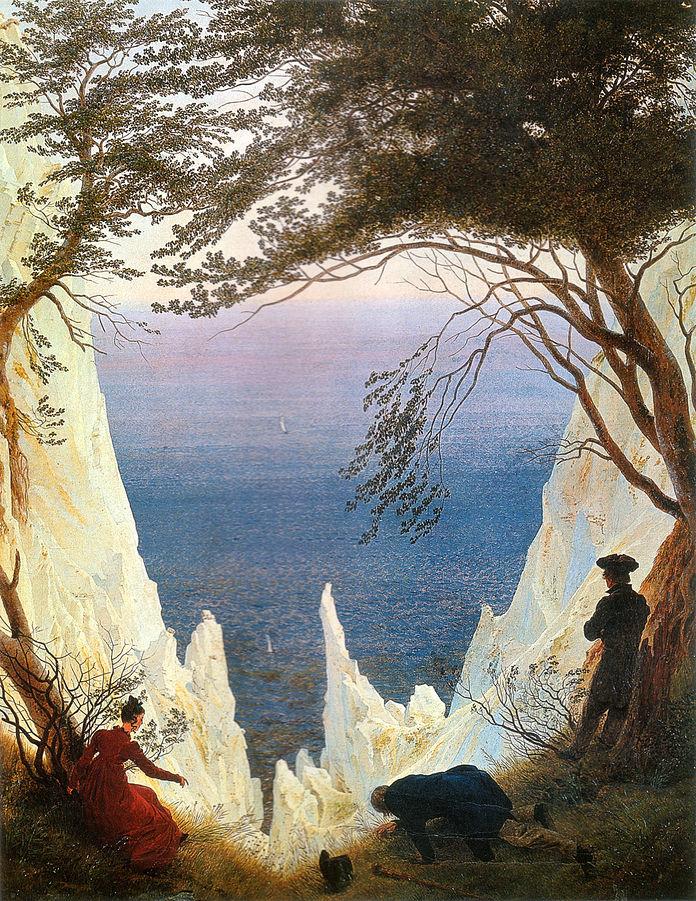
Look below at the Caspar David Friedrich's painting entitled "Chalk Cliffs on Rugen”. Create a romantic story on the basis of the painting. In order to do that, provide a line for each of the characters (e.g. in the form of a dialogue) or describe their thoughts.
Create a crossword with "romanticism" as the answer.
Keywords
romantic hero, Byronism, Wertherism, individualism, madness, rebellion, romanticismromanticism
Glossary
bohater romantyczny
bajronizm
werteryzm
indywidualizm
szaleństwo
bunt
romantyzm