to describe the properties and applications of plasmaplasmaplasma in English.
Exercise 1
Answer the following questions:
What states of matter do you know?
Give the physical properties which describe the different states.
There exist three states of matter: gas, liquid and solid.
Solids have a certain shape and volume. Liquids take the shape of the container in which they are placed but they keep their volume. Gases take the shape of the container in which they were placed and fill in the entire volume of container.
Exercise 2
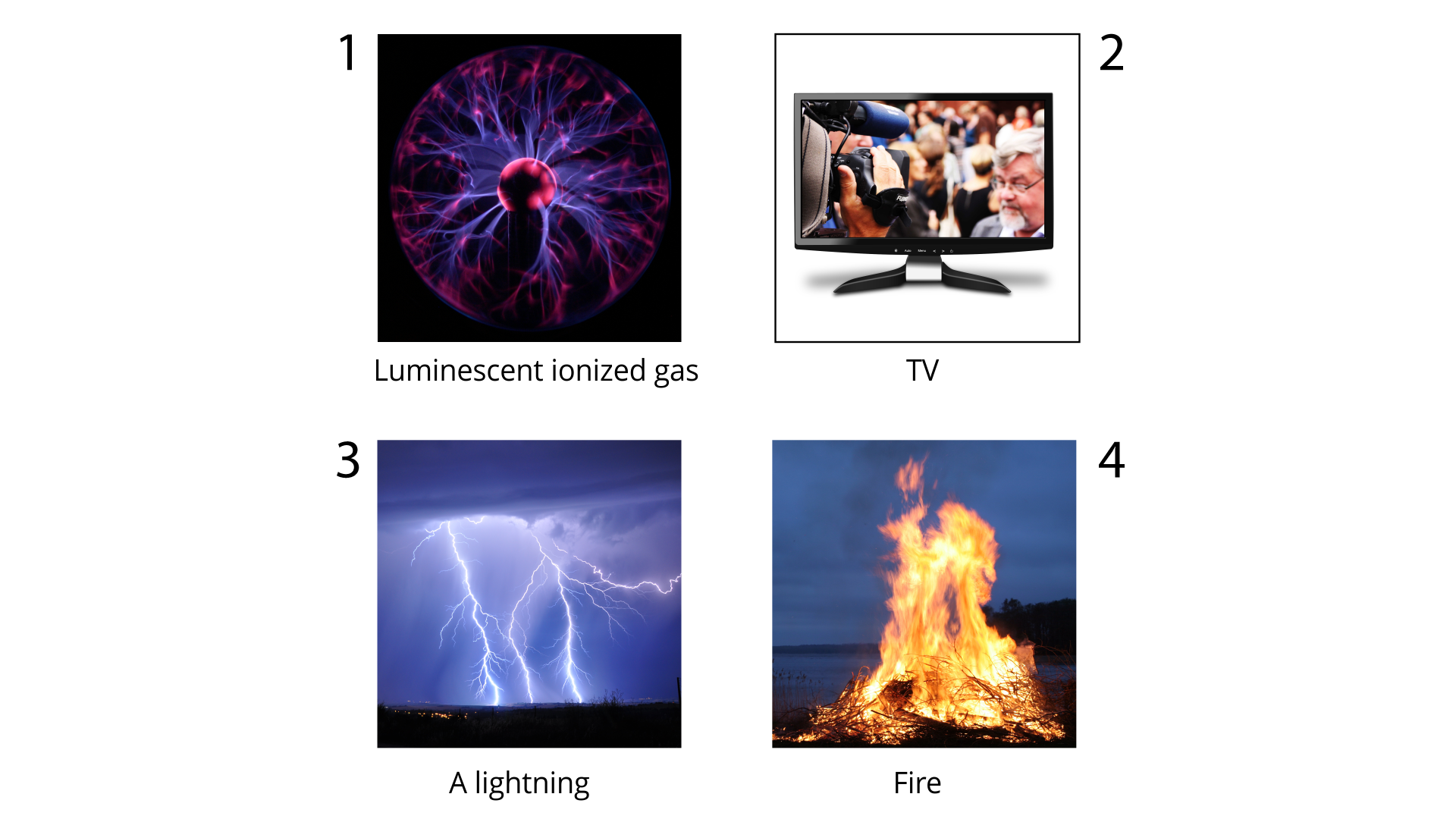
Specify the physical state of matter of the physical bodies which are shown in the following photographs.
R1auRI0oDupnw
Ilustracja przedstawia zdjęcie: 1- kuli plazmowej, na środku znajduje się kula, od której odchodzą linie przypominające rozgałęzione i sterczące we wszystkich kierunkach nitki zakończone fioletowymi płomykami - Luminescent ionized gas, 2 - telewizor - TV, 3 - błyskawicę na nocnym niebie - a lightning, 4 - ognisko na plaży - fire.
Physical bodies
In Photo 2 there is a television set that has a specific shape and volume. Therefore, the television set is an example of a solid body. On the other hand, in Photos 1, 3, 4 there are physical bodies which have an important feature: the emission of light. So far, we have not learnt about the state of matter with such a property.
The Photos 1, 3, 4 there are physical bodies which have an important feature - the emission of light.
These bodies do not have a certain shape or a certain volume; what is more, for their existence they need a constant supply of energy from outside. The luminescent ionized gas (Photo 1) and the lightning bolt (Photo 3) require the flow of an electric current through the gas. The temperature of the atmospheric gas during the atmospheric discharge reaches a few or several thousand degrees.
The glare of the fire (Photo 4) is related to the turbulent occurrence of the chemical reaction. In the case of combustion of organic bodies composed of hydrocarbons, the combustion temperature is several hundred Kelvin.
The physical luminous bodies (Photos 1, 3 and 4) are in the fourth state of matter. For its occurrence, plasmaplasmaplasma needs a continuous supply of energy in the form of heat or electricity. Because plasmaplasmaplasma naturally does not fill the entire volume of the container, it is not gas.
Conclusion
There is the fourth state of matter called plasmaplasmaplasma. Plasma consists of excited molecules, ionized molecules (ions) and electronselectronselectrons. The presence of this state of matter is often associated with the emission of visible or ultravioletultravioletultraviolet light.
Exercise 3
Watch the interactive illustration „The fourth state of matter - plasmaplasmaplasma” and answer the questions.
1. What particles is plasmaplasmaplasma consists of?
2. In what conditions is plasmaplasmaplasma created?
R1XaLHZHai9hQ
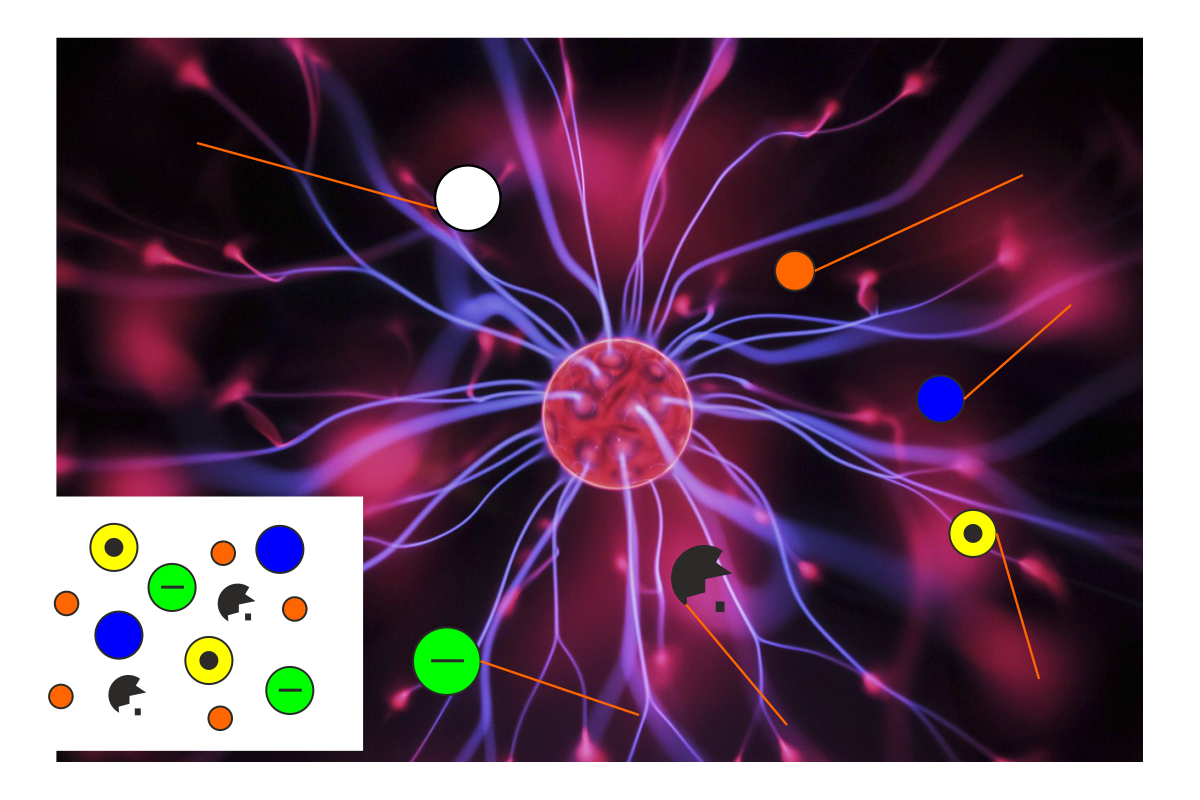
Ilustracja interaktywna przedstawia obraz kuli plazmowej. Na środku znajduje się kula, od której odchodzą linie przypominające rozgałęzione i sterczące we wszystkich kierunkach nitki zakończone fioletowymi płomykami. Na niej narysowane są schematycznie kolorowe koła symbolizujące cząsteczki wchodzące w skład plazmy. Koło białe oznaczone numerem 1, najmniejsze koło pomarańczowe oznaczone numerem 2, koło niebieskie oznaczone numerem 3, koło żółte z czarnym środkiem oznaczone numerem 4, nieregularny czarny kształt oznaczony numerem 5, największe koło zielone ze znakiem minus wewnątrz oznaczone numerem 6. Na ilustracji widoczne są numery, a na nich podpisy. 1. molecule {audio}, 2. free electron {audio}, 3. ion {audio}, 4. excited molecule {audio}, 5. high energy molecule {audio}, 6. ion {audio}.
Ilustracja interaktywna przedstawia obraz kuli plazmowej. Na środku znajduje się kula, od której odchodzą linie przypominające rozgałęzione i sterczące we wszystkich kierunkach nitki zakończone fioletowymi płomykami. Na niej narysowane są schematycznie kolorowe koła symbolizujące cząsteczki wchodzące w skład plazmy. Koło białe oznaczone numerem 1, najmniejsze koło pomarańczowe oznaczone numerem 2, koło niebieskie oznaczone numerem 3, koło żółte z czarnym środkiem oznaczone numerem 4, nieregularny czarny kształt oznaczony numerem 5, największe koło zielone ze znakiem minus wewnątrz oznaczone numerem 6. Na ilustracji widoczne są numery, a na nich podpisy. 1. molecule {audio}, 2. free electron {audio}, 3. ion {audio}, 4. excited molecule {audio}, 5. high energy molecule {audio}, 6. ion {audio}.
1
2
3
4
5
6
1. molecule {audio}
2. free electron {audio}
3. ion {audio}
4. excited molecule {audio}
5. high energy molecule {audio}
6. ion {audio}
The fourth state of matter - plasma
1. PlasmaplasmaPlasma is made of free molecules, many of which emit light. Such molecules are formed in the ionized gas. Because of this, the particles of plasmaplasmaplasma consist of excited molecules as well as ions and electronselectronselectrons.
2. PlasmaplasmaPlasma is generated in high gas temperature (over 3500 K). Near the temperature of 10000 K, every gas becomes plasma.
Although plasma is the most commonly occurring state of matter in the Universe, we rarely have an opportunity to see it - examples of phenomena in which plasma formation can be observed are lightning and northern lights. Due to its antimicrobial properties, plasma is more and more often used in many areas, primarily medicine, dentistry and food processing.
Plasma in dentistry and medicine
Research on the use of cold plasma in dentistry and medicine focus primarily on the action of plasma on the physiological state of normal and cancer cells, inhibiting the development of tumors, accelerating the treatment of difficult to heal wounds, as well as removing microorganisms from biological surfaces and medical equipment. Plasma treatment of higher organisms, including humans, depends on its dose:
small doses - can kill the protein without affecting mammalian cells,
medium doses - there is a process of accelerating wound healing, increasing cell proliferation, increasing growth factor secretion and apoptosis of the tumor cells,
high doses - are harmful and can cause cell death.
The use of plasma in dentistry is based mainly on the fight against bacteria living on the surface of the teeth in the form of difficult to fight biofilms, which cause infection of the mouth, teeth or gums.
Plasma in food processing
The use of plasma in purifying food products from microorganisms brings with it a number of advantages - compared to traditional methods of food decontamination, such as heat treatment, plasma practically does not change the structure or properties of nutritional or sensory products - the taste or smell values remain the same as in the case non‑plasma samples.
Summary
PlasmaplasmaPlasma - ionized matter in a gas‑like state of matter, in which a significant number of the particles are electrically charged. Plasma consists of excited molecules and free charged particles in the form of ions and electronselectronselectrons. PlasmaplasmaPlasma is created in conditions of high gas temperature over 3500 K or during the flow of an adequately strong electric current. Near the temperature of 10000 K, each gas becomes plasma.
Exercises
RXLwD0X6qdQZh
Exercise 4
Wersja alternatywna ćwiczenia: Determine which sentences are true. Możliwe odpowiedzi: 1. Plasma can be electrically conductive., 2. Plasma is generated by a device called plasmotron., 3. Every ionized gas is plasma., 4. The candle flame is an example of a low-temperature plasma., 5. Plasma temperature ranges from about 1000 K to over 50000 K.
Wersja alternatywna ćwiczenia: Determine which sentences are true. Możliwe odpowiedzi: 1. Plasma can be electrically conductive., 2. Plasma is generated by a device called plasmotron., 3. Every ionized gas is plasma., 4. The candle flame is an example of a low-temperature plasma., 5. Plasma temperature ranges from about 1000 K to over 50000 K.
Determine which sentences are true.
Plasma can be electrically conductive.
Plasma is generated by a device called plasmotron.
Every ionized gas is plasma.
The candle flame is an example of a low-temperature plasma.
Plasma temperature ranges from about 1000 K to over 50000 K.
Exercise 5
Describe the construction of the candlecandlecandleflameflameflame and the phenomena occurring there. What temperature does the candlecandlecandleflameflameflame reach?
Near the wick, in the outer part of the flameflameflame, there is a decomposition zone. In this zone some hydrocarbons emitted by the wick are combusted into oxide and carbon dioxide. The resulting high temperature is followed by the thermal decomposition of hydrocarbons to methane, ethane and their radicals. The inner darker part of the candlecandlecandleflameflameflame, around the wick is a soot formation zone. The luminous layer (emitting the yellow candlecandlecandle light) is called the burning zone of the precipitated soot. The temperature in this zone is approximately 900 - 1000°C. The blue part of the flameflameflame, called the gas combustion zone, reaches the temperature about 1400 °C. In this zone there occurs the complete combustion of gases formed in the decomposition zone.
Exercise 6
Write in English where plasma is used in various fields of technology and science.
1. Waste disposal - research work
2. Arc furnace for metals smelting, e.g. aluminum and refractory metals.
3. Deposition of thin layers of plasma on bearings.
4. Ceramic layers deposition on implants via vacuum sputtering in high frequency electromagnetic field.
5. The thermonuclear reactor in the new experimental thermonuclear power plant in France, called ITER (International Experimental Reactor), uses high‑temperature plasma of deuterium and tritium (hydrogen isotopes).
5. Matter in the plasma state is an extremely reactive gas in which free ions and electronselectronselectrons initiate new reactions. For example, corona discharge allows you to obtain ozone. Thermal plasma is used, for example, the production of nitrogen oxides and acetylene.
6. Surface cleaning using plasma. The contaminants are evaporated and removed by the plasma stream.
RWCJvV0TaSmwm
Exercise 7
Wersja alternatywna ćwiczenia: Indicate which pairs of expressions or words are translated correctly. Możliwe odpowiedzi: 1. plazma - plasma, 2. jon - ion, 3. elektron - electron, 4. świeca - flame, 5. płomień - candle
Wersja alternatywna ćwiczenia: Indicate which pairs of expressions or words are translated correctly. Możliwe odpowiedzi: 1. plazma - plasma, 2. jon - ion, 3. elektron - electron, 4. świeca - flame, 5. płomień - candle
Indicate which pairs of expressions or words are translated correctly.
plazma - plasma
jon - ion
elektron - electron
świeca - flame
płomień - candle
zadanie
Source: GroMar, licencja: CC BY 3.0.
Rb3T8IAIjFg1F1
Interaktywna gra, polegająca na łączeniu wyrazów w pary w ciągu jednej minuty. Czas zaczyna upływać wraz z rozpoczęciem gry. Jeden ruch to odkrywanie najpierw jednej potem drugiej karty z wyrazem. Każdy wyraz jest odczytywany. Kolejny ruch to odkrywanie trzeciej i czwartej karty. W ten sposób odsłuchasz wszystkie wyrazy. Nawigacja z poziomu klawiatury za pomocą strzałek, odsłuchiwanie wyrazów enterem lub spacją. Znajdź wszystkie pary wyrazów.
Interaktywna gra, polegająca na łączeniu wyrazów w pary w ciągu jednej minuty. Czas zaczyna upływać wraz z rozpoczęciem gry. Jeden ruch to odkrywanie najpierw jednej potem drugiej karty z wyrazem. Każdy wyraz jest odczytywany. Kolejny ruch to odkrywanie trzeciej i czwartej karty. W ten sposób odsłuchasz wszystkie wyrazy. Nawigacja z poziomu klawiatury za pomocą strzałek, odsłuchiwanie wyrazów enterem lub spacją. Znajdź wszystkie pary wyrazów.
Match Polish terms with their English equivalents.
świecenie
jon
flame
plasma
plazma
elektron
płomień
ion
electron
shining
Source: Zespół autorski Politechniki Łódzkiej, licencja: CC BY 3.0.