Social mosaic of Poland of the late Middle Ages
how the gentry was formed;
how the bourgeoisie changed;
what economic changes occurred in Europe at the turn of the 14th and 15th century;
why the manorial and serfdom economy developed in Poland;
what the gentry democracy in Poland was about.
Just like in Western Europe, Polish society at the end of the Middle Ages was divided into classes. One difference, however, was a specific society formed in the Kingdom of Poland at the end of the 15th century, having a very strong political and economic position of the gentrygentry and other social groups subordinated to it. It was formed as a result of different economic changes (manorialmanorial and serfdomserfdom economy), ethnic diversity of the inhabitants of the Kingdom of Poland and the unique position of the upper social class.
The knights and the mightymighty, who became a gentrygentry
class over time, were at the top. Their obligation to defend the country and their right to elect an heir to the throne made successive rulers grant them numerous privilegesprivileges – special powers. It made them a unique social group as the only one holding political rights. Consequently, an unprecedented state system, known as the gentry democracygentry democracy, was formed at the turn of the 15th century.
The Polish bourgeoisie was also different from that in Western Europe. No political ambitions and gentry privilegesprivileges, which were granted by successive rulers, contributed to the gradual marginalisation of its legal position. As a result, the bourgeoisie could not become the knights (and the gentrygentry later) and had no influence on the country's political life, being responsible for only local affairs regarding the current functioning of towns.
The position of the next class represented by villagers was closely related to processes taking place in the state. As a result of economic (increase in grain prices) and political changes (dependence of peasants upon their lords), the {rent} paid by peasants was replaced by serfdomserfdom, contributing to the development of the manorialmanorial and serfdomserfdom system based on work on the land of owners as a form of rent. Later, it became a characteristic element of the native economy until the fall of the Polish‑Lithuanian Commonwealth in the 18th century.
O dowiedzeniu swego szlachectwaszlachectwa. Ustanawiamy, że gdyby komuś zakwestionowano szlachectwoszlachectwo lub szlachetne urodzenie, ten ma przedstawić przed sądem dwóch starszych świadków z rodziny i pokolenia ojca oraz dwóch z rodziny i pokolenia matki, a także dwóch świadków z drugiego pokolenia [wstecz, którzy zaświadczą o jego szlachectwie - przyp. aut.].
Źródło: Teksty źródłowe do ćwiczeń z historii średniowiecza Polski, Wrocław 1975, s. 184 – uwspółcześnienie języka – P.W.).
Complete the sentence correctly. According to the law approved by King Casimir, a nobleman was one who...
- presented witnesses of this fact from the mother's and father's family from up to two generations ago.
- lived a virtuous life and had two children.
- had the support of all families in the area in this regard.
Dalej przyrzekamy, że kanclerstwo, wicekanclerstwo, marszałkostwo i inne urzędy dworskie przydzielać będziemy bez żadnej różnicy mężom odpowiednim, czy będą pochodzić z ziemi wielkopolskiej, czy krakowskiej. Dalej, ponieważ dobra i posiadłości naszego stołu królewskiego [to jest majątek króla złożony z nieruchomości – przyp. aut.] początkowo wyznaczone zostały nie tylko dla osoby naszej, lecz także dla obrony i zachowania całego królestwa, przyrzekamy, że nie będziemy zastawiać za pieniądze zamków i ziem książęcych czy głównych, w których są starostowie [...]. Dalej przyrzekamy, że odtąd od ziemian lub ich ludzi nie będziemy żądać żadnych opłat lub danin czterech lub sześciu groszy, lecz poprzestaniemy zgodnie z dawnym zwyczajem na pobieraniu opłaty dwóch groszy od każdego łanu. [...] Dalej przyrzekamy, że nie będziemy uchwalać żadnych nowych ustaw i nie będziemy nakazywać ziemianom, aby wyruszyli na wojnę bez zgody ogólnych zjazdów, które winny odbywać się w poszczególnych ziemiach.
Źródło: Teksty źródłowe do ćwiczeń z historii średniowiecza Polski, Wrocław 1975, s. 207–213.
Look at the text and select correct statements.
- The king could charge tax on landowners only in the amount of four groszes per lan.
- The king himself cannot pledge royal property.
- The king cannot request the gentry to fight in war without gentry assemblies' consent.
- The king should appoint court officials only from among the mighty of Kujawy and Pomerania.
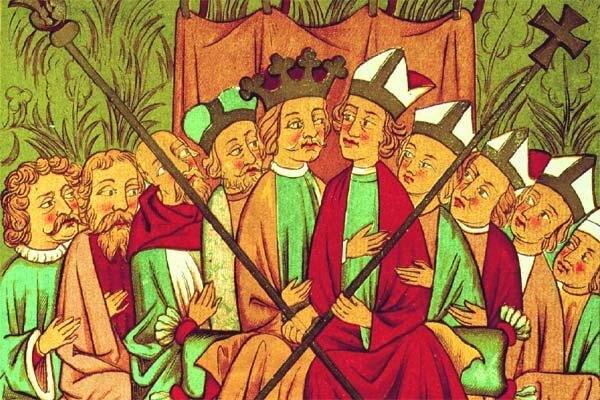
Look at the table and select all elements which help emphasise the message of the miniature mentioned above.
| Gest | It appears on the miniature | It emphasises the unity of power |
| Similar gestures of secular and clerical figures | □ | □ |
| People on the miniature wearing different headgears | □ | □ |
| Secular and clerical figures on an equal footing | □ | □ |
| Animals symbolising virtues of officials' authority | □ | □ |
| The same number of secular and clerical dignitaries | □ | □ |
| Very similar secular and clerical clothes | □ | □ |
Match the terms with their definitions.
in the period of feudalism, a fixed payment (fee) made by peasants to an owner of lands for their use., a large farm engaged in large-scale grain production for sale., a trade and social union of craftsmen of the same profession in one town., the highest representative body, in the Middle Ages, a craftsman not belonging to any guild, despite its existence., a local assembly convened in Poland from the 14th century in each voivodeship., a political system, which prevailed in Polish lands from the end of the 15th century, guaranteeing the gentry the right to vote and to decide on state matters., a feudal rent (payment made by peasants to their lords) in the form of obligatory and free work on land owned by a lord.
| Guild | |
| Bungler | |
| Manorial farm | |
| Rent | |
| Serfdom | |
| Land sejmik | |
| General sejm | |
| Gentry democracy |
Keywords
sejm, privilege, gentry, Middle Ages, Casimir the Great, gentry democracy
Glossary
Przywilej – prawa nadawane przez władcę określonej grupie społecznej (szlachcie, duchowieństwu) obowiązujące na danym terenie lub w całym kraju.
Ratusz – reprezentacyjny budynek będący siedzibą władz miejskich, mieszczący się najczęściej w centrum miasta.
Szlachta – wyższy ze stanów społecznych wykształcony w XIV‑XV w. Przynależność do niej określało urodzenie i posiadanie nazwiska rodowego. Posiadała szereg przywilejów i łączyły się z obowiązkiem służby wojskowej.
Cech – związek zawodowo‑społeczny skupiający rzemieślników wykonujących ten sam zawód w danym mieście.
Partacz – w średniowieczu rzemieślnik nie należący do cechu, mimo jego istnienia. Prowadzili oni swoje warsztaty nielegalnie, bez nadzoru cechu, sprzedając najczęściej wyroby gorszej jakości, ale po niższej cenie.
Folwark – duże gospodarstwo rolne, którego celem była masowa uprawa zboża przeznaczonego na sprzedaż. Upowszechnił się w XVI wieku. Wykorzystywano w nim pańszczyźnianą pracę chłopów. Kmieć – peasant – zamożny chłop posiadający własną chatę i pole.
Czynsz – w okresie feudalizmu stałe świadczenie (opłata) wnoszone przez chłopów na rzecz właściciela gruntów w zamian za ich użytkowanie.
Pańszczyzna – forma renty feudalnej (świadczenia chłopów na rzecz swoich panów) polegająca na obowiązkowej i bezpłatnej pracy na gruntach należących do pana (właściciela).
Sejmik ziemski – lokalne zgromadzenie zwoływane w Polsce od XIV wieku w każdym województwie. Zajmował się sprawami administracyjnymi i prawem.
Sejm walny – nazwa najwyższego organu przedstawicielskiego – parlamentu – najpierw w Królestwie Polskim, a od 1569 roku w Rzeczypospolitej Obojga Narodów, decydujące o ważnych sprawach w państwie. Składał się z dwóch izb – senatu i izby poselskiej oraz trzech stanów sejmujących króla, posłów i senatorów.
Możni, możnowładcy – członkowie zamożnego rodu, elity mający wpływ na rządy kraju. W średniowiecznym społeczeństwie była najwyższą warstwą społeczną.
Demokracja szlachecka – panujący na ziemiach polskich od końca XV w. system polityczny, gwarantujący stanowi szlacheckiemu prawo głosowania i decydowania o sprawach państwa. Był przykładem równości praw w stanie szlacheckim bez względu na pochodzenie, majątek czy zasługi szlachcica.