In 1815, in light of the arrangements of the Congress of Vienna, Cracow and a small area on the left bank of the Vistula River became a free city officially referred to as the Republic of Cracow. After the creation of the Grand Duchy of Posen, a Polish administration was established in the territory annexed by Prussia. Duke Antoni Radziwiłł was entrusted with the function of the governor. In the 1820s, the area of the Grand Duchy of Posen underwent economic reformsagrarian reformseconomic reforms. Peasants were granted freehold to the land. After the failure of the November Uprising, emigrants started preparing a national uprising that would rely on the strength of the Polish masses. The Grand Duchy of Posen was a liaison between the Polish lands and the emigrants, while Cracow became the centre of independence‑oriented undertakings. In 1846, the emissaries of the Polish Democratic Society tried to organise a national uprising. However, they were unsuccessful and riots only broke out in Cracow. In the same year, Polish peasants supported by Austrian authorities took up arms against the Galician nobility, which is known as the Galician SlaughterGalician SlaughterGalician Slaughter.
Task 1
W dostępnych Ci źródłach poszukaj informacji o pomniku Karola Marcinkowskiego. Gdzie został postawiony? Kim był Karol Marcinkowski?
W dostępnych Ci źródłach poszukaj informacji o pomniku Karola Marcinkowskiego. Gdzie został postawiony? Kim był Karol Marcinkowski?
Arrange the puzzles and find out what the inscription is on the monument ... What do you think this writing means? Compare your interpretation with the ideas of other students.
R142cABSgcMfK
Zdjęcie przedstawiające pomnik Karola Marcinkowskiego.
Zdjęcie przedstawiające pomnik Karola Marcinkowskiego.
A monument to Karol Marcinkowski
Source: Mister No, licencja: CC BY 3.0.
Task 2
Read the text and do the exercise below.
Zbigniew FrasGalicja
Why did Galician peasants trust Austrian officials?
The replacement of Polish law with Austrian law in Galicia limited the rights of the nobility and, to a certain degree, improved the situation of peasants. Due to the weakness of Galician towns, it was not the townspeople (who were not representative of any significant social force), but the emerging intelligentsia who became the counterweight to the aristocratic and landed gentry elite. The intention behind the intervention of the emperor’s officials into the relations between owners and peasants was not to improve the situation of peasants, but to increase the state treasury’s income by a more efficient collection of taxes. Peasants, who until then had been exploited and cheated by the nobility, started to regard imperial officials as their true defenders, as they always eagerly listened to their complaints. The emperor’s ordinances that reached villages through imperial officials convinced people that his majesty remembered about his peasant subjects. Moreover, peasants understood that there were more important figures in the world than village owners.
fras Source: Zbigniew Fras, Galicja, Wrocław 2002, s. 298.
R6fIxuePl0IoM
Exercise 1
Read the popular science passage above and find the reasons why the Galician peasantry believed that the Austrian emperor cared for them more than the Polish nobility. Mark the correct statements, disregard erroneous information or information that is not directly related to the matter. Możliwe odpowiedzi: 1. Imperial officials were interested in the more efficient collection of taxes., 2. The nobility’s privileges in Galicia were limited and the peasantry’s situation was somewhat improved., 3. Imperial officials wanted to improve the life of peasants., 4. Peasants were exploited and cheated by Polish townspeople., 5. The emerging intelligentsia became a counterweight to the aristocratic and landed gentry elite., 6. Peasants treated the emperor’s ordinances as proof of his care for them., 7. Peasants started regarding imperial officials as their true defenders.
Read the popular science passage above and find the reasons why the Galician peasantry believed that the Austrian emperor cared for them more than the Polish nobility. Mark the correct statements, disregard erroneous information or information that is not directly related to the matter. Możliwe odpowiedzi: 1. Imperial officials were interested in the more efficient collection of taxes., 2. The nobility’s privileges in Galicia were limited and the peasantry’s situation was somewhat improved., 3. Imperial officials wanted to improve the life of peasants., 4. Peasants were exploited and cheated by Polish townspeople., 5. The emerging intelligentsia became a counterweight to the aristocratic and landed gentry elite., 6. Peasants treated the emperor’s ordinances as proof of his care for them., 7. Peasants started regarding imperial officials as their true defenders.
Read the popular science passage above and find the reasons why the Galician peasantry believed that the Austrian emperor cared for them more than the Polish nobility. Mark the correct statements, disregard erroneous information or information that is not directly related to the matter.
Imperial officials were interested in the more efficient collection of taxes.
The nobility’s privileges in Galicia were limited and the peasantry’s situation was somewhat improved.
Imperial officials wanted to improve the life of peasants.
Peasants were exploited and cheated by Polish townspeople.
The emerging intelligentsia became a counterweight to the aristocratic and landed gentry elite.
Peasants treated the emperor’s ordinances as proof of his care for them.
Peasants started regarding imperial officials as their true defenders.
R1XzRun2ZktJK
Exercise 2
Place the events below on the timeline. 1833 Możliwe odpowiedzi: 1. the expedition of Józef Zaliwski, 2. the establishment of the Association of Polish People in Cracow, 3. the Polish Nation Union 1835 Możliwe odpowiedzi: 1. the expedition of Józef Zaliwski, 2. the establishment of the Association of Polish People in Cracow, 3. the Polish Nation Union 1839 Możliwe odpowiedzi: 1. the expedition of Józef Zaliwski, 2. the establishment of the Association of Polish People in Cracow, 3. the Polish Nation Union
Place the events below on the timeline. 1833 Możliwe odpowiedzi: 1. the expedition of Józef Zaliwski, 2. the establishment of the Association of Polish People in Cracow, 3. the Polish Nation Union 1835 Możliwe odpowiedzi: 1. the expedition of Józef Zaliwski, 2. the establishment of the Association of Polish People in Cracow, 3. the Polish Nation Union 1839 Możliwe odpowiedzi: 1. the expedition of Józef Zaliwski, 2. the establishment of the Association of Polish People in Cracow, 3. the Polish Nation Union
Place the events below on the timeline.
Połącz wydarzenia z datami
1833,
1835,
1839
the expedition of Józef Zaliwski
the establishment of the Association of Polish People in Cracow
the Polish Nation Union
Task 3
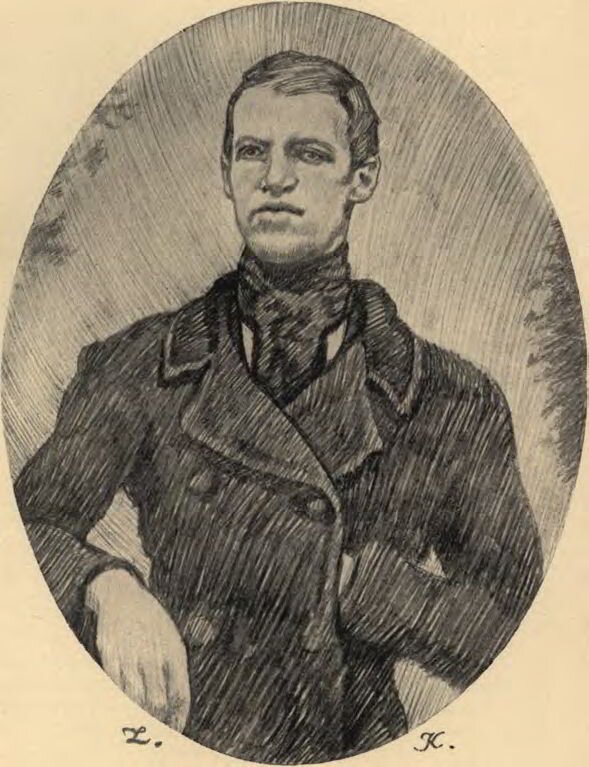
Listen to the broadcast about Edward Dembowski, the legendary emissary also known as the Red Castellan’s‑Son. What did he achieve in terms of fighting for Polish independence? What were the consequences of his lack of political experience?
Ilustracja przedstawia portret Edwarda Dembowskiego.
Edward Dembowski
Source: Bolesław Limanowski, domena publiczna.
Edward Dembowski was a person of aristocratic birth, a radical democrat, a philosopher and a peasantry enthusiast. He died unnecessarily at the age of almost 24 on 27 February 1846 in the doomed Cracow Uprising. He became a legendary figure fighting for independence and a symbol of the romantic emissary. A journalist described him as a person that was “usually quiet and silent with his eyes looking down, hidden behind glasses, wearing long, smoothly combed hair, which, when needed, he covered with a black wig; a seemingly cold man, a type of conspirator. He easily travelled from one end of the country to the other and propagated a great popular uprising. With his mysterious personality, he charmed women, radicalised the youth, and knew how to speak to the people”.
Dembowski began his public life at the age of 19, working as an editor for a magazine propagating Hegel’s philosophy, which Europe of that time found fascinating. Dembowski was also engrossed in the thought of French utopians. Soon, the initially faithful student developed his own thought, which he referred to as the philosophy of love for the people. Dembowski matured in the atmosphere of action, in the whirl of ideological discussions and conspiratorial work. He was a member of the left wing of the Union of the Polish Nation, which was active in the territory annexed by Russia, and strived to cause a quick outbreak of the uprising.
Unmasked, he arrived in Posen (Poznań), where, while remaining under the supervision of Prussian police, he wrote letters to democratic magazines in Posen. Dembowski’s role in the national liberation movement was becoming more serious. He propagated the idea of a radical popular revolution as the lever of the nation’s unification and liberation. At last, relocated from the territories annexed by Prussia, at the beginning of 1845 Dembowski commenced intensive political activities in Galicia. He devoted himself to conspiratorial work. He was a man of great imagination and skill of camouflage, which he used to travel across the western part of the territories annexed by Austria. He cleverly avoided elaborate traps that were often set by the head of the Lwów (Lviv) police.
Following the outbreak of the uprising in 1846, Dembowski arrived in Cracow as the head of a troop of miners from Wieliczka. As a secretary of dictator Jan Tyssowski, he became an éminence grise and the ideological leader of the uprising. Dembowski radicalised the social programme of the uprising and wanted to raise the peasantry’s status to make them equal members of the nation. He prepared a proclamation that promised the equality of classes, the abolition of serfdomserfdomserfdom and the granting of land to peasants. Nevertheless, contrary to the actual circumstances and moods of the peasantry, he made all effort to speed up the uprising. He was a noble, idealistic doctrinaire who lacked political experience.
Dembowski’s efforts did not stop the rampant slaughter of the nobility that was already happening in Galicia at the hands of peasants incited by the Austrians. The young revolutionist made a desperate attempt to save the hopeless situation. On 27 February 1846, he led a procession of unarmed men from Cracow to convince peasants’ troops to join him. Five hundred people walked in the procession, including 30 clergymen and 40 riflemen. They carried crosses, gonfalons and sacred paintings. At dusk, in Podgórze, close to the Podgórze cemetery, Austrian infantry opened fire. Dembowski was killed by the opening salvo. His death sealed the failure of the nine‑day‑long Cracow Uprising, which is distinguished from other Polish insurrections by its strong social radicalism.
Task 4
Read the text below and describe the actions of the partitioning authorities and peasants.
Mid‑February, 1846, — shortly before the national revolution planned by emigrates — one more uprising came unforeseen (and probably could not have been foreseen) by the emigrants, namely the armed riot of Polish peasantry against the Polish nobility, referred to as the Galician SlaughterGalician SlaughterGalician Slaughter.
What was the Galician SlaughterGalician SlaughterGalician Slaughter and how did it end? It was a peasant uprising in which landed gentry, Polish court officials, government officials and priests were murdered. The uprising was a result of skilful propaganda by Austrian officials, which easily appealed to poverty‑stricken peasants who were waiting for village owners to abolish serfdom in vain. The most famous leader of the peasant troops was Jakub Szela (1787–1866), a farmer and carpenter from the village of Smarżowa near Jasło. For many years he was a representative in the trials against the landowning Bogusz.
During the Galician SlaughterGalician SlaughterGalician Slaughter, the Polish nobility were killed with such cruelty that the uprising became known as a slaughter. Szela led his own unit, crushed several nearby manors, and killed the Bogusz family. Peasants, encouraged by Austrian officials, started to disarm the gathering insurgent troops, and under the pretext of seizing the troops, destroyed their equipment, stole their cattle, burned their manors and murdered their successors along with their families. The Austrians would pay for the heads of murdered gentry. Soon, the peasants’ rebellion took over all of central and western Galicia and claimed the lives of over 1,000 people. Peasants did not emerge victorious from this uprising either, as they did not gain the liberties promised by the Austrian administration, and serfdomserfdomserfdom was not reduced. In April 1846, Szela was deported to Bukovina, where he was given a farm. The Austrian army pacified the peasants’ uprising.
Task 5
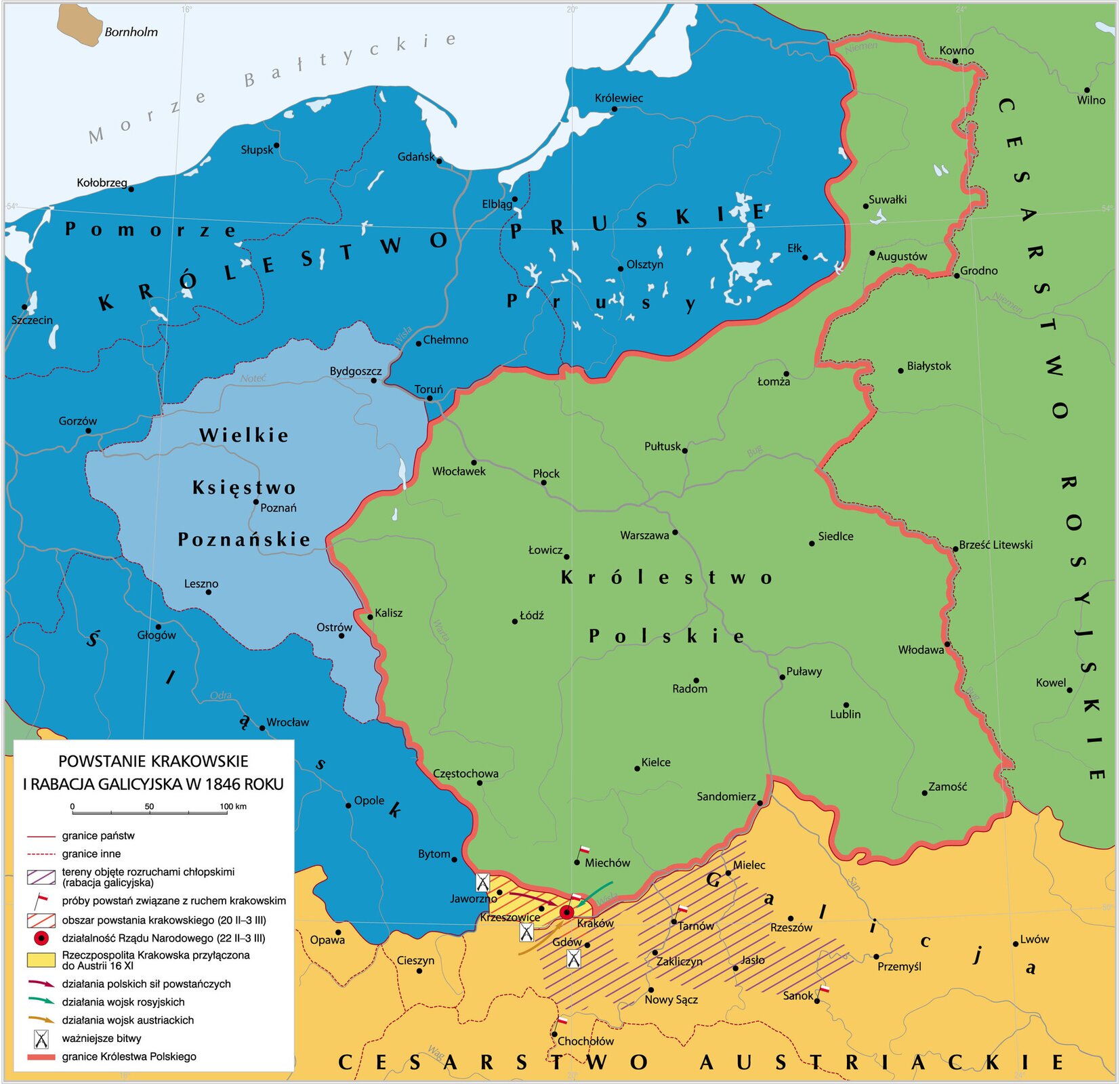
Look for information in the available resources (web, textbooks, etc.) and list the places where the largest peasant riots took place. Indicate the land that was annexed to Austria in 1846.
Look for information in the available resources (web, textbooks, etc.) and list the places where the largest peasant riots took place. Indicate the land that was annexed to Austria in 1846.
List the places where the largest peasant riots took place. Indicate the land that was annexed to Austria in 1846.
RtwH2iSlsOne3
Grafika mapy przedstawiającej Powstanie Krakowskie i Rabację Galicyjską w 1846 roku.
Uwłaszczenie – reformy przeprowadzone w XIX w. na ziemiach polskich przez rządy państw zaborczych, nadające chłopom prawo własności do całości lub części użytkowanej przez nich ziemi.
Praca organiczna – legalne działania, zmierzające do wzmocnienia sił i organizacji społeczeństwa polskiego w sytuacji braku własnego państwa w XIX wieku.