Amphibians – the semi-aquatic animals
amphibians are vertebrates;
the body structure of animals depends on their habitat.
to indicate and describe the amphibians’ adaptation to the life on land and in water (based on observation);
to describe amphibians’ respiratory mechanism;
to present frog’s life cycle;
Amphibians are semi‑aquatic vertebrates that show adaptations for life in both of these environments. They occur on all continents except Antarctica. They live on land, e.g. in the soil, on trees or in fresh water. They never occur in seas and oceans.
Amphibians are cold‑blooded animals, which means that their body temperature depends on the temperature of the environment. In our climate, when it's getting colder, amphibians go into a state of numbness. They winter in clusters in different burrows, crevices and in the sludge at the bottom of water reservoirs. They become active again in early spring.
Think whether there are amphibians which are active all year round.
The body structure of amphibians
Due to the presence or absence of a tail, amphibians are divided into the Anura – frogs and toads, and Caudata – newts. In the body structure of Anura we can distinguish the head and trunk. The tail occurs in Caudata as well as larvae of Anura and Caudata. The national representatives of this division have got two pairs of limbs equipped with fingers facilitating moving on land. If they are connected by means of interdigital webbinginterdigital webbing, they facilitate swimming. Limbs are widely spaced to the sides, which makes the trunk stay in contact with the ground and gives the movements of most amphibians characteristic slowness and clumsiness. Nevertheless, they are capable of quickly escaping in an emergency.
All amphibians have naked, scaleless, thin skin. It is highly vascularised and moist, which significantly facilitates gas exchange. The mucus layer protects the amphibians from drying on land and makes it easier to move in water, reducing friction. The toad's skin is also equipped with venom glands. Their secretion protects these animals against attacks by predators, causing, for example, irritation of the mouth and hypersalivation. The pigment cells present in the skin allow the amphibians to adopt masking or warning colouring.
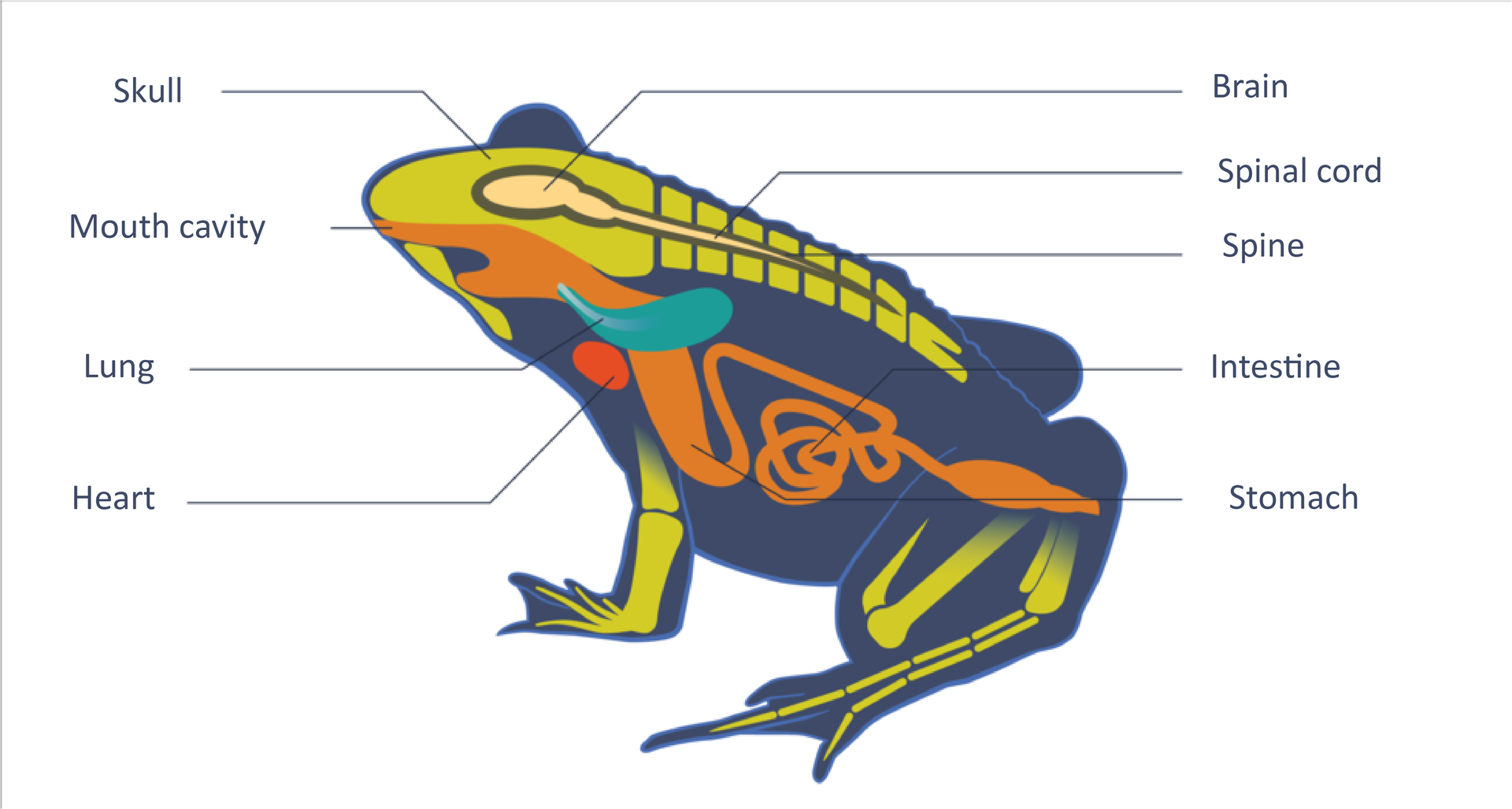
Describing the adaptations in the frogs' external body structure for life in water and on land.
African dwarf clawed frog (Hymenochirus boettgeri),
a tank with an area for swimming and being out of the water,
a net for fishing out a frog,
magnifying glass.
a high box.
Look at the frog. Observe and determine: how it moves in water and on the solid ground, the shape of its body, the location of its eyes, whether there is an interdigital webbing between its fingers.
Determine, which features facilitate life on land and which in water.
Fish the frog out of the tank, place it in the box. Carefully touch the surface of its skin. Observe its appearance through the magnifying glass. Explain the significance of the skin when the animal is on land and in water.
When describing the adaptations in the frog's body structure to the environment, we determine the shape of a given structure element, and we think how its shape (or its presence) facilitates life in water. Sometimes, to determine such a relationship, it is necessary to analyse the physical features of water and their effect on the body structure of an amphibian.
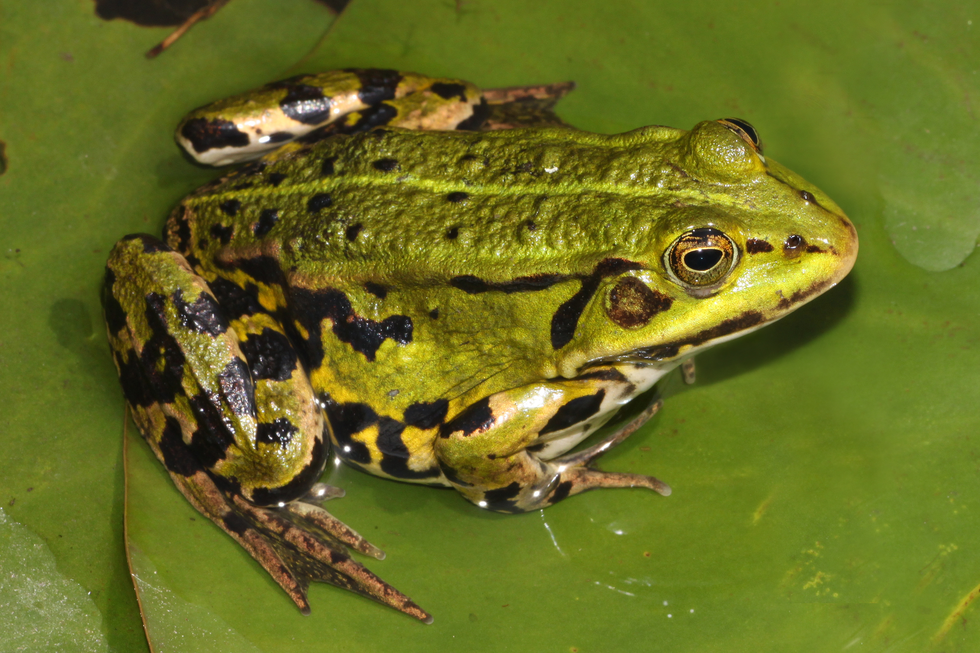
Explain how frogs overcome stationary obstacles if they see only moving objects.
Amphibian respiration
Larvae of amphibians take oxygen from water using gills. In adult individuals, the skin and lungslungs are involved in the gas exchange process. The air is pressed into the lungs by rhythmical depressing and elevating of the floor of the oral cavity.
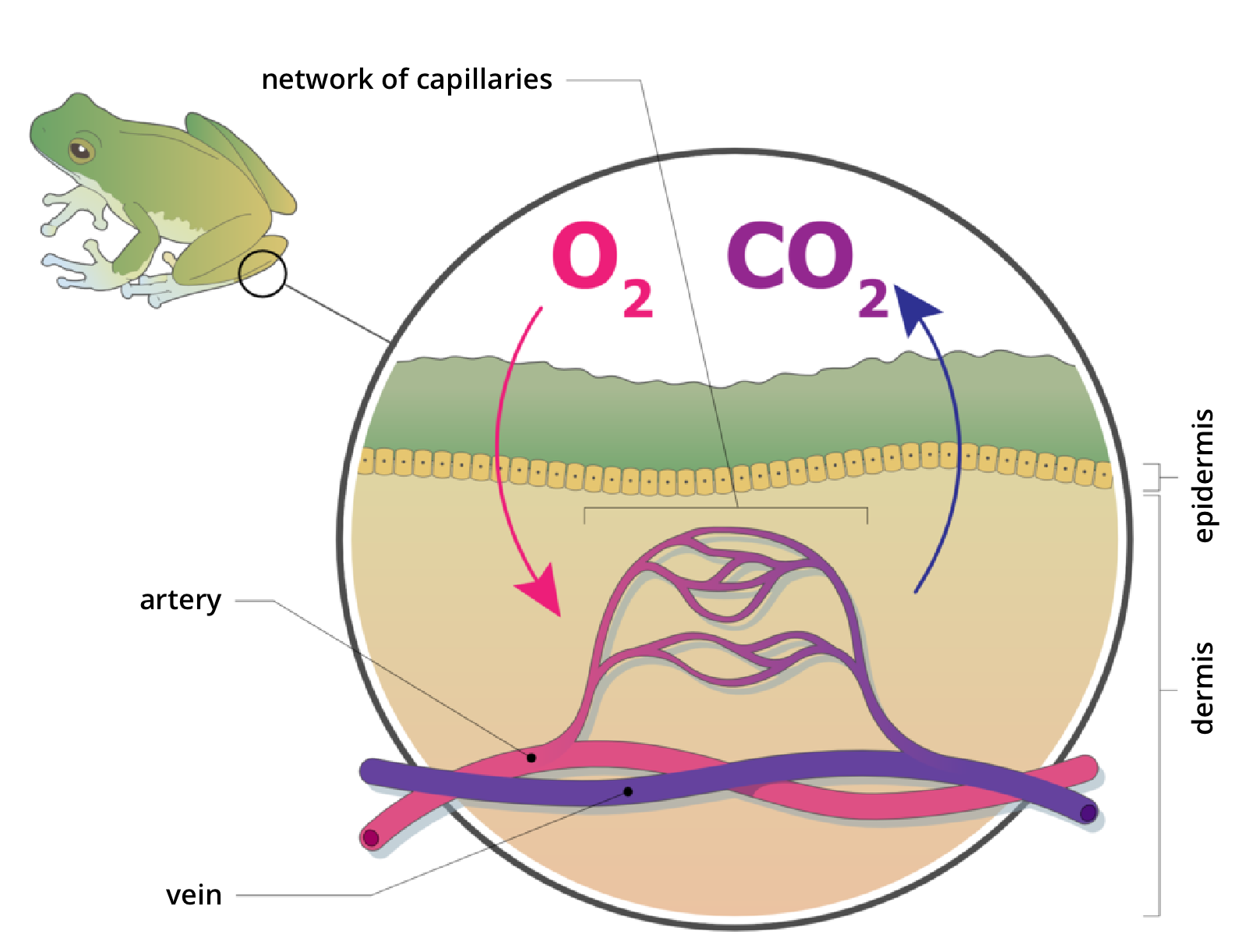
Due to the fact that the amphibian skin is thin and porous, gas molecules and water can freely penetrate it. Strong blood flow in the skin makes the gas exchange occur on its entire surface. Oxygen taken through the skin into the blood is transferred to all tissues, and the resulting carbon dioxide is transported to the vessels underneath the skin and removed from the body. The mucus covering the body facilitates efficient gas exchange. This ensures constant skin moisture and facilitates the penetration of gas molecules that dissolve in water.
Reproduction of amphibians
Amphibians are dioecious animals the reproduction and development of which takes place in water. During mating season (occurring in Poland from March to June) most amphibians embark on a journey to the nearest reservoir.
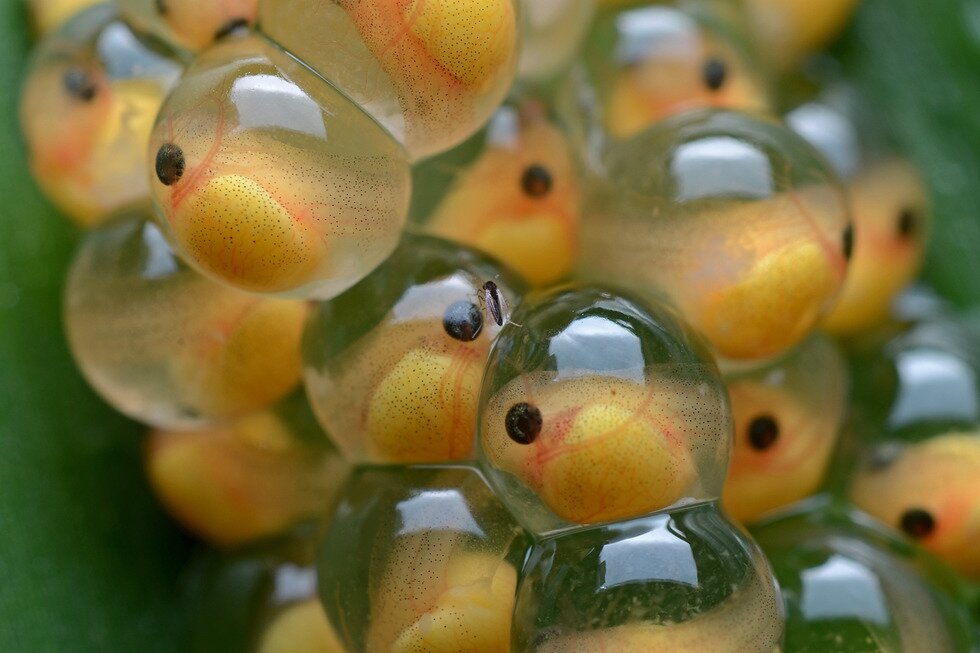
The female amphibian lays eggs, the so‑called spawnspawn, in the water, which are surrounded by jelly‑like substance. The male, joined with the female in a mating position, covers them with sperm. The fertilisation takes place in water. After some time, the larvae, called tadpoletadpole, hatch from the fertilised eggs. They differ from adult forms: they are herbivorous, they use gills to breathe, they resemble fish in shape – they have a barrel‑shaped trunk with a head barely separated from the body. In the early stages of development, they have got no limbs, however, they have got a long tail with a skin fold acting as a fin. Tadpoles, similarly to fish, are equipped with a lateral line organ. During approximately 16 weeks of life in the water, they undergo a metamorphosismetamorphosis, during which the limbs develop and the tail disappears. Internal organs are also restructured, e.g. the gills disappear and the lungs develop. After transforming into an adult form, most of the anurous amphibians leave the aquatic environment.
Learning about the body structure of a tadpole and indicating embryos in eggs.
a tadpole in a tank,
spawn,
magnifying glass.
Using the magnifying glass, look at the body structure of a tadpole. Indicate body structure features, which are evidence of adaptations for life in water.
Look at the spawn with the magnifying glass. Look at the embryos in the eggs.
Tadpoles have got a multitude of adaptations for life in water. During its stay in the aquatic environment many changes in its body structure occur that make it more and more similar to an adult form.
Explain why scientists wear gloves while fishing out toads.
Some gardeners eradicate toads because they think the toads eat their fruit. Explain why they are wrong.
Analyse the map showing the number of amphibian species in the world and then answer the following questions.
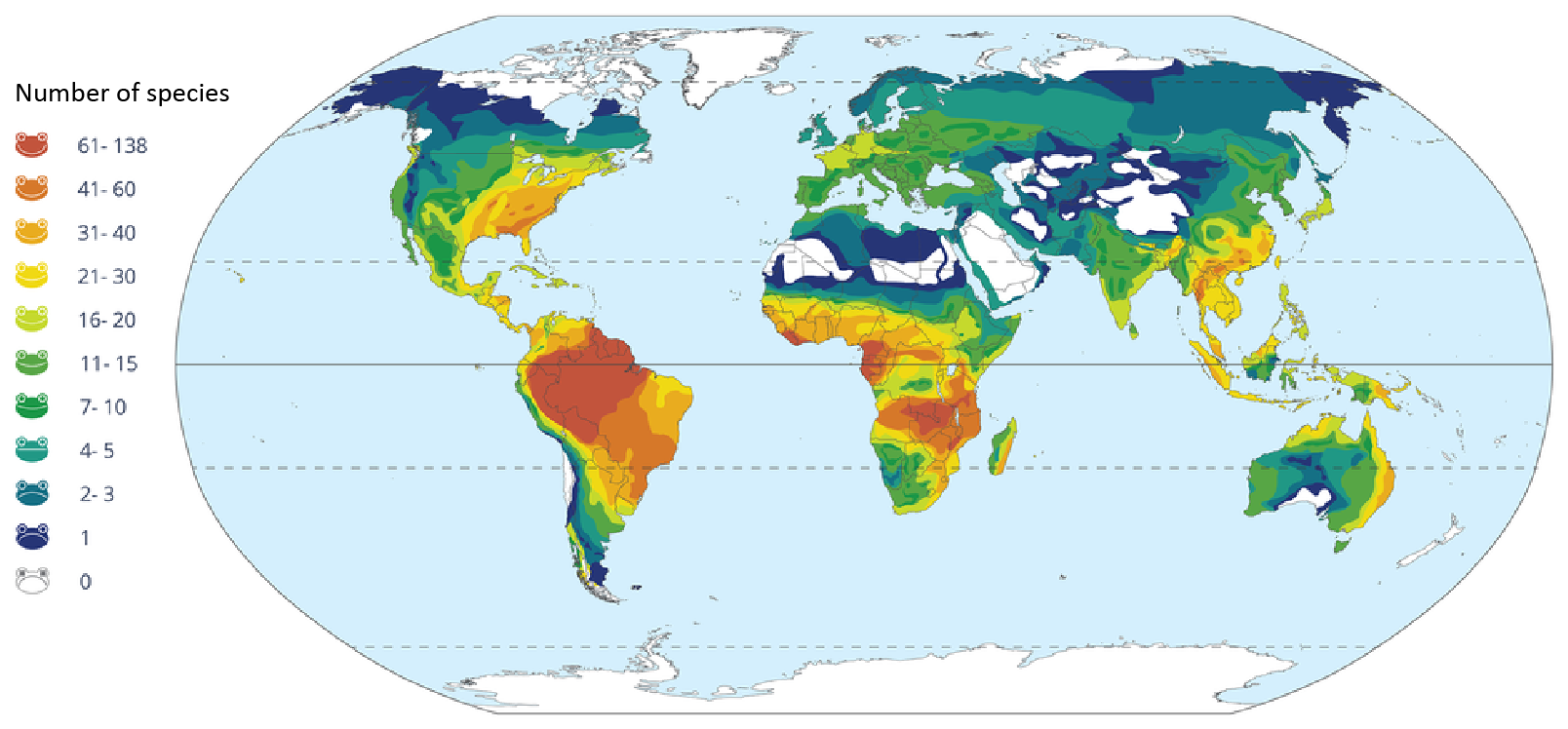
Which continent is home to most amphibian species?
Why is there more amphibian species in Brazil than in Poland, Canada or Australia?
Match the environmental features and appropriate body structure features of frogs and their vital functions.
masking colouring, gill respiration (tadpoles), interdigital webbing between the fingers, hibernation, lung respiration
| oxygen dissolved in water | |
| oxygen contained in the air | |
| the presence of a grass snake | |
| the water is highly resistant | |
| low winter temperatures |
Conclusion
The skin of amphibians is naked, thin, delicate and covered with mucus, that is why, similarly to lungs, it is used to take oxygen and remove carbon dioxide.
Amphibians are cold‑blooded vertebrates whose adult forms usually live in humid terrestrial habitats and who spend their breeding time in freshwater reservoirs.
The development of amphibians involves metamorphosis. A larval form known as a tadpole occurs which breaths using gills.
Keywords
frog, amphibians, masking colouring (mimicry)
Glossary
błona pławna – fałd skórny rozpięty między palcami, obecny u zwierząt silnie związanych ze środowiskiem wodnym, jak żaby, traszki, niektóre żółwie, ptaki wodne i nieliczne ssaki
kijanka – larwa płaza (żaby, ropuchy, rzekotki, salamandry)
metamorfoza – (przeobrażenie) proces zmian postaci, budowy i fizjologii organizmu młodocianego prowadzący do wytworzenia z larwy (niekiedy poprzez kilka etapów) osobnika dorosłego; występuje m.in. u stawonogów, ryb, płazów
płuca – narząd wymiany gazowej występujący u dorosłych płazów, gadów, ptaków i ssaków, umożliwiający oddychanie tlenem atmosferycznym
skrzek – komórki jajowe płazów składane do wody w dużych skupiskach, otoczone galaretową otoczką
zapłodnienie wewnętrzne – połączenie komórki jajowej z plemnikiem w drogach rodnych (w jajowodzie) samicy