Playing the guitar
what a sound wave is and how it’s produced;
how ears receive sounds.
to describe how a musical instrument produces sound;
explain what affects the pitch of the sound;
to explain how the length and tthe ension of a string affects the pitch.
Pitch
Whenever you’re playing a musical instrument, you make particles in its immediate vicinity vibrate. How is it that an instrument can produce both high and low tones? What affects pitchpitch? Lets examine it by conducting an experiment.
a small plastic box without a lid,
2 rubber bands of different thickness.
Put rubber bands around the box and make sure that the distance between them is sufficient to grab each of them separately with your fingers.
Pull on the thinner rubber band with your finger. Assess whether the sound produced is high or low. Then pull on the thicker rubber band and compare the sound produced to the previous one.
Grab any rubber bank approx. 1 cm from the edge of the box and pull on the longer end. Assess whether the sound produced is higher or lower than the first sound.
The shorter the section of a rubber band that is made to vibrate, the faster it vibrates and the higher is the sound it produces. In addition, thicker the band, lower the sound it produces.

The faster the body vibrates, the higher sounds it produces. If you take a look at a guitarist playing their instrument, you’ll be able to see that they press strings in such a way so that only parts of them vibrate. This way, the speed (frequency) of vibrations changes. The more vibrations per second, the higher the sound. Average human ear is able to hear sounds with a frequency from 20 to approx. 20,000 vibrations per second. Higher sounds are called ultrasounds.
Before you watch a film titled “Guitar sounds”, write down a research question and a hypothesis. While watching the film, write down your observations and, at the end, your conclusions.

Film dostępny na portalu epodreczniki.pl
Nagranie filmowe w tonacji czarno-białej, na którym jest mężczyzna grający na gitarze.
Sound volume
Pitch depends on the frequency with which the source vibrates. On the other hand, whether sound is loud or soft depends on the strength of vibrations. For instance, the harder you pull on a guitar string, the stronger the vibration (the greater the amplitudeamplitude of vibrations) and the louder the sound produced. This will not cause a change in pitch.
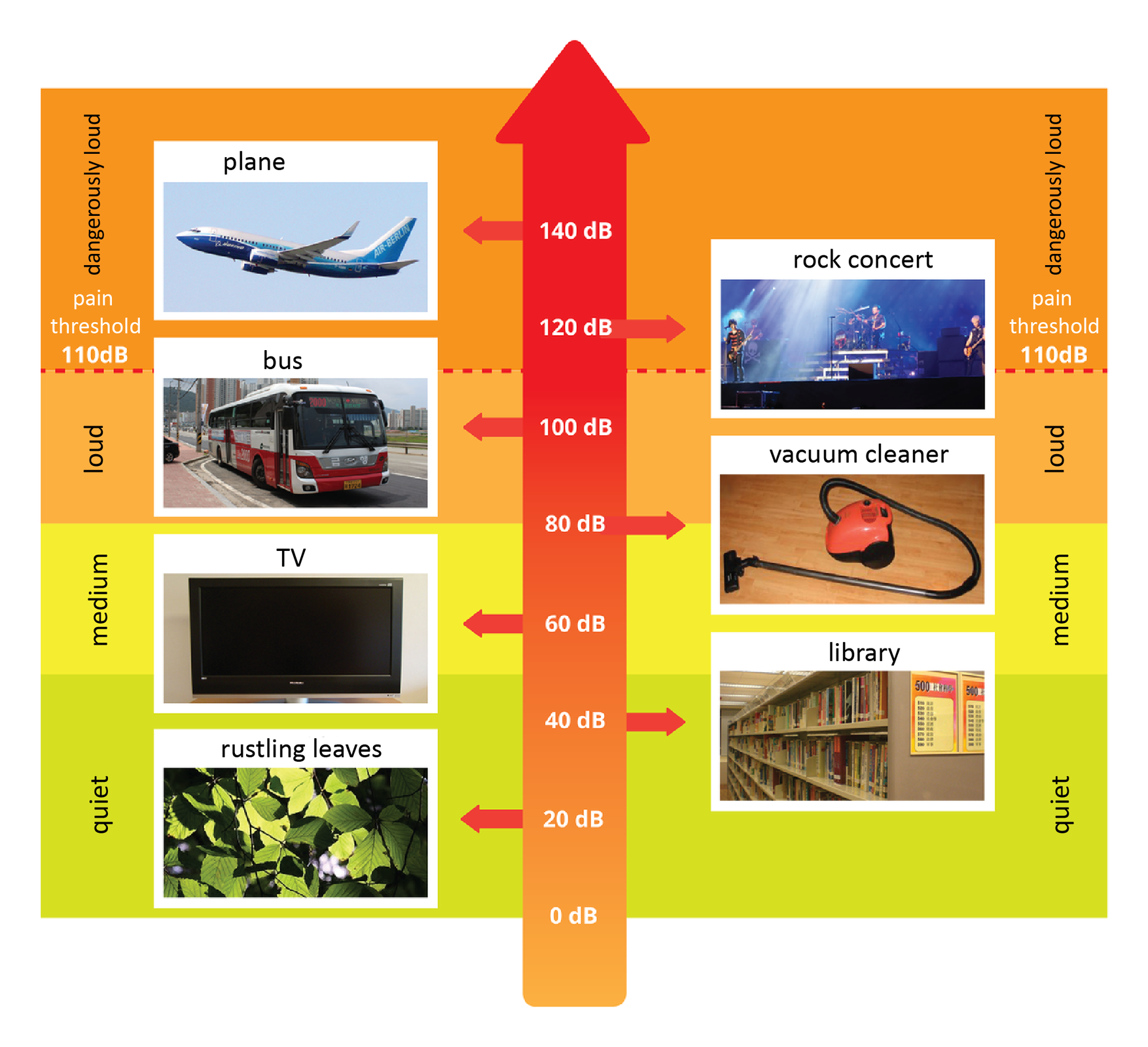
The larger the distance from the source of sound, the more it will lose its intensity. Vibrations are reduced until they finally disappear. Sound volume is measured in decibels (dB). Sounds louder than 130 dB can cause ear pair and even permanently damage your hearing.
Echo
If the guitarist that you’re observing gives a concert at a large hall, you may hear an echo. Where does it come from? Sounds can reflect from large surfaces, e.g. walls, mountain slopes or a dense forest wall. Sound reflected from an obstacle is called an echo. Certain animals can use this phenomenon to orient themselves in their surroundings.
How do animals hear
All instruments are build so that they produce sounds audible to humans. However, certain bodies vibrate with such frequency that they’re not audible. Although for humans hearing plays an extremely important role, it’s not the most vital of the senses. For many animals it’s different. For instance, for nocturnal animals hearing provides the most information about their surroundings. Some animals have large auricles and the ability to move them. In your opinion, how does that help them?

Discovering the importance of large auricles.
2 drawing paper sheets,
assistance from a colleague.
Roll the sheets into two tubes.
Put the narrower ends to your ears and ask someone from your class to say something from a distance of approx. 10 metres.
Turn the tubes the other way and ask the same person to say something again. Assess when you’re able to hear their voice better.
Put your ear to the chest of your partner with whom you’re conducting the observation and assess whether you’re able to hear their heartbeat.
Put the narrower end of the tube to your ear and the wider end to the chest of the aforementioned person. Assess how you’re able to hear her heartbeat.
Tubes allow to better hear sounds.
Owing to large and mobile auricles, animals hear softer sounds. That’s why many herbivores has good hearing – they’re able to hear a predator sneaking up on them before they see it and run away.

Finish the sentence. The number of vibrations per minute depends on
- sound volume.
- number of decibels attributed to the sound.
- the formation of echo.
- pitch.
Specify whether the statement is true or false.
| True | False | |
| Greater vibration frequency means a higher sound. | □ | □ |
| The longer the string, the lower the sounds it produces. | □ | □ |
| Higher vibration frequency means higher sould volume. | □ | □ |
| The more tense the string, the lower the sounds it produces. | □ | □ |
Summary
Pitch depends on the frequency of vibrations. The more frequently the object vibrates, the higher the sound it produces.
Sound volume depends on the amplitude of vibrations of the body being its source.
Humans are able to hear sounds with a frequency from 20 to approx. 20,000 vibrations per second.
Keywords
sound, pitch, guitar
Glossary
amplituda – różnica między największą i najmniejszą wartością, np. wychylenia struny podczas drgań; im większa amplituda drgań, tym dźwięk jest głośniejszy
wysokość dźwięku – cecha dźwięku zależna od częstotliwości drgań źródła, czyli od liczby drgań w czasie 1 sekundy; im większa częstotliwość drgań, tym dźwięk jest wyższy