Quarrels in the ducal family and division of Poland by Bolesław III Wrymouth
what kind of ruler Bolesław II the Generous was;
why Bishop Stanislaus of Szczepanów died, and what the consequences if his death were;
why the authority of ducal rule collapsed during Władysław I Herman’s reign;
how Bolesław III Wrymouth gained power, what kind of duke he was, and how it came to be that the country was divided according to his testament.
After years of crisis and collapse, the Piast monarchy was rebuilt by Casimir I the Restorer. He managed to unite the most important Polish lands and maintain friendly relations with the biggest neighbors – the German Empire and Kievan Rus'. He also reinstated and reformed the state organization, and reconstructed the network of fortified towns on which his power relied. After Casimir died, his eldest son Bolesław took power in the country. He carried out an active foreign policy, e.g., by getting involved in the dynastic conflict in Hungary and Rus', as well as intra‑German disputes, speaking out against Emperor Henry IV who had been weakened by the conflict with the Pope. Thanks to the support of Pope Gregory VII in the dispute about investiture, and his concern for the development of the Church in Poland, he obtained consent for a royal coronation, which took place in 1076. Unfortunately, the ruler’s exaggerated ambitions led to his conflict with the elite, headed by the Cracow Bishop – Stanislaus of Szczepanów. His death by order of the king (1079) led to a rebellion against Bolesław, as a result of which he had to leave the country by going to Hungary where he died.
Afterwards, power was taken over by his younger brother, Władysław I Herman. He did not pursue an expansive policy like his predecessor, but focused on peaceful coexistence. However, his weak position and dependence on the country’s elites forced him to share power with PalatinePalatine (voivode) Sieciech – the most powerful of the magnates. He held actual power for almost two decades, ruthlessly combating his opponents. Such an attitude and lack of reaction from the duke led to a rebellion of the subjects, supported by the ruler’s sons – Zbigniew, and Bolesław III Wrymouth. In the end, between 1097 and 1100, they succeeded in overthrowing Sieciech and depriving their father of any real power. They also forced him to divide the country into districtsdistricts – Masovia (Władysław I Herman), Greater Poland and Kuyavia (Zbigniew), and Silesia and Lesser Poland (Bolesław III Wrymouth). After Władysław’s death in 1102, Zbigniew took over Masovia. Both brothers ruled independently, but Bolesław questioned Zbigniew’s position. In 1006, there was a conflict between them, as a result of which Zbigniew, defeated, had to leave the country. After he was allowed to return, he was accused of disloyalty and put in prison, where he died.
After his death, Bolesław III Wrymouth continued the policy of expansion in Pomerania, eventually gaining control thereof. He strengthened alliances with Russia and Hungary, as well as regulated the relations with Bohemia. Another great success was the obtainment, by the Polish episcopate, of the BullBull of Gniezno in 1136, which confirmed the existence of an independent archbishopric, over which German clergy had wanted to take control. In 1138, Bolesław III Wrymouth divided the country between his sons, entrusting Principate to the oldest of them – Władysław II the Exile. We do not know whether the so‑called Testament of Bolesław III Wrymouth was ever written down. The earlier Piasts never did this. Nevertheless, the ruler’s decision was supposed to regulate the principles of inheritance and help avoid conflicts between his sons. However, the disintegration of the state was unavoidable.
The events connected with the removal of Bolesław II the Generous from the country were first presented by Gallus Anonymus. But his chroniclechronicle story lacked the details that were provided as late as at the turn of the 12th and 13th centuries, more than 100 years after the events concerned, by chronicler Wincenty Kadłubek. It is still being discussed whether the events described in the chronicle correspond to some extent to reality. Do they echo the death of Bishop Thomas Becket? Today, this is difficult to say.
Read carefully the two descriptions of events related to the death of Bishop Stanislaus of Szczepanów, and then do the exercise below.
Anonim tzw. Gall o sporze króla Bolesława II z biskupemJak doszło do wypędzenia króla Bolesława z Polski, długo byłoby o tym mówić; tyle wszakże można powiedzieć, że sam będąc pomazańcem [Bożym], nie powinien był [drugiego] pomazańca za żaden grzech karać cieleśnie. Wiele mu bowiem zaszkodziło, gdy przeciw grzechowi grzech zastosował i za zdradę wydał biskupa na obcięcie członków. My zaś ani nie usprawiedliwiamy biskupa‑zdrajcy, ani nie zalecamy króla, który tak szpetnie dochodził swoich praw [...].
Source: Anonim tzw. Gall o sporze króla Bolesława II z biskupem, [w:] Anonima tzw. Galla Kronika, czyli Dzieje książąt i władców polskich , red. K. Maleczyński, tłum. P. Wiszewski, Kraków 1952, s. 50–51.
Mistrz Wincenty zwany Kadłubkiem o śmierci biskupa Stanisława[Bolesław mścił się na rycerzach, którzy opuścili go w czasie wyprawy na Ruś]. Gdy prześwięty biskup krakowian Stanisław nie mógł odwieść go od tego okrucieństwa, najpierw groził mu zagładą królestwa, wreszcie wyciągnął ku niemu miecz klątwy. Atoli on [...] w dziksze popadł szaleństwo [...]. Rozkazał więc przy ołtarzu, w infule [...] porwać biskupa! [...] Wszak tyran [...]sam podnosi świętokradzkie ręce, sam odrywa oblubieńca od łona oblubienicy, pasterza od owczarni. Sam zabija ojca w objęciach córki i syna w matki wnętrznościach. [...] Świętego bezbożnik, miłosiernego zbrodniarz, biskupa niewinnego najokrutniejszy świętokradca rozszarpuje [...]
Source: Mistrz Wincenty zwany Kadłubkiem o śmierci biskupa Stanisława, [w:] Mistrza Wincentego Kronika polska, t. II, 20, tłum. K. Abgarowicz i B. Kürbis, Warszawa 1974, s. 117.
Group the information so that it corresponds to the accounts given in each chronicle.
The bishop cast a curse on the king., The blame for the bishop’s death lies entirely with the king., The king sentenced the bishop to bodily mutilation., The bishop’s conduct was treacherous and sinful., The king’s sinful behavior did him harm., Punishing the bishop with bodily mutilation was the king’s sin., The bishop defended the king’s subjects., The king took revenge on the bishop for his noble deeds.
| The account of Gallus Anonymus | |
|---|---|
| The account of Wincenty Kadłubek |
Read about the time period of episcopal work of Stanislaus of Szczepanów. Which elements of the story are feasible and which are legendary?
Read the text and mark the virtues of the Duke that it mentions.
Anonim tzw. Gall o cnotach Władysława HermanaLecz na razie dajmy nieco chłopcu odpocząć po trudach, aż pióro nasze pogrzebie w pokoju księcia Władysława, męża pobożnego i łagodnego. Książę Władysław tedy, pamiętny na dawne zamieszki, po wygnaniu Sieciecha z Polski, choć słaby był [...] wszystko mianowicie już to sam osobiście roztropnie załatwiał, już to każdorazowo temu komesowi, którego ziemię odwiedzał, zlecał troskę o dwór i jego sprawy.
Source: Anonim tzw. Gall o cnotach Władysława Hermana, [w:] Anonima tzw. Galla Kronika, czyli Dzieje książąt i władców polskich, red. K. Maleczyński, tłum. P. Wiszewski, Kraków 1952, s. 83.
Gallus Anonymus listed the following as Herman’s positive traits:
- self-reliance
- godliness
- care for magnates
- love for subjects
- concern for the poor
- prudence
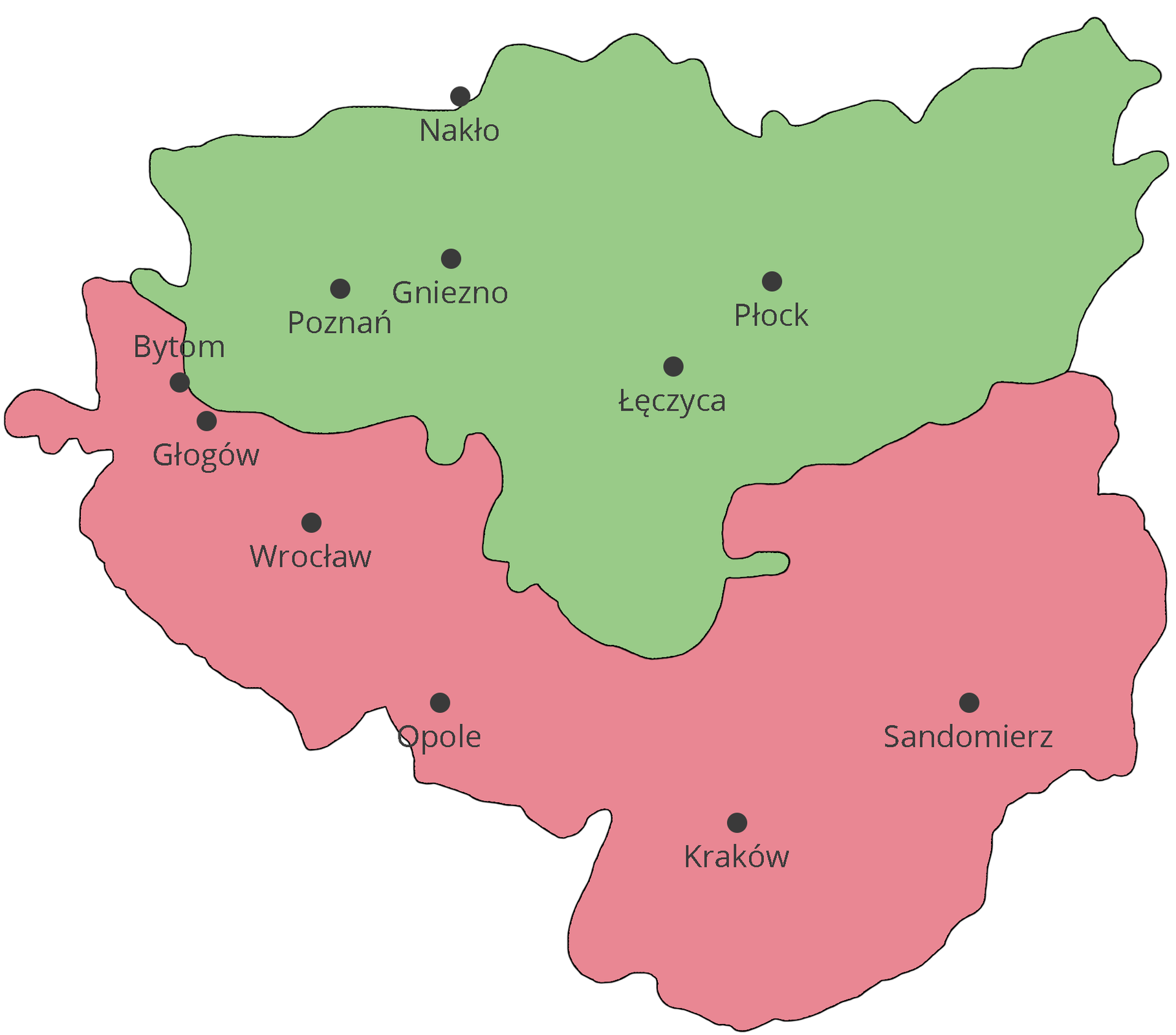
Assign who the individual regions were supposed to belong to. Use the map of contemporary Poland and the district disintegration map for this purpose.
Łęczyca Land, Sieradz Land, Lesser Poland, Silesia, Masovia, Kuyavia, Greater Poland
| Zbigniew’s lands | |
|---|---|
| Bolesław’s lands |
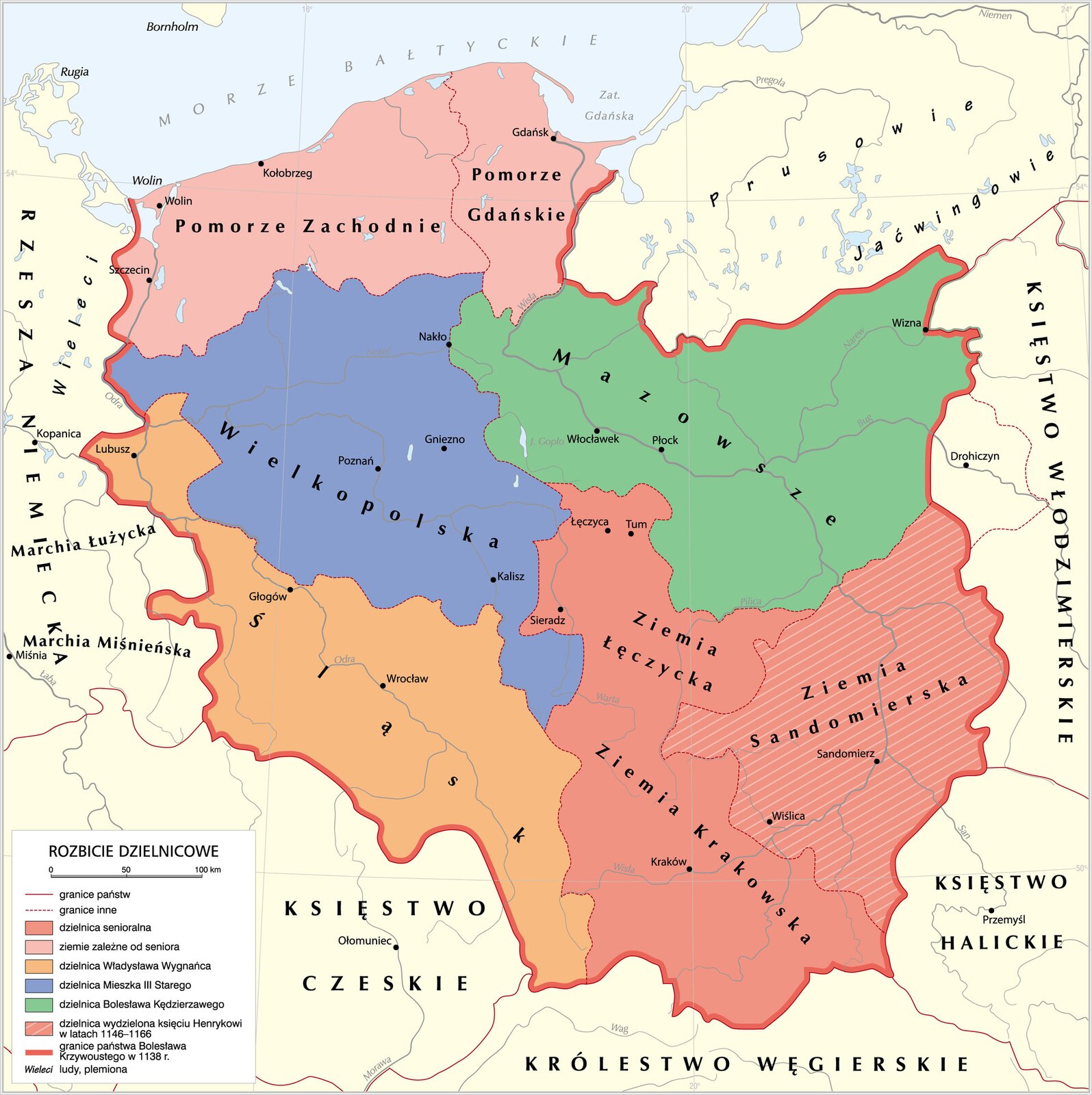
Analyze the Piast family tree and do the exercises below.
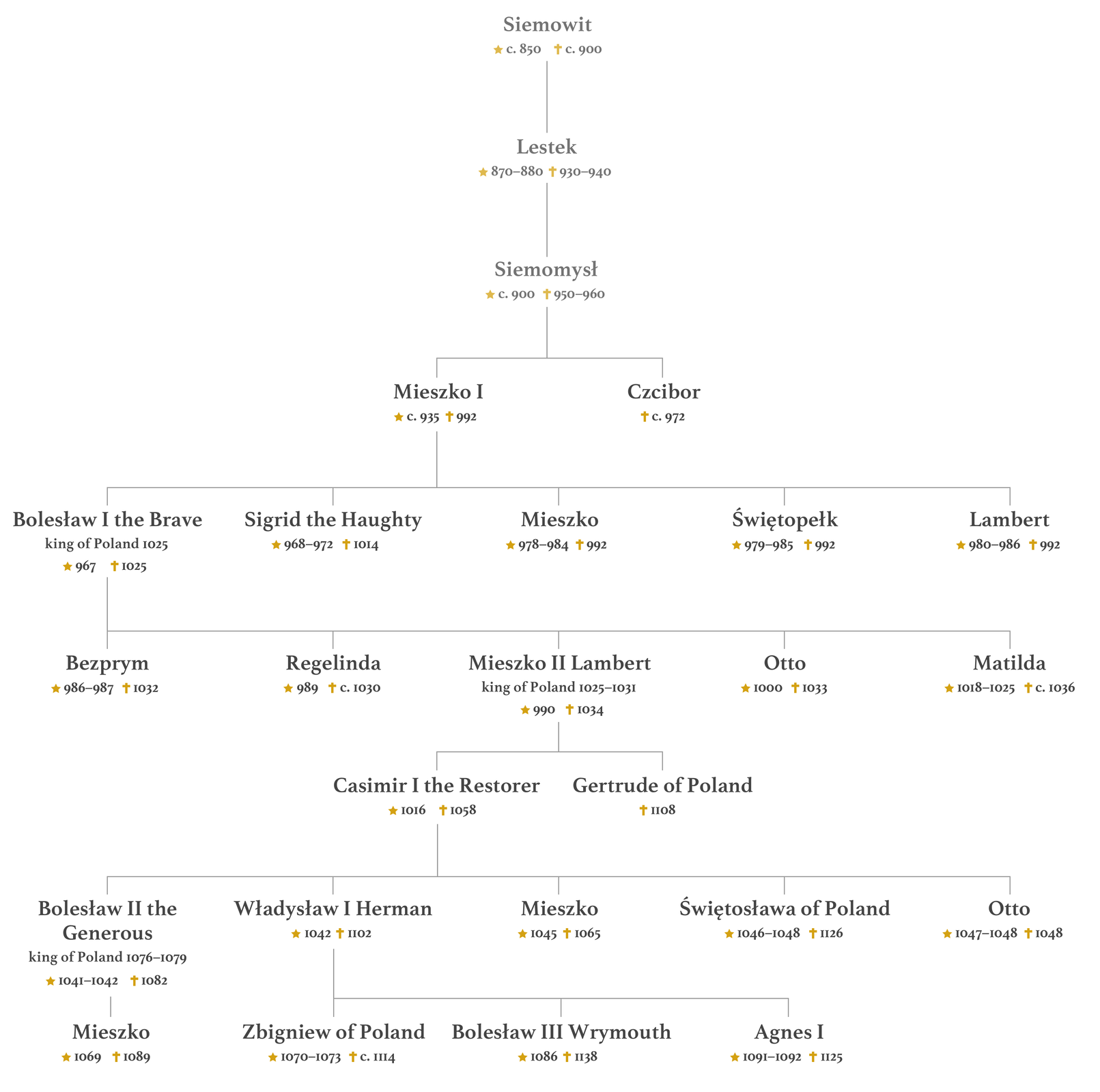
Group together the rulers of Poland who were kings, and dukes.
Mieszko I, Bolesław II the Generous, Bolesław III Wrymouth, Casimir I the Restorer, Władysław I Herman, Bolesław I the Brave, Mieszko II Lambert
| Kings | |
|---|---|
| Dukes |
Indicate the sons of rulers who were legitimate successors to the throne but did not assume power.
- Bezprym
- Zbigniew
- Świętopełk
- Dytryk
Keywords
testament, canonizationcanonization, expansion policy
Glossary
kronika – opis wydarzeń, typowy dla średniowiecza utwór o charakterze opisu dziejów przedstawionych chronologicznie.
palatyn – nazywany też komesem, a w Polsce wojewodą. W średniowieczu był zarządcą królewskiego dworu i zastępował władcę przy wydawaniu sądów.
bulla – nazwa listu lub dokumentu wystawionego przez papieża, później określenie tylko ważniejszych dokumentów papieskich.
sukcesja – zasada przekazywania, dziedziczenia władzy monarszej następcy w przypadku śmierci, abdykacji lub innych okolicznościach.
dzielnica – część Polski we władaniu księcia, która powstała po podziale kraju dokonanym przez księcia Bolesława Krzywoustego.
Kanonizacja - oficjalne i uroczyste uznanie zmarłej osoby za świętą przez Stolicę Apostolską (w katolicyzmie) lub Święty Synod (prawosławie), poprzedzone procesem kanonizacyjnym.
Pryncypat – w Polsce zasada władzy monarszej. Wg niej najstarszy z książąt dzielnicowych (senior) sprawował władzę zwierzchnią nad pozostałymi książetami.