that the solubility in water is expressed as the maximum number of grams of substance that is dissolved in 100 g of water at a given temperature and pressure (the pressure is taken into account in the case of gas solutions, e.g. oxygen in water, and when the solute is solid or liquid, the pressure is of little importance and can be omitted);
that the graph showing the dependence of the solubility of a given substance on the temperature is called the solubility curve;
that the percentage determines the number of grams of solute contained in 100 grams of solution and can be calculated from the formula: .
You will learn
to calculate the percentage concentration of a saturated solution at a set temperature;
to determine the solution solubility based on the percentage of saturated solution at a given temperature.
RKuOPkMAFy1Mg
Nagranie dźwiękowe dotyczy przygotowania roztworów nasyconych z rozcieńczonych roztworów w danym stężeniu procentowym.
Nagranie dźwiękowe dotyczy przygotowania roztworów nasyconych z rozcieńczonych roztworów w danym stężeniu procentowym.
Nagranie dźwiękowe dotyczy przygotowania roztworów nasyconych z rozcieńczonych roztworów w danym stężeniu procentowym.
Preparation of saturated solutions from dilute solutions at a given percentage concentration
Concentration solutions may be obtained from dilute solutions, e.g. by evaporation of the solvent. When saturation is reached, further concentration of the solution will lead to the evaporation of solute from the solution.
Task 1
Before you start solving tasks, look at the presentation showing the process of solving tasks.
R1VBJxenzfAqJ
Grafika posiada niebieskie tł na którym widnieje napis: Stages of solving the task for caculation as parts of obtaining saturated solutions with a given percentage concentration.
Source: GroMar Sp. z o.o., licencja: CC BY-SA 3.0.
RcIu0jgEeT0ZC
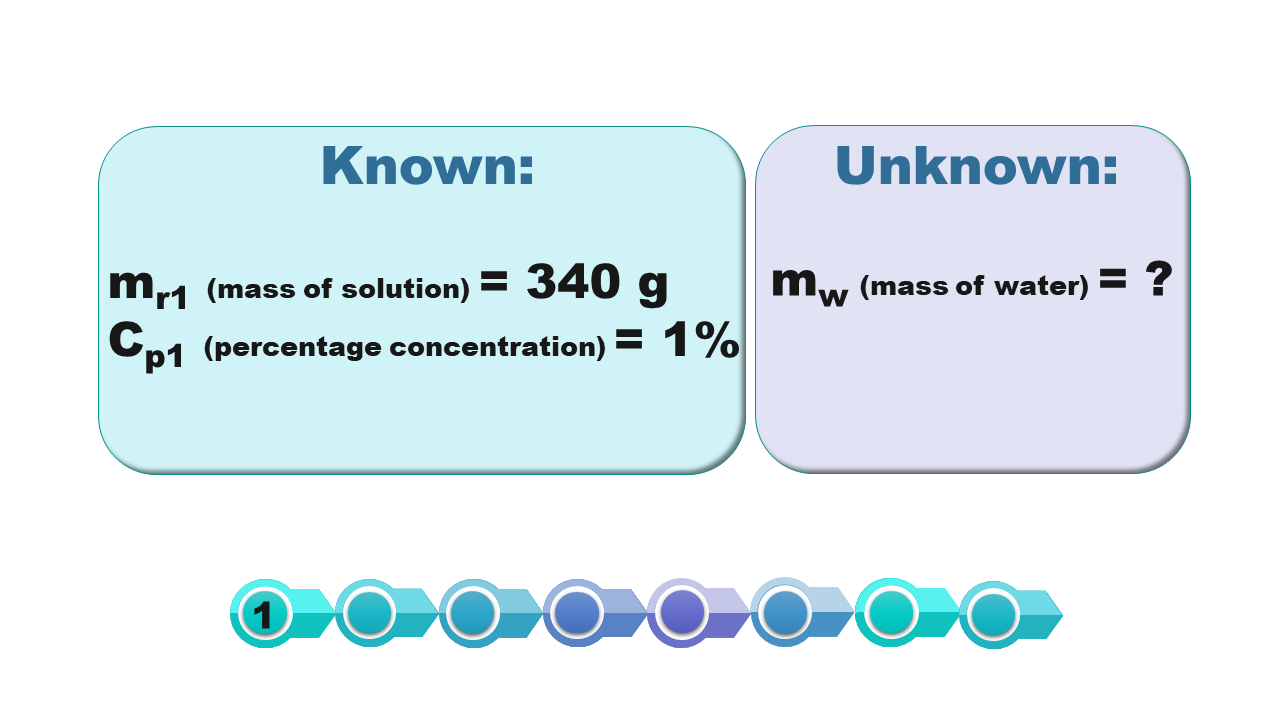
Grafika przedstawia dwa zbiory informacji. Pierwszy zbiór opisany jest jako wiadome, known, zawiera informacje dotyczące masy roztworu,mass of solution, procentowe stężenie, percentage concentration. Em indeks dolny er jeden w nawiasie mass of solution, równa się 340 gram. Ce indeks dolny pe jeden w nawiasie percentage concentration równa się 1 %. Drugi zbiór opisany jest jako niewiadome, unknown, zawiera informacje o masie wody, mass of water. Em indeks dolny wu w nawiasie mass of water równa się znak zapytania.
Calculate how many grams of water should be evaporated from 340 g of 1% sodium chloride solution to obtain a saturated solution of this substance at 20 ° C.
Source: GroMar Sp. z o.o., licencja: CC BY-SA 3.0.
R1FQ9Y4jclMS1
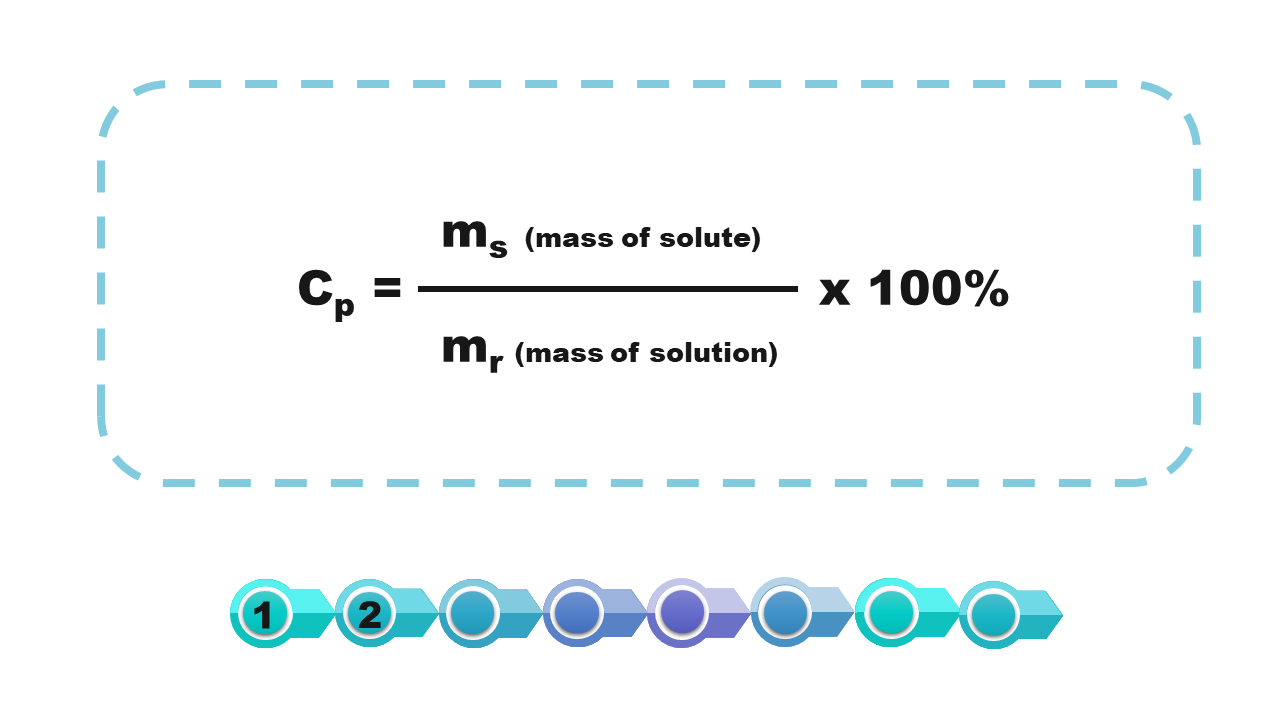
Grafika przedstawia wzór do wyliczenia stężenia procentowego ce indeks dolny pe. Ce pe równa się w liczniku mass of solute em es, w mianowniku mass of solution em er, cały ułamek razy 100%.
Source: GroMar Sp. z o.o., licencja: CC BY-SA 3.0.
R13pv1eQl1801
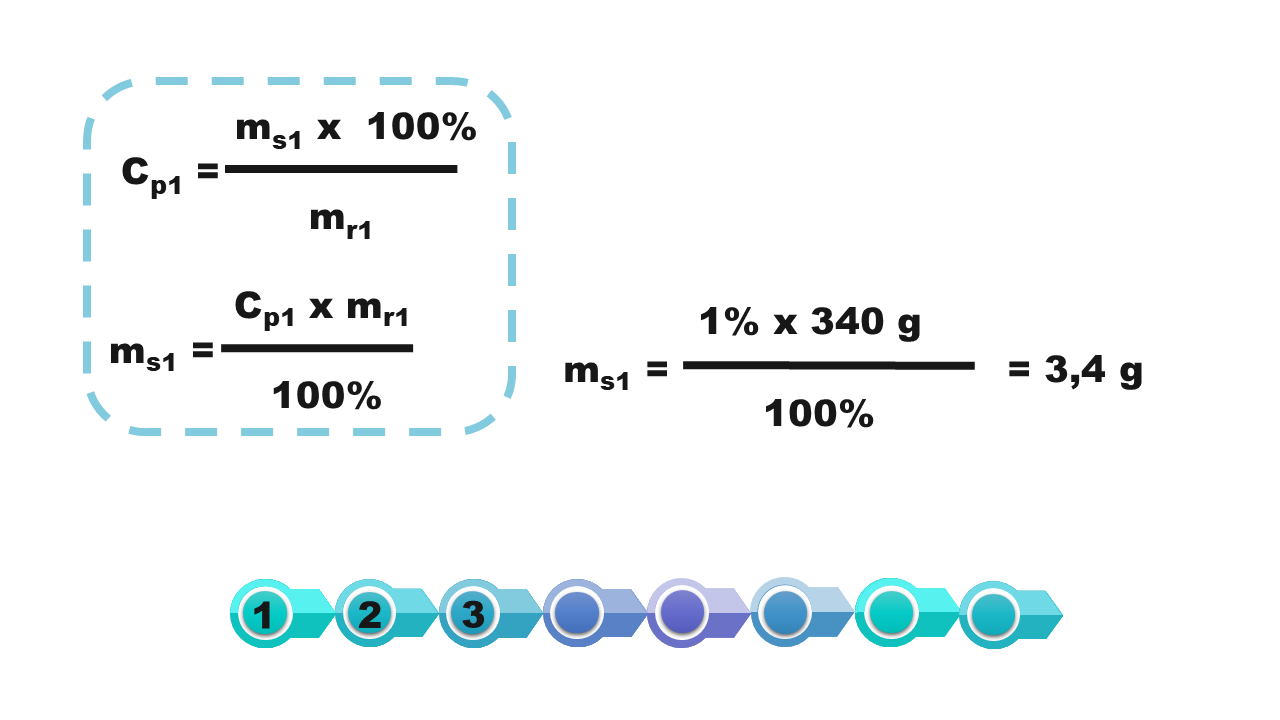
Grafika ukazuje jak obliczamy, ile gramów chlorku sodu znajduje się w roztworze z treści zadania, którego masa wynosi 340 g, a stężenie 1%.
We calculate how many grams sodium chloride is in the solution from the content of the task, which weight is 340 g, and the concentration of 1%.
Source: GroMar Sp. z o.o., licencja: CC BY-SA 3.0.
RQBxsARWwASf9
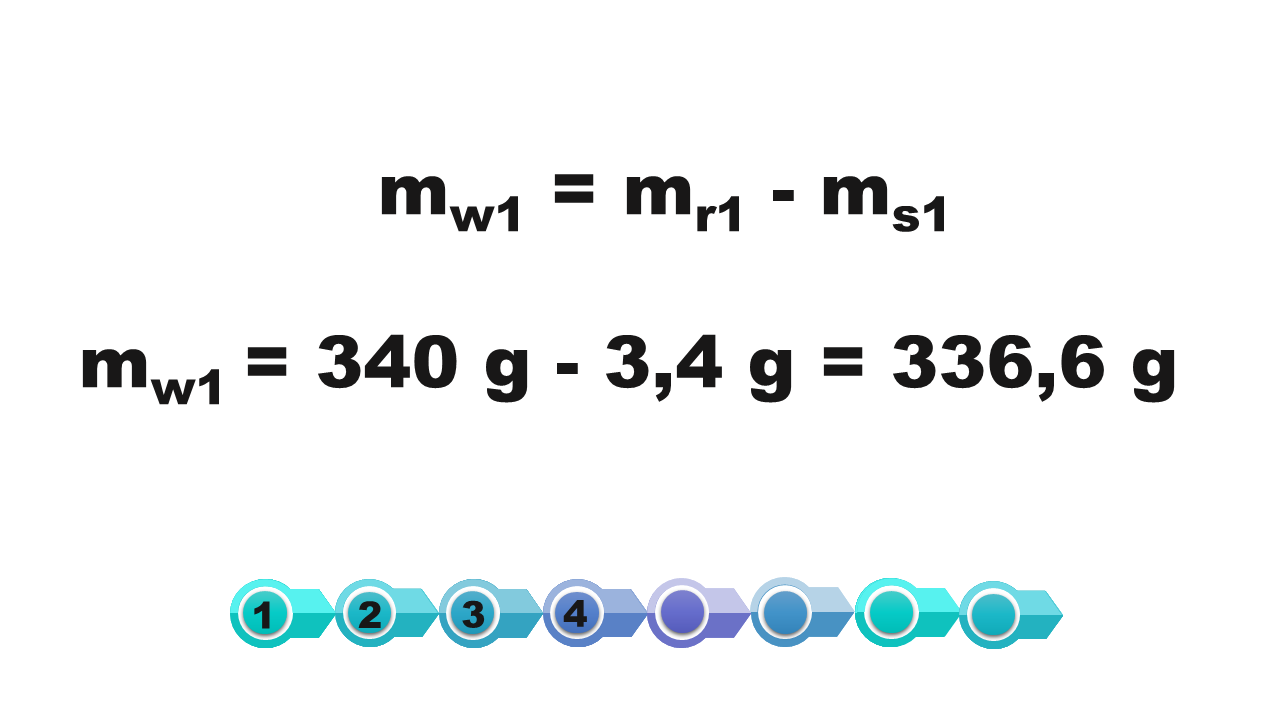
Grafika pokazuje jak obliczamy, ile gramów wody znajduje się w roztworze z treści zadania, którego masa wynosi 340 g, a stężenie 1%. em w1 = em er1 minus em es 1 em w1 = 340 g minus 3,4 g = 336,6 g
We calculate how many grams of water there is in the solution from the content of the task, which weight is 340 g, and the concentration of 1%.
Source: GroMar Sp. z o.o., licencja: CC BY-SA 3.0.
R8TeGPKTOuJnq
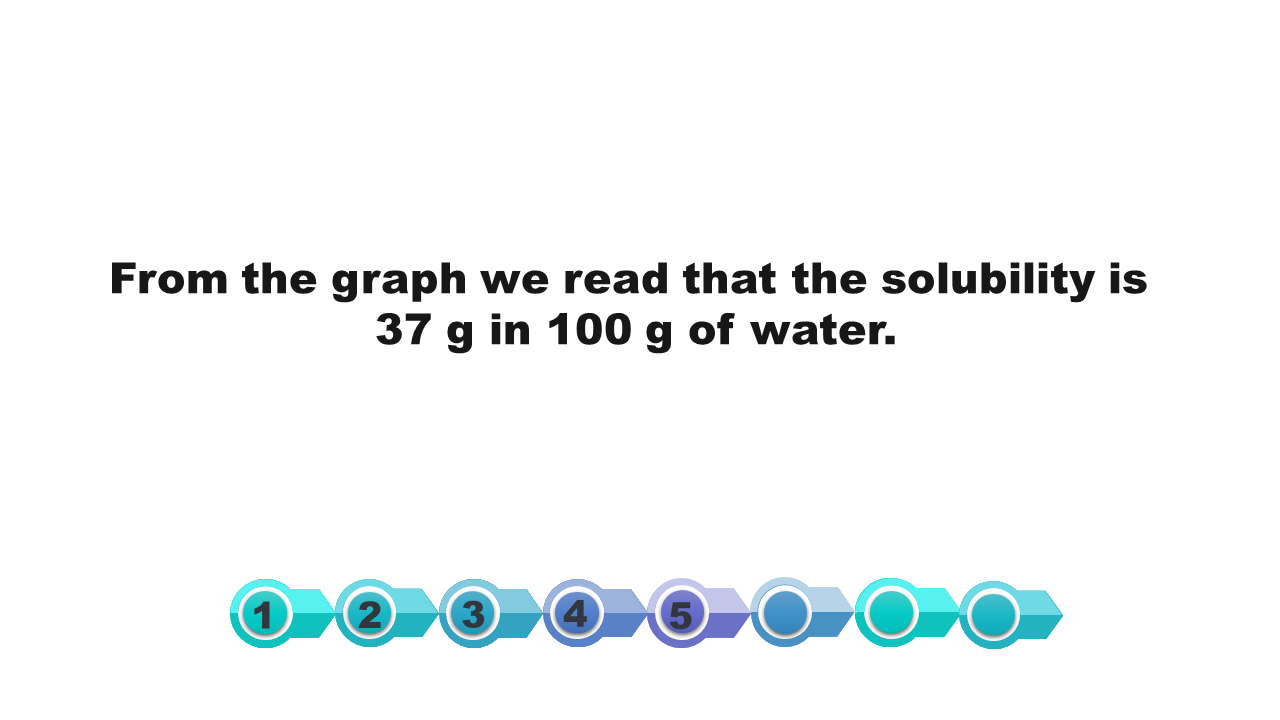
Grafika przedstawia obliczenia, ile g wody zawiera nasycony roztwór en a c el w temperaturze 20 °C, gdy zawiera 3,4 g chlorku sodu.
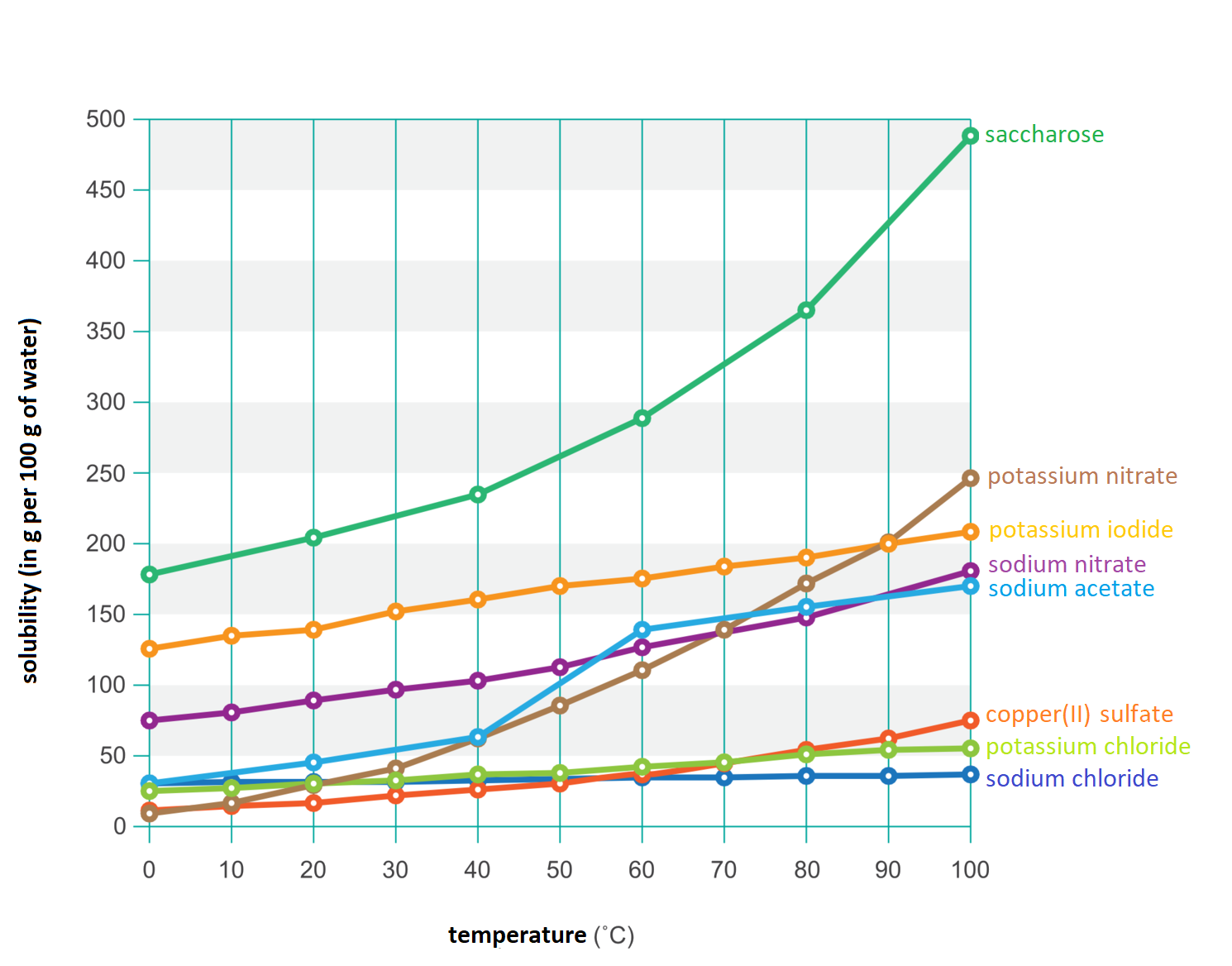
Based on the solubility curve, we determine the solubility of sodium chloride at 20 ° C: From the graph we read that the solubility is 37 g in 100 g of water.
Source: GroMar Sp. z o.o., licencja: CC BY-SA 3.0.
RzHBKcaQ7rEtY
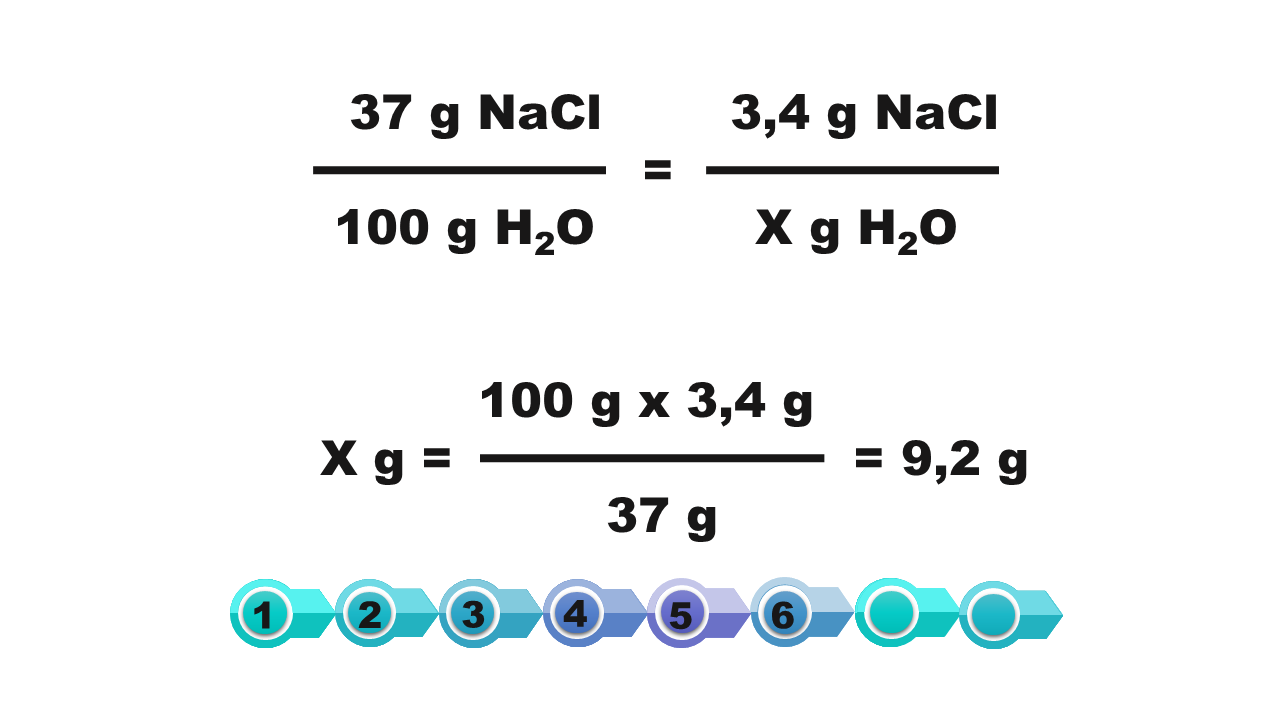
Grafika przedstawia obliczenia, ile wody należy odparować, z 336,6 g, aby uzyskac roztwór nasycony zawierający 3,4 g chlorku sodu w temperaturze 20 °C.
We calculate how much water the solution is saturated at 20 C when it contains 3.4 g of sodium chloride.
Source: GroMar Sp. z o.o., licencja: CC BY-SA 3.0.
RdEwdyX78pNOG
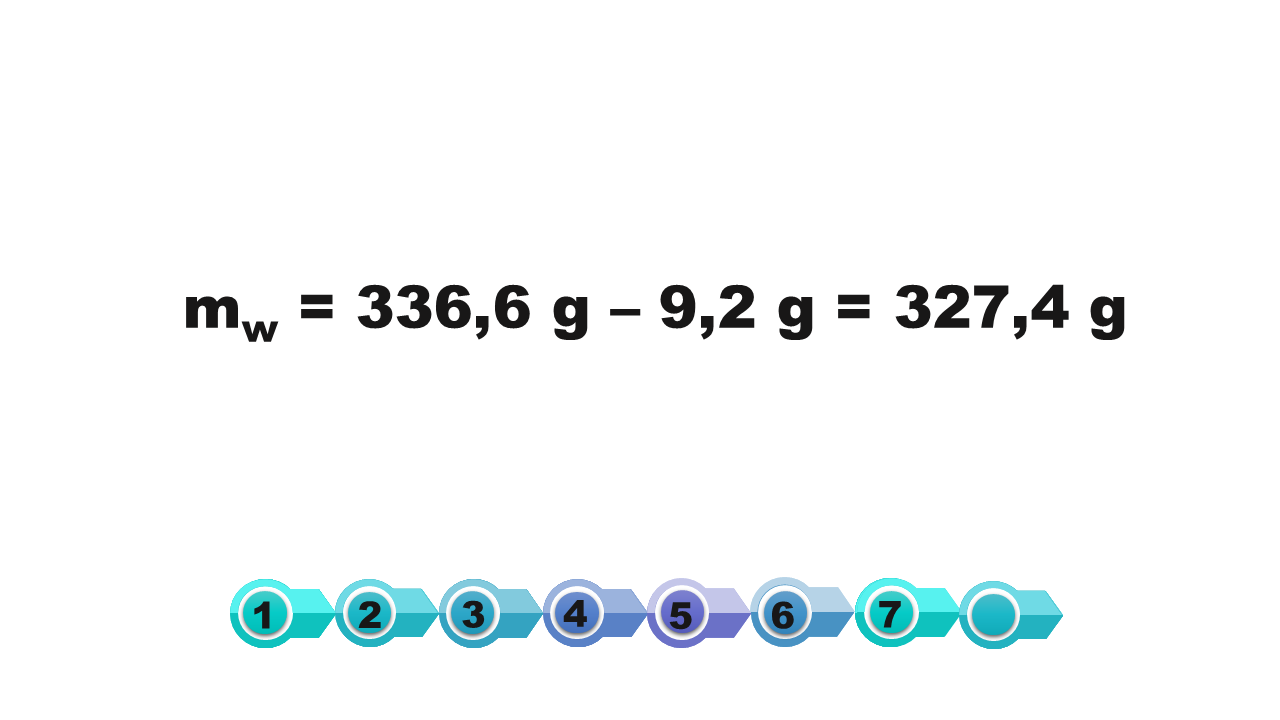
Grafika przedstawia obliczenia, ile wody należy odparować, aby nasycony był roztwór zawierający 3,4 g chlorku sodu w temperaturze 20 ° C.
We calculate how much water should be evaporated, so that the solution, which contains 3.4 g of sodium chloride at 20 ° C, is saturated.
Source: GroMar Sp. z o.o., licencja: CC BY-SA 3.0.
R1LvlaRDuYXyQ
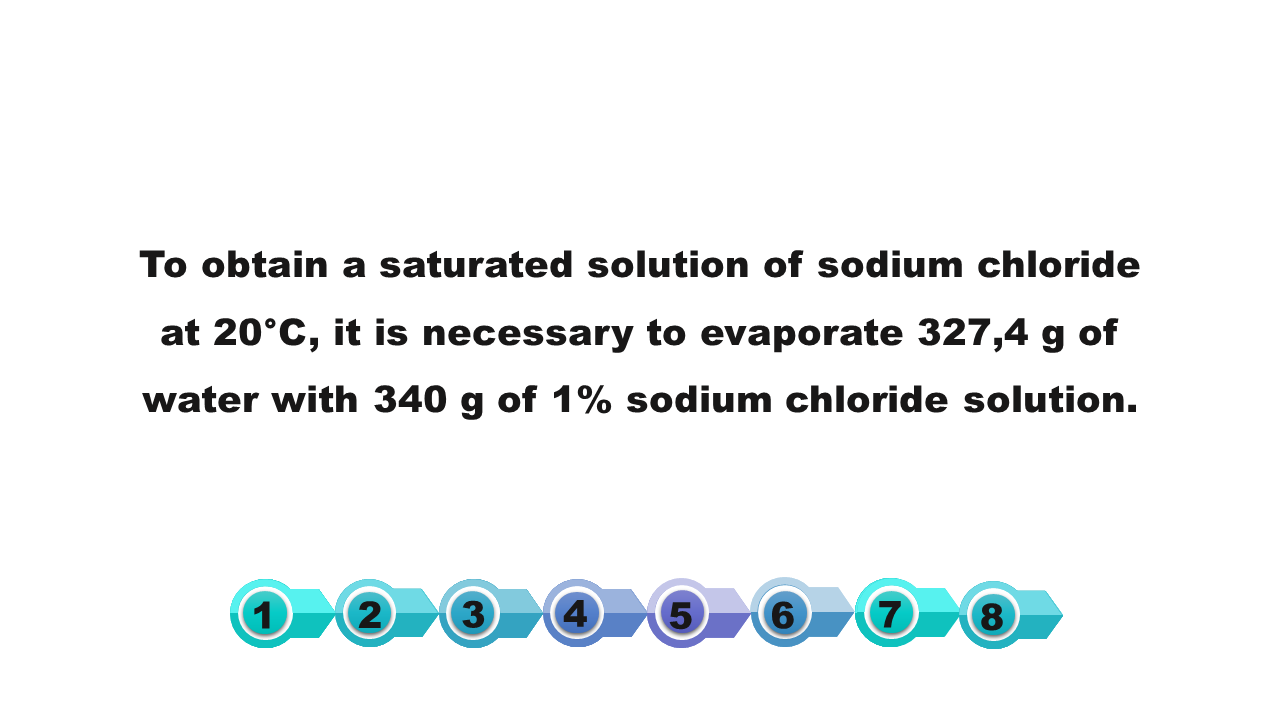
Grafika imformuje jak uzyskać nasycony roztwór chlorku sodu w temperaturze 20 ° C, konieczne jest odparowanie 327,4 g wody z 340 g 1% roztworu chlorku sodu.
Answer. To obtain a saturated solution of sodium chloride at 20 ° C, it is necessary to evaporate 327.4 g of water with 340 g of 1% sodium chloride solution.
Source: GroMar Sp. z o.o., licencja: CC BY-SA 3.0.
Grafika przedstawia wykres pokazujący zależność rozpuszczalności wybranych substancji w wodzie od temperatury. Na wykresie przedstawione są wartości temperatury na osi poziomej oraz rozpuszczalność w gramach na 100 gram wody na osi pionowej. Na wykresie przedstawione zostały krzywe dla następujących substancji w kolejności od najwyższych do najniższych wartości rozpuszczalności: sacharozy saccharose, azotanu pięć potasu, potassium nitrate, jodku potasu, potassium jodide, azotanu pięć sodu, sodium nitare, octanu sodu, sodium acetate, siarczanu sześć miedzi dwa, copper sulfate, chlorku potasu, potassium chloride, chlorku sodu, sodium chloride.
Solubility curves
Source: GroMar Sp. z o.o., licencja: CC BY 3.0.
Exercise 1
Calculate how many grams of water should be evaporated from 340 g of 1% sodium chloride solution to obtain a saturated solution of this substance at 20°C.
R1A9Zboi2NGiZ
Wykonaj ćwiczenie zgodnie z poleceniem.
Wykonaj ćwiczenie zgodnie z poleceniem.
Exercise 2
Calculate how many grams of potassium chloride should be added to 120 g of a 5% solution of this substance, so that after dissolution a solution saturated at 40°C can be obtained.
Rzsz2cxGQJTGR
Wykonaj ćwiczenie zgodnie z poleceniem.
Wykonaj ćwiczenie zgodnie z poleceniem.
Diluting the saturated solutions to obtain a solution with a certain percentage concentration
Important!
In saturated solutions, during dilution, the mass of the solvent changes (increases) in relation to the mass of solute (which remains unchanged).
Exercise 3
Calculate how many grams of water should be added to 250 g of a saturated potassium iodide solution at 10°C to obtain a 10% solution.
RZ9KvE5zvXqaC
Wykonaj ćwiczenie zgodnie z poleceniem.
Wykonaj ćwiczenie zgodnie z poleceniem.
Temperature change of the solution
Task 2
Consider and answer whether heating the solution or cooling it will change the percentage concentration and solubility of the substance in the water.
RLF9D3uxKRYOY
Wykonaj ćwiczenie zgodnie z poleceniem.
Wykonaj ćwiczenie zgodnie z poleceniem.
The solubility of solids in water generally increases with increasing temperature, and decreases as temperature decreases. For this reason, when the saturated solution is cooled, a portion of the solute is isolated as a precipitate. Knowing the solubility of substances at two different temperatures, one can determine the amount of substance that will be released during cooling of any mass of saturated solution.
Exercise 4
Calculate how many grams of potassium nitrate are released from the saturated solution at 100°C during cooling to 10°C. The solution of this substance saturated at 100°C was formed by dissolving the appropriate amount of potassium nitrate dissolved in 200 g of water.
RmJusqpIXgtug
Wykonaj ćwiczenie zgodnie z poleceniem.
Wykonaj ćwiczenie zgodnie z poleceniem.
Exercise 5
400 g of a 35% concentrate potassium chloride solution was cooled to 10°C. Evaluate if crystals of this substance are released from the solution after cooling. What will be the mass?
RcF3UKf2QGsun
Wykonaj ćwiczenie zgodnie z poleceniem.
Wykonaj ćwiczenie zgodnie z poleceniem.
R1Rsw5mLUB08A
Exercise 6
Select the correct answer. The solubility of solids in water: Możliwe odpowiedzi: 1. generally increases with increasing temperature, and decreases as it decreases, 2. generally increases as the temperature decreases, and increases as it decreases, 3. is not dependent on temperature
Select the correct answer. The solubility of solids in water: Możliwe odpowiedzi: 1. generally increases with increasing temperature, and decreases as it decreases, 2. generally increases as the temperature decreases, and increases as it decreases, 3. is not dependent on temperature
Select the correct answer. The solubility of solids in water:
generally increases with increasing temperature, and decreases as it decreases
generally increases as the temperature decreases, and increases as it decreases
is not dependent on temperature
RTssmcpduOfsd
Create a multiple-choice test based on today's lesson. Then exchange your questions with a friend or classmate.
Create a multiple-choice test based on today's lesson. Then exchange your questions with a friend or classmate.
Create a multiple-choice test based on today's lesson. Then exchange your questions with a friend or classmate.
Question: ...
...
...
...
...
Summary
Based on the knowledge of the solubility of the substance, the percentage of saturated solution can be calculated.
Knowing the percentage concentration of a saturated solution of a substance, you can calculate its solubility.
R27Wn1Z8sFniQ1
Grafika przedstawiająca tablicę szkolną, na której znajdują się zdania do dokończenia. Finish selected sentences. 1 It was easy for me (uzupełnij). 2 It was difficult for me (uzupełnij). 3 Today I learned (uzupełnij). 4 I understood that (uzupełnij). 5 It surprised me (uzupełnij).
Grafika przedstawiająca tablicę szkolną, na której znajdują się zdania do dokończenia. Finish selected sentences. 1 It was easy for me (uzupełnij). 2 It was difficult for me (uzupełnij). 3 Today I learned (uzupełnij). 4 I understood that (uzupełnij). 5 It surprised me (uzupełnij).
Source: GroMar Sp. z o.o., licencja: CC BY-SA 3.0.