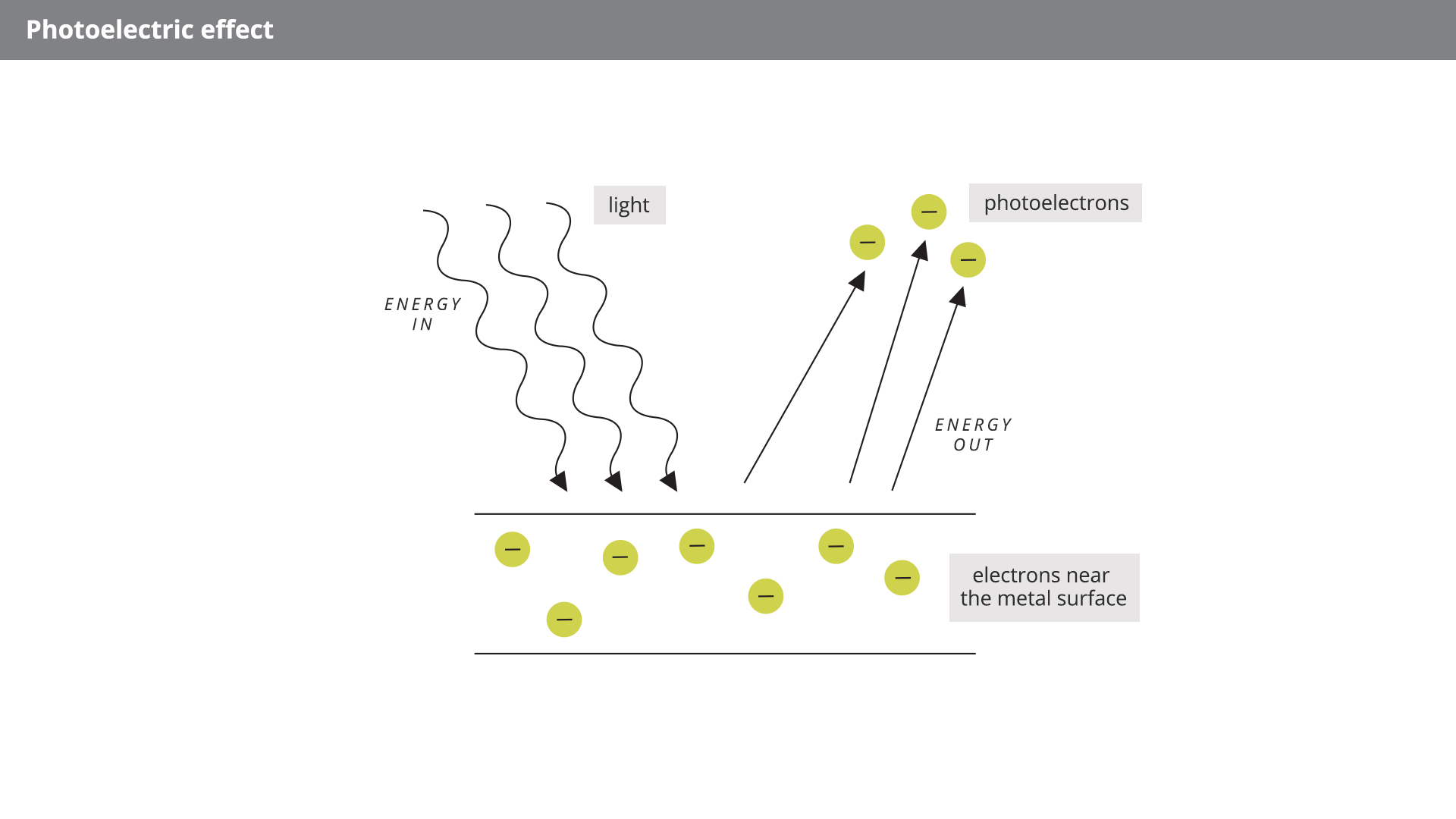
When light is incidentincidentincident on the metal surfacesurfacesurface, electrons are emitted from it. This phenomenon is called photoelectric effectphotoelectric effectphotoelectric effect. These electrons are called photoelectrons and the electric currentcurrentcurrent produced by the photoelectrons is called photoelectric current.
The outermost shelloutermost shelloutermost shell of an atom is occupied by valence electronvalence electronsvalence electrons. They are relatively loosely attached to the atom. A specific energy is needed to remove the valence electrons from the atom. This energy is provided by the incident light.
R17scZUi4NTi31
Na rysunku zatytułowanym Photoelectric effect przedstawione zostało schematycznie zjawisko fotoelektryczne. Padające na powierzchnię metalu światło - light (zygzakowate strzałki skierowane ukośnie do dołu opisane Energy In) dostarcza energię potrzebną do wybicia elektronów z jej wierzchniej warstwy. Metal, opisany electrons near the metal surface, schematycznie narysowany jako dwa poziome odcinki między którymi znajdują się małe koła ze znakiem minus. Nadmiar energii, który nie został zużyty na pracę wyjścia, elektrony unoszą w postaci energii kinetycznej (strzałki ukośnie skierowane do góry opisane Energy Out). Na końcu strzałek małe koła ze znakiem minus opisane photoelectrons.
The photoelectric effect occurs under certain conditions.
The frequency of the incidentincidentincident light must be above a minimal value called threshold frequencythreshold frequencythreshold frequency , which is specific for any material.
High‑frequency light (light with short wavelengths) have energy greater then low‑frequency light (light with long wavelengths).
In order for the electron to be emitted from the metal surfacesurfacesurface, it must gain from an incident quantum of light or photon more energy than the work functionwork functionwork function - the quantity that characterizes a given metal. The kinetic energy of photoelectrons increases with increasing frequency of incident light (energy of incident photons).
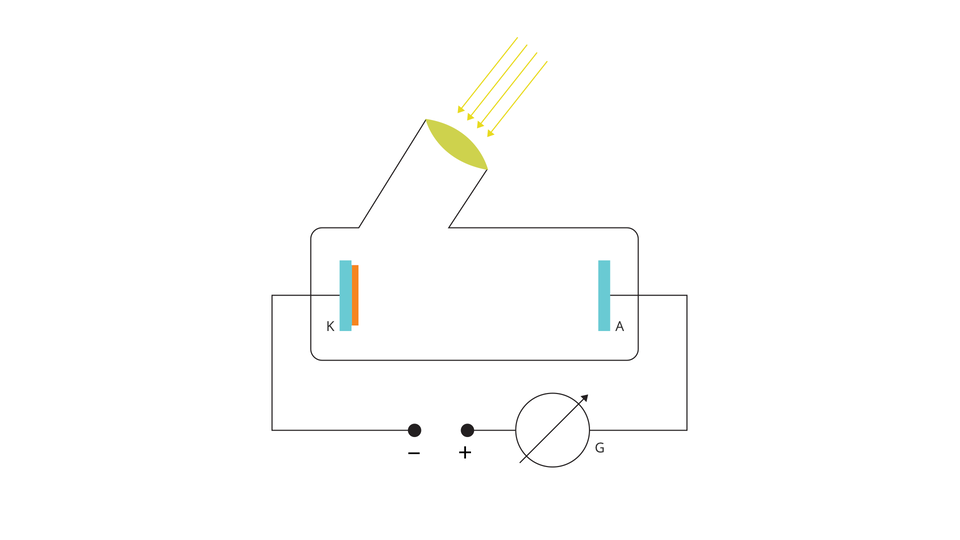
Look at the slideshow and learn what kind of an experimental setup is necessary to observe the photoelectric effectphotoelectric effectphotoelectric effect. Try to formulate some general conclusions.
R12oNbbEwz1xM
Pokaz slajdów przedstawia jakiego rodzaju zestaw eksperymentalny jest niezbędny do zarejestrowania efektu fotoelektrycznego. Instrukcja obsługi z poziomu klawiatury: 1. Uruchomienie aplikacji - ENTER, 2. Na każdym ze slajdów czytany jest automatycznie tekst alternatywny po polsku, 3. Przy pierwszym uruchomieniu na pierwszym slajdzie, czytanie tekstu po angielsku - TAB, 4. Przejście między slajdami: do następnego slajdu - TAB, do poprzedniego slajdu - TAB + SHIFT, 5. Przejście do czytania napisu po angielsku - strzałka w górę + strzałka w dół (czyta tekst po angielsku widoczny na slajdzie).
Pokaz slajdów przedstawia jakiego rodzaju zestaw eksperymentalny jest niezbędny do zarejestrowania efektu fotoelektrycznego. Instrukcja obsługi z poziomu klawiatury: 1. Uruchomienie aplikacji - ENTER, 2. Na każdym ze slajdów czytany jest automatycznie tekst alternatywny po polsku, 3. Przy pierwszym uruchomieniu na pierwszym slajdzie, czytanie tekstu po angielsku - TAB, 4. Przejście między slajdami: do następnego slajdu - TAB, do poprzedniego slajdu - TAB + SHIFT, 5. Przejście do czytania napisu po angielsku - strzałka w górę + strzałka w dół (czyta tekst po angielsku widoczny na slajdzie).
If the incidentincidentincident light frequency is less than the threshold frequencythreshold frequencythreshold frequency, increasing the light intensity does not help and the electrons will not be emitted from the metal surface.
The photoelectric currentcurrentcurrent increases as the light intensity increases, given that the frequency of light is greater than the threshold frequency.
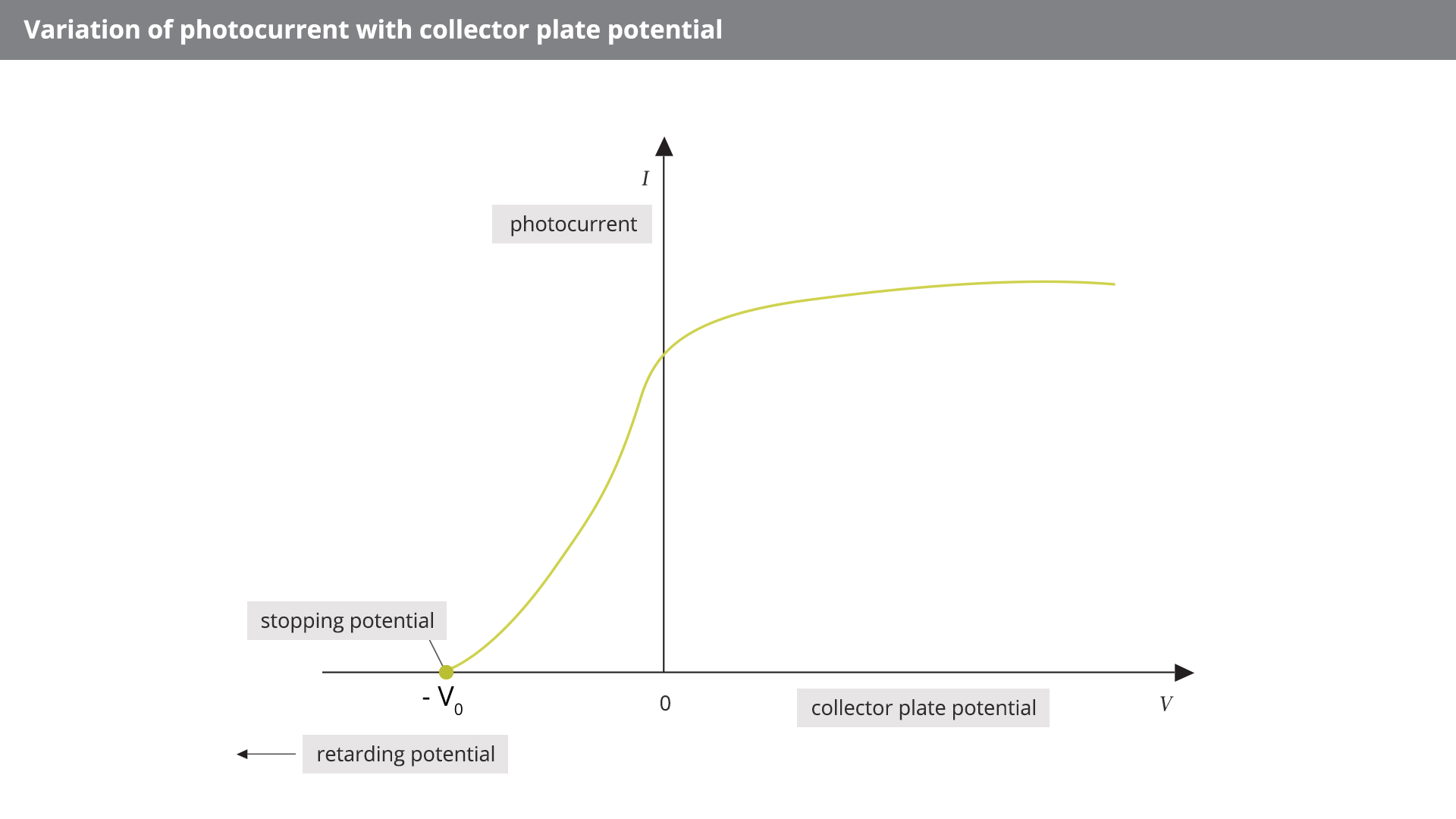
The photoelectric currentcurrentcurrent in a typical setup is extremely small. The number of the electrons reaching the anode can be measured from the anode current. However, such a measurement is not precise. But a reverse voltage can be applied to the anode. This reverse voltage (retarding potentialpotentialpotential) repels the electrons and prevents them from reaching the anode – the photoelectric current becomes zero. The maximum retarding potential is called the stopping potentialstopping potentialstopping potential VIndeks dolny 00. The energy corresponding to this potentialpotentialpotential is eVIndeks dolny 00 and is equal to the maximum kinetic energy EIndeks dolny kk of the emitted electrons:
In this way we can measure the work function W with better precision.
R1LVfm3kocGb21
Rysunek zatytułowany Variation of photocurrent with collector plate potential przedstawia wykres zależności prądu fotoelektronów od przyłożonego napięcia. Przy dostatecznie dużym napięciu prąd osiąga stan nasycenia, czyli wszystkie emitowane elektrony docierają do anody. Natężenie prądu fotoelektrycznego jest równe zeru dopiero po przyłożeniu napięcia hamującego (nawet najszybszy elektron nie dotrze do anody). Oś pozioma opisuje przyłożony potencjał V opisana collector plate potential, oś pionowa natężenie prądu fotoelektrycznego I opisana photocurrent. Na osi poziomej w pierwszej części układu współrzędnych zaznaczono -V z indeksem 0 i podpisano stopping potential. Od niego wykres narysowany ukośnie do góry, w miejscu przecięcia z osią I wykres zmienia kierunek na prawie poziomy. Pod wykresem strzałka pozioma skierowana w lewo opisana retarding potential.
Electronvolt is the amount of energy a single electric charge (electron) gains while being accelerated in an electric field with the potential difference of 1 volt. Energy of photons is conveniently expressed in eV. For instance, visible light photons have energies in the range of 1,8 – 3,1 eV.
If the wavelength of light is 250 nm, what is the maximum kinetic energy of the emitted photoelectrons from a metal for which a work functionwork functionwork function is equal to 4,5 eV?
0,47 eV
Exercises
RbOM9j8zGjNfI
Exercise 2
Wersja alternatywna ćwiczenia: Which phenomenon supports the particle theory of light? Możliwe odpowiedzi: 1. dispersion, 2. photoelectric effect, 3. refraction
Wersja alternatywna ćwiczenia: Which phenomenon supports the particle theory of light? Możliwe odpowiedzi: 1. dispersion, 2. photoelectric effect, 3. refraction
Which phenomenon supports the particle theory of light?
dispersion
photoelectric effect
refraction
zadanie
Source: GroMar, licencja: CC BY 3.0.
Exercise 3
The work function of sodium is 3,78 · 10Indeks górny –19–19 J. What is its threshold frequency?
0,57 · 10Indeks górny 1515 Hz.
Exercise 4
Explain in English what the photoelectric effect is.
R1eV15vymYu5T
Exercise 5
Wersja alternatywna ćwiczenia: Indicate which pairs of expressions or words are translated correctly. Możliwe odpowiedzi: 1. efekt fotoelektryczny - photoelectric effect, 2. częstotliwość graniczna - stopping potential, 3. potencjał hamujący - threshold frequency, 4. praca wyjścia - work function, 5. elektrony walencyjne - valence electrons
Wersja alternatywna ćwiczenia: Indicate which pairs of expressions or words are translated correctly. Możliwe odpowiedzi: 1. efekt fotoelektryczny - photoelectric effect, 2. częstotliwość graniczna - stopping potential, 3. potencjał hamujący - threshold frequency, 4. praca wyjścia - work function, 5. elektrony walencyjne - valence electrons
Indicate which pairs of expressions or words are translated correctly.
efekt fotoelektryczny - photoelectric effect
częstotliwość graniczna - stopping potential
potencjał hamujący - threshold frequency
praca wyjścia - work function
elektrony walencyjne - valence electrons
zadanie
Source: GroMar, licencja: CC BY 3.0.
R6XXv2c8jPDP61
Interaktywna gra, polegająca na łączeniu wyrazów w pary w ciągu jednej minuty. Czas zaczyna upływać wraz z rozpoczęciem gry. Jeden ruch to odkrywanie najpierw jednej potem drugiej karty z wyrazem. Każdy wyraz jest odczytywany. Kolejny ruch to odkrywanie trzeciej i czwartej karty. W ten sposób odsłuchasz wszystkie wyrazy. Nawigacja z poziomu klawiatury za pomocą strzałek, odsłuchiwanie wyrazów enterem lub spacją. Znajdź wszystkie pary wyrazów.
Interaktywna gra, polegająca na łączeniu wyrazów w pary w ciągu jednej minuty. Czas zaczyna upływać wraz z rozpoczęciem gry. Jeden ruch to odkrywanie najpierw jednej potem drugiej karty z wyrazem. Każdy wyraz jest odczytywany. Kolejny ruch to odkrywanie trzeciej i czwartej karty. W ten sposób odsłuchasz wszystkie wyrazy. Nawigacja z poziomu klawiatury za pomocą strzałek, odsłuchiwanie wyrazów enterem lub spacją. Znajdź wszystkie pary wyrazów.
Match Polish terms with their English equivalents.
stopping potential
częstotliwość graniczna
threshold frequency
praca wyjścia
elektrony walencyjne
valence electrons
work function
potencjał hamujący
photoelectric effect
efekt fotoelektryczny
Source: Zespół autorski Politechniki Łódzkiej, licencja: CC BY 3.0.