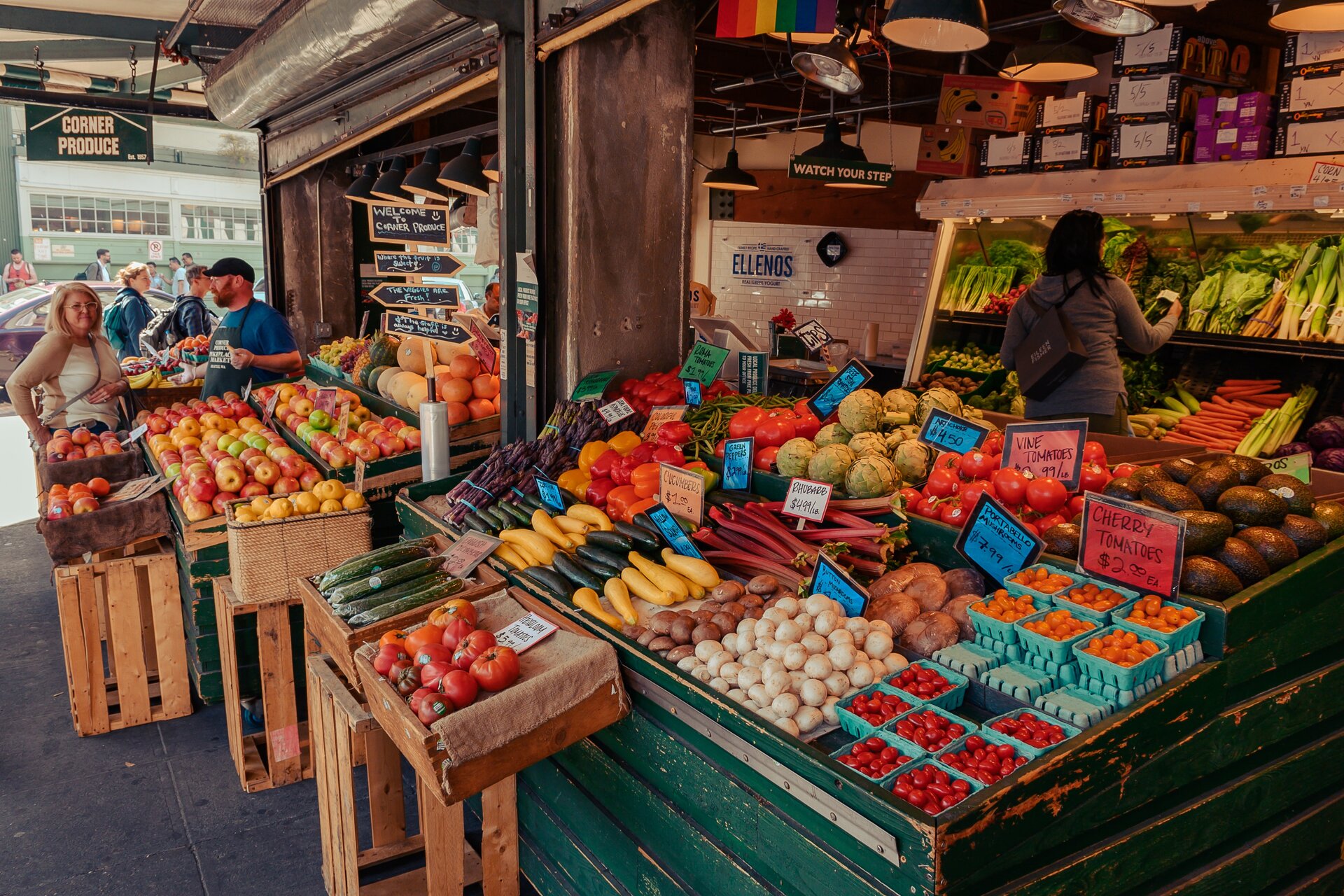
Not everyone likes grocery stores. Some people prefer open‑air markets. In this section, you’re going to read a text about a girl and her shopping trip to a market.
Nie każdy lubi zakupy w sklepach spożywczych. Niektórzy wolą targi. W tej sekcji przeczytasz tekst o pewnej dziewczynce i jej wycieczce na targ.
Rjx6L9BQmlI17
Zdjęcie przedstawia dwa stragany z owocami i warzywami na targu. Przy pierwszym straganie widoczna jest kobieta stojąca tyłem, przeglądająca warzywa znajdujące się w głębi stoiska. Na straganie rozmieszczone są drewniane skrzynki i pojemniki wypełnione świeżymi produktami, takimi jak cytryny, czerwone pomidory, długie ogórki, pieczarki, żółta i zielona cukinia, rabarbar, szparagi, karczochy, zielona fasolka szparagowa, papryka w kolorach żółtym, czerwonym i pomarańczowym, awokado, seler naciowy oraz żółte i czerwone pomidorki koktajlowe. Każdy produkt jest oznaczony tabliczką z odręcznie wypisaną nazwą i ceną. Na tabliczkach widnieją napisy w języku angielskim, m.in.: CUCUMBERS, GREEN PEPPERS, RHUBARB, BUTTON MUSHROOMS, PORTOBELLO MUSHROOMS, CHERRY TOMATOES, VINE TOMATOES, ARTICHOKE, ROMA TOMATOES. Drugi stragan obsługiwany jest przez mężczyznę ubranego w fartuch i jednorazowe rękawiczki, który zwrócony jest w stronę kobiety stojącej przy wejściu. Na straganie znajdują się pojemniki wypełnione różnymi gatunkami jabłek, melonami, arbuzami, ananasami, winogronami i bananami. Pomiędzy straganami ustawiony jest pionowy słupek z przymocowanymi tabliczkami przypominającymi drogowskazy. Na tabliczkach ręcznie wypisano w języku angielskim następujące hasła (od góry): WELCOME TO CORNER PRODUCE; Where the fruit is sweet!; THE VEGGIES ARE Fresh!; The Staff is always helpful.
Do you like shopping at the open-air markets?
Czy lubisz robić zakupy na targach?
Źródło: dostępny w internecie: https://www.pexels.com/ [dostęp 19.11.2021], domena publiczna.
Źródło: GroMar Sp. z o.o., licencja: CC BY-SA 3.0.
Study the text below and do the exercises.
Przeczytaj tekst poniżej i wykonaj ćwiczenia.
Zuzanna Kościuk
Many people don’t like grocery stores. They like to shop at open‑air marketsopen‑air markets [open‑air market]open‑air markets. Open‑air markets are popularpopularpopular because you can buy freshfreshfresh, locallocallocal food there.
My mom and I go to an open‑air market every Saturday. First, we shop for food. Local farmersfarmers [farmer]farmers sell a lot of tastytastytasty products. We usually buy a poundpoundpound of meat and a gallongallongallon of milk. You can also buy a gallon of juice or sweet teasweet teasweet tea, but we rarely do. Instead, we buy an ounceounceounce of peanuts. My family always eats peanuts as a snack. An ounce of peanuts is like 6 packagespackages [package]packages of them, but they’re much cheaper than in grocery stores! Sometimes, we also buy a pintpintpint of blueberries. They’re healthy and great for snackssnacks [snack]snacks.
After shopping for food, we look for other things. My mom is a dressmakerdressmakerdressmaker, so she always looks for nice materials. She takes a lot of time to pickpickpick something. She usually buys half a yardyardyard of cottoncottoncotton for making clothes. Sometimes, she also asks the seller to buy an inchinchinch of various materials to test them at home. While my mom looks at silksilksilk or leatherleatherleather, I walk around the market and use my pocket moneypocket moneypocket money to buy things. Most often, I buy sweets.
When we finish shopping, my mom says that our groceries weigh a stonestonestone. Luckily, we live only half a milemilemile away from the market!
Joe
1 Źródło: Zuzanna Kościuk, licencja: CC BY-SA 3.0.
Exercise2
Read the text and choose the correct answer.
Przeczytaj tekst, a następnie wybierz prawidłową odpowiedź.
RUdUiNFHto9vG
1. People like to shop at open-air markets because they sell Możliwe odpowiedzi: 1. fresh food., 2. many different products., 3. food from farmers.
Źródło: GroMar Sp. z o.o., licencja: CC BY-SA 3.0.
R1ARBROiT1NiQ
2. Joe and his mom go to the market Możliwe odpowiedzi: 1. on weekdays., 2. at weekends., 3. on Sundays.
Źródło: GroMar Sp. z o.o., licencja: CC BY-SA 3.0.
RGkVgFsUdwksv
3. First they buy Możliwe odpowiedzi: 1. milk and meat., 2. milk and fruits., 3. juice and meat.
Źródło: GroMar Sp. z o.o., licencja: CC BY-SA 3.0.
R1Z9MYdgrI5E2
4. For snacks they like buying Możliwe odpowiedzi: 1. sweets., 2. vegetables., 3. blueberries and peanuts.
Źródło: GroMar Sp. z o.o., licencja: CC BY-SA 3.0.
R11U7Gz1abv3m
5. Joe’s mom buys materials because Możliwe odpowiedzi: 1. she makes clothes., 2. she needs them for cleaning the house., 3. she needs them in the garden.
Źródło: GroMar Sp. z o.o., licencja: CC BY-SA 3.0.
R1SH3xJYt8WjO
6. Joe and his mom live Możliwe odpowiedzi: 1. far away from the market., 2. in a house., 3. close to the market.
Źródło: GroMar Sp. z o.o., licencja: CC BY-SA 3.0.
Exercise3
Read the text again and decide if the following sentences are true or false.
Przeczytaj tekst ponownie, a następnie zdecyduj, czy podane zdania są prawdziwe, czy fałszywe.
R1Miu2l7G8qn5
1. Food that you can buy at open-air markets is local. TRUEFALSE
2. Joe’s family usually buys juice. TRUEFALSE
3. Joe’s family buys berries for snacks. TRUEFALSE
4. Joe’s mom is a dressmaker, so she often looks to buy different materials. TRUEFALSE
5. Their shopping is very heavy. TRUEFALSE
1. Food that you can buy at open-air markets is local. TRUEFALSE
2. Joe’s family usually buys juice. TRUEFALSE
3. Joe’s family buys berries for snacks. TRUEFALSE
4. Joe’s mom is a dressmaker, so she often looks to buy different materials. TRUEFALSE
5. Their shopping is very heavy. TRUEFALSE
Źródło: GroMar Sp. z o.o., licencja: CC BY-SA 3.0.
GRAMATYKA: weights and measures (jednostki miary i wagi)
W Wielkiej Brytanii, tak samo jak w Polsce, stosuje się system metryczny, ale Brytyjczycy używają też własnego systemu jednostek miar i wag. Wyróżniamy następujące jednostki objętości, długości i wagi.
Jednostki objętości:
a gallon of - galon (4,5 litra)
I buy a gallon of juice. -Kupuję galon soku.
a pint of - pinta(ok. 0,5 litra)
I want a pint of ice cream. -Chcę pintę lodów.
Jednostki długości:
an inch - cal (ok. 2,5 centymetra)
He’s two inches taller than me. - Jest dwa cale wyższy ode mnie.
a mile - mila(ok. 1600 metrów)
I live a mile away from the market. - Mieszkam milę od targu.
a yard - jard (ok. 90 centymetrów)
My mom buys fabric by the yard. -Moja mama kupuje materiał na jardy.
Jednostki wagi:
an ounce of - uncja (ok. 28 gramów)
I buy an ounce of nuts. - Kupuję uncję orzechów.
a pound of - funt(ok. 45 dekagramów)
I need to buy a pound of meat. - Muszę kupić funt mięsa.
a stone - kamień (6,35 kilograma)
UWAGA!
Ponieważ we współczesnym języku polskim nie ma jednostki masy o nazwie „kamień”, tłumacząc zdania z języka angielskiego na polski podajemy wagę w przeliczeniu na kilogramy.
She weighs ten stones. -Ona waży 60 kilogramów.
Exercise4
Choose the correct answer.
Wybierz poprawną odpowiedź.
RG7vNfDJWDKjv
1. Let’s buy a gallona stonea pound of milk.
2. He weighs 15 ouncesstonesinches.
3. I want half a yarda gallona stone of fabric.
4. Do you want a stonean incha pint of ice cream?
5. We have half a pounda gallonan ounce of meat for dinner.
6. Do you live an inchan ouncea mile away?
7. Can I have a yardan ouncea gallon of nuts, please?
1. Let’s buy a gallona stonea pound of milk.
2. He weighs 15 ouncesstonesinches.
3. I want half a yarda gallona stone of fabric.
4. Do you want a stonean incha pint of ice cream?
5. We have half a pounda gallonan ounce of meat for dinner.
6. Do you live an inchan ouncea mile away?
7. Can I have a yardan ouncea gallon of nuts, please?
Źródło: GroMar Sp. z o.o., licencja: CC BY-SA 3.0.